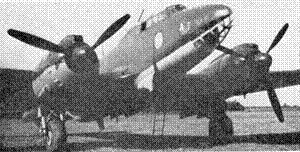
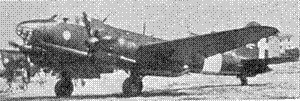
Caproni Ca.310 / SABCA S.46

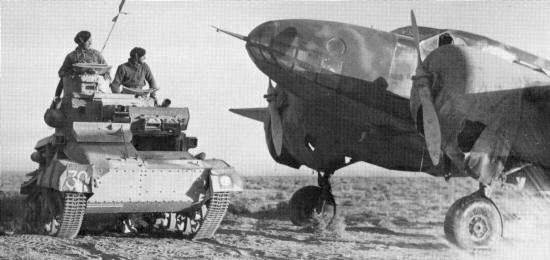
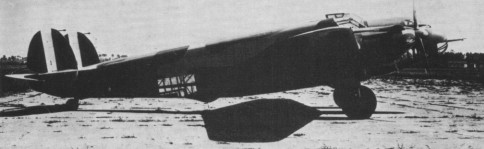
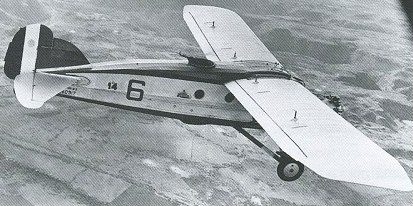
Developed in parallel with the Ca.309 Ghibli, the Ca.310 Libeccio (south west wind) reconnaissance / transport aircraft was structurally similar, but had retractable landing gear and was powered by two 460hp/350kW Piaggio P.VII C.35 radial engines.
Export deliveries went to Norway, Peru and Yugoslavia. Yugoslavia also acquired 12 more under the designation Ca.310bis; this variant differed primarily by having an unstepped extensively glazed nose.
The Caproni C.310 World War 2 to be retired by the Italians in 1948.
The prototype of the Ca.310bis served as a development aircraft for the following Ca.311.

(SABCA) made a marketing agreement with the Italian company Caproni, with SABCA selling some of Caproni’s military aircraft in certain markets, including the Caproni Ca.135, Ca.310 and the Ca.312, which were to be designated SABCA S.45bis, S.46 and S.48 respectively.

Caproni Ca.310 (Libeccio)
Engines: 2 x Piaggio P.VIII C.35, 470 hp
Length: 40.03ft (12.2m)
Width: 53.15ft (16.20m)
Height: 11.55ft (3.52m)
Maximum Speed: 227mph (365kmh; 197kts)
Maximum Range: 1,050miles (1,690km)
Service Ceiling: 22,966ft (7,000m; 4.3miles)
Armament:
1 x 7.7mm Breda SAFAT machine gun in dorsal turret.
2 x 7.7mm Breda SAFAT machine guns in fixed-firing forward wingroot locations.
Up to 992lbs of internal ordnance.
Accommodation: 3
Hardpoints: 0
Empty Weight: 6,724lbs (3,050kg)
Maximum Take-Off Weight: 10,251lbs (4,650kg)

Caproni Ca.306 Borea / Ca.309      

Caproni Ca.309 Series V Ghibli

The prototype of the six-passenger low-wing transport Caproni Bergamaschi Ca.306 Borea (north wind) appeared at the 1935 Milan Exhibition. The Borea was first of a range of light twin-engine aircraft manufactured for a variety of roles.

The first of these was the mixed wood and metal construction Ca.309 Ghibli (desert wind) of 1936, 78 of which were built for use in Libya. The military versions were used as light transports or reconnaissance bombers with a lengthened glazed nose, bomb racks, cameras, and with armament comprising three 7.7mm machine-guns. Powered by two Alfa Romeo 115 in-line engines, of 185hp each and having a fixed, spatted undercarriage, the Ghibli had a maximum speed of about 150mph.

Caproni Ca.309 Ghibli

Seven squadrons equipped with Ghiblis were operational when Italy entered the war in 1940. The Ghibli was used for police duties by the Aviazione Presidio Coloniale and the Aviozione Sahariana as a light reconnaissance-bomber and transport (carrying two crew members and six passengers).

Several production series were produced, the final versions of the Ghibli to Ibe produced in quantity being the Series V and VI, the latter having a forward-firing 20-mm. cannon mounted in the nose.

Caproni Bergamaschi Ca 309 Ghibli
Engine: 2 x 200hp Alfa Romeo 115-II
Max take-off weight: 2695 kg / 5941 lb
Empty weight: 1745 kg / 3847 lb
Wing load: 14.35 lb/sq.ft / 70.00 kg/sq.m
Wingspan: 16.20 m / 53 ft 2 in
Length: 13.30 m / 43 ft 8 in
Height: 3.25 m / 10 ft 8 in
Wing area: 38.70 sq.m / 416.56 sq ft
Max. speed: 250 km/h / 155 mph
Cruise speed: 210 km/h / 130 mph
Service ceiling: 14764 ft / 4500 m
Range: 670 km / 416 miles
Armament: 3x MG 7,7mm, 335kg Bomb.
Undercarriage: fixed.

Caproni Ca.193

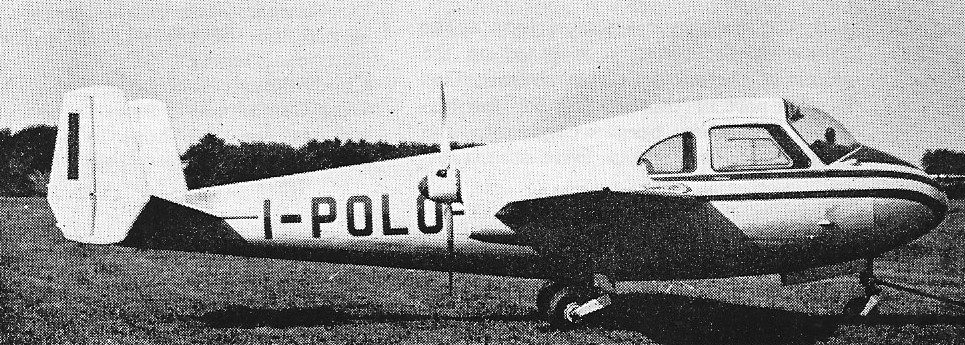
The 1948 Caproni Ca.193 is a cantilever mid-wing monoplane powered by two 155 hp Blackburn Cirrus Major 3 engines driving two blade fixed pitch pusher propellers.
The cabin is forward of the main spar, giving appreciable sweep-back to the wing leading edge.
Construction is all-metal, the wing monospar with stressed skin covering. The fuselage is a monocoque and the dihedral tailplane has twin fins and rudders at the tip with statically and aerodynamically balanced trim tabs mounted in the movable surfaces. The designer was considering a single fin.
The cabin provides accommodation for five.

The only Caproni Ca.193 built was flown for the first time on 1947. The five/six seat pusher aircraft was displayed at the Venice Exposition.

Engines: 2 x Blackburn Cirrus Major III, 155 hp
Wingspan: 45 ft 3 in
Wing area: 205 sq.ft
Length: 29 ft 6 in
Height: 8 ft 2 in
Empty weight: 2685 lb
Loaded weight: 4185 lb
Useful load: 1500 kb
Max speed: 186 mph at SL
Max speed 9840 ft: 164 mph
Min speed no flap: 65 mph
Climb to 9840 ft: 14 min
Service ceiling: 17,700 ft

Caproni Ca.135 / SABCA S.45

Ca.135 Tipo Spagna

Designed in mid¬ 1934 by Ing Cesare Pallavicino, the Ca 135 was a mid wing, twin tailed monoplane. The prototype, powered by two 836 hp Isotta-Fraschini Asso XI RC 40 engines, was built by Caproni Bergamaschi and flew for the first time on April 1, 1936.
Carrying a four man crew, the Ca 135 was armed with a single 12.7 mm (0.5 in) Breda-SAFAT machine gun in the nose, another in a ventral position, and one or two similiar guns in a Breda dorsal turret.
The Isotta-Fraschini Asso XI RC 40 was retained for the initial production version, and 32 were delivered to the Regia Aeronautica’s 330 and 340 Gruppi Bombardied from June 1938, and a further six (known as Tipo Peru) to the Peruvian air force in 1938 39.
The Regia Aeronautica Ca 135s were employed chiefly as bombing trainers, but those of the Hungarian air force (delivered in 1940 41) were used for bombing attacks in the Balkan campaign during the latter part of 1941, and on the southern part of the Eastern Front during the following year.
The maximum bombload, carried internally, amounted to 1862 kg (4105 lb) on the Ca 135 Asso, reducing to 1600 kg (3527 lb) on the Fiat and Piaggio engined versions. Two torpedoes could be carried instead of bombs.
Eight examples were completed of the Ca 135 S (Tipo Spagna), which differed in having 1000 hp Fiat A.80 RC 41 engines. These were intended for the Italian Legion fighting in the Spanish Civil War, but the first three were lost during delivery and the remaining five were delivered to the Regia Aeronautica.
The principal production version was the Ca 135 bis, of which 68 were ordered with 1000 hp Piaggio P.Xl RC 40 radial engines: 32 for the Regia Aeronautica and 36 (designated Ca 135 bis U) for the Hungarian air force. All 68 went to Hungary, the Regia Aeronautica making good the defi¬ciency by having 32 Asso engined Ca 135s refitted with the Piaggio engines. Total pro¬duction amounted to 115, includ¬ing the prototype.

(SABCA) made a marketing agreement with the Italian company Caproni, with SABCA selling some of Caproni’s military aircraft in certain markets, including the Caproni Ca.135, Ca.310 and the Ca.312, which were to be designated SABCA S.45bis, S.46 and S.48 respectively.

Ca.135 bis
Span: 18.80 m (61 ft 8.25 in)
Length: 13.70 m (44 ft 11.5 in)
Gross weight: 9500 kg (20944 lb)
Maximum speed: 428 km/h (266 mph)

Caproni Ca.101 / Ca.102

The Ca 101 appeared with various power plants as a civil transport aircraft.
Characterized by a steel tube, square section fuselage, the Ca 101 was a high-wing strut-braced cabin monoplane, underpowered, and its payload (defensive armament plus 500 kg (1102 lb) of bombs, or eight passengers in a transport role, in addition to the crew of three) was modest.
It was developed originally for use by the Regia Aeronautica’s colonial and night bomber squadrons, and entered service with the Stormi da Bombardamento before Italy’s invasion of Ethiopia, employed on both attack and supply missions. After that campaign, it was phased out of the combat units and transferred to transport and ancillary duties. Most of those produced for military use, were powered by three 240 hp Alfa Romeo D.2 9 cylinder radial engines, driving two blade metal propellers.

Armament consisted of a free mounted dorsal 7.7 mm (0.303 in) machine gun, with one or two similar guns mounted ventrally and, on occasion, two others firing through the side windows to protect it from beam attacks.
The Ca.101 D2 was powered by three 179kW Alfa Romeo D2 uncowled radial engines. Fitted with Handley Page leading-edge slats, the Ca.101s armament comprised four 7.7mm machine-guns firing from a retractable dorsal turret, a ventral bulge and lateral window ports. The bomb load was carried externally under the fuselage.
Overall production included 24 built by the Cantieri Aeronautici Bergamaschi, and some Ca 101s were still in service after Italy’s entry into the Second World War. These included about 20 supplied to the Hungarian air force, with which they served as transports on the Eastern Front until 1943, in spite of the relatively low payload which could be carried.
Also built in small numbers was a twin-engined derivative, the Ca 102, powered by a pair of 500 hp Bristol Jupiter radials. The Ca 102 quater was a variant of this with four engines mounted in tandem pairs. Although an experimental prototype only, it did serve operationally for a time with the 620 Sperimentali Bombardieri Pesanti (Experimental Heavy Bomber Squadron).
A few civil Ca.101s were flown on colonial passenger routes for several years (with various Walter, Piaggio and Alfa Romeo engines of 149-313kW).

Ca.101 D2
Engines: 3 x Piaggio “Stella VII”, 275kW
Max Take-off weight: 5135 kg / 11321 lb
Empty weight: 3435 kg / 7573 lb
Wingspan: 19.7 m / 64 ft 8 in
Length: 14.4 m / 47 ft 3 in
Height: 3.9 m / 12 ft 10 in
Wing area: 61.7 sq.m / 664.13 sq ft
Max. speed: 250 km/h / 155 mph
Cruise speed: 205 km/h / 127 mph
Ceiling: 6000 m / 19700 ft
Range w/max.fuel: 1000 km / 621 miles
Crew: 3-4
Armament: 2-4 machine-guns, 500kg of bombs

Caproni Ca.73 / Ca.82 / Ca.88 / Ca.89

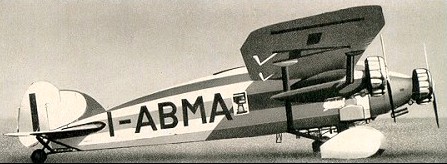
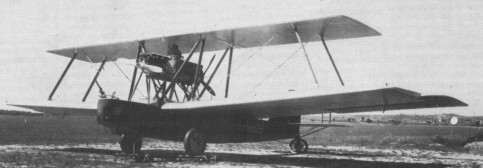
Developed in 1925 from Caproni’s earlier Ca 66, the Ca 73 was a large two bay biplane having with the lower wing mounted on top of the fuselage and the much shorter span upper wing supported above it by struts. The tail unit was biplane horizontal surfaces and a single fin and rud¬der. The power plant, mounted centrally between the wings, was two 400 hp Lorraine engines mounted in tandem, driving a tractor propeller at the front and a pusher propeller at the rear. The Ca 73 carried nose, dorsal and ventral single machine guns for defence and its bombs were attached to the fuselage sides beneath the lower wing.

Subsequent versions included the Ca 73 bis (400 hp Lorraines) and Ca 73 ter (490 hp Isotta Fraschini Asso engines); the latter was later redesignated Ca 82, and carried its bombs attached directly to the lower wing.

Caproni also produced developed versions designated Ca 88 (originally Ca 73 quater) and Ca 89, of which the latter had a cockpit windscreen, glazed bomb aiming panels in the nose, a dorsal turret, and a retractable ventral gun. In over eight years’ service, the Ca 73 series served also as paratroop trans¬ports and ambulance aircraft.

Span: 25.00 m (82 ft 0.25 in)
Length: 15.10 m (49 ft 6.5 in)
Gross weight: 5000 kg (11023 lb)
Maxi¬mum speed: 175 km/h (109 mph)

Ca.88
Engines: 2 x I.F.Asso 500
Wingspan: 25 m
Length: 15.20 m
Weight: 5700 kg
Max speed: 195 kph
Ceiling: 5500 m

Capelis XC-12   

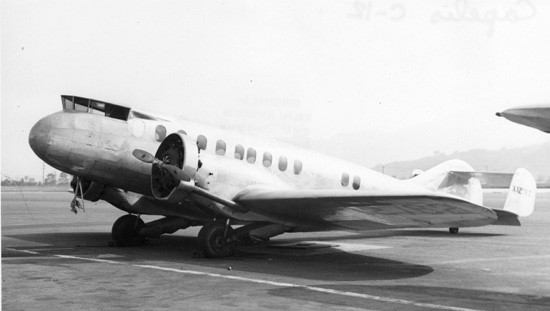
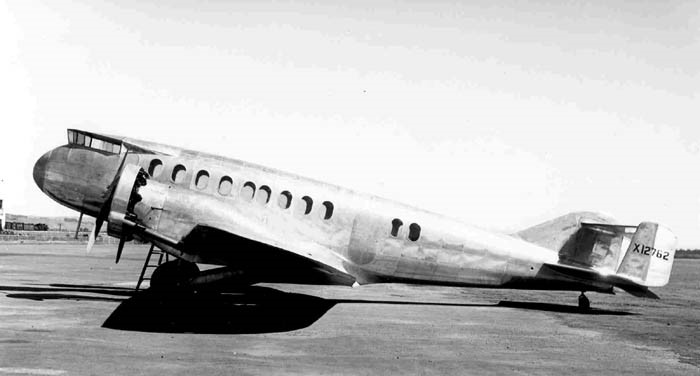
The Capelis Safety Airplane Company Ltd XC-12 was a 1933 aircraft design that most notably was used as a prop in the films Five Came Back, The Flying Tigers, The Falcon in Danger, and Immortal Sergeant. The aircraft featured unusual twin horizontal tail structures supported by three vertical tail surfaces. Construction and finishing methods involved using sheet metal screws which ultimately led to the abandoning of the project.

The original design by Socrates H. Capelis was issued U. S. patent #1,745,600 in 1930. The patent comprised a modified application with a half-span dorsal wing mounted rearward on top of the cabin and two additional engines mounted on the wings. The project was funded by local Greek restaurateurs as a promotional aircraft; it was constructed with help from University of California students.

A less radical design by Dr. John E. Younger featured all-metal construction; the aircraft was built as an all-metal, low-wing, retractable gear, twin engine transport with a triple vertical tail supporting a dual (biplane arrangement) horizontal stabilizer. The wing used a large box-spar construction with corrugated skin panels. The partly retracting landing gear extended automatically when the throttle was closed.

Following a 1938 incident, the XC-12 was modified at Glendale, California: The forward slanting eight-piece windshield was modified to a four piece that slanted rearward, and the passenger windows were squared off to look more like a Douglas DC-3.

On April 15, 1938, the XC-12 suffered minor damage from a forced landing after running out of fuel while flying over Fresno, California. The main wing spar construction was bolted together, and many of the metal skin panels were attached with P-K sheet metal screws rather than with permanent rivets. These tended to vibrate loose, requiring tightening or replacing every few flights, constituting a safety hazard that would later ground the aircraft. With promotional tours abandoned after the 1938 crash, the aircraft’s flying career was over.

The aircraft was purchased by RKO in March 1939, after which the studio’s insurance company permanently grounded the aircraft. Used as a full-size prop, the transport appeared only in ground roles in RKO’s feature films made during World War II; flying sequences used a scale XC-12 shooting miniature. The aircraft became an RKO back lot relic, falling into worse repair during the 1940s until it was completely scrapped some time around 1950. The XC-12 miniature continued to be used in later feature films.

The aircraft was featured as a prop in Five Came Back (1939), The Flying Tigers (1942), and Immortal Sergeant (1943). In RKO’s Dick Tracy’s Dilemma (1947) the XC-12 was shown somewhat dismantled, and in Daredevils of the Clouds (1948), after which it was apparently scrapped.

Filmography:

Five Came Back (RKO) 1939 (aircraft and model)

Flying Blind (Paramount) 1941 (model)

King of the Zombies (Monogram) 1941 (model and disassembled fuselage)

Flying Tigers (Republic) 1942 (aircraft and model) John Wayne guides in a crippled XC-12 with an engine on fire, and later uses it as an improvised bomber

Invisible Agent (Universal) 1942

Immortal Sergeant (20th Century Fox) 1942/1943 (aircraft and model)

Adventures of the Flying Cadets (Universal) 1943 (model)

Night Plane from Chungking (Paramount) 1943

The Falcon in Danger (RKO) 1943 (while a Lockheed Model 10 Electra aircraft model is used for the in-flight scenes, the full-size aircraft appears as a wreck)

Wings Over the Pacific (Monogram) 1943 (model)

The Purple V (RKO) 1943

Action in Arabia (RKO) 1944

Passport to Destiny (RKO) 1944

Jungle Queen (serial) (Universal) 1945; re-edited into Jungle Safari a 1956 feature film

Dick Tracy’s Dilemma (RKO) 1947 The aircraft is shown somewhat dismantled in this movie, but not scrapped

Daredevils of the Clouds (Republic) 1948 (model)

Jungle Goddess (Lippert Pictures) 1948 (model)

Tarzan’s Magic Fountain (RKO) 1949 (model)

On the Isle of Samoa (Columbia) 1950 (model)

China Gate (Globe Enterprises) 1957 (model)

Specifications:
Powerplant: 2 × Wright Cyclone R-1750, 525 hp (391 kW) each
Propeller: 2-bladed
Wingspan: 55 ft (17 m)
Wing area: 500 sq ft (46 m2)
Airfoil: Modified USA 45
Length: 42 ft (13 m)
Height: 12 ft (3.7 m)
Empty weight: 6,500 lb (2,948 kg)
Gross weight: 9,500 lb (4,309 kg)
Fuel capacity: 145 gal
Maximum speed: 190 kn (220 mph, 350 km/h)
Cruise speed: 170 kn (190 mph, 310 km/h)
Stall speed: 53 kn (61 mph, 98 km/h)
Service ceiling: 28,000 ft (8,500 m)
Capacity: 12
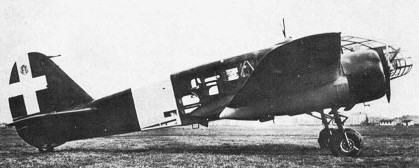
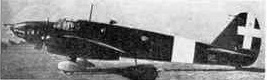
Cant Z.1018 Leone

Concurrently with development of the production models of the Alcione, Zappata was engaged on the development of the twin- engined Z.1018, the first of several prototypes of which flew in 1939.

The Z.1018 broke away from previous C.R.D.A. practice in featuring metal construction, although one of two Piaggio P.VII- powered prototypes tested an alternative wooden fuselage. Several types of engines were installed in the prototypes, one having Piaggio P.XV radials, another having Alfa Romeo 135 R.C.32 radials, and yet another having Daimler-Benz DB 605 engines. Some prototypes had twin fin and rudder assemblies, but a single unit was adopted far the production model which, powered by 1,400-h.p. Atfa Romeo 135 R.C.32 radials, began to appear in service in 1943 but was too late to participate extensively in the air war prior to ltaly’s collapse.