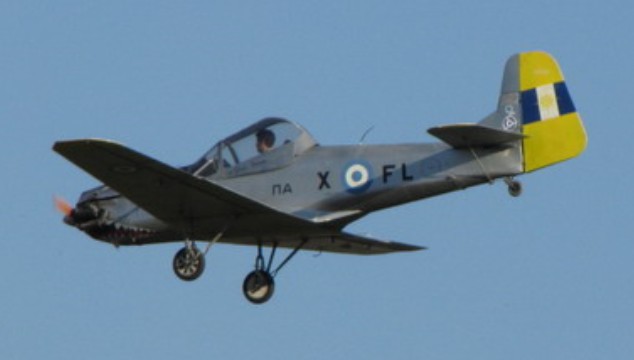
The Lygistis Ultralight was designed and constructed during 1987-1990.
The Lygistis Ultralight was designed and constructed during 1987-1990.
Designed by R D Fehlner, E B Trent and Harris Woods the Scamp originally with a tailwheel around a box keel of 5” x 2” extruded aluminium, to which are attached the landing gear, bottom wings, empennage, and fuselage bulkheads, as well as another extruded piece running vertically in front of the pilot to hold the top wing. All spars are tubular aluminium, and the strength in this basic structure gives it aerobatic capabilities. The Scamp can be used for limited aerobatics and is stressed to + 6G and -3G. An open-cockpit, single-seater biplane with T-tail, and tricycle undercarriage. A fibreglass engine cowling was supplied in the kit.
It was marketed as plans and kits for home-builders, reportedly 1,050 plan sets sold.
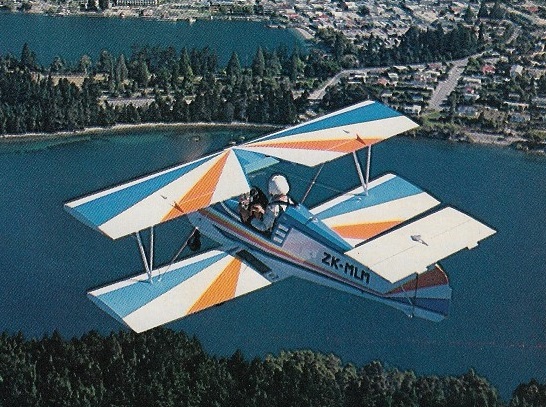
First flown in 1974, the Scamp can be built from either plans or a kit.
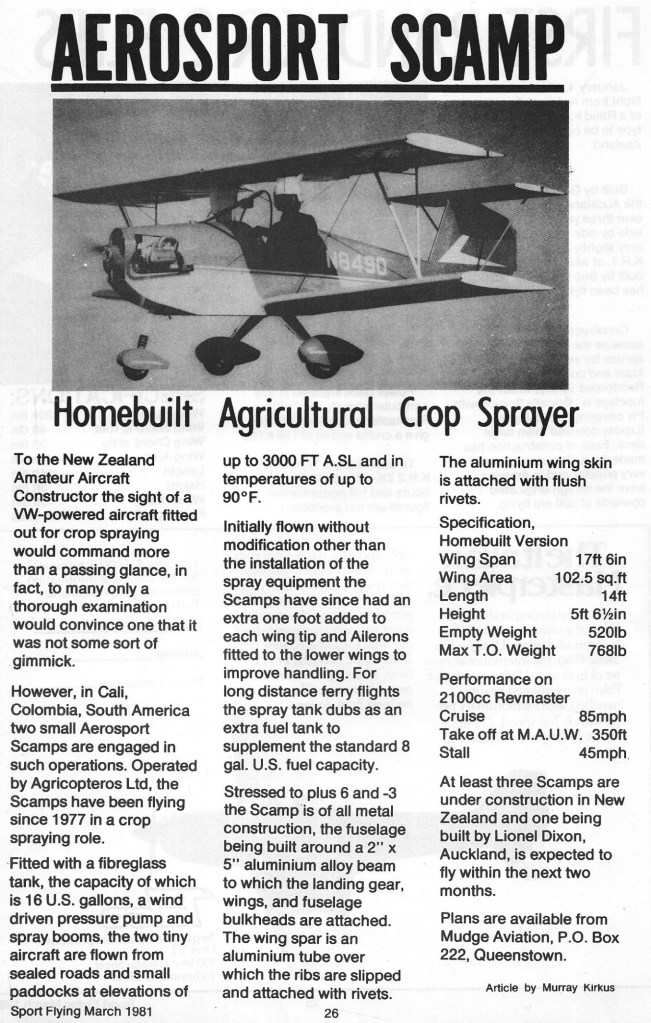
At least one example has been fitted out as a sprayer in South America. Powered by a 2100 cc Revmaster, it has a tank slung underneath with a 200 lb agricultural overload.
Price in 1982: $4,460 (with plans, excludes engine). Units delivered to June 1982: 78.
Engine: VW
Gross weight: 768 lb
Empty weight: 520 lb
Useful load: 248 lb
Fuel capacity: 30 USG
Wingspan: 17 ft 6 in
Length: 14 ft
Top speed: 105 mph
Cruise speed: 90 mph
Stall: 45 mph
Ceiling: 12,000 ft
Takeoff dist: 300 ft
Landing roll: 400 ft
Range: 150 mile
Max X-wind: 30 kt
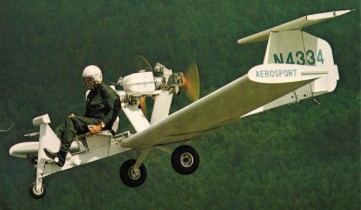
Designed by Mr H. L. Woods and first the first, N4334, flown 4 November 1970, the Aerosport Rail was the third of a series of open aircraft meant to be flown at lower speeds and altitudes for fun. With safety in mind, it was de¬signed to meet all FAA Normal Category Certification requirements. Its twin engines have separate fuel and ignition systems for reliability. The original open-air pusher was powered by twin Aerosport 600 engines rated at 25 hp each. Top speed was about 80 mph, while standard cruise was cited at 60 mph.
Powered by 33 hp two-stroke engines, it has a top speed of 95 mph (153 kph).
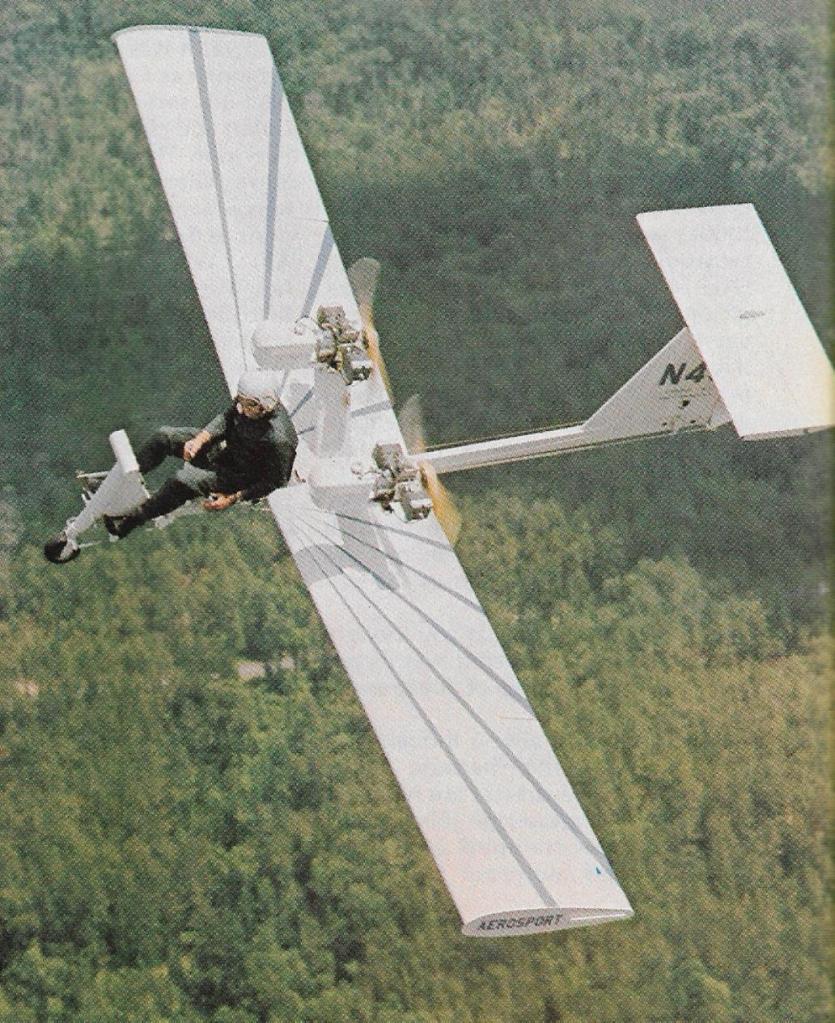
The Mk II Rail has been changed to take a modified Volkswagen powerplant mounted behind the pilot’s head. The all-metal Rail seats only one, stands on a tricycle gear and makes use of a T-type tail assembly. The Rail has always emphasized easy construction, simplified tools and economy of operation.
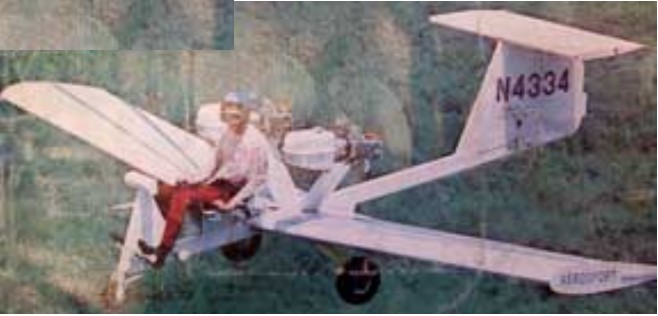
Rail
Engines: 2 x Aerosport-Rockwell JLO LB-600/2, 33 hp
Wing span: 23 ft 3.5 in / 7.1 m
Length: 15 ft 9 in / 4.8 m
Height: 6 ft 0 in / 1.83 m
Max TO wt: 710 lb / 322 kg
Useful load: 272 lb
Max level speed: 95 mph / 153 kph
Cruise: 66 mph
Stall: 45 mph
Range: 120 mi
Ceiling: 12,000′
Seats: 1
Rail Mk.II
Engine: VW 1600-2100cc
Gross weight: 100 lb
Empty weight: 438 lb
Fuel capacity: 8.5 USG
Wingspan: 23.3 ft
Length: 16 ft 7 in
Vmax: 90 mph
Cruise speed: 66 mph
Climb rate: 900 fpm
Stall: 45 mph
Ceiling: 12,000ft
Takeoff dist: 230 ft
Landing roll: 300 ft
Range: 100 sm
Rail MkII
Engines; 2 x Rockwell JLO LB-600 snow mobile pusher, 33 hp at 4300 rpm
Engines weight: about 56 lbs
Wing span: 23’ 3 0.5”
Wing area: 81.5 sq/ft
Length: 15’ 9”
Height: 6’
Empty weight: 438 lb
Seat: 1
Undercarriage: Tricycle steerable nose wheel
The 1971 Quail is a stubby, little single-seater with an enclosed cabin that can be powered by a variety of engines, the KAM-25 Kiekhaefer, the Volkswagen 1600, 1700 or the Franklin 2 cyl. This high-wing plane is constructed of all metal and stands on tricycle landing gear. The Quail’s wing is similar to that of the Rail, and also like the Rail its tricycle gear can be equipped with optional wheel fairings.
The first, N88760, first flew in December 1971.
One of the lightest all-metal homebuilts, outside the ultralight category at 435 pounds, the Aerosport Quail gets 32mpg, has a rugged spring gear for rough fields, is easily built using Pop rivets, has pilot comfort in the cabin and a complete electrical system.
Engine: VW 1500cc
Gross weight: 792 lb
Empty weight: 534 lb
Fuel capacity: 10 USG
Wingspan: 24 ft
Length: 15ft 11in
Vmax: 125 mph
Cruise: 110 mph
Climb rate: 820 fpm
Stall: 45 mph
Ceiling: 12,000ft
Takeoff run: 340ft
Landing roll: 500ft
Engine: VW 1600 cc
Gross weight: 792 lb
Empty weight: 534 lb
Fuel capacity: 10 USG
Wingspan: 24 ft
Length: 15ft 11in
Top speed: 130 mph
Cruise: 115 mph
Stall: 48 mph
Climb rate: 850 fpm
Ceiling: 12,000 ft
Takeoff dist: 300 ft
Landing roll: 400 ft
Range: 230 sm

Aerospool CZ WMD-10 CLASSIC is a side-by-side, two-seat, braced high-wing plane of composite structure with a load-bearing cage in the central part of the fuselage and a fixed tricycle landing gear, meant for sport and recreational flying under VFR conditions in SLZ category.

The power plant is a four stroke, four cylinder engine ROTAX 912 ULS with a ground adjustable, three blade propeller Woodcomp SR 200. The plane can be fitted with a ballistic rescue system.

ULL aircraft Classic
Engine: Rotax 912 ULS, 73,6 kW at 5800 rpm
Propeller: 1.68 m, three-blade, ground adjustable SR 200
Propeller ground clearance: 250 mm
Wing span: 10,0 m
Wing area: 10,5 sq.m
Aspect ratio: 9,52
Length: 6,3 m
Height: 2,2 m
Empty weight with fixed undercarriage: 280 kg
Empty weight with ballistic rescue system: 305 kg
Maximum take-off weight: 450 kg
Live load: 170 kg
Fuel tanks capacity: 90 litres
Mean camber line: 1,05 m
Aileron length: 1,45 m
Aileron area: 0,36 sq.m
Flap length: 2,50 m
Flap area: 0,81 sq.m
Tailplane span: 2,4 m
Tailplane area: 1,68 sq.m
Fin/rudder height: 1,19 m
Fin/rudder area: 1,02 sq.m
Main undercarriage wheel spacing: 1,75 m
Wheel base: 1,52 m
Main undercarriage wheel dimension: 0,32 m 0,35 m


In September 1978 details were given of the Aerospatiale TB-30 piston-engined trainer, designed as a basic light trainer, in collaboration with the Armee de l’Air in response to rising costs before starting jet training. Features include a metal airframe with a life in the military training role of not less than 10,000 hours, a cockpit resembling that of a jet combat aircraft, and equipment for full basic flying training, including aerobatic, instrument, night, formation, navigation, combat manoeuvres and VFR/IFR navigation.
Aerospatiale TB.30 Epsilon Article
The first of two prototypes flew on 22 December 1977, but delays were caused by redesign of the wingtips, lowering the tail-plane and adding a ventral fin to cure high speed pitch and yaw instability.
Deliveries beginning in 1982 from SOCATA, the Aerospatiale subsidiary at Tarbes for the Armee de l’Air, the first of 150 aircraft to the French Air Force was accepted in July 1983.
An armed export version of the Epsilon, featuring structural reinforcement, a gunsight, and four under-wing hardpoints to carry up to 300kg of stores, flew in February 1983.
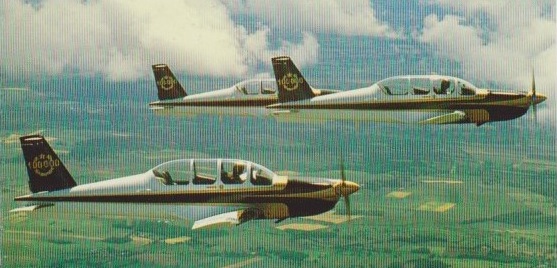
Assembled by OGMA for the Forca Aerea Portuguesa, 18 of the piston-engined Epsilon were ordered by Portugal in October 1987. The Togolaise Air Force operated three Epsilons for dual training/light attack use, with four underwing pylons for a total of 661 lb (300 kg) of stores. Powerplant is a 300 hp (224 kw) Lycoming AEIO-540-L1B5D.
On November 9, 1985, an Epsilon flew powered by a TP-319 turboprop. The aircraft was being used as a testbed for the engine, which has been developed by Turbomeca from the TM-319 turboshaft.
On 30 April 1989 SOCATA flew the first example of its turboprop-powered Omega trainer.
Omega is the outcome of re-engining the Epsilon using a 360 shp (269 kW) Turbomeca TP319-1A2. To familiarise students with future jet aircraft, engine power and propeller settings are controlled through a single lever and there is a 31 per cent increase in fuel capacity, allowing Omega to fly two full training missions without refuelling. The airframe has been strengthened to cope with the higher acrobatic weight.
Epsilon
Engine: 1 x Lycoming AEIO-540-L1B5D, 300 hp (224 kW)
Epsilon
Engine: 1 x Avco Lycoming AEIO-540-K, 225 kW
Span: 7.9 m / 25 ft 11 in
Length: 7.6 m / 24 ft 11 in
Height: 2.7 m / 8 ft 10 in
Wing area: 9 sq.m / 96.88 sq ft
Empty wt: 932 kg
MTOW: 1250 kg
Max. speed: 355 km/h / 221 mph
Ceiling: 6100 m / 20000 ft
Initial ROC: 565 m / min
Ceiling: 7000 m
T/O run (to 15m): 640 m
Ldg run (from 15m): 440 m
Fuel internal: 210 lt.
Range/Endurance: 1250 km / 3.75 hr
Combat radius: 465 km.
Omega
Engine: 1 x Turbomeca TP319-1A2, 360 shp (269 kW)
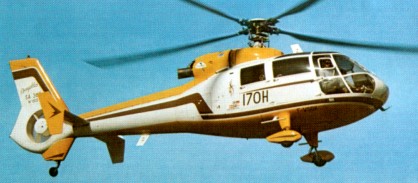
The Aerospatiale Dauphin was origi¬nally planned as a modern replace¬ment for the Alouette III, but it diversified into a family with different fuselages, landing gears (fixed tailwheel type with forward spatted mainwheels or retractable tricycle gear, for example) and various single or twin engines. The original SA 360C Dauphin introduced the four blade ‘Starflex’ main rotor and was shown at the 1973 Paris Air Show. The first of two prototypes flew on 2 June 1972 with a 980shp Astazou XVI turbine, a four-blade main rotor (using the same blades as the Alouette III), a characteristic fenestron tail unit and fully-glazed front fuselage section.
After 180 flights, the prototype was refitted with a 1050shp Astazou XVIII engine and new plastic rotor blades, and was modified to reduce vibrations and eliminate ground resonance.
Flights were resumed in May 1973 and it was officially introduced at Le Bourget Air Show, where it distinguished itself by winning a series of three world records in the E1D class for helicopters from 1750 to 3000kg, piloted by Roland Coffignot. With a payload equivalent to eight passengers, it flew at 299km/h over a 100km closed circuit; at 312km/h over a 3km straight course and at 303km/h over 15km. The second prototype, which flew on 29 January 1973, was given new blades, and the first production aircraft subsequently introduced a stepped nose, which was standardised.
Production of the Dauphin began in 1974 with the SA.360C, but the market was limited. At the end of 1976 Aerospatiale had 15 completed Dauphin civil airframes unsold. The SA 360 Dauphin was certified for single pilot IFR in 1978, using a Sperry package of avionics.
Production of the single-engine civil Dauphin stopped after 34 had been made, although development of a military version continued on an experimental basis.
A military prototype had been developed, the SA.361, with a 1400shp Astazou XX turbine and Starflex rotor. A second model was built with the same powerplant but the original rotor hub.
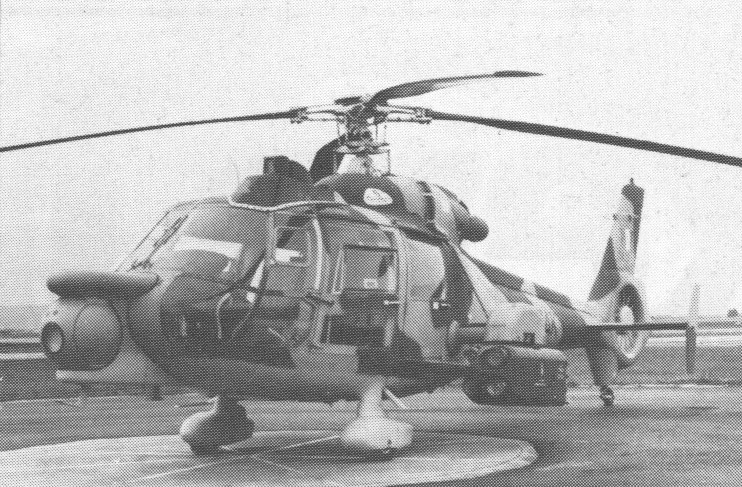
In the SA.361H/HCL (Helicoptere de Combat Leger) configuration, the Dauphin can carry eight HOT antitank missiles and an SFIM turret,
SA 360 Dauphin
Engine: Turbomeca Astazou XVIIIA, 783kW (1,050 shp)
Rotor diameter: 37.73 ft / 11.5 m
Length: 13.4m
Height: 3.4m
Empty weight: 1550kg
Max take off weight: 6394.5 lb / 2900.0 kg
Max speed: 315km/h
Cruising speed: 265km/h
Ceiling: 2250m
Range: 362 nm / 670 km
Crew: 1+9
SA 360C Dauphin
Engines: Turbomeca Astazou XVIIIA, 1050 hp
Seats: 10/14
Disc loading: 5.92 lb/sq.ft
Pwr loading: 6.3 lb/hp
Max TO wt: 6615 lb
Empty wt: 3440 lb
Equipped useful load: 3075 lb
Payload max fuel: 1602 lb
Range max fuel/ cruise: 338 nm/ 2.3 hr
Range max fuel / range: 352 nm/ 2.7 hr
Service ceiling: 14,270 ft
Max cruise: 146 kt
Max range cruise: 133 kt
ROC: 1400 fpm
HIGE: 8035 ft
HOGE: 5740 ft
Max sling load: 3300 lb
Fuel cap: 1125/1473 lb.
SA.361N Dauphin II
Engines: 2 x 725 hp / 541 kW Arriel 1C
Gross weight: 7935 lb / 3600 kg
Cruise: 170 kt

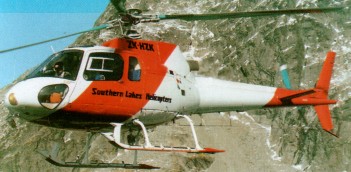
Aerospatiale flew the first prototype (F-WVKH) of the AS 350 Ecureuil (squirrel) five/six-seat light general purpose helicopter on 24 June 1974 and introduced a new simplified rotor and an all-new streamlined fuselage with room for five or six persons. Built from composites/fibre-glass, the rotor head was designed without the need for conventional mechanical hinging. It used the inherent flexibility of laminated composites for movement. The AS.350 uses many automobile parts such as a cooling fan from a normal Citroen car and an oil radiator by another automobile manufacturer. The cabin is made of thermoformed polycarbonate semi-monocoque sections with ultrasonic welding. The bearings usually found in rotor hubs have been replaced by elastomeric ball joints which need no lubrication. The first prototype was powered by a Lycoming LTS engine, and the second with a Turbomeca Arriel 1A engine. The first flight of the second example (F-WVKI) was on 14 February 1975.
Aerospatiale AS350 Ecureuil Article
The first production version was the AS 350B powered by 478kW Arriel IB and certified 27 October 1977.
Delivery of the 2,000th AS 350/550 (F-WWPZ, later ZJ270 of UK Defence Helicopter Flying School) took place in July 1997.
Production of the AS350B started in July 1978 after eight pre-production models had been built. By the end of December of that year, the company had 459 orders.
The AS350 B2 is an uprated Squirrel variant powered by a 732shp Turbomeca Arriel engine. It was being marketing in the USA as the SuperStar to replace the SA315B Lama in the heavy lifting role.
The AS350B3 is equiped with basically a glass cockpit, a six axis auto-pilot, an AS355 swash plate, rotor head and dual hydraulics. This helicopter is IFR certified.
The conversion from a B model to an AS.350BA consists mainly of fitting the AS355 rotor head and blades and replaced the AS 350B during 1992. French VFR certification was received in 1991, UK and US certifications in 1992, and Japanese in 1993. Production of AS 350BA ended in 1998. All AS 350B1, 350BA and 350B versions can be upgraded to 350B2.
The Aerospatiale AS.350C AStar six-place helicopter received U.S. certification in 1978. The helicopter is powered by a 615 shp Lycoming LTS101 turbine driving all fiberglass rotor blades and sold only in USA.
The AS350D Astar of 1976 differs solely in having an American Lycoming LTS101 engine.
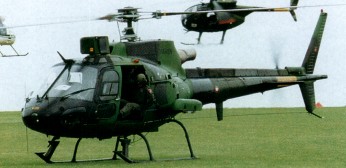
Sales of the single- (AS 350) and twin-engined (AS 355) versions of the Ecureuil (Squirrel) exceeded 1,300 by 1990.
In February 2001, delivery took place of the 3,000th of Ecureuil family (including AS 355/555), which also was first EC 130 upgraded version. There were a total 10,986,000 Ecureuil flying hours by January 2001.
Also built under licence by Helibras in Brazil as the Esquilo.
The AS.550 Fennec is a military version of the Eurocopter AS.350 Squirrel powered by a single full FADEC controlled Turbomeca Aniel B2 engine, ordered by the French and Danish Armies.
In 1992 the RoSAF took delivery of 10 utility and training AS.550 A2 models and a further ten AS.550 C2 models, which were equipped with a with a roof mounted sight and can be armed with GIAT 20mm cannon pods, BAE Systems CRV 7 unguided rockets and Hughes HeliTOW anti armour guided missiles.
The A2 is a battlefield version, and can carry weapons.
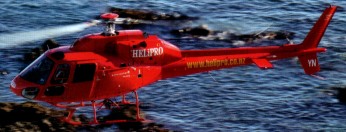
Development of the twin-engined AS.355 version of the Squirrel started in 1978 and it is essentially similar to earlier models with the added attraction of twin-engined reliability specified by some op¬erators in the rescue, police and night flying roles. The first Twin Squirrel (F-WZLA), with 420shp 250-C20F Allison turboshafts and the Starflex rotor system made its maiden flight on 28 September 1979 followed by the second prototype on 13 November. The twin-engined version is known as the Twinstar in the USA and Ecureuil 2 everywhere else.
After 122 hours of flight testing, production went ahead at a rate of between five and seven helicopters a month, rising to 20-24 in 1981.
Production of the AS 355F was superseded by the AS 355F1 in January 1984. Conversion from an AS355F to AS355F1 enables a higher gross weight.
After several modifications the civilian AS.355F2 is fitted with twin Allison turbines developing around 315kW and new wider composite blades and remoulded engine intakes for anti-icing protection. The AS 355F2 was certified 10 December 1985.
Three military versions of the Ecureuil light helicopter; the single-turbine AS.350L-1, the twin-turbine AS.355M for the French Air Force, and the similar AS.355M-2 for export. All have strengthened airframes, reinforced landing gear, and increased instru¬mentation. Other armament options include the 20mm GIAT M621 cannon, 7.62mm machine-gun pods, and unguided rockets.
A naval variant, the AS 555MN, is equipped with a chin-mounted radar, but is unarmed.
The Aerospatiale AS 555UN Fennec, powered by paired Turbomeca TM 319 turboshafts is the military version of the AS 355 Ecureuil.
An enlarged engine casing above and behind the five-seat cabin identifies the twin-engined AS 355/555 version. The AS.555SR engines are 420 shp (313 kW) Allison 250-C20F turboshafts which are replaced in the North American-marketed TwinStar by 450 shp (335.6 kW) Allison units. 1990 military versions were designated AS 555s and users include Brazil (built by Helibras and designated CH-55 and VH-55 for the Brazilian air force) and France. Armament can comprise GIAT 20-mm cannon and HOT or TOW anti-tank missiles. For naval use two torpedoes can be carried.
The MN is a naval version for sea survey, the SN an ASW version. The AN can have axial weapons.
A total 3,028 AS 350s, AS 355s and EC 130s had been ordered by at least 70 countries by January 2001, of which 2,675 were then in service; 1,948 single-engined Ecureuils were in service at May 2000.
Military customers include Singapore armed forces (10 AS 550B2 and 10 AS 550C2); Australia (RAAF 18 for training; RAN six utility); Danish Army (12 AS 550C2 with ESCO HeliTOW system ordered 1987, delivered 1990); French Army ALAT (originally expressed need for up to 100 to replace Alouette III); French CEV (flight test centre), and FBS Ltd, which ordered 38 AS 350BBs, with deliveries beginning November 1996 and service entry in April 1997. Of these, 26 are Squirrel HT. Mk Is with Defence Helicopter Flying School at Shawbury and 12 are NVG-compatible HT. Mk 2s with 670 Squadron, Army Air Corps, at Middle Wallop; by June 2001 the fleet had amassed 100,000 hours. Other orders include 11 for Brazilian Navy fox liaison and patrol work; 30 for Brazilian Air Force for training; 36 for Brazilian Army (16 for liaison and 20 for training and firefighting); six AS 350B3 for Chilean Army; eight for China (see also CHAIC Z-11) and 40 AS 350B2 options for US Customs Service (augmenting five B2s delivered from 21 October 1998 to supplement 19 earlier AStars); six AS 550C3; 13 AS 350B3 ordered by United Arab Emirates in 2000; and four AS 350B3 for the South African Police Air Wing, of which last two delivered in January 2002. Orders in 1997-2002 were 102, 73, 95, 137, 103 and 132. Deliveries in 2002 were 163.
In 2003 an AS 350B3 cost US$1.4 million.
The AS350 features Starflex bearingless glass fibre main rotor head with the main rotor turning at 394 rpm, and tail rotor at 2,086 rpm. Flying controls are single fully powered, with accumulators to delay manual reversion following hydraulic failure until airspeed can be reduced, and inverted aerofoil tailplane to adjust pitch attitude in climb, cruise and descent. In the military AS 550versions fuel is held in a self-sealing composites tank with capacity of 540 litres. An option is a 475 litre auxiliary tank in the cabin.
Engines include: AS 350B2 powered by one 546kW Turbomeca Arriel 1D1 with transmission rated at 440kW for T-O; AS 350B3/AS 550C3 powered by one 632kW Turbomeca Arriel 2B turbine engine controlled by FADEC, with transmission rated at 500kW for T-O; AS 350D powered by AlliedSignal LTS101 sold only in USA.
Soloy offers conversion using Rolls-Royce 250-C30M turboshaft.
Two individual bucket seats in the front and a four-place rear bench are standard,with a large forward-hinged door on each side of versions for civil use. Sliding doors are standard on military the versions. There is a baggage compartment aft of the cabin, with full-width upward-hinged door on the starboard side. The top of the baggage compartment is reinforced to provide a work platform on each side.
Hydraulic system includes four single-body servo units, operating at 40 bar pressure, and accumulators to delay reversion to manual control; electrical system includes a 4.5kW engine-driven starter/ generator, a 24V 16Ah Ni/Cd battery and a ground power receptacle.
Options include A 907kg capacity cargo sling (1,160 kg for AS 350B2/550, 1,400 kg on AS 350B3), AND A 135kg capacity electric hoist (optional 204kg on AS 350B3).
The need for a light twin-turbine helicopter, particularly in America, led Aerospatiale to develop a bigger version of the Ecureuil — Ecureuil II (or Twinstar) — powered by two 420shp Allison 250-C20F. It made its first flight on 27 September 1979 (F-WZLA) followed by the second prototype on 13 November. After 122 hours’ flight testing, production went ahead at a rate of between five and seven helicopters a month, rising to 20-24 in 1981.
Similar to the AS 350, the AS355/AS555 has the Starflex main rotor with the two engine shafts driving into a combiner gearbox containing freewheels. The main rotor turns at 394 rpm and tail rotor at 2,086 rpm as does the AS350.
Flying controls are powered, with full dual flying controls without manual reversion, trim by adjustable stick friction, and inverted aerofoil tailplane.
Engines are two Turbomeca Arrius 1A turboshafts, each rated at 357kW for take-off and 302kW maximum continuous; 388kW 30 minutes OEI emergency; 407kW 2.5 minutes OEI emergency; full authority digital engine control (FADEC) allows automatic sequenced starting of both engines, automatic top temperature and torque limiting and preselection of lower limits for practice OEI operation. Transmission rating 511kW for T-O. Two integral fuel tanks, with total usable capacity of 730 litres, in body structure. Optional 475 litre auxiliary tank in cabin.
The AS 355/555 is equipped with two hydraulic pumps, reservoirs and tandem powered flying control units and electric generators, with a 204kg capacity winch available. A cargo hook is optional; capacity 1,134kg.
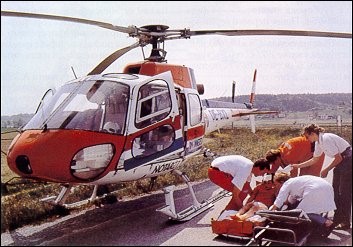
AS 355F superseded by AS 355F1 in January 1984. The AS 355F2 certified 10 December 1985. The AS.355F2 civilian variant is fitted with twin Allison turbines developing around 315kW and new wider composite blades and remoulded engine intakes for anti-icing protection.
AS 355N powered by two Turbomeca TM 319 Arrius 1A certified in France in 1989, UK and USA in 1992; deliveries of this version began early 1992.
Customers for the AS355/AS555 totaled 592 twin-engined Ecureuils in service at May 2000.
The French Air Force ordered 52 Fennecs, first eight as AS 355F1s powered by Rolls-Royce 250; flown by 67e Escadre d’Helicopteres at Villacoublay and other units for communications and, with side-mounted Giat M61 20mm gun pod, by ETOM 68 in Guyana; delivery of the remaining 44 (AS 555AN powered by Arrius) began 19 January 1990; from 24th onwards, provision for centrally mounted 20mm cannon and T-100 sight, plus Mistral missiles.
The French Army ordered 18 AS 555UNs for TFR training (delivery from February 1992). The French Air Force operate the AS.355N in the surveillance role and later models are fitted with Turbomeca TM319 turbines. A naval variant, the AS 555MN, is equipped with a chin-mounted radar, but is unarmed.
The Brazilian Air Force has 13 AS 555s: 11 with armament, designated CH-55, and two VIP transports, designated VH-55. The Brazilian Navy acquired 11 UH-12Bs; Brazilian AS 555s assembled by Helibras in Brazil; four more navies ordered eight AS 555s in 1992, two in 1993, four in 1994 and one in 1995.
Two AS 333F1s, leased from OSS of Hayes, UK, supplied to the RAF’s No. 32 (The Royal) Squadron at Northolt on 1 April 1996 for VIP transport; third subsequently added.
Total of six AS 3555Ns ordered by Malaysian Navy on 13 October 2001 with deliveries at end 2003.
Orders in 1997-2001 totalled nine, 20, 10, 13 and 17. About 750 Ecureuils and Astars have been delivered to operators in 19 nations.
In May 2005 a Eurocopter AS 350B3 Squirrel set a new world record for the highest take-off and landing when it touched down on the peak of Mount Everest at a height of 29,035 ft / 8850 m. To be recognised as a record, the Squirrel had to remain on the ground for two minutes before departing.
VERSIONS:
AS 350B2 Ecureuil
Uprated engine and transmission; wide-chord new section main and tail rotor blades originally developed for AS 355 twin; certified 26 April 1989; known as SuperStar in North America; supplied to UK Ministry of Defence as AS 350BB, designated Squirrel HT. Mk 1 with normal instrumentation and Squirrel HT. Mk 2 with provision for pilot’s NVGs.
AS 350B3 Ecureuil
632kW Arriel 2B and wide-chord tail rotor; optimised for high-altitude operation; uprated transmission and digital engine control. First flight (F-WWPB) 4 March 1997; French VFR certification December 1997 after 150 hour test programme; first delivery, to Osterman Helicopter, January 1998; Australian and New Zealand certification achieved late 1998. By 1 June 2001, 180 AS 350B3s were in service with 120 customers, in 25 countries; 100th AS 350B3 delivered 14 December 1999 to Japanese customer.
AS 350BA Ecureuil
Powered by 478kW Turbomeca Arriel 1B and fitted with large main rotor blades of AS 350B2; maximum T-O weight increased by 150kg.
AS 350D AStar
Version of 350B for North American market; improved LTS101 engine, with 6% more power, offered early 1999.
AS 350 Firefighter
Conair system able to pick up water load in 30 seconds while hovering over water; demonstrated 1986; Isolair system certified September 1995.
AS 550ÑÇ Fennec
Light anti-tank version armed with four TOW missiles; has same power plant as AS 550A3 and 2 hour 45 minute endurance.
AS 550A3 Fennec
Light attack version of AS 350B2 with 3-hour endurance; powered by 632kW, Arriel 2B; standard features include taller landing gear, sliding doors; NVG-compatible cockpit; reinforced airframe; provision for armoured seats and engine cowlings; can be armed with single 20mm cannon or two rocket launchers.
AS 550U3 Fennec
Military utility version with Arriel 2B power plant; capable of performing observation, commando and transport duties.
AS 355N Ecureuil 2 / Twinstar
Civil production version, adaptable for passengers, cargo, police, ambulance, slung loads, carrying harbour pilots, working on high-tension cables and other missions; Category A OEI performance; known as TwinStar in USA.
AS 555UN Fennec
Military utility version and French Army ALAT IFR pilot trainer.
AS 555AN Fennec
Armed version; later machines adapted for centreline-mounted 20mm gun and pylon-mounted rockets.
AS 555MN Fennec
Naval unarmed version. Can carry a 360 degree chin-mounted radar.
AS 555SN Fennec
Armed naval version for ASW and over-the-horizon targeting, operating from ships of 600 tonnes upwards; armament includes one lightweight homing torpedo or the cannon and rockets of land-based versions; avionics include Honeywell RDR-1500B 360° chin-mounted radar, Thales Nadir 10 navigation system, Thales RDN 85 Doppler and SFIM 85 T31 three-axis autopilot.
AS.350 Ecureuil
Engine: Turboméca Arriel II, 632 shp
Length: 35.794 ft / 10.91 m
Rotor diameter: 35.072 ft / 10.69 m
Fuselage length: 10.9m
Height: 3.15m
MTOW: 4630.5 lb / 2100.0 kg
Weight empty: 2348.3 lb / 1065.0 kg
Max. speed: 147 kts / 272 km/h
Cruising speed: 125 kts / 232 km/h
Initial climb rate: 1555.12 ft/min / 7.9 m/s
Service ceiling: 4750m
HIGE: 2500m
H OGE: 1860m
Range: 378 nm / 700 km
Crew: 2
Payload: 6 pax
AS.350B Ecureuil
Engine: Turbomeca Arriel 1D1, 614 shp
TBO: 2000 hrs
Main rotor: 35.1 ft
Seats: 6
Length: 42.6 ft / 12.99 m
Height: 10.3 ft / 3.5 m
Width: 10.69 m
Max ramp wt: 4300 lb
MTOW: 4300 lb
Std empty wt: 2363 lb
Max useful load: 1937 lb
Max landing wt: 4300 lb
Max sling load: 2000 lb
Disc loading: 4.4 lb/sq.ft
Power loading: 6.7 lb/hp
Max usable fuel: 983 lb
Max ROC: 1555 fpm
Max speed: 147 kts
Service ceiling: 15,600 ft
HIGE: 9675 ft
HOGE: 7380 ft
Normal cruise @ 3000 ft: 123 kts
Fuel flow @ normal cruise: 301 pph
Endurance @ normal cruise: 2.9 hr
AS.350B2 / SuperStar
Engine: 1 x Turbomeca Arriel 1D1
Instant pwr: 545 kW
Rotor dia: 10.7 m
Length: 12.99 m
Height: 3.5 m
Width: 10.69 m
MTOW: 2250 kg
Useful load: 1090 kg
Max cruise: 135 kts
Max range: 670 km
HOGE: 8350 ft
Service ceiling: 15,750 ft
Crew: 2
Pax: 4
Seats: 6/7
AS.350B3
Engine: 1 x Turbomeca Arriel 2B, 847 shp
Max cont pwr: 728 shp
Empty wt: 1202 kg
MAUW: 2250 kg
Height: 3.5 m
Width: 10.69 m
Length: 12.99 m
ROC @ 2250 kg: 1979 fpm
Cruise: 120-130 kt
Max cruise: 147 kt
Vne: 155 kt
MAUW external load: 2800 kg
AS.350BA
Engine: 1 x Turbomeca Arriel 1B
Instant pwr: 475 kW
Rotor dia: 10.7 m
Length: 12.99 m
Height: 3.5 m
Width: 10.69 m
MTOW: 2100 kg
Useful load: 945 kg
Max cruise: 126 kts
Max range: 730 km
HOGE: 6500 ft
Service ceiling: 15,750 ft
Crew: 2
Pax: 4
Seats: 6/7
AS.350C AStar
Engine: 1 x Lycoming, 615 shp
Seats: 6
AS.350D AStar
Engine: 1 x Lycoming LTS101-600A2, 615 shp
TBO: 2400 hrs
Main rotor: 35.1 ft
Seats: 6
Length: 42.6 ft
Height: 10.3 ft
Max ramp wt: 4300 lb
MTOW: 4300 lb
Std empty wt: 2360 lb
Max useful load: 1940 lb
Max landing wt: 4300 lb
Max sling load: 2000 lbs
Disc loading: 4.4 lb/sq.ft
Power loading: 9.37 lbs/hp
Max usable fuel: 938 lb
Max ROC: 1760 fpm
Service ceiling: 15,000 ft
HIGE: 8800 ft
HOGE: 5400 ft
Max speed: 147 kts
Normal cruise @ 3000 ft: 122 kts
Fuel flow @ normal cruise: 293 pph
Endurance @ cruise: 3 hr
AS.350L Ecureil
Engine: 1 x Turbomeca Arriel
Installed pwr: 480 kW
Rotor dia: 10.7 m
Fuselage length: 10.9 m
No. Blades: 3
Empty wt: 1065 kg
MTOW: 2200 kg
Payload: 900 kg
Max speed: 270 kph
ROC: 480 m/min
Ceiling: 4575 m
HIGE: 2950 m
HOGE: 2250 m
Fuel cap (+aux): 530 lt (475 lt)
Range: 700 km
Crew: 1
Pax: 5
AS.355 Ecureuil 2 / Twinstar
Engine: 2 x Allison 250-C20F, 309 shp
Length: 35.761 ft / 10.9 m
Height: 10.171 ft / 3.15 m
Rotor diameter: 35.105 ft / 10.69 m
Fuselage length: 10.9m
MTOW: 5600.7 lb / 2540.0 kg
Weight empty: 2877.5 lb / 1305.0 kg
Max. speed: 121 kts / 224 km/h
Cruising speed: 108 kts / 200 km/h
Initial climb rate: 1279.53 ft/min / 6.5 m/s
Service ceiling: 11155 ft / / 3400 m
HIGE: 2000m
HOGE: 1500m
Range: 378 nm / 700 km
Fuel capacity: 193 USG / 730 lt
Crew: 1
Payload: 5 pax
AS.355F TwinStar
Engine: 2 x Allison 250-C20F, 420 shp
TBO: 3500 hrs
Main rotor: 35.1 ft
Seats: 6
Length: 42.6 ft
Height: 10.3 ft
Max ramp weight: 5070 lb
MTOW: 5070 lb
Standard empty weight: 2807 lb
Max useful load: 2263 lb
Max landing weight: 5070 lb
Max sling load: 2300 lb
Disc loading: 5.2 lb/sq.ft
Power loading: 6 lb/hp
Max usable fuel: 1293 lb
Max rate of climb: 1614 fpm
Service ceiling: 14,800 ft
Hover in ground effect: 6900 ft
Max speed: 147 kts
HOGE: 7900 ft
Normal cruise @ 3000 ft: 128 kts
Fuel flow @ normal cruise: 435 pph
Endurance @ normal cruise: 2.8 hr
AS.355F1 Ecureuil II
Engine: 2 x Allison 250-C20F
AS.355F2 Ecureuil II
Engine: 2 x Allison 250-C20F
Instant pwr: 315 kW
Rotor dia: 10.7 m
MTOW: 2540 kg
Useful load: 1185 kg
Max cruise: 120 kts
Max range: 705 km
Seats: 6/7
AS.355N Ecureuil II
Engine: 2 x Turbomeca Arrius 1A
Instant pwr: 355 kW
Rotor dia: 10.7 m
MTOW: 2540 kg
Useful load: 1135 kg
Max cruise: 120 kts
Max range: 720 km
HIGE: 8530 ft
HOGE: 5085 ft
Seats: 6/7
AS.550A2/C2 Fennec
Engine: 1 x Turbomeca Arriel 1D1
Instant pwr: 545 kW
MTOW: 2500 kg
Payload: 1160 kg
Max speed: 130 kts
Max range: 654 km
HIGE: 9850 ft
HOGE: 7850 ft
Crew: 1
Pax: 5
AS.550U2 Fennec
Engine: 1 x Turbomeca Arriel 1D1
Instant pwr: 545 kW
MTOW: 2500 kg
Payload: 1160 kg
Max speed: 130 kts
Max range: 654 km
HIGE: 9850 ft
HOGE: 7550 ft
Crew: 1
Pax: 5
AS.555MN/SN Fennec
Engines: 2 x Turbomeca Arrius TM3191A1
Instant pwr: 340 kW
MTOW: 2600 kg
Payload: 1134 kg
Max speed: 121 kts
Max range: 722 km
HIGE: 8530 ft
HOGE: 5085 ft
Crew: 1
Pax: 5
AS.555SR
Engines: 2 x Allison 250-C20F, 420 shp (313 kW)
AS.555AN Fennec
Engine: 2 x Turbomeca Arrius TM3191A1
Instant pwr: 390 kW
MTOW: 2600 kg
Payload: 1135 kg
Max speed: 118 kts
Max range: 659 km
HIGE: 8530 ft
HOGE: 5080 ft
Crew: 1
Pax: 5
AS.555UN Fennec
Engine: 2 x Turbomeca Arrius TM3191A1
Instant pwr: 390 kW
MTOW: 2600 kg
Payload: 1135 kg
Max speed: 118 kts
Max range: 695 km
HIGE: 8530 ft
HOGE: 5080 ft
Crew: 1
Pax: 5
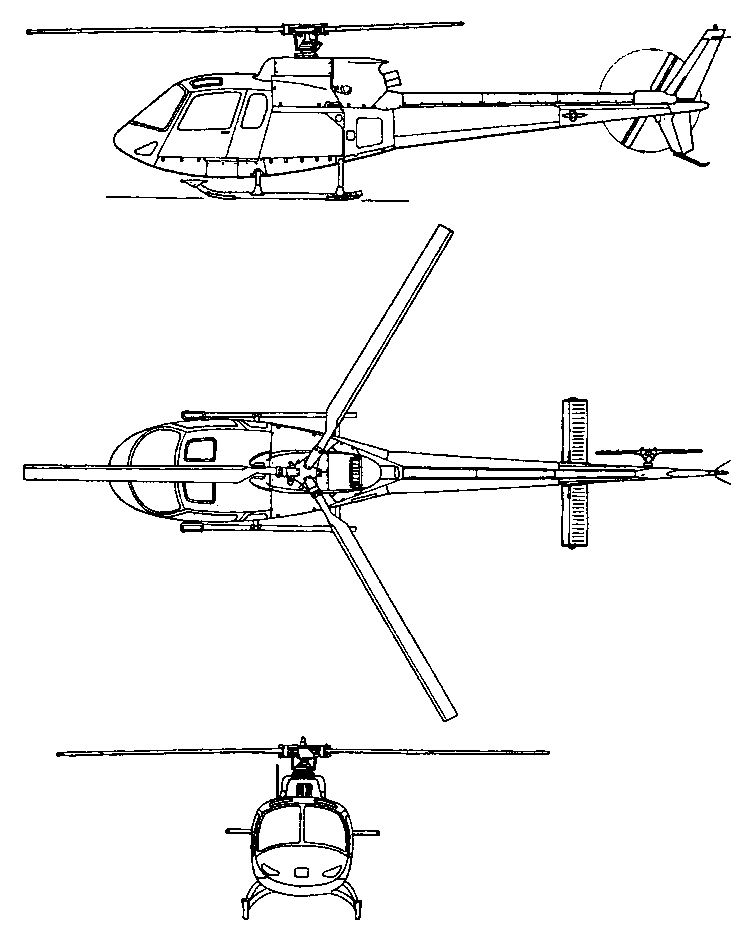
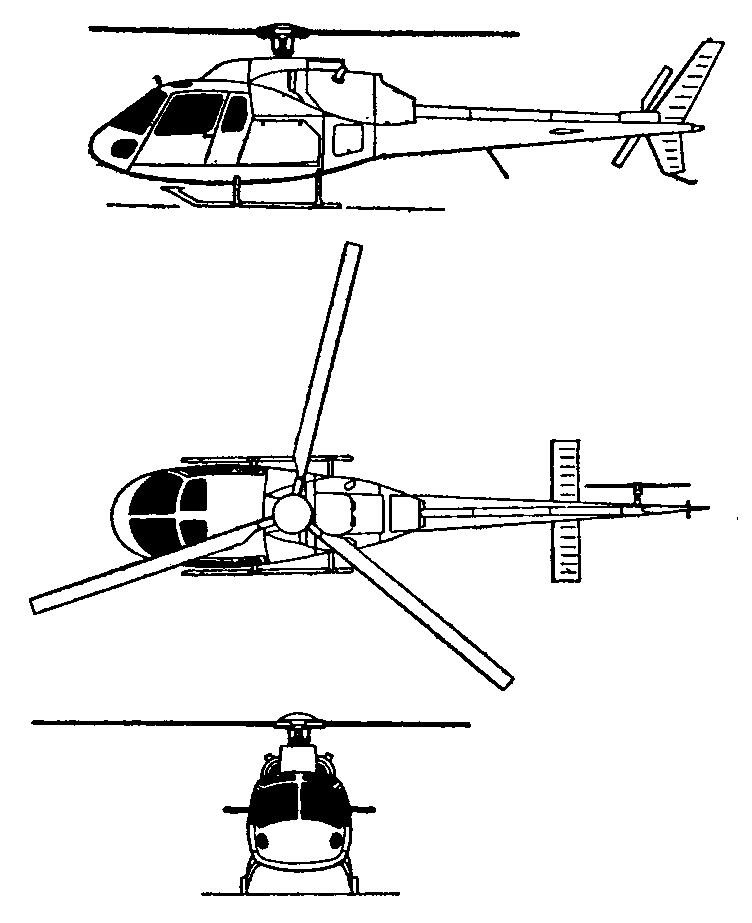
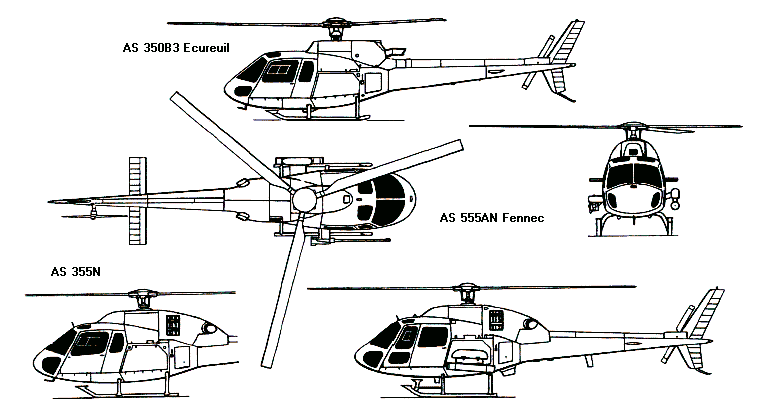
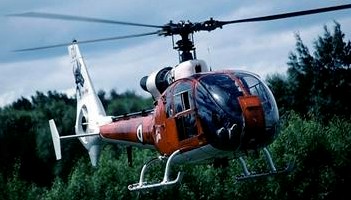
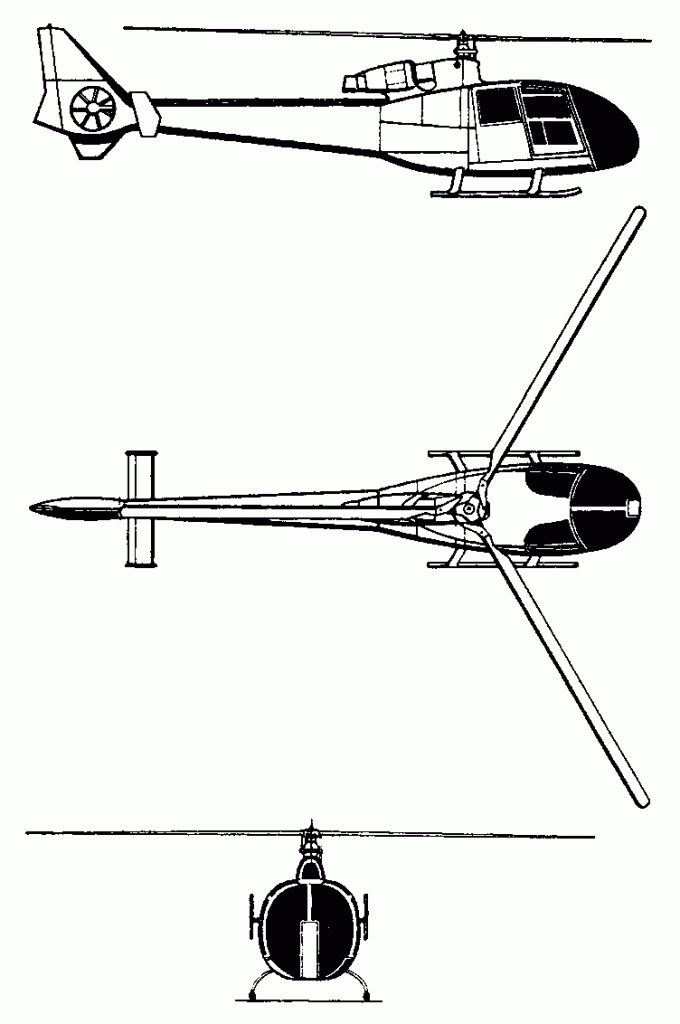
The SA 341 Gazelle all-purpose lightweight helicopter began as a proposal for a new observation helicopter for the French army. It was re-named the SA 340 soon afterwards. The Gazelle features a fully enclosed fuselage structure and, while it can be flown by a single pilot, has provision for two pilots with side-by-side seating.
The SA.340 prototype F-WOFH flew for the first time on 7 April 1967, with an Astazou UN turbine and the same transmission, landing skids, anti-torque rotor and tail plane as the Alouette. Following the first flight, development continued throughout 1967 at Sud-Aviation’s factory at Marignane, near Marseille. This first aircraft utilises the tail rotor and skid of the Alouette II and the engine and transmission system of the Alouette II Astazou, but the second prototype (F-ZWRA, first flown on 17 April 1968) was representative of production SA.341’s in having the Astazou IIN2 and a ‘solid’ vertical fin with a circular cut-out in its centre, within which its small 13-blade tail rotor rotates. The main rotor blades, made of laminated glassfibre, are of the type developed by Bolkow of Germany in collaboration with Sud-Aviation. In 1967 while still in the final design stages, Westland joined a production-sharing agreement signed on 22 February 1967 and officially confirmed on 2 April 1968, and performed final assembly of the first British military version in 1970.
Aerospatiale SA340 / SA341 / SA342 Gazelle Article
The first prototype, designated SA 340.001, was flown on 7 April 1967, and the second on 12 April 1968. The first French Gazelle had a longer cabin than its predecessors, an enlarged tail unit and an uprated Astazou IIIA engine. These were followed by four pre-production SA 341 Gazelles (first flown on 2 August 1968), of which the third was equipped to British Army requirements, assembled in France, and then re-assembled by Westland in the UK as the prototype Gazelle AH.1. It was first flown on 28 April 1970.
The initial Westland-assembled Gazelles followed early in 1972 (first flown on 31 January 1972).
Westland Helicopters Ltd of Weston-Super Mare in Somerset delivered 32 Gazelles to the Royal Air Force. Others served with the Army Air Corps and Fleet Air Arm.
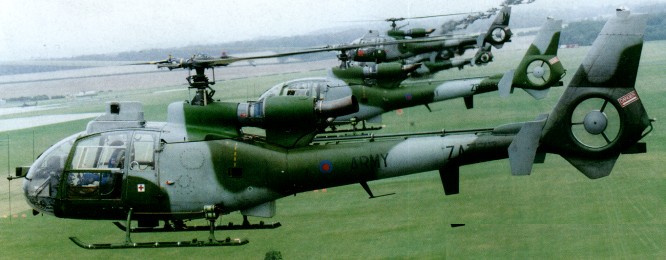
On 14 May 1970 the first Aerospatiale-built SA 341 pre-production aircraft, in slightly modified form, established three new speed records for helicopters of its class.
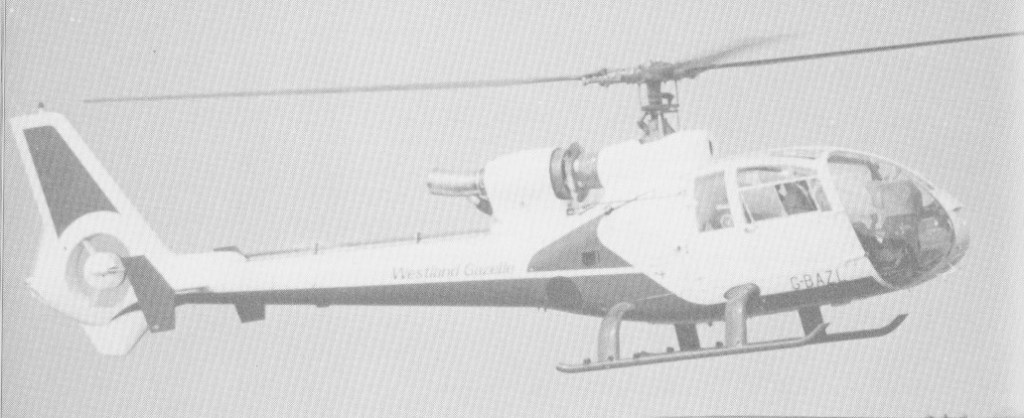
Manufacture of the Gazelle began with a civil-registered aircraft on 6 August 1971.The upgraded SA 342 first flew in 1976.
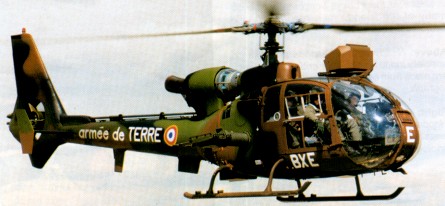
Two military models are; the SA.342L-1 for export customers, and the similar SA.342M for the French Army. Armament options include four or six HOT anti-tank missiles, a GIAT M621 20mm cannon, and machine-gun or rocket pods.
Armament which can be carried by the military versions includes machineguns, rockets and reconnaissance flares, plus a variety of missiles, including the anti tank HOT missile (High subsonic Optically guided Tube¬launched).
The Gazelle has been built under licence by Egypt and Yugoslavia where the Serbs used Yugoslav-built Gazelles in the Balkan civil war during the 1990s.
Variants:
SA 341B Gazelle AH.1
British Army version; Astazou IIIN engine; Nightsun searchlight, Decca Doppler 80 radar and automatic chart display; first Westland-assembled example flown on 31. January 1972; entered operational service on 6 July 1974 (total 158)
SA 341C Gazelle HT.2
Fleet Air Arm training versions; Astazou IIIN engine; stability-augmentation system and a hoist incorporated; first flown on 6 July 1972 and first entered service on 10 December 1974 (total 30)
SA 341D Gazelle HT.3
RAF training version; Astazou IIIN engine; stability-augmentation system; Schermuly flares installation; first deliveries to service on 16 July 1973 (total 14)
SA 341E Gazelle HCC.4
RAF communications version; Astazou IIIN engine (total 1)
SA 341F Gazelle
Basic French army version; Astazou IIIC engine (total 166)
SA 341G Gazelle
Civil commercial version; Astazou IIIA engine; officially certificated for passenger service on 7 June 1972; subsequently became the first helicopter to obtain US approval for operations under IFR Cat.1 conditions with a single pilot; also developed into a so-called ‘Stretched Gazelle’, with rear section of the cabin modified to provide additional 20cm legroom for the rear passengers
SA 341H Gazelle
Military export version; Astazou IIIB engine; subject to licence-production agreement signed on 1 October 1971 with SOKO in Yugoslavia (total 112)
SA 342J Gazelle
Civil version of SA 342L; 649kW Astazou XIV engine, improved fenestron tail rotor, increased take-off weight; approved for service on 24 April 1976; deliveries commenced in 1977
SA 342K Gazelle
Military export version for ‘hot and dry’ areas; 649kW Astazou XIVH engine with momentum-separation shrouds over air intakes; first flown on 11 May 1973; initial sales to Kuwait.
SA 342L Gazelle
Military counterpart of SA 342J; 649kW Astazou XIV engine; adaptable for wide range of armaments and equipment, including six Euromissile HOT anti-tank missiles
SA 342M Gazelle
French army antitank version with four Euromissile HOT missiles, SFIM APX M397 stabilised sight
Aérospatiale SA 341 Gazelle
Engine: Turboméca Astazou III N, 584 shp
Length: 31.234 ft / 9.52 m
Overall length: 11.97 m
Height: 9.711 ft / 2.96 m
Rotor diameter: 34.449 ft / 10.5 m
Empty weight: 908 kg
MTOW: 3748.5 lb / 1700.0 kg
Max. speed: 143 kts / 265 km/h
Service ceiling: 16732 ft / 5100 m
Range: 351 nm / 650 km
Crew: 1+4
Armament: ext.
Aerosatiale SA 341G Gazelle
Engines: Turbomeca Astazou IIIA, 590 hp
Disc loading: 4.26 lb/sq.ft
Main rotor dia: 34 ft 5.5 in / 10.05m
Fuselage length: 31 ft 2 in / 9.53m
Cabin length: 7 ft 2 in / 2.20m
Cabin max width: 4 ft 4 in / 1.32m
Cabin max height: 3 ft 11.5 in / 1.21m
Cabin volume: 63.7 cu.ft / 1.80 cu.m
Baggage hold volume: 15.9 cu.ft / 0.45 cu.m
Pwr loading: 6.7 lb/hp
Max TO wt: 3970 lb / 1800 kg
Empty wt: 2022 lb / 917 kg
Equipped useful load: 1796 lb
Payload max fuel: 845 lb
Range max fuel/ cruise: 318 nm/ 2.2 hr
Range max fuel / range: 361 nm / 416 mi / 670 km / 2.6 hr
Range 1102 lb / 500 kg payload: 193 nm / 223 mi / 360 km
Service ceiling: 16,400 ft / 5000 m
Max cruise SL: 142 kt / 164 mph / 264 kph
Max range cruise: 125 kt
ROC SL: 1770 fpm / 540 m/min
HIGE: 9180 ft
HOGE: 6890 ft
Max sling load: 1540 lb
Fuel cap: 794/951 lb
Seats: 5
HT.Mk.3
Rotor dia: 34ft 5.5 in (10.5 m)
Max cruise: 164 mph (264 km/h)
AS.342L Gazelle
Engine: 1 x Turbomeca Astazou XIVM turboshaft: 640kW
Fuselage Length: 31.27 ft (9.53m)
Height: 10.43 ft (3.18m)
Rotor dia: 10.5 m
Main rotor: three blade
Empty Weight: 2,202lbs (999kg)
Maximum Take-Off Weight: 4,409lbs (2,000kg)
Fuel cap (+aux): 240 lt (80 lt)
Maximum Speed: 165mph (265kmh; 143kts)
Maximum Range: 441miles (710km)
Rate-of-Climb: 2,400ft/min (732m/min)
Ceiling: 4300 m
HIGE: 2315 m
HOGE: 1770 m
Accommodation: 2 + 3
Hardpoints: 2 (with wing stubs)
AS.342L1 Gazelle
Engine: 1 x Turbomeca Astazou X1VM
Instant pwr: 600 kW
MTOW: 2000 kg
Payload: 700 kg
Max speed: 260 kts
Max range: 710 km
Crew: 1
Pax: 4
AS.342M Gazelle