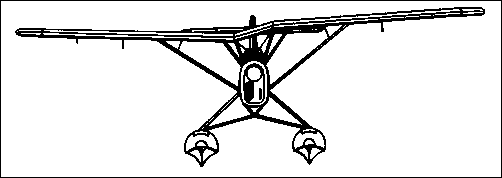
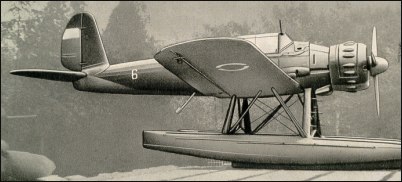
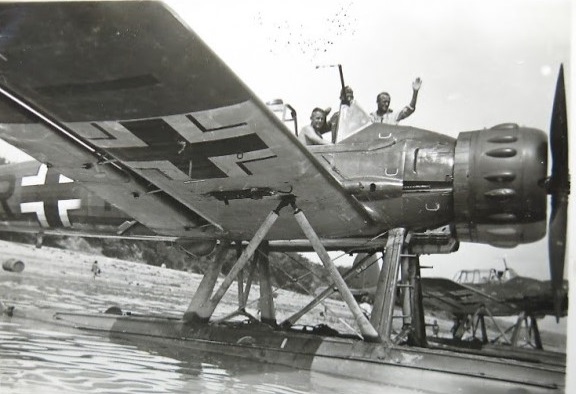
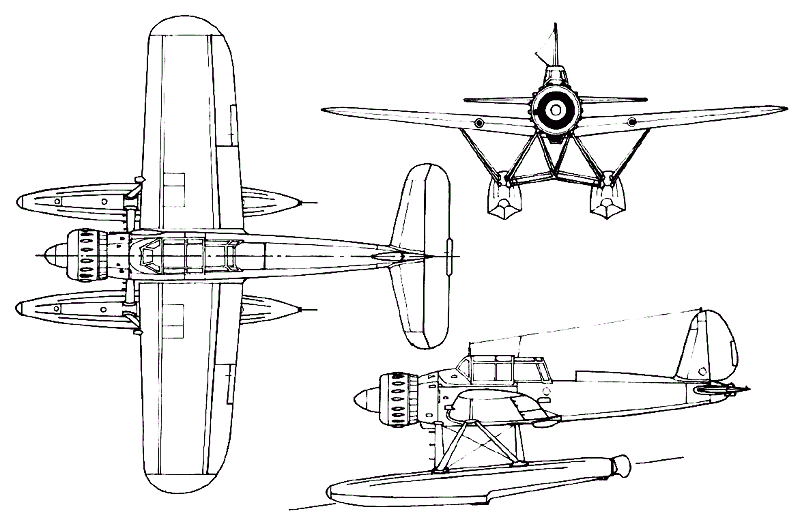
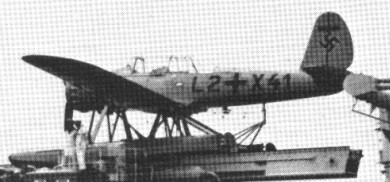
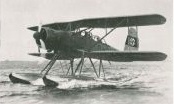
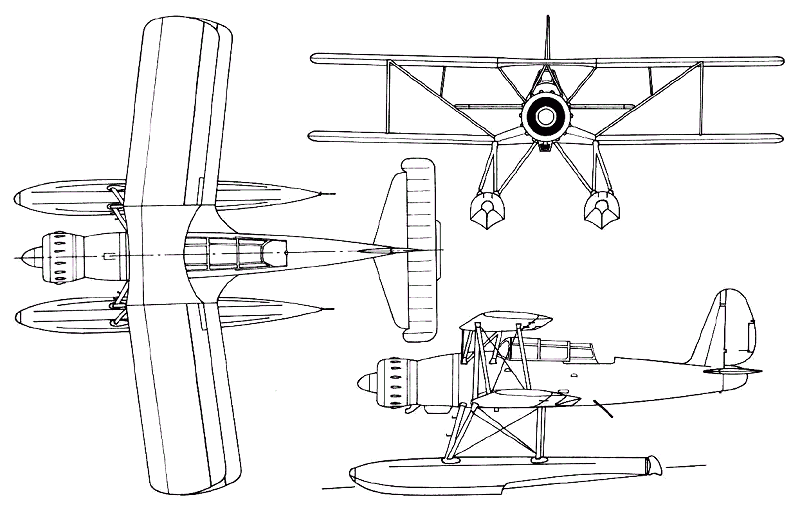
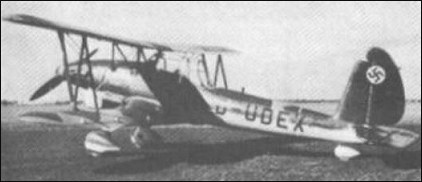
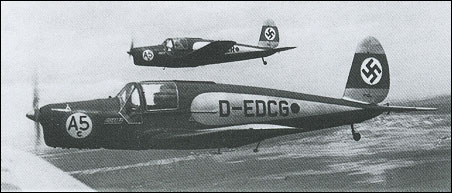
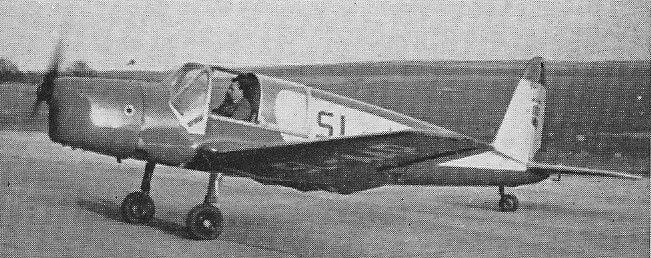
The Ar 231 was a small open cockpit single-seat reconnaissance floatplane, built in detachable sections, to be stored on a U-boat. The Ar 231 was a parasol-wing design, but for easier storage the right wing was attached lower than the left wing, and the center section was angled. When dismantled they could be stowed in a tube 6 ft 7 in (2m) in diameter for carriage by the submarine when submerged. The Ar 231 could be stored in six minutes, but only four were built and flight-tested in 1941. Ar 231 V1 Wn° 2310001, KK + BP, Ar 231 V2 Wn° 2310002, KK + BQ Ar 231 V3 Wn° 2310003, KK + BR Ar 231 V4 Wn° 2310004, KK = BS
Engine: Hirth HM 501A, 160 hp Propeller: two-blade wooden fixed pitch Wingspan: 10,17 m Length: 7,82 m Height: 3,83 m Wing area: 15,20 sq.m Empty weight: 868 kg MTOW: 1050 kg Wing loading: 69 kg/sq.m Power loading: 6,562 kg/hp Maxspeed: 170 Kmh Cruise: 130 Kmh ROC: 1000 m in 6 min Ceiling: 3000 m Range: 510 km Endurance: 4 hours
Development of the Arado Ar198 began in 1936 when the RLM issued a specification to the German aircraft industry calling for a plane specially suited to the short-range reconnaissance role. This specification was initially taken up by Arado, Blohm & Voss (Hamburger Flugzeugbau Division), Focke-Wulf, and Henschel. Each of these firms was able to base their design on previous aircraft and experience with this specific aircraft type and they were able to submit designs to the RLM within a short time. The requirement was to replace the Heinkel He 46 already in service with the Luftwaffe by an aircraft designed to make use of the most modern technology. This included the use of a powerful engine, good characteristics over the speed range, optimal vision for the crew and, protective and defensive features for the crew.
After various changes to the basic design, a contract for a pre-production series AradoAr 198A-0 was granted in July 1937.
For the Ar 198 a crew of three, consisting of pilot, gunner/radio operator, and observer, was planned. Due to the required optimal vision and high speed, a fully-enclosed crew compartment was built into the design. Tactical reconnaissance put a high emphasis on ground vision and the observer’s position was positioned below the wing plane for unobstructed vision, while the pilot and rear gunner were enclosed in an extensively glazed cabin above the wing plane. In this generously laid-out crew compartment there was an accessible connection to each crew position which resulted in good communications between crew members.
The entire forward fuselage structure, inclusive of the crew compartment, was of steel tube construction with the engine bearer included in this construction. Formers, light-metal fillets and a light-metal skin allowed for an aerodynamically advantageous shape. The rear fuselage was of an all-metal monocoque construction and purely as a tail-boom with no equipment for tactical missions installed. The Ar 198 had fixed landing gear.
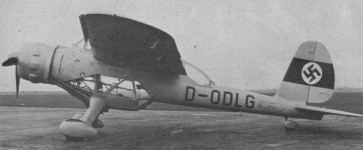
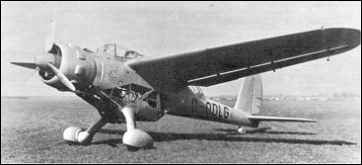
The Ar 198 V1 (D ODLG) making its first flight in March 1938 at the Arado factory airfield at Warnemünde. During the early flights a marked instability in the projected low-speed range about all axes was noticed. It was thought that this was due to the large extension of the lower fuselage and consequently the layout was markedly changed for the second and third prototypes. In order to correct the flight characteristics the wings of the Ar 198 V1 were fitted with automatic slats which resulted in noticeable improvement in flight characteristic which also demanded considerable experience of the pilot.
A joint Ilmavoimat / Maavoimat / VL evaluation team flew this first prototype in July 1938 and generally rated it highly. Althought it demanded considerable experience to fly, performance was excellent, as was visibility.
The assembly process for the aircraft proved complex, with an associated high cost of production. Arado also had insufficient production capacity and this led the RLM to put a halt to the mass-production of the Arado Ar 198. Continued evaluation of the Ar 198 however, was not cancelled by that decision. The second prototype was completed and turned over to the Luftwaffe Flight Test Center at Rechlin. Soon after some very sucessful test flights this aircraft crashed on the landing approach when the starboard automatic slat came off, damaging the wing and forcing the pilot to make an emergency landing on rough ground. Damage to the airframe was such that restoration of the machine was not carried out. The Arado Ar 198 V1, however, after the elimination of a few faults, was flown for a long time with increasing enthusiasm on the part of its assigned crew. The third prototype was only 80 per cent completed and then used for static tests.
Engine: BMW Bramo Fafnir 323A-1, 900 hp Wingspan: 14,9 m Length: 11,8 m Height: 4,5 m Empty weight:: 2400 kg MTOW: 3031 kg Max speed: 359 kph / 223 mph Stall speed: 70 mph Landing speed: 55mph Service ceiling: 26,250 ft Range: 1081 km / 672 miles Required runway TO MAUW: 600 m Required runway landing MAUW: 510 m Armament: 2 MG 17 7,92 mm, 1 MG 15 7,92 mm, 4 x 50 kg bombs Crew: 3
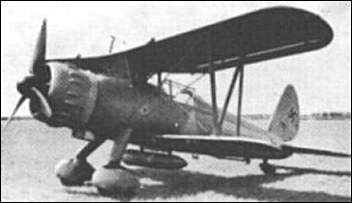
A 1937 single-engined biplane fighter development of the Ar 68 intended for use on aircraft carriers. The Ar 197 was fitted with fixed landing gear and fittings of catapult-launch. The first prototype had a DB 600 engine, the two others had a BMW 132 radial. There was no production.
Ar 197 V1 Engine: 1 x Daimler Benz dB 600A, 900 hp Propeller: metal three-blade variable pitch Wing span: 11,00 m Length: 9,20 m Height: 3,60 m Wing area: 27,75 m² Empty weight: 1840 kg MTOW: 2475 kg Max speed: 400 Kmh at 2500 m Ceiling: 8000 m Range: 695 km Armament: 2 MG 17 7,92 mm, 2 guns MG 20 mm, 4 x of 50 kg bombs
A development of the Ar.95, the Ar 196 was designed to replace the Heinkel He 60 floatplane aboard the warships as a shipboard catapult-launched reconnaissance floatplane (with a secondary role as a coastal patrol platform). Arado submitted their design consisting of a two-seat monoplane with all-metal skin and after an evaluation period, the Arado design was selected with development beginning in 1937.
The first prototype flew in 1938. The development, which produced four prototypes, tested two arrangements of floats. One prototype was fitted with a centerline float and two outboard floats whilst the remaining three utilized the more traditional twin pontoon floats each situated under their respective wing.
Following a number of pre-production aircraft, production proper began with twenty Ar.196A-1, which were delivered from mid-1939. Production continued with A-2 to A-5 versions and a few modified single-float Ar.196B.
The Ar 196 was constructed as two production series separated by classification role. The “shipboard” Ar 196 series was designed for catapulting from German warships. This series was comprised of the A-1 and A-4 models. The “coastal” Ar 196 variant operations involved taking off and returning to their respective port areas. This production series comprised of the A-2 and A-3 models. An A-5 model was later offered that featured improved radio equipment and twin 7.92mm machine guns for the radio operator in the rear cockpit. Basic armament consisted of varying quantities of 20mm cannons and 7.92mm machine guns. The Ar 196 could field two 110lb bombs in the strike role.
Ar.196 seaplanes were operational with the German Navy in reconnaissance, patrol and anti-submarine roles throughout World War II and were for many years the standard catapult sea-plane of the Navy, up to four being carried on board some battleships. The aircraft was eventually deployed on German warships that included the Deutschland, the Admiral Scheer, the Admiral Hipper and the Leipzig. This floatplane was in use with Bulgaria and Romania.
Ar 196A fication Engine: 1 x BMW 132K, 705kW Take-off weight: 3600 kg / 7937 lb Empty weight: 1265 kg / 2789 lb Wingspan: 12.4 m / 40 ft 8 in Length: 11.0 m / 36 ft 1 in Height: 4.5 m / 14 ft 9 in Wing area: 28.3 sq.m / 304.62 sq ft Max. speed: 315 km/h / 196 mph Cruise speed: 268 km/h / 167 mph Ceiling: 6600 m / 21650 ft Range w/max.fuel: 1080 km / 671 miles Range w/max.payload: 820 km / 510 miles Crew: 2 Armament: 2-3 machine-guns, cannon, 100kg of bombs
The Arado Ar 195 was prototype design intended for operations from Germany’s first aircraft carrier, the Graf Zeppelin. The aircraft was developed as a carrier-based torpedo.
The Ar 195 was based on the Ar 95 with major differences centreing mainly on a tail arrestor hook for catapult-launching. The Ar 195 featured a single BMW brand 819 horsepower radial engine, biplane wings, and crewed by a pilot and rear gunner. Landing gear was fixed and a single vertical tail surface was at the rear. Armament consisted of a single 7.92mm machine gun in a forward fixed firing position for the pilot and an additional 7.92mm machine gun in a trainable flexible rear gun mount. A single bomb or torpedo could be mounted in an underfuselage rail.
Though the Ar 195 prototype was flying by 1937 only three were built. The type was unsuccessful against the Fieseler-designed Fi 167.
Engine: BMW 132M, 850 hp Wingspan: 12,50 m / 41.01 ft Length: 10,50 m / 34.45 ft Height: 3,60 m / 11.81 ft Wingarea: 46 sq.m Empty weight: 2380 kg / 5,247 lb MTOW: 3745 kg / 8,256 lb Wing loading: 81,413 kg/sq.m Power loading: 4,4 kg/hp Max speed: 175mph / 282kmh / 152kts Cruise speed: 250 km Service Ceiling: 19,685ft / 6,000m) Range: 650 km / 404 miles Crew: 2 Armament: 1 x 7.92mm MG17 machine gun in fixed forward firing position 1 x 7.92mm MG17 machine gun in flexible rear cockpit mount. Hardpoints: 1
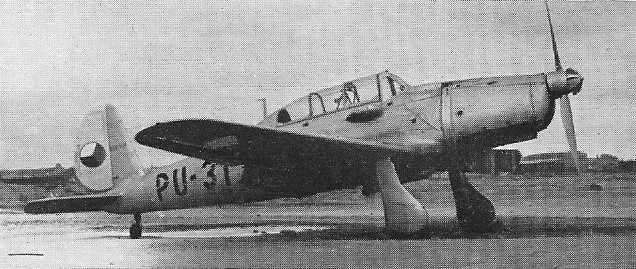
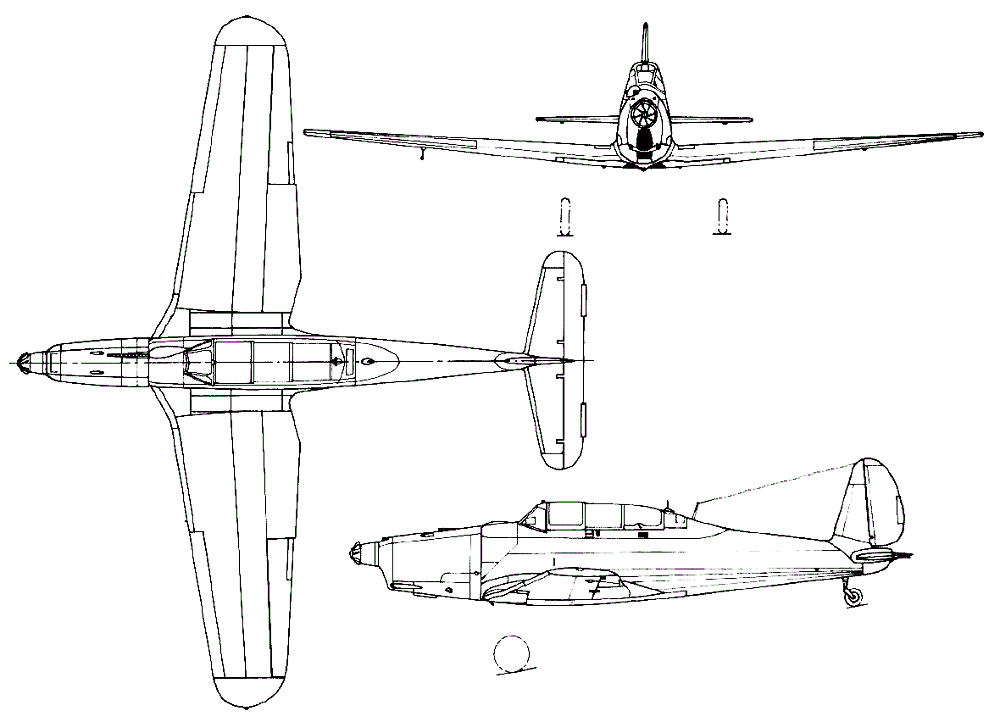
A 1936 tandem two-seat monoplane trainer with retractable landing gear. Powered by one 335kW Argus As.410A engine on Ar.96B production aircraft built from 1940 (prototype had one 179kW Argus As.10C). The Ar.199 was a development of the design.
During the war years, production was transferred to Letov and Avia in Czechoslovakia where manufacturing continued until the end of 1948 as C.2B-1. Letov built the Arado Ar-96B trainer as the C-2A (back designation for wartime production Ar-96 for Luftwaffe), and C-2B (Arado Ar-96B produced for Czech Air Force).
Avia C.2-1
The C.2B-1 was a standard basic trainer in the Czechoslovak Air Force and National Security Guard.
Engine: 1 x As 410A, 340kW Wingspan: 11.0 m / 36 ft 1 in Length: 9.1 m / 29 ft 10 in Height: 2.6 m / 8 ft 6 in Wing area: 17.1 sq.m / 184.06 sq ft Take-off weight: 1750 kg / 3858 lb Empty weight: 530 kg / 1168 lb Max. speed: 330 km/h / 205 mph Cruise speed: 275 km/h / 171 mph Ceiling: 7000 m / 22950 ft Range w/max.fuel: 990 km / 615 miles Crew: 2 Armament: 1-2 machine-guns
Ar 96B / Avia C.2B-1 Engine: Argus As 410A, 465 hp Wingspan: 35 ft 11.5 in Wing area: 186.22 sq.ft Length: 29 ft 11.25 in Height: 8 ft 6 in Empty weight: 2854 lb Loaded weight: 3747 lb Max speed: 219 mph Cruise: 175 mph Range: 428 mi
The Ar 95 developed as a naval torpedo-bomber and reconnaissance biplane for use from a proposed German aircraft carrier. The first prototype (built as a twin-float seaplane) first flew in 1936 and was followed by other seaplane and landplane prototypes, differing in engines fitted.
The landplanes featured heavily trousered main landing gear legs. A change of direction led to the delivery of six aircraft to Spain, where they fought during the late stage of the Civil War. Six Ar.95 landplanes and seaplanes were exported to Chile in 1939, and those built for Turkey were retained for use by the Luftwaffe.
Ar 95A Wingspan: 12.5 m / 41 ft 0 in Length: 11.1 m / 36 ft 5 in Height: 5.2 m / 17 ft 1 in Wing area: 45.4 sq.m / 488.68 sq ft Take-off weight: 3570 kg / 7871 lb Empty weight: 2450 kg / 5401 lb Max. speed: 309 km/h / 192 mph Cruise speed: 253 km/h / 157 mph Ceiling: 7300 m / 23950 ft Range: 1100 km / 684 miles
A two seat biplane dive bomber which competed with the early Ju 87. Three were built, all with different tail configurations; the V3 was considered satisfactory. The pilot was under a canopy and observer/machine gunner was behind. Construction was and entirely metal fuselage, the aerofoil with a mixed structure with partial coating in fabric. The prototypes were not followed by series production.
Ar 81 V1: Engine: Jumo Junkers 210 C, 700 hp Propeller: three-blade Wingspan: 11,65 m Length: 11,25 m Height: 3,57m Wingarea: 37,60 sq.m Empty weight: 1925 kg MTOW: 3070 kg Wing loading: 82 Kg/sq.m Power loading: 4,385 Kg/hp Max speed: 345 Kmh Armament: 2 MG 17, 1 MG 15 7,92 mm, plus 500 kg bombs
Single-seat fighter, a monoplane with open cockpit and fixed landing gear. Production aircraft would have had retractable landing gear. The Ar 80 had a disappointing performance, and the Luftwaffe preferred the Bf 109. Entirely metal construction, six were built: 3 prototypes and 3 production aircraft.
Ar 80-V1: Engine: Argus Ace 10C, 240 hp Propeller: two-blade Wingspan: 10,88 m Length: 10,30 m Height: 2,65 m Empty weight: 1642 kg MTOW: 2125 kg Max speed: 349 Kmh Ceiling: 10000 m Range: 800 Km Seats: 1
Ar 80-V2: Engine RR Kestrel, 695 hp Propeller: two-blade Wingspan: 10,88 m Length: 10,30 m Height: 2,65 m Empty weight: 1642 kg MTOW: 2125 kg Max speed: 349 Kmh Ceiling: 10000 m Range: 800 Km Seats: 1
Ar 80-V3: Engine: Junkers Jumo 210C, 640 hp Propeller: two-blade Wingspan: 10,88 m Length: 10,30 m Height: 2,65 m Empty weight: 1642 kg MTOW: 2125 kg Max speed: 349 Kmh Ceiling: 10000 m Range: 800 Km Seats: 2
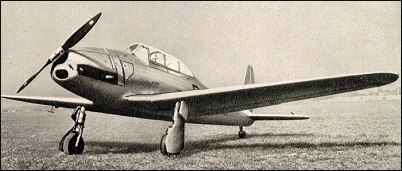
Designed as an aerobatic two-seat training and touring aircraft, the Arado Ar 79 first appeared in 1938, powered by a 78kW Hirth HM 504A-2 engine. The forward fuselage was of welded steel-tube construction, the rear section being a monocoque structure. The wings were of single-spar wooden construction with plywood and fabric covering: The aircraft featured retractable tail-wheel landing gear, the main wheels retracting sideways and inwards into the wing centre section.
Ar 79B
Ar 79s set a number of international class speed records during 1938, including solo 1000km at 229.04km/h on 15 July, and solo 2000km at 227.029km/h on 29 July. Later that year an Ar 79 was prepared for an attempt on the long-distance record, a jettisonable 106-litre fuel tank being fitted under the fuselage and a 520-litre tank at the rear of the cabin. Pilots Oberleutnant Pulkowski and Leutnant Jennett ferried the aircraft from Brandenberg to Benghazi in Libya, the starting point for what was to be a 6303km non-stop flight to Gaya, India, accomplished between 29 and 31 December at an average speed of 160km/h.
Engine: Hirth HM 504A-2, 105 hp Propeller: two-blade fixed pitch Wingspan: 10,00 m Length: 7,62 m Height: 1,87 m Wingarea: 14 sq.m Empty weight: 460 kg MTOW: 760 kg Max speed: 230 Kmh Cruise: 205 Kmh Ceiling: 5500 m Range: 1025 Km
Ar 79B Engine: Hirth H.M.500-A1, 105 hp Wingspan: 32 ft 9.5 in Length: 25 ft Height: 6 ft 10.4 in Empty weight: 1014 lb Loaded weight: 1675 lb Max speed: 143 mph at SL Cruise: 127 mph Range: 636 mi ROC: 1020 fpm