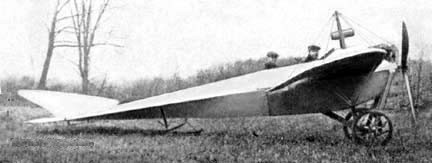
The 1910 Armitage 2-seater monoplane was designed and built by George Armitage in the USA.
The 1910 Armitage 2-seater monoplane was designed and built by George Armitage in the USA.
In 1909 in the USA, George Armitage built a single-seater monoplane. Reportedly it made 57 flights.

Engine: Rotax 503, 52 hp.
HP range: 52-65.
Height: 6 ft.
Length: 8.5 ft.
Wing span: 32 ft.
Wing area: 500 sq.ft.
Speed max: 26 mph.
Cruise: 26 mph.
Range: 100 sm.
ROC: 150 fpm.
Take-off dist: 450 ft.
Landing dist: 50 ft.
Service ceiling: 10,000 ft.
Fuel cap: 5 USG.
Weight empty: 225 lbs.
Gross: 650 lbs.
Seats: 1-2.
Landing gear: nose wheel.
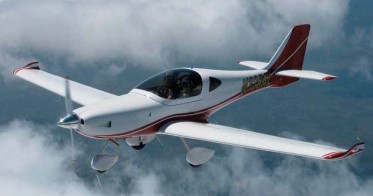
Arion Aircraft design of the Lightning structure was tested extensively for symmetrical and asymmetrical flight loads to over 9 G at a gross weight of 1320 lbs. Torsional testing of the fuselage and tail, load testing of welded parts rounded out the strength testing profile.
A Ballistic Recovery Systems was designed for the Lightning. This is instaled inside the molded skins.
Through a mix of molded fiberglass components and welded 4130 steel structures, the construction method has no epoxy layups are needed to complete the kit. Trimming and fitting the parts, some final fabrication of the parts and bolting the plane together is all that is required from the kit. Aircraft grade hardware is used throughout.
The Lightning cruises at 175 mph on 120 hp, burning 5.5 US gallons per hour. Solo climb rates is at 1700 fpm. Roll rates exceed 45 degrees/second. Top speed is 190 mph, and the touchdown speed is under 50 mph.
The Lightning was available with extended tips for LSA.
A carryover from the kit-built market, the all-composite, American-built Arion LS-1 Lightning was available in 2012 in Experimental-built kit form with a 135-140 knot cruise. The base price 2012: $119,900.
Lightning
Engine: Jabiru 3300, 120 hp
Propeller: Sensenich WC62FK-58 Carbon Fiber Ground Adjustable
Wing Span: 27′ 2″
Length: 20′
Height: 6’6″
Wing Area: 91.0 sq ft
Empty Weight: 825 lbs
Gross Weight: 1425 lbs
Fuel Capacity: 23 gallons std or 30 gal optional
Maximum Speed: 190 mph
Cruise Speed @ 8000 ft 75% pwr: 150 – 170 mph
Vne: 208 mph
Stall (Full Flap): 45 mph
Stall Clean: 56 mph
Glide Ratio: 17:1
Take Off Roll: 315 ft
Landing Roll (with brakes): 500 ft
Climb Rate (at gross): 1200 ft / min
Turn Rate 45/45o: <1 second
Maneuvering Speed: 125 mph
Endurance: 5 hr w/ reserve (30 gal tanks)
Range w/ res: 750 sm
Cockpit Width Elbow: 43″
Cockpit Width Shoulder: 41″
Brakes: Independent Hydraulic
Rudder Pedals: Adjustable even in flight
Construction: Vacuum infused oven post cured fiberglass
Canopy: Forward Hinged Clear or Tinted
Flaps: Electric Std
Trim: Electric Std
Max Loading: + 5G -3.8
Lightning Sport
Engine: Jabiru 3300, 120 hp
Propeller: Sensenich WC62FK-56 Carbon Fiber Ground Adjustable
Wing Span: 30′ with extended tips for LSA
Length: 20′
Height: 6’6″
Wing Area: 91.0 sq ft
Empty Weight: 800 lbs LSA
Gross Weight: 1320 lbs for LSA
Fuel Capacity: 23 gallons std or 30 gal optional
Maximum Speed: 150 mph
Cruise Speed @ 8000 ft 75% pwr: 138 mph
Vne: 208 mph
Stall (Full Flap): 40 mph
Stall Clean: 51 mph
Glide Ratio: 17:1
Take Off Roll: 275 ft
Landing Roll (with brakes): 350 ft
Climb Rate (at gross): 1800 ft/min
Turn Rate 45/45o: <1 second
Maneuvering Speed: 125 mph
Endurance: 5 hr
Range w/ res: 700 sm
Cockpit Width Elbow: 43″
Cockpit Width Shoulder: 41″
Brakes: Independent Hydraulic
Rudder Pedals: Adjustable even in flight
Construction: Vacuum infused oven post cured fiberglass
Canopy: Forward Hinged Clear or Tinted
Flaps: Electric Std
Trim: Electric Std
Max Loading: + 5G -3.8
LS-1 Lightning
Engine: Jabiru 3300
Max cruise: 120 kt
Climb rate: 1,200 fpm
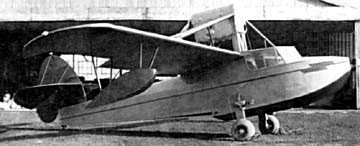
Three-seat monoplane amphibian, with Menasco Pirate engine
Donald G. White of Buffalo, New York, formed a White Aircraft Inc in 1939 to continue production, in modified form, of the Pirate amphibian designed and built previously by Argonaut Aircraft Inc.
The 1934 H-20 Pirate three seater prototype NX14760 c/n H20-100 was powered by a 120hp Curtiss Crusader, later 125hp Menasco and cost $4,975.
The one H-24 Pirate NX/NC15682 c/n H24-500 (ATC 650), designed by Howard J Heindell, was built in 1935 and cost $4,995.
H-20 Pirate
Engine: 120hp Curtiss Crusader, later 125hp Menasco C-4
Wingspan: 35’4″
Length: 26’0″
Useful load: 870 lb
Max speed: 110 mph
Cruise: 100 mph
Stall: 42 mph
Range: 490 mi
Ceiling: 12,000′
Seats: 3
H-24 Pirate
Engine: 125hp Menasco C-4
Wingspan: 42’0″
Length: 27’1″
Useful load: 650 lb
Max speed: 104 mph
Cruise: 89 mph
Stall: 45 mph
Range: 350 mi
Ceiling: 10,500′
Seats: 2
1935 Factory ad shows H-24 Pirate:
Wingspan: 35’4″
Length: 26’0″
Useful load: 680 lb
Max speed: 120 mph
Cruise: 104 mph
Stall: 40 mph
Range: 500 mi

Circa 1947, Mike Argandar at Rosemead Airport behind the midget racer he built.
“Mike Argandar” built a midget racer circa 1947 but at age 31, on July 25, 1948 was killed Rosemead Airfield, Rosemead, Los Angeles County, California, United States, in a crash of that plane.
In 1969, production of the Interstate Cadet was resurrected by Bill and Jan Diehl, owners of Arctic Aircraft Co. in Anchorage, Alaska. The one family operation has modified the Cadet to become a lightweight bush plane. Installation of a 150-hp Lycoming engine has markedly increased performance and useful load. Large, high flotation tires permit safe landings on beaches or riverbeds. Construction is of chromoly tubing covered with Dacron. All control cables, brake cables, fuel lines, are completely exposed. The revived Cadet, now dubbed the S2B2, has been certificated for aerobatics, and even snap maneuvers are approved.
Engine: Lycoming 150 hp
Gross wt. 1,900 lb
Empty wt. 1,100 lb
Fuel capacity 40 USG
Top speed: 115 mph
Cruise speed: 110 mph
Stall: 39 mph
Range: 650 mi
Initial climb rate: 1,000 fpm
Takeoff run: 350 ft

A successor to the L6 Grasshopper of WW2, the S.1 BE is a strut-braced high-wing monoplane known as the Arctic Tern, a developed version of the Interstate S.1A, first flown in the 1950s.
The Tern aka Interstate S-1-B2 was 1975 continued production of Interstate L-6 (S-1-B1) revised for bush operations. Tooling and jigs re-acquired by Interstate Co in 1985. (No connection, nor similarity, between this and Rocheville-EMSCO Arctic Tern.)
Interstate S1B2 Tern
Engine: Lycoming O-320-A2B, 150 hp.
TBO: 2000 hrs.
Prop: McCauley 2-blade, 72-in.
Length: 24 ft.
Height: 7 ft.
Wingspan: 36.8 ft.
Wing area: 186.2 sq.ft.
Maximum takeoff weight: 1850 lbs.
Standard empty weight: 1075 lbs.
Maximum useful load: 775 lbs.
Maximum landing weight: 1850 lbs.
Wing loading: 9.97 lbs/sq.ft.
Power loading: 12.3 lbs/hp.
Maximum usable fuel: 240 lbs.
Best rate of climb: 1275 @ 60 kts.
Climb gradient: 765 ft/nm.
ROC @ 8000 ft: 820 fpm.
Service ceiling: 19,000 ft.
Maximum speed: 103 kts.
Stalling speed clean: 42 kts.
Stalling speed flaps down: 28 kts.
Turbulent-air penetration speed: 105 kts.
Seats: 2.
Fixed tail wheel under carriage.
First built: 1975.
A two-seat lightplane, a version of an original Fournier design.

A development of the Ar 96. A tandem two-seat advanced trainer of wooden construction, with a monoplane low wing cantilever, and retractable main landing gear. First flown on 29 December 1944.
Thr Ar.396 A1 single-seat version was armed and the Ar.396 A2 two-seater version was not armed.
Three prototypes were built but not delivered to Luftwaffe because of the end of the hostilities.
Production continued in France by SIPA after WWII as the SIPA S 10, S 11, and S 12.
Arado Ar.396 / SIPA S 11
Engine: Argus As 411 MY, 580 hp
Propeller: metal three-blade variable pitch
Wingspan: 11,00 m
Length: 9,30 m
Height: 2,45 m
Wing area: 18,30 m²
Empty weight:: 1643 kg
MTOW: 2060 kg
Max speed: 355 Kmh at 2400 m
Cruise: 275 Kmh
Ceiling: 6900 m
Range: 600 Km

