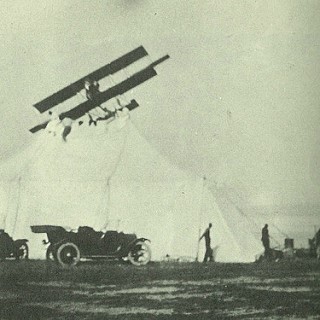
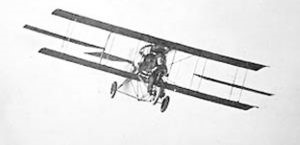
The Looper was built in 1912 and was a special headless version, built for Lincoln Beachey and stressed for aerobatics. On 7th October 1913, that Beachey’s machine fouled the ridgepole of a tent during a test flight and hit two couples who were sitting there. Ruth Hildreth, was killed outright, while her sister, Dorothea, suffered a laceration due to the propeller along with a fractured hip and arm. Their escorts, both US Navy Lieutenants, sustained fewer injuries. Ironically, Beachey was wearing a safety harness and survived the crash relatively unscathed, though he was mortified at what had happened.
After a brief retirement in 1913, Beachey returned to the air to master the inside loop, a maneuver first mastered by a French aviator. Spurred on by national pride and the spirit of competition, Beachey directed Curtiss to design and build a reinforced airplane able to sustain the forces of a loop. Beachey completed his first loop in November 1913.
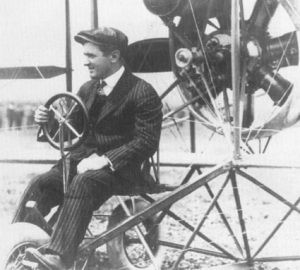
Beachey at the controls
Despite this, Beachey was not satisfied. His airplane was structurally reinforced to stand up to the forces of aerobatics, but its engine would stop running when inverted. In early 1914 technology advanced and Beachey travelled to France to acquire a pair of Gnome rotary engines. This innovative design was composed of seven cylinders arranged in a circle around the propeller shaft. When running, both the 80-hp engine and the propeller whirled around. The Gnome operated equally well upside down as right side up. Beachey directed his crew to install a Gnome engine in his newest airplane, giving rise to his “Little Looper”. On tour throughout the United States, Beachey conducted many flights over the rest of the year, expanding his repertoire and exposing millions of people to aviation.
Beachey’s reputation had swelled across North America as a result of his demonstration flight. Tens of millions of Americans saw Beachey fly the Little Looper through its aerobatic routine, captivating communities with the wonder and promise of aviation from coast to coast. As a “headless” Curtiss-type pusher with no forward-facing horizontal stabilizer, the Little Looper afforded Beachey an exceptional perch exposed at the front of the airplane, with unparalleled visibility and a strong feel for the airstream in any maneuver.
The Hiller Aviation Museum displays the original Little Looper.
Engine: LeRhône, 84-hp Span: 25 ft 1 in Length: 18 ft 4 in Height: 8 ft 0 in Weight, empty: 750 lbs Weight, gross: 890 lbs Max speed: 84 mph Endurance: 45 minutes
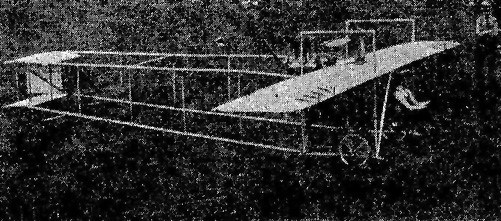
Lincoln Beachey and his brother Hillery started experimenting with monoplane aircraft construction after the January 1910 Los Angeles meeting. He was present at the Wright team’s inaugural meeting at the Indianapolis Motor Speedway in June 1910, but he didn’t make any flights in his monoplane. Two weeks later, perhaps hoping to learn by studying aeroplanes up close, Beachey secured a position as “chief assistant” to Charles Willard. In that capacity, he brought his monoplane to the Curtiss team’s meeting at Minneapolis in late June 1910. He made some short flights there, but the machine reportedly never got more than three feet off the ground. On June 24th he damaged the machine by crashing into a fence, and after that it seems to have lost interest in it.
The Freedom Jet, now known as SMART-1, was available only for military shows in conjunction with test and evaluation activities. These aircraft are experimental — research and development category, and were not available for sale to the general public. Renamed as the Small Manned Aerial Radar Target, Model 1 (SMART-1), the tiny jet aircraft that have been performing air shows for the last quarter century have been “drafted” by the military. Its small size, maneuverability, and manned features, plus dependability and economy make the aircraft a threat representative and support system for new system research, design and development. The aircraft is equipped with long range fuel tank, UHF data transmission antenna, TSPI data transmission and recording, and is transportable by road or air cargo.
Thrust – 300 lbs. Wing Span – 17 feet Length – 12 feet Empty Weight – 465 lbs. Gross Weight – 1,150 lbs. Maximum Speed (Sea Level) – 250 knots T.A.S. Minimum (Stall) Speed at Full Gross Weight – 72 knots T.O. Distance – 2,500 feet (S.L.) Maximum Range – 325 n.m. (160 knot economy cruise) Dash Range – 240 n.m. (250 knots) Maximum Operating Altitude – 24,000 feet
Single seat single engined high wing monoplane with conventional three axis control. Inverted V tail. Pitch/yaw control by elevon; control inputs through stick for pitch/roll and pedals for yaw. Integrated flaps and ailerons. Wing braced from below by struts; wing profile; NASA high-lift airfoil double surface. Undercar¬riage has three wheels in tricycle formation: spring steel, inflatable tires. Aluminium tube framework, without pod. Engine mounted below wing driving pusher propeller. Two struts either side of the pilot support the high wing, and there are no rigging wires, the absence of a kingpost making for a very clean design. Wings are foam blanks fitted to aluminum spars and heat-shrink covered with Dacron. The maker says that 3 inch (7.6 cm) square section tubing is used for the structure, which as a result can handle 9 g. It has a single large diameter vertical wing support between pilot and engine.
Engine: Rotax 38 hp Prop: 52” Wingspan: 30’. Wing area: 150 sq.ft. Empty weight: 243 lbs. Gross weight: 625 lbs. Fuel capacity: 5 USG. Fuel consumption: 1.5 gph. Load factors: +9, -6 G’s. Takeoff roll: 100’. Climb rate: 950 fpm. Landing roll (full flaps): 60’. Stall speed: 20 knots. Max cruise: 63 mph. Available as: plans and materials; plans and all parts kit or complete flight tested aircraft.
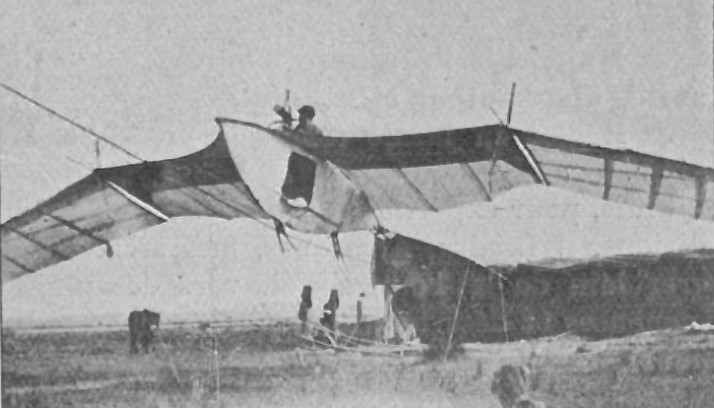
Albert Bazin built a series of gliders from 1904 up to 1907. In 1907 he built this ornithopter with a 12 hp three-cylinder engine. It had no rudder, since the machine “was built to fly straight forward, the shortest distance between one point and another being the straight line”. The area of the different wings could be extended and decreased, thereby achieving lateral control. It was apparently tested suspended from a wire.
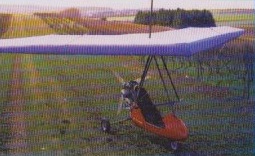
The Bautek Skycruiser is a German ultralight trike, designed and produced by Bautek of Kenn, Germany. The aircraft is supplied was a complete ready-to-fly-aircraft.
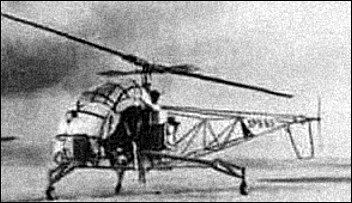
Paul Baumgarti was an Austrian who had worked on three helicopter designs during the war years before emigrating to Brazil. He experimented with a number of light helicopters in the 1950s and 1960s including the single-seat PB-60 unpowered ground-towed rotor kite, and the PB-64 which was an ultra-light single-seater with a minimal tubular fuselage structure. Baumgarti subsequently built his PB-63 under Brazilian Air Ministry funding. After the first model with coaxial rotors, it was given a traditional two-blade articulated rotor. This was a conventional helicopter with a single seat and semi-enclosed cabin, powered by an 85hp Continental C.85 engine. No production of any of these designs was undertaken. The last of a family of experimental helicopters designed in Brazil by the engineer Paul Baumgarti.
PB-63 Engine: 1 x Continental C85-12, 85hp Rotors: 2-blade main; 2-blade tail Rotor diameter: 6.0m / 19 ft 8 in Gross weight: 360kg / 794 lb Empty weight: 238kg Cruising speed: 60 m.p.h. Ceiling: 2285m / 7,500 ft Seats: 1
The Austrian engineer, Paul Baumgartl, concerned himself during the Second World War with the design of small single-seat helicopters, in the suburbs of Vienna. Baumgartl’s first product was the Heliofly I of 1941, which was little more than a strap-on autogyro glider for sporting use.
The Heliofly III-57 resulted from previous work. This had a rotor consisting of two co-axial contea-rotating single blades, each of which was to be driven by its own 8 hp Argus As 8 engine, which also acted as a counter-balance.
Baumgartl Heliofly III-59
When it became apparent that the Argus engines could not be readily obtained, the helicopter was redesigned in 1943 as the Heliofly III-59 to be powered by a single 16 hp engine. In this design, the engine drove and counterbalanced the lower blade and, through gearing, also drove the upper blade, so that torque was still counterbalanced by contra-rotation. A weight, instead of an engine, counterbalanced the upper blade, and the flapping rotor system had cyclic pitch control. Heliofly III-59 Engine: 16 hp / 12kW Rotor diameter: 6.10m Max take-off weight: 120kg Empty weight: 35kg Crew: 1