Beagle B.125 Bulldog / Scottish Aviation Bulldog

A military version of the Pup was developed after being assessed by Rolls Royce Test Pilot Graham Andrews, who made 12 recommendations including its adaptation to a twin seated aircraft suitable for training purposes. The aircraft evolved into the Beagle B.125 Bulldog with a 200 hp (150 kW) Lycoming engine. Only one prototype aircraft was built by Beagle (with another largely complete) before it ceased operations; the design and production was taken over by Scottish Aviation.

Scottish Aviation Bulldog Article

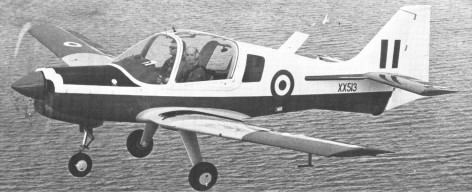
The Bulldog development of the B121 Pup was designed by Beagle as the B125, the prototype G-AXEH (c/n 001) flying from Shorehamon May 19,1969. Following Beagle’s collapse Scottish Aviation took over design and production rights in May 1970 and moved manufacturing facilities to Prestwick. SAL flew the second prototype G-AXIG (c/n 002) on February 14, 1971, in the colours of the Swedish Air Force. The third airframe (c/n 003) was used for ground structural testing. Designated the Bulldog Series 100, the first production aircraft G-AYWN (c/n BH100-101) was flown on June 22 as the first Bulldog for Sweden, serialled 61001, and operated in Sweden as the Sk61. It was followed by the second for Sweden, G-AYWO/61002 (c/n BH100-102), on July 14, both being delivered on July 26. Further allocations are G-AYWP, ‘YZL, ‘YZM and G-AZAK to ZAT, respectively BH100-103 to 114 and serialled 61003 to 61015. These are all known as Model 101. Following on the production line are the first Model 102s for the Malaysian Air Force, BH100-115 and 116. In 1971 orders were for 58 Bulldogs for Sweden, 15 for Malaysia and five for Kenya.
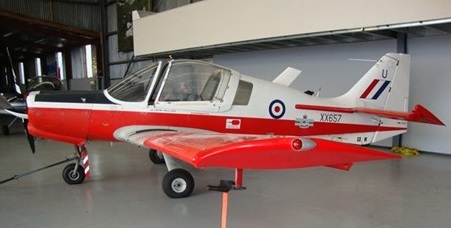
Bulldog Mk.1

In 1973, Finnaviation received a research and development contract from the Swedish Air Force to design skis for their primary trainer, Beagle Bulldog. The Swedes had developed a unique bottom shape for the skis around which an aerodynamic casing and load carrying structure of fiberglass epoxy laminate was designed. The skis were test loaded in the Helsinki University of Techonology structures lab.

Beagle, tried to get its two airplane line accepted in the U.S. The Pup, was expensive, slow for such a clean appearing airframe, and was against the most difficult market for an import the low cost basic trainers. Beagle Aircraft Limited went into receivership and production ceased in 1982.

Following delivery in 1981 of a follow-on batch of five Bulldog 125s to the Royal Jordanian Air Force, a further order for five was placed, making 23 in all. In 1981 the Nigerian Air Force ordered another four Bulldog 123s to bring its total to 36.

In 2014, Ex-Nigerian Air Force Bulldogs were sold as scrap and shipped to Palmerston North, New Zealand, for rebuild or resale.
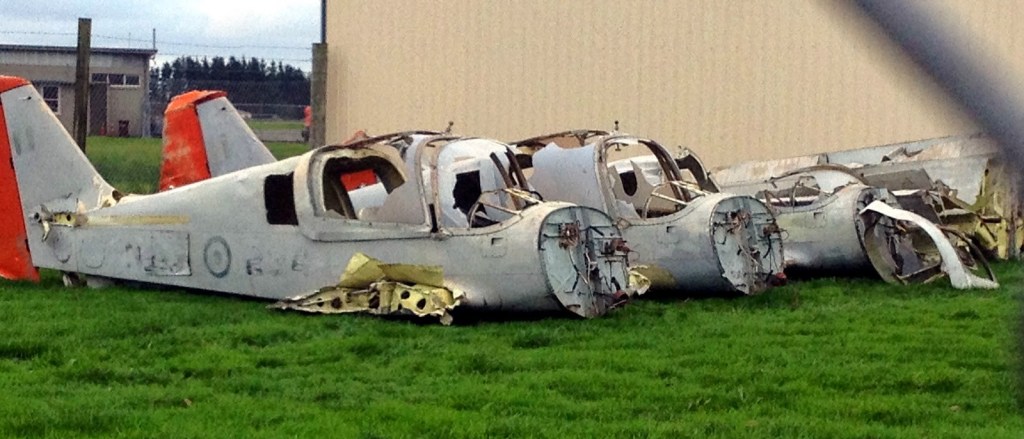
Nigerian Bulldogs

Gallery

Beagle B 125 Bulldog
Engine: Avco Lycoming IO-360-A1B6
Length: 23.261 ft / 7.09 m
Wingspan: 33.005 ft / 10.06 m
Max take off weight: 2350.5 lb / 1066.0 kg
Max. speed: 130 kts / 241 km/h
Range: 540 nm / 1000 km
Crew: 2+1

Mk.102
Seats: 2.

Mk.103
Seats: 2.

Mk.120
Engine: Lycoming IO 360 A1B6, 200 hp.
Seats: 2.

Mk.121 / T.1
Engine: 200 hp.
Wing span: 33 ft (10m).
Seats: 2/3
Cruise: 120 knots.
Load limit: +6/ 3 G
Rear seat cap: 200 lb.
Max speed: 150 mph (241 km/h).

B.121 Pup 150
Engine: Lycoming, 150hp.
Wing span: 31 ft 0 in (9.45 m).
Length: 22 ft 9 in (6.93 m).
Height: 8 ft 6 in (2.59 m).
Max TO wt: 1600 lb (725 kg).
Max level speed: 153 mph (246 kph).

Mk.123
Seats: 2.

Mk.125
Seats: 2.

Mk.127
Seats: 2.

Mk.128
Seats: 2.

Beagle B.121 Pup

An aerobatic lightplane, the Pup was built by Beagle Aircraft in England at Shoreham Airport and Rearsby Aerodrome. The Pup was designed as a single-engined all-metal two-seat aerobatic aircraft or a four-seat touring aircraft.

Beagle B.121 Pup Article June 1968

The prototype Pup (a Series 1 G-AVDF) first flew from Shoreham Airport on 8 April 1967. Production of the Pup-100 began in February 1968. The Pup-100 model carries two seats and two optional children’s seats. It’s powered by a 100 hp Rolls-Royce/Continental O-200-A four cylinder engine.

Beagle 100B Pup OO-NAR (c/n B121-160)

The more powerful Pup 150, with seating for an extra adult, was flown in October 1967. The second (G-AVLM) and third (G-AVLN) aircraft were Series 2 aircraft fitted with an enlarged rudder which became standard on all production aircraft.

Pup Series 2 with a 150 h.p. engine

The Pup-150 fuselage is only three inches longer than the Pup-100 while wingspan dimensions of the low-wing tricycle gear airplane remain the same. A 150 hp Lycoming O-320-A2B engine allows optional seating for four. The Pup-150 also offered a larger 34-Imperial-gallon fuel tank as opposed to the standard 24-Imperial-gallon tank installed as standard equipment in the 100 and 150 models. A large rudder on the 150 allows full aerobatics including unlimited spinning.

The first delivery (a Series 1) was to the Shoreham Flying School on 12 April 1968.

A Series 3 variant, a four-seater, was developed for the Iranian Civil Air Training Organisation. G-AVLM was converted during 1968 to become the series 3 prototype aircraft with a further enlarged rudder.

By 1969 production had increased at Shoreham to one Pup a day, aircraft were flown to either Rearsby Aerodrome or Cambridge Airport for painting and finishing. One aircraft was evaluated by the Royal New Zealand Air Force in 1969, but was not ordered. Deliveries were made to civilian operators in several countries including Australia, Sweden and Switzerland.

The Pup-160 was powered with a 119kW Lycoming O-320-D2C engine.

Pup 150

The Pup was more spacious than its direct competitors and was a more complex design to manufacture and was also corrosion proofed throughout (usually then only an option on US-built competitors). For these reasons it was correspondingly more expensive to build, yet was sold at a competitive price. Its maintenance requires more care (i.e. expense) and its early days were troubled by issues with the doors and spares availability.

A total of 128 Pups had been delivered by the close of 1969, when 267 aircraft were on order. In December 1969 the government withdrew financial support for Beagle and the company was placed in receivership. Production ceased with the 152nd aircraft. Some remaining nearly completed aircraft were finished at a variety of locations, the last being completed G-BCGV (s/n B121-176) was first registered 17 June 1974. The Pup was developed into the Bulldog by Beagle, then Scottish Aviation.

A military version of the Pup was developed after being assessed by Rolls Royce Test Pilot Graham Andrews, who made 12 recommendations including its adaptation to a twin seated aircraft suitable for training purposes. The aircraft evolved into the Beagle B.125 Bulldog.

Gallery

B.121 Srs.1 Pup 100
Engine: 1 x RR/Cont. O-200-A, 100 hp / 74kW
Wingspan: 31 ft / 9.45 m
Length: 22 ft 11 in / 6.99 m
Height: 2.3 m / 7 ft 7 in
Wing area: 119.5 ft² / 11.10 m²
Take-off weight: 1,600 lb / 725 kg
Empty weight: 985 lb / 447 kg
Max. speed: 225 km/h / 140 mph
Cruise speed: 127 mph / 204 km/h
Ceiling: 2000 m / 6550 ft
Range: 800 km / 497 miles
Seats: 3

B.121 Srs.2 Pup 150
Engine: Lycoming 0-320-A2B, 150 hp (112 kW)
Wingspan: 31 ft 0 in / 9.45 m
Wing area: 119.5 ft² / 11.20 m²
Length: 23 ft 2 in / 7.06 m
Height: 7 ft 6 in / 2.29 m
Empty weight: 1090 lb / 494 kg
MTOW: 1925 lb / 873 kg
Fuel capacity: 24 ImpG / 109 lt
Fuel capacity w/opt: 34 ImpG / 155 lt
Cabin length: 6 ft 6 in / 1.98 m
Cabin max width: 3 ft 9 in / 1.14 m
Cabin max height: 3 ft 6 in / 1.07 m
Cabin volume: 85 cu.ft / 2.4 cu.m
Baggage space: 15 cu.ft / 0.42 cu.m
Top speed: 138 mph / 222 km/h
Max cruise 75% 7500ft/2290m: 114 kt / 131 mph / 211 kph
Range w/opt fuel: 549 nm / 633 mi / 1020 km
Service ceiling: 14,700 ft / 4480 m
Fuel @ 65% pwr: 45 lb/hr
Endurance 65% power: 5 hours
Stalling (clean/flaps): 53-48 mph/85-76 kmh
Max ROC SL: 700 fpm / 244 m/min
Take-off distance, 50 ft: 1350 ft.
Landing distance, 50 ft: 1430 ft.
Seats: 2-4

B.121 Srs.3 Pup 160
Engine: Lycoming O-320-D2C, 160 hp
Fuel capacity: 36 ImpG / 164 lt
Seats: 2+2
No built: 6

Pup 100

Beagle A.113 Husky / Auster A.113 / Auster D.4 / D.5 / D.6

A new range of Auster lightplanes appeared in early 1960. It included the two-seat D.4/108, three seat D.5/160 and /180 and four-seat D.6, all powered by Lycoming engines and featuring metal spars. The Auster D.6 was developed from the J/5V, but J/5V G-APUW did not have the metal spar and other refinements of the D.6

A total of 157 D.4 and D.5 had been sold by the beginning of March 1964.

Prototype D.4

The 1961 types in the Auster range – D.4, D.5 and D.6 development of the Auster Alpha were announced with Lycoming engines, but since then the company was taken over by the Pressed Steel Co., Ltd., as part of its Beagle (British Executive and General Aviation, Ltd.) group. Beagle has announced that Rolls Royce/Continental powerplants will be installed in Auster/Beagle aircraft being developed under the direction of Mr. Peter Masefield.

Prototype D.6 / J/5V

The Beagle group had continued production of the Auster D.5/160 and Auster D.5/180, the latter as the A.113 Husky when fitted with a 134kW Lycoming O-360-A1A engine.

A major innovation of the D series was the use of metal wing spars which, with new low-flammability long-weathering plastic-based butyrate dope and paint finishes, made the D entirely suitable for use in the tropics. The D.4 was a two-seater with either a 9.75m or 10.98m wingspan and an 80, 112/119 or 134kW Lycoming engine; the D.5 was a three-seater offering the two wing spans but only the 119 and 134kW engines; and the D.6 was a four-seater with the greater wing span and engines as for the D.5.

The first production D.4/108 flew on 12 February 1960.

The first D.5/160 on 10 January 1960. Beagle developed the D5/160 as the “Beagle D5/180 Husky” with a 180 hp Lycoming O-360 engine, the first being G-ASBV first flown in 1962. A small number were sold until production was discontinued in 1967.

The first D.6/160 flew on 9 May 1960.

D5/160

133 examples (Auster D.5/160) were built by the Oficinas Gerais de Material Aeronáutico in Portugal from 1961 onwards; and the Portuguese Air Museum preserves two of these; one in flying condition.

A.113 Husky

The designation “A.113” was only a design number and was not used in promotional material or in aircraft registrations with the Civil Aviation Authority where the term ‘D5/180’ was preferred. Additionally, the name Husky was only given to this version and not to the D5/160.

One Beagle Husky (XW635) was won by Sir Billy Butlin in a raffle and presented to the RAF’s Air Training Corps in 1969. It flew with No. 5 Air Experience Flight, flying air cadets from Cambridge Airport until it was retired in 1989 and sold to a civilian user.

Operators included the Burma Air Force, Portuguese Air Force, and Thai Border Patrol Police – One aircraft only.

Beagle-Auster D.4/108

Beagle-Auster D.5/160
Engine: 1 × Lycoming O-320-A2A, 160 hp (119 kW)
Wingspan: 36 ft 0 in (10.98 m)
Wing area: 185 ft² (17.2 m²)
Length: 23 ft 4½ in (7.13 m)
Height: 7 ft 11 in (2.41 m)
Empty weight: 1,450 lb (659 kg)
Loaded weight: 2,450 lb (1,114 kg)
Maximum speed: 125 mph (109 knots, 201 km/h)
Cruise speed: 108 mph (94 knots, 174 km/h)
Range: 460 mi (400 nmi, 741 km)
Service ceiling: 12,800 ft (3,900 m)
Rate of climb: 640 ft/min (3.3 m/s)
Crew: one pilot
Capacity: 2 passengers

D.5/180 Husky / A.113 Husky
Engine: 1 x Lyc. O-360-A2A, 132kW / 180 hp
Wingspan: 10.97 m / 36 ft 1 in
Length: 7.1 m / 23 ft 4 in
Height: 2.5 m / 8 ft 2 in
Take-off weight: 1090 kg / 2403 lb
Empty weight: 646 kg / 1424 lb
Max take off weight: 2400 lb / 1088kg
Range: 502 nm / 930 km / 580 mi
Max. speed: 206 km/h / 128 mph
Cruise speed: 177 km/h / 110 mph / 96 kt
Max ROC SL: 800 fpm / 245 m/min
Ceiling: 4420 m / 14,500 ft
Seats: 4
4 built

Beagle-Auster D.6/180

A.113
D.5/180 Husky

Beardmore WB.26

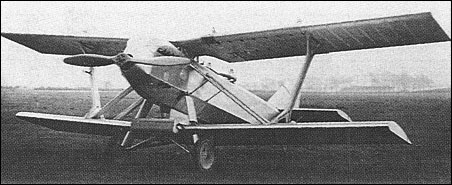
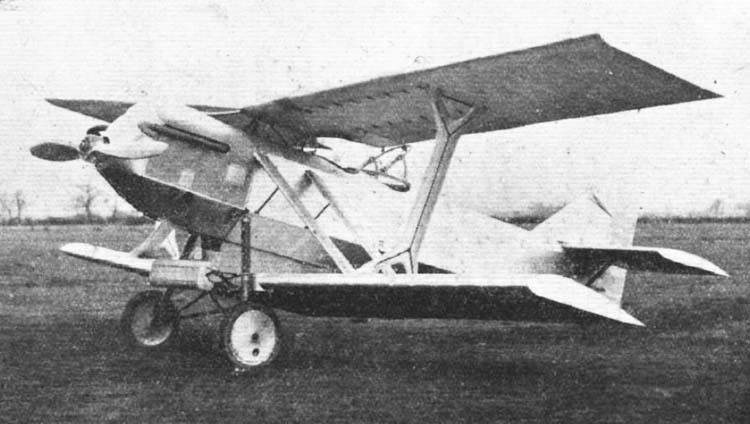
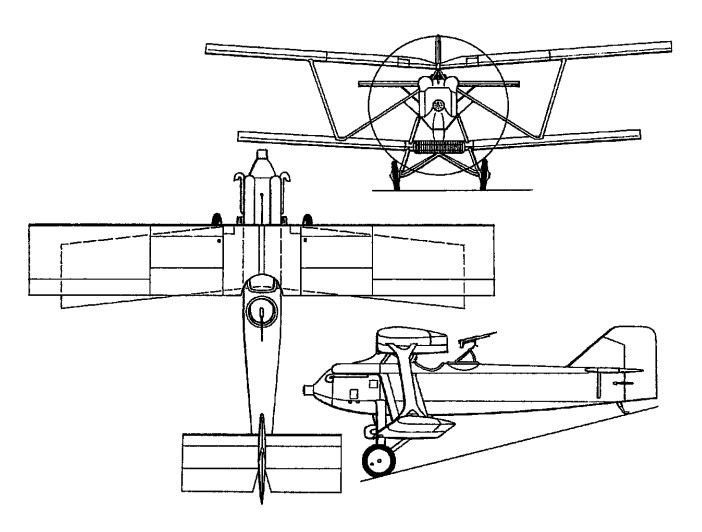
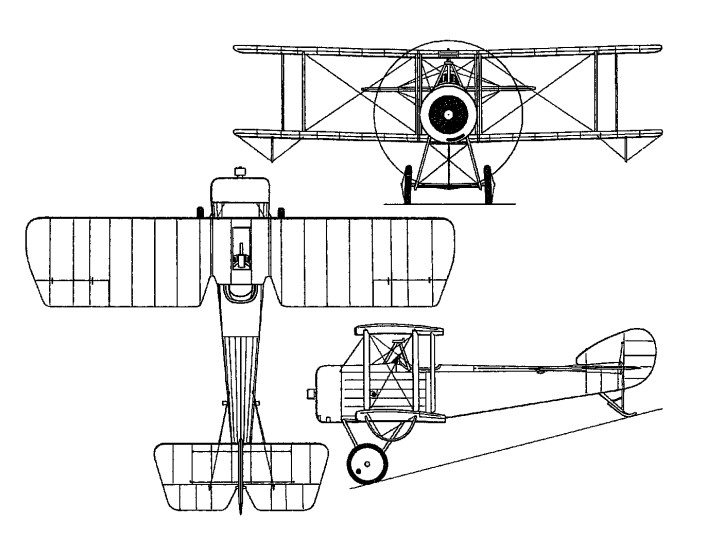
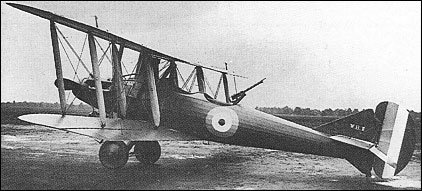
In 1924, the Scottish shipbuilding company of William Beardmore and Company designed a two-seat fighter for Latvia, the W.B.XXVI. Beardmore’s chief designer, W.S. Shackleton produced a wooden single-bay biplane, powered by a Rolls-Royce Eagle engine. The slab-sided fuselage was of hexagonal section, with the crew of two seated in separate cockpits. To reduce drag, the wings had no bracing wires, bracing being solely by means of struts, with a large inter-wing gap. A Lamblin radiator was installed in the leading edge of the lower wing. Instead of the normal Vickers and Lewis machine guns, the aircraft was armed by Beardmore’s own gas-operated Beardmore-Farquhar machine guns.

The prototype first flew some time in 1925. While it proved to be manoeuvrable, it was underpowered, and performance was poor, with the Latvians unwilling to pay for replacement of the Eagle with a more powerful Napier Lion engine. It was sent to Latvia for evaluation in 1926, but was only flown three times in Latvia before it was rejected, and was eventually sent back to Beardmore and scrapped. No more W.B.XXVIs were built.

Engine: 1 × Rolls-Royce Eagle IX, 360 hp (269 kW)
Wingspan: 37 ft 0 in (11.28 m)
Wing area: 356 sq ft (33.1 sq.m)
Length: 27 ft 10½ in (8.50 m)
Empty weight: 2,555 lb (1,162 kg)
Loaded weight: 3,980 lb (1,809 kg)
Maximum speed: 145 mph (233 km/h)
Endurance: 4 hr
Service ceiling: 20,000 ft (6,100 m)
Wing loading: 11.2 lb/sq ft (54.7 sq.m)
Power/mass: 0.09 hp/lb (0.15 kW/kg)
Climb to 15,000 ft: 20 min
Crew: 2
Guns: 2× fixed forward firing Beardmore-Farquhar machine guns and 1 or two flexibly mounted Beardmore-Farquhar machine guns on Scarff ring

Beardmore W.B.XXIV / Wee Bee

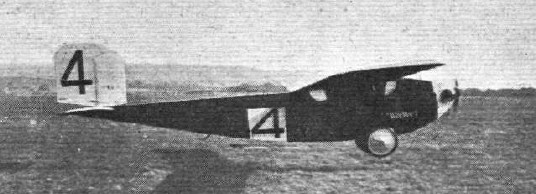
The Beardmore W.B.XXIV Wee Bee I was the company’s winning entrant to the Lympne Aerodrome light aeroplane trials of 1924. The competition rules were framed to encourage more robust designs than those that had competed as “motor-gliders” at Lympne the previous year; they were to be single engined two seaters, with engine capacities up to 1,1000 cc allowed. The total prize money was £3,600; the first prize £2,000.
The Wee Bee was a high wing monoplane designed by W.S.Shackleton, its aerodynamically thick wing divided at the centre and braced, close to the fuselage, by pairs of parallel struts to the lower longerons. The wings were of two spar construction with plywood skinning between the two spars out as far as the bracing; outboard, only the leading edges were plywood covered, with fabric elsewhere. The outboard ailerons were mounted on false spars (stringers). In plan, the wings were almost rectangular, with an aspect ratio of about 5.5.
The fuselage was built up on six spruce longerons, with bulkheads (formers) of spruce and three-ply. The Wee Bee’s decking was concave as it reached the flat fuselage sides, making for a better view from the two tandem cockpits. These were positioned at the leading edge and just behind mid-chord, fitted with dual controls. Both cockpits were semi-enclosed and faired into the upper fuselage/ wing surface. The front one was entered by lifting up a small hinged part of the leading edge, which was locked down for flight; this gave excellent visibility with the help of the “hollow ground” decking. The aft cockpit had a roof hatch with a transparent celluloid window in the upper wings, with good views though openings in the sides below the wing. The 32 hp (24 kW) Bristol Cherub flat twin engine was hung from a duralumin sheet bracket fixed to the engine bulkhead and positioned below with a pair of duralumin tubes, themselves braced to the lower longerons with steel tubes. It was enclosed in a smooth, streamlined cowling, with the upper cylinder heads protruding for cooling.
The fin and tailplane were both integral with the fuselage and narrow in chord, carrying wider control surfaces. Both horizontal and vertical surfaces were rectangular, but the rudder had a noticeable horn balance. The main undercarriage was very simple, with two wheels mounted on a bent chrome-nickel alloy tube which passed through the fuselage bottom. This placed the wheels well clear of the fuselage horizontally (the track was 3 ft 9 in / 1.14 m) but left the Wee Bee sitting close to the ground. Landing loads were absorbed by elastic axle bending.
The only Wee Bee first flew in the late summer of 1924, ready for the Lympne competition. The preliminary trial for this were held at the weekend of 27-8 September, where only seven of the initial nineteen entrants did enough to go to the competition proper. As well as the Wee Bee, the other competitors were the Bristol Brownie, two Hawker Cygnets, the Parnall Pixie, the Cranwell CLA2 and the Westland Woodpigeon. The Wee Bee was flown by Maurice Pearcy.
The aircraft were given marks for four tasks: speed over two sets of five laps, slow speed flying and take off and landing distances. Only the Wee Bee and the Brownie, both Cherub engined, had the reliability to complete the speed tests, in which the Wee Bee achieved 70.1 mph (112.8 km/h), about 5 mph faster than the Bristol. It flew at just under 40 mph (64 km/h) and took off to clear a 6 ft (1.83 m) barrier with a run of 705 ft (215 m). Given the Wee Bee’s clean aerodynamics it was not surprising to find it took to greatest distance to pull up at landing; wheel brakes were not fitted. Despite the long landing, the Wee Bee ended the competition well ahead in marks of the Brownie, its nearest rival, winning the Air Ministry first prize of £2,000.
At Lympne in 1924 the Wee Bee flew as no.4, but at the Royal Aero Club meeting of August 1925, also held at Lympne, it appeared as G-EBJJ. At that meeting, with an aluminium front cockpit hatch in place of the earlier wooden one, it won the light two seater race and came fourth in the Grosvenor Cup, both times piloted by A.N Kingswill. In December 1933 it was sold to Percy Parker of Warrnambool, Victoria, Australia, where it was registered as VH-URJ. Mr. Parker sold it prior to 1939. It flew until 1939 and was then stored, but probably flew again a few years after the end of World War II, though exact dates are uncertain.

Engine: 1 × Bristol Cherub I air cooled flat twin, 32 hp (24 kW)
Length: 22 ft 2 in (6.76 m)
Wingspan: 38 ft 0 in (11.58 m)
Height: 7 ft 2 in (2.18 m)
Wing area: including ailerons 208.5 sq.ft (19.37 sq.m)
Empty weight: 465 lb (211 kg)
Gross weight: 840 lb (381 kg)
Maximum speed: 87 mph (140 km/h)
Crew: 2

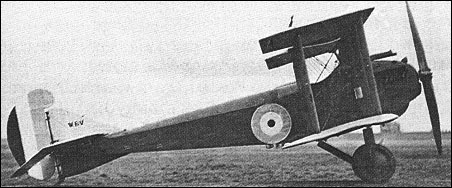
Beardmore WB.V

The W.B.V single-seat shipboard fighter was developed in parallel with the W.B.IV. It was intended to carry a 37mm Puteaux cannon between the cylinder blocks of its 200hp Hispano-Suiza eight-cylinder water-cooled engine and featured folding wings, a jettisonable undercarriage and inflatable flotation bags beneath the underside of the leading edge of the lower wing. Three prototypes of the W.B.V were ordered, the first flying on 3 December 1917, but the engine-mounted cannon was removed and a more conventional synchronised 7.7mm Vickers gun and a 7.7mm Lewis gun on a tripod ahead of the cockpit mounted. The second prototype W.B.V was completed and flown in 1918, but further development was abandoned before the end of World War I.

Engine: 200hp Hispano-Suiza
Take-off weight: 1134 kg / 2500 lb
Empty weight: 844 kg / 1861 lb
Wingspan: 10.92 m / 35 ft 10 in
Length: 8.10 m / 26 ft 7 in
Height: 3.61 m / 11 ft 10 in
Wing area: 36.60 sq.m / 393.96 sq ft
Max. speed: 180 km/h / 112 mph

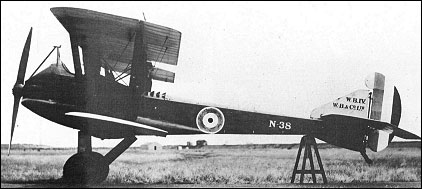
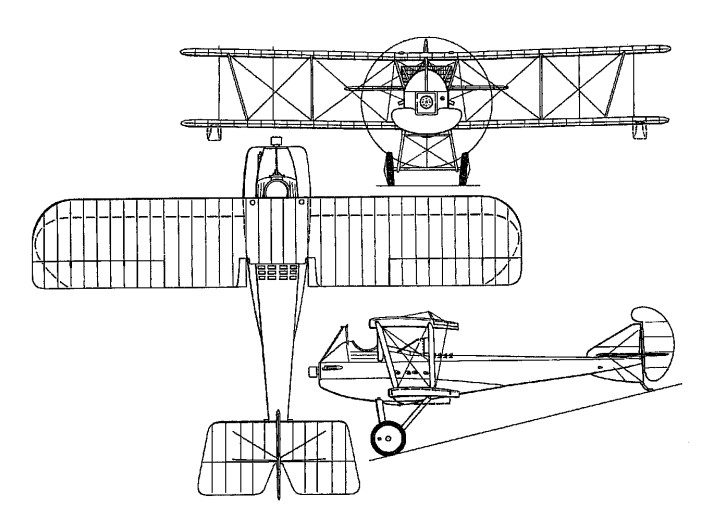
Beardmore WB.IV

The W.B.IV single-seat shipboard fighter was the first entirely original fighter to be developed by William Beardmore & Company. The 200hp Hispano-Suiza eight-cylinder water-cooled engine was mounted aft of the cockpit and drove the propeller via an extension shaft which passed between the pilot’s legs to provide the best possible view for the pilot, The cockpit was water-tight, a large flotation chamber was provided in the forward fuselage, wingtip floats were incorporated to stabilise the aircraft in the event of it alighting on the water in an emergency, and the undercarriage was jettisonable. The mainplanes could be folded, and The WB.IV was armed with a single synchronised 7.7mm Vickers gun and a 7.7mm Lewis gun mounted on a tripod ahead of the cockpit. Three prototypes of the W.B.IV were ordered, the first of these flying on 12 December 1917, but the other prototypes were not completed.

Engine: 200hp Hispano-Suiza
Take-off weight: 1177 kg / 2595 lb
Empty weight: 932 kg / 2055 lb
Wingspan: 10.92 m / 35 ft 10 in
Length: 8.08 m / 26 ft 6 in
Height: 3.00 m / 9 ft 10 in
Wing area: 32.52 sq.m / 350.04 sq ft
Max. speed: 177 km/h / 110 mph

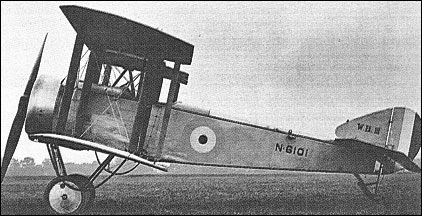
Beardmore WB.III / SB.3

William Beardmore and Co developed their W.B.III as a carrier version of the Sopwith Pup fighter with manually-folding mainplanes and folding main undercarriage members. The William Beardmore and Company firm was already under contract to produce the land-based Sopwith Pup, this under legal license, and developed the WB III for shipboard use by the Royal Naval Air Service during World War 1.

Design of the WB III was conventional for biplane fighter aircraft of the time, keeping up with features as found on the Sopwith Pup. The engine was held in a forward compartment at the front of the slab-sided fuselage. A cylindrical engine cowling was fitted over the front engine facing for a more streamlined approach. The engine, a single nine-cylinder Le Rhone 9C series engine or a seven-cylinder Clerget (each delivering up to 80 horsepower), turned a two-bladed wooden propeller. The biplane wing arrangement featured straight parallel struts unlike the Sopwith Pup’s staggered formation, necessitated by the Navy requirement for manually folding wings (space on aircraft carriers was always at a premium). Additionally, the undercarriage – consisting of two fixed single-wheeled members – could be removed by the ground crew for improved stowage while the tail was supported by a simplistic tail skid. The fuselage tapered off to the empennage to which was affixed a rounded vertical tail fin and applicable horizontal planes.

Performance from the available powerplant allowed for a top speed of up to 103 miles per hour with a service ceiling of up to 12,400 feet and a rate-of-climb equal to 534 feet per minute. Endurance time (essentially the aircraft’s operational range) was listed at 2 hours and 45 minutes. The WB.III maintained a wingspan of 25 feet with a running length of 20 feet, 3 inches. She sat with an 8 foot, 1 inch height. On empty, she weighed in at 890lbs and could take off with a weight of up to 1,290 lbs. Armament was a single fixed, upward-firing .303 Lewis machine gun, firing through a cut-out section of the upper wing assembly.

The prototype WB III (a modified Pup) was accepted by the British military on February 7th, 1917. A contract for 100 production examples soon followed under the official British designation of SB 3.

Armament comprised a single 7.7mm Lewis gun which fired upwards through a cut-out in the upper wing centre section, and the W.B.III could be fitted with either the seven-cylinder Clerget or nine cylinder Le Rhone 9C rotary, both of 80hp. The first 13 production W.B.IIIs had folding undercarriages similar to the prototype and were known as S.B.3Fs, but subsequent W.B.Ills had jettisonable undercarriages (S.B.3D) and flotation equipment.

The initial production models fell under the designation of SB 3F and covered some thirteen examples until supplanted by the revised SB 3D. The SB 3D sported a jettisonable undercarriage as well as emergency flotation equipment in a slightly lengthened fuselage.

The WB III served on only three Royal aircraft carriers, these being the HMS Furious, HMS Nairana and the HMS Pegasus. One S.B.3D was used in an unsuccessful attempt to fly from the forecastle of the battle cruiser HMS Renown. Japan became the only other notable operator of the WB III/SB 3 series.

Beardmore SB 3F
Engine: 1 x Le Rhone 9C OR 1 x Clerget rotary, 80 hp
Length: 20 ft 3 in (6.16m)
Wingspan: 25.00ft (7.62m)
Height: 8 ft 1 in (2.47m)
Wing area: 22.57 sq.m / 242.94 sq ft
Maximum Speed: 103mph (166kmh; 90kts)
Maximum Range: 171miles (275km)
Rate-of-Climb: 534ft/min (163m/min)
Service Ceiling: 12,402ft (3,780m)
Armament: 1 x 7.7mm (0.303 caliber) Lewis machine gun
Accommodation: 1
Empty Weight: 891lbs (404kg)
Maximum Take-Off Weight: 1,290lbs (585kg)

Beardmore WB.II

Based on the design of the B.E.2c, the two-seat WB.II fighter was built as a private venture by G Tilghman-Richards of William Beardmore & Co. The W.B.II was powered by a 200hp Hispano-Suiza 8Bd eight-cylinder water-cooled engine and carried an armament of two fixed synchronised 7.7mm Vickers guns and a single 7.7mm Lewis gun on a swivelling Beardmore- Richards mounting. The W.B.II was first flown on 30 August 1917, and performance proved good, but the Hispano-Suiza engine was in short supply and was required for the S.E.5a single-seater. No production of the W.B.II was undertaken, although two civil examples were built in 1920 as the W.B.IIB.

Engine: 200hp Hispano-Suiza 8Bd
Take-off weight: 1202 kg / 2650 lb
Empty weight: 800 kg / 1764 lb
Wingspan: 10.62 m / 34 ft 10 in
Length: 8.18 m / 26 ft 10 in
Height: 3.05 m / 10 ft 0 in
Wing area: 32.88 sq.m / 353.92 sq ft
Max. speed: 193 km/h / 120 mph