Bauhauer Helicopter         

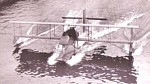
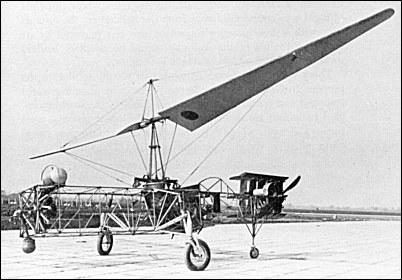
Dutchman A. G. von Baumhauer built a helicopter in 1925 that flew in a very limited fashion. Able to stay in the air only briefly, this unsuccessful machine had a single main rotor and a small vertical tail rotor to offset torque. It needed the weight of dangling chains at each corner to keep level. A separate engine powered the tail rotor, which operated independently of the main rotor.

Bates 1911 Monoplane

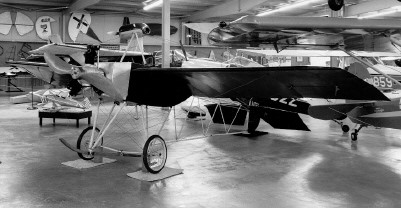
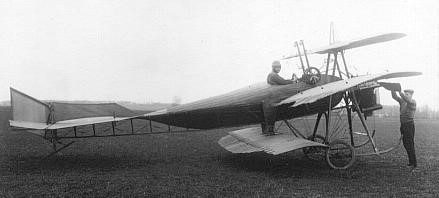
The 1912 Bates Monoplane was built by Carl S. Bates at Cicero Field near Chicago, IL. Bates was a farm boy from Clear Lake, IA who became interested in flying at an early age. He was only 14 when he constructed a man-carrying kite in 1898. In 1903, he moved to Chicago to attend the Armour Institute of Technology and there came under the guidance of aeronautical pioneer Octave Chanute.

In 1911, he is credited with a monoplane of original design, powered with a Bates 30 hp motor. The airplane in the AirVenture Museum is a redesign of that aircraft. The Bates Monoplane fore part of the fuselage is of wood, while the structure back of the cockpit is of steel tubing, oval in cross section, with a “pigeon-tail” empennage and a generous rudder.

Walter Kutz of Skokie, IL who later moved to Waterford, WI, purchased the aircraft in 1918. He stored the aircraft in a barn, but never flew it. In 1957, Leon Tefft, an EAA member, restored the aircraft for Kutz. After Mr. Kutz died, his family decided to loan the airplane to EAA for display in the AirVenture Museum. As displayed in the museum, the aircraft has a Poyer engine.
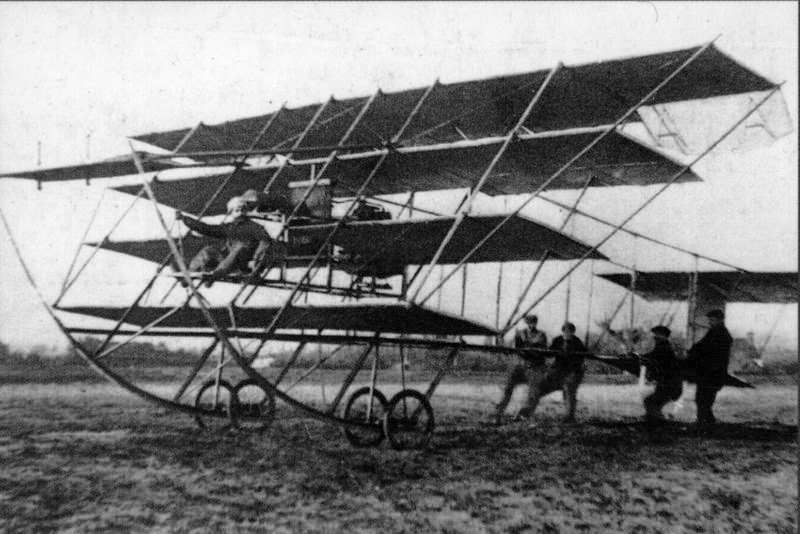
Battaille & Brabant Quadruplane   

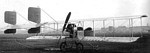
In 1910 Paul Bataille, a mining engineer, and Pierre Brabant, an electrical engineer who worked for Bataille’s company, filed a patent for a quadruplane. The lowest wing was originally going to be a “flapper” (aile battante), but when the quadruplane was actually built it had four fixed wing. The heavily reverse-staggered-wing pusher featured a high forward elevator and a four-wheel undercarriage. The machine was tested in Kiewit in 1910 and in 1911 at the Casteau exercise field where it was piloted by Aimé Behaeghe. After a week of testing, and a roll-over accident, with no success, the decision was made to modify the machine into a triplane. Eventually the aircraft was abandoned.