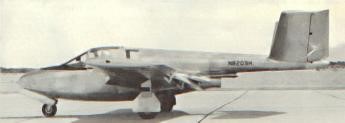
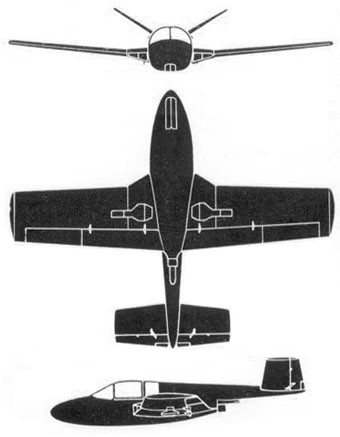
In the early fifties Harold Dale played with the idea to design the ideal jet trainer: seating trainee and instructor side-by-side in front of the wing for clear visibility all around. It should have a slow landing speed and a comfortable cruising speed of 350 mph. The plane Harold had in mind was a mid-wing cantilever monoplane of aluminium alloy structure, with slotted flaps, leading edge intake ducts, semi-monocoque fuselage, upwards opening doors, butterfly tail unit and retractable tricycle landing gear.
Harold Dale was a project engineer with North American working on the F-100, so his ideal plane had to be designed in the spare time. He had assistance from his wife Eleanor who also had an engineering degree, handling much of the mathematics, administration, etc.
The name chosen was the WEEJET 800 (WE=Harold and Eleanor), the 800 meaning the power class of the licence built Turboméca Marboré II engine of 880 lb thrust.
In February 1952 Dale Air-Engineering (Torrance, California) and the WEEJET 800 were official registered and the first material was submitted to the CAA West Region Administration. It was the first jet aircraft in the small plane field submitted to the CAA, who followed every phase of the two and a half years of design and evaluated all data during development.
In 1954 a local aircraft parts manufacturer (Carma Manufacturing Co) heard of the design and got involved in the project in two ways: he supplied the hydraulic shock absorber struts and offered to built the aircraft in his plant in Tucson, Arizona. Now it became feasible to produce and market the aircraft. Construction started at Tucson in the second half of 1954 and five people worked one and a half years on it.
The prototype (N8209H) conducted its 20 minutes first flight on Good Friday March 30, 1956, with Harold Dale at the controls. During the following weeks further test flights were made by another pilot, except for the spin tests, these were performed by USAF-pilot Doneby; the aircraft handled and performed well.
During 1956 the US Navy had become interested in jet trainers and the WEEJET was to be in their evaluation. Therefore all data had to be available before the end of the month and the aircraft was to be flown to Patuxtent, Maryland on April 29. On April 28 1956 disaster struck: during the final spin test the pilot inadvertently activated the trim tab into full nose-down position. The pilot lost control while trying to recover and had to bail out, the aircraft crashed and burned. Later data was found thrown clear of the wreckage, showing the spin tests were a complete success.
All following data was issued on April 25, 1956 in a proposal to the US Navy for the production version. The designation was Carma WEEJET TRAINER.
Carma VT-1 WEEJET Type: Two side by side seat primary jet trainer Engine: Continental J69-T-9 (Marbore II), 920 lb (417 kg) s.t. Wingspan: 28 ft 0 in (8.53 m) Length: 24 ft 6 in (7.47 m) Height: 6 ft 8 in (2.03 m) Wing area: 150 sq.ft (13.94 sq.m) Empty Wt: 2,481 lb (1,125 kg) Max T/O Wt: 4,541 lb (2,060 kg) Max speed: 334 mph (537 km/h) at 15,000 ft (4,570 m) Cruise speed: 208 mph at 25,000 ft Max climb: 2,200 ft (670 m)/min Service ceiling: 35,000 ft (10,670 m) Endurance: 1.72 hr at sea level
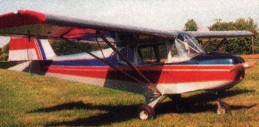
The Carlson Aircraft Sparrow Ultralight is a three axis aircraft conforming to FAA 103 regulations. The Sparrow II is a two seat version of the Sparrow ultralight with optional folding wings.
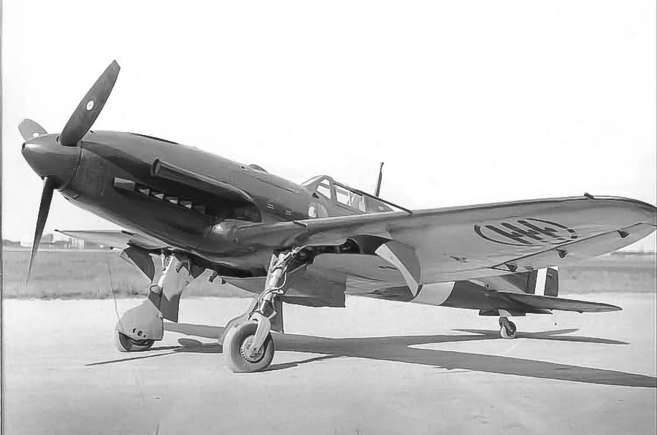
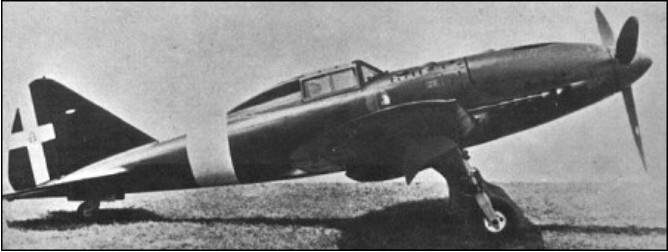
Following the Reggiane Re 2000, in 1941 there appeared the Re.2001 Falco II with a 783-kW (1,050-hp) Daimler-Benz DB 601A-1 inline, redesigned canopy and revised wing. After two prototypes had been completed in 1940 with German built DB 601A 1s, the fighter was ordered into production as the Re 2001 Falco II.
A total of 236 were built (including prototypes and 10 pre¬production aircraft), in various sub series, major versions being the Serie I (100 built), with two 12.7 mm (0.5in) Breda SAFAT machine guns over the engine; the Re2001CN (Caccia Notturna: night fighter) Serie II and III with an additional 7.7 mm (0.303 in) gun in each wing or two German 20 mm (0.79 in) MG 151 cannon in underwing fairings; and the Re 2001CN Serie IV, which could carry an under fuselage 640 kg (1410 lb) bomb or a drop tank.
Various experimental models of the Re2001 included a torpedo carrying fighter conversion (Re 2001G); an antitank conversion (Re 2001M; a prototype conversion with flush mounted leading edge wing radiators (Re 2001bis); two Serie Is converted for catapult launching trials; and a testbed for the Isotta Fraschini Delta RC 16148 engine.
The one prototype with the 840 hp Isotta-Fraechini Delta IV engine was test flown at Guidonia and the maximum speed attained was 320 mph at 14,760 ft and 252 mph at SL. During one test flight the engine overheated at 28,250 ft and the test pilot was forced to leave the aircraft when it burst into flames.
Re.2001 with Isotta-Fraechini Delta IV engine
Production Serie I Re 2001s made their operational debut in attacks on Malta in the early summer of 1942, with subsequent production models following them into service later that year. Thirty nine Serie I aircraft were adapted as Re 2001CBs, able to carry a 640 kg (1410 lb) bomb or torpedo, and a further 12 as land based carrier trainers, fit¬ted with arrester gear. The most widely used version of all was the Re 2001CN (50 Serie II and 74 Serie III/IV), which from 1943 served with five Gruppi of the Regia Aeronautica as a defensive night fighter in central and northern Italy. But, by the armistice only 21 Falco IIs remained serviceable, of which eight were used subsequently by the Italian co belligerent air force. The type was used in a large development programme with other engines, and the total of 237 aircraft included 224 production aircraft in two fighter, one fighter-bomber and one night-fighter series. There followed 227 Re.2002 Ariete (ram) fighter-bombers with the 880-kW (1,180-hp) Piaggio P.XIX RC 45 radial, and finally 37 Re.2005 Sagittario (Archer) fighters.
Caprione-Reggiane Re.2002 Ariete II
The Re.2002 Ariete (Ram) fighter-bombers with the Regia Aeronautica, these being powered by the 876kW Piaggio P.XIX RC 45 radial engine mounted in a slightly lengthened and strengthened fuselage. The type first saw operational service in 1942, suffering heavy losses while contesting the Allied landings on Sicily.
The Re.2005 Sagittario (Archer) had the same general configuration as its predecessors. However, its design incorporated considerable structural redesign, and refined landing gear, and the type reverted to the inline engine. First flown in September 1942 with a Daimler-Benz DB 605A-1, the Re.2005 led to a production model, of which deliveries began in 1943, with a licence-built version of this engine, the Fiat RA.1050 RC 58 Tifone. Only 48 had been delivered before finalisation of the armistice with the Allies, these aircraft fighting in the defence of Naples, Rome and Sicily, the survivors battling above Berlin.
Re.2001 Falco II Prototype 783-kW (1,050-hp) Daimler-Benz DB 601A-1 inline two built
Re.2001 Engine: Isotta-Fraechini Delta IV, 840 hp Max speed: 320 mph at 14,760 ft Max speed: 252 mph at SL
Re.2001 Falco II Engine 1 x Daimler-Benz DB 601A-1 / Alfa Romeo RA. 1000 RC.41-1a Monsonie, 783-kW (1,050-hp). Crew: 1
Re 2001 Falco II Serie III Span: 11 m (36ft 1.75in). Length: 8.36 m (27 ft 5.25in). Gross weight. 3280 kg (7230 lb). Max speed: 542 kph (337 mph).
Re.2002 Ariete Engine 1 x Piaggio P.XIX RC 45 radial, 880-kW (1,180-hp) Crew: 1 227 built
Re.2005 Sagittario Single-seat fighter and fighter-bomber. Engine: l x Fiat RA.1050 RC 58 Tifone, 1100kW (1,475hp). Span: 11m (36ft 1 in). Wing area : 219.586 sq.ft / 20.4 sq.m Length: 8.73m (28 ft 7.75 in). Height: 10.335 ft / 3.15 m Weight empty : 5733.0 lb / 2600.0 kg Normal TO weight: 3610 kg (7,960 lb). Max take off weight : 7849.8 lb / 3560.0 kg Max speed: 421 mph at 6,560 ft. Service ceiling: 39993 ft / 12190 m Wing load: 35.88 lb/sq.ft / 175.0 kg/sq.m Operational range: 777 miles. Armament: 3 x 20-mm cannon and 2 x 12.7-mm (0.5-in) mg, 1000 kg (2,205 Ib) bombs Crew: 1 37 built
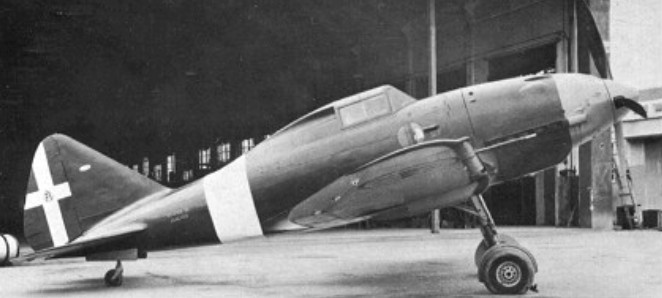
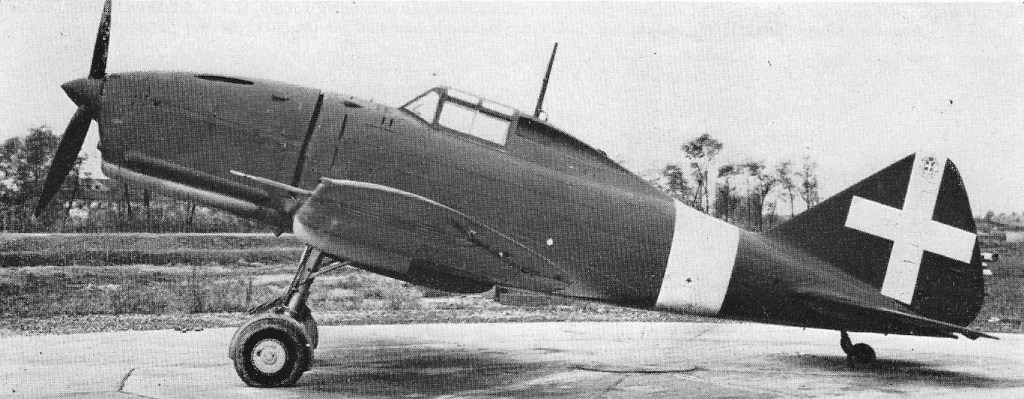
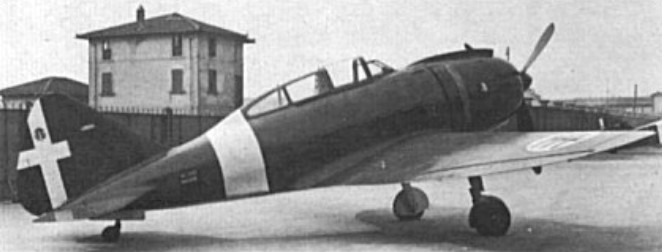
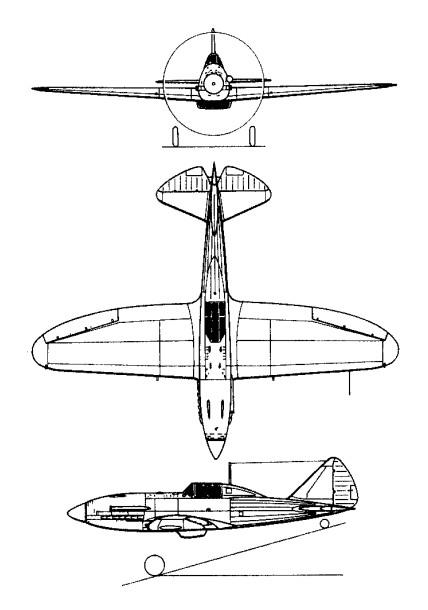
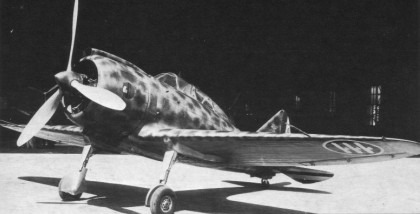
Designed by Roberto Longhi and Antonio Alessio in 1938, The Re 2000 Falco I (Falcon) was buily by Reggiane SA, a subsidiary of the Caproni group. The Re.2000 was the first aircraft designed by Reggiane that employed aluminum stressed skin rather than wooden or mixed wood and metal, with semi elliptical wings, with five spars and integral fuel tanks, and a tubby fuselage, the design was powered a 986 hp Piaggio P.XI RC 40 two row 14 cylinder radial in the Serie I production model. Reggiane Re.2000 had no fuselage tanks, but with the entire wing volume devoted to fuel, it had up to 460 kg (640 lt) gasoline, with a 900 1,100 km endurance. The armament was two 12.7 mm Breda’s (300 rounds each), plus the provision for bomblet-dispensers (spezzoniera).
The Re.2000 prototype’s first flight was on 24 May 1939 at Reggio Emilia, flown by Mario De Bernardi,. The Re.2000, with 260 kg fuel (the maximum was 460 kg/640 lt) was quite light: 2,059 kg empty, 2,529 kg loaded. It reached 518 km/h at 5,250 m and 506 km/h/6,000 m, climbed to 6,000 m in 6,5 min, and had 11,500 m ceiling. During test flights the aircraft gave an excellent performance, and on several occasions, it performed better than other fighters then in production. In mock dogfights, it could successfully fight not only the slower Fiat CR.42 biplane, but even the more modern Macchi C.200 and the German Bf 109E.
In service, the Re.2000’s engine, a 986 hp (735 kW) Piaggio P.XI RC 40 radial, was not reliable. Moreover, it was not as rugged as the Macchi and its fuel tanks were vulnerable (they were not self-sealing). Consequently, the Regia Aeronautica rejected it.
The Falco was placed in production for export as the Re.2000 Serie 1 with minor modifications. Deliveries totalled 157 aircraft including 70 for Hungary and 60 for Sweden, beginning in in 1940.
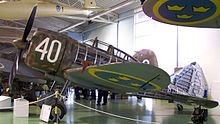
Re.2000 at Swedish Air Force Museum in Linköping
The Swedish purchases of various types of Italian warplanes in 1939–41 were an emergency measure resulting from the outbreak of war, as no other nations were willing to supply aircraft to this small neutral country whose domestic production did not become sufficient until 1943. The Swedish Air Force purchased 60 Re.2000 Serie Is, which received the Swedish designation J 20 and were delivered during 1941-43.
All of the J 20s were stationed at the F10 wing, Bulltofta airbase, Malmö, in the southern tip of Sweden in 1941-45. They were mainly used to intercept Axis and Allied bombers that violated Swedish airspace. One J 20 was lost in combat, shot down while intercepting a Luftwaffe Dornier Do 24 near Sölvesborg on 3 April 1945.
Its mechanical reliability did not meet Swedish Air Force requirements, with the aircraft having to spend a lot of time in maintenance. At the end of the war, the 37 J 20s that remained in service were so badly worn out that they were decommissioned in July 1945 and subsequently scrapped, while only one was kept for display purposes.
In December 1939 a British commission, led by Lord Hardwick and Air Ministry representatives, came to Italy to purchase (along with marine engines, armaments and light reconnaissance bombers) 300 Re 2000s. The Director of Aircraft Contracts confirmed the British order in January 1940. The German government approved the sale in March of the same year, but withdrew its approval the following month. The Italian and British governments then decided to complete the contract through the Italian Caproni’s Portuguese subsidiary, but the British order was cancelled when Italy entered World War II on 10 June 1940.
The Italian navy later accepted 10 Falco 1 Serie II aircraft which, strengthened for catapult launching and fitted with arrester hooks, underwent shipboard trials during 1942.
The Re.2000GA (Grande Autonomia) version, added extra 340 liters fuel tanks. This version was to have been used to reach Eastern Africa, but it wasn’t ready before the Italian defeat. Re.2000GAs were heavier and significantly slower than the standard production Re.2000s. At an empty weight was 2,190 kg compared to the Re.2000’s 2,080 kg, maximum speed was 520 km/h at 5,300 m. Armament was two 12.7 mm SAFAT with 600 rounds, and provisions for a Nardi dispenser with 88 2 kg bomblets (a typical ‘special armament’ for Re.2000s). The Re.2000GA was never really reliable (even for Re.2000 standards), especially its engine.
The Re.2000bis was equipped with the P XI bis engine built with only nine examples delivered when 377a Sq. was created, in August 1941.
In addition, 12 Serie III Falcos, with a modified cockpit hood, extra fuel, and internal improvements, were assigned to the Italian air force and deployed for overseas escort duties or as fighter bombers (with an under fuselage 200 kg [440 lb] bomb) from naval bases in Sicily. The Re.2000 Serie 3 long-range fighter had additional internal fuel and provision for an auxiliary tank or 2000-kg (4,405-lb) bomb load (12 Serie 1 conversions).
Only five Serie Is served in the Regia Aeronautica, including the prototype. They were organized into the Sezione Sperimentale Reggiane inside the 74a Squadriglia in Sicily. Later it was renamed 377a Squadriglia Autonoma Caccia Terrestre, and received nine further Serie III Re.2000bis; 12 of the 26 Reggianes were later converted to GA standard.
The few Re.2000 and 2000GA were used over Mediterranean Sea as escort and attack aircraft, sometimes with Macchi 200/202s and C.R.20 two-engine fighters. 377a was based in Sicily, and fought in Malta and Pantelleria, mainly in an escort role and protecting Axis ships almost until Tunisia (with a range up to 300–350 km), well beyond the other RA single seat-fighters; sometimes it was used to attack Malta with bomblets (spezzoni) and machine guns, typically at dawn. It reported a single ‘kill’ against a Bristol Blenheim. Overall, their service was not remarkable: there was at least one sudden fatal flat spin, while another Re.2000 had fatal engine damage (a piston was driven through the cylinder) and crash-landed, overturning, catching fire and almost killing its pilot (rescued by the ground crew). Although the Reggiane had a long range, it was disliked and even feared by ground crew and pilots, for its difficult maintenance and unpredictable engine reliability and handling. The last Re.2000 was sent back to the factory in September 1942.
The final fate of Re.2000 in Regia Aeronautica was to serve with 1° Nucleo Addestramento Intercettori (N.A.I.), based at Treviso, and serving for experimental purposes until the Armistice. The last two serviceable aircraft were demolished by the Germans, with another one destroyed after being captured at Furbara.
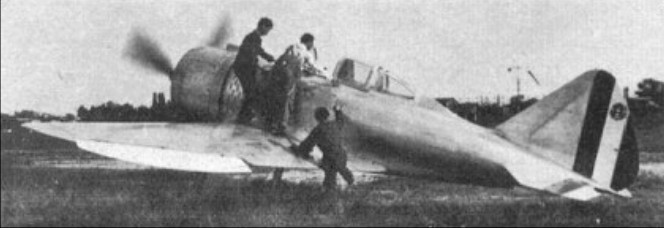
The Regia Marina (Italian Navy) experimented with a carrier version (Serie II) which was successfully launched by catapult. Lacking a carrier, Italy used a similar system to the British CAM ships equipped with Hurricanes. The first proposal was made in late December 1940, although the program officially began with an order issued in April 1943. The first modified Re.2000 Cat. (taken from the Swedish orders) flew on 27 June 1941, the last on 18 January 1942 (MM.8282-8288), but crashed on 10 September. There was another navalized Re.2000, the MM.471. It flew initially with a lower powered A.74 RC.38 engine, but it was lost too, during the travel from Reggio Emilia to Taranto (12 May 1941). The first launch was performed on 9 May 1942 with test pilot Giulio Reiner. The work to make suitable the Re.2000 Cat., nicknamed Ochetta (little goose) took considerable time and only at the beginning of 1943 were they used aboard the Littorio class, but not more than one for every ship (although capable of holding three aircraft). Initially the Re.2000 Cat. aircraft were issued to Littorio and Vittorio Veneto, while Roma followed only in the summer, after testing had taken place aboard the RN Miraglia.
The Re.2000 Cat. was slower than a standard Re.2000; instead of 515–530 kilometres per hour (320–329 mph; 278–286 kn), the maximum speed was only 505–520 kilometres per hour (314–323 mph; 273–281 kn) at 5,500 metres (18,040 ft) km/h at 5,500 m, and 390 kilometres per hour (240 mph; 210 kn) at sea level compared with 541 kilometres per hour (336 mph; 292 kn) for the Re.2000. The climb to 6,000 m was 7,75 min (vs 6,5-7 min), apparently there was not much difference in ceiling 10,000–11,100 m and endurance, range was 450 km, endurance 1,000 km (at 460 km/h), up to km 1,290 (at m 6,000, full loaded, km/h 430). Weights were 2,120–2,870 or, probably with the complete kit, 2,200–2,970 kg; the engine was the P.XIbis, that had 1,000 hp (750 kW) both at take-off and at 4,000 meters. Differing from the Serie I, both Serie II and III variants were equipped with radios. There was the usual Italian armament (two 0.50 caliber Breda machine-guns with 300 rounds each), and some provisions for external loads (tanks or bombs), apparently never utilized.
The Re.2000 were assigned to Squadriglia di Riserva Aerea delle FF.NN.BB. (air reserve squadron for naval battleships), led by Captain Donato Tondi. This was initially based at Grottaglie, then at Capodichino and finally at La Spezia, as air defence for naval bases. The squadron disbanded on April 1943 and was replaced by the 1° Gr. Riserva Aerea delle FF.NN.BB, led by now Maj. Tondi, with three flights. It had all the eight Re.2000s and several old fighters. Many of them were aboard the battleships: two for Vittorio Veneto and Roma, one for Littorio (summer 1943).
Six Re.2000 Cat.s were still available at the time of the Armistice and four were in service aboard the battleships Italia (Littorio before the fall of Mussolini), Roma and Vittorio Veneto (the normal load was only one, the battleship had up to three aircraft, but smaller than the Re.2000). The two left at La Spezia were demolished after September 1943 (they served with 1a Squadriglia). During the Roma ’s sinking (9 September 1943) only one was launched, as they were a single mission aircraft (forced to reach a land airfield); therefore, Do 217s attacked facing only anti-aircraft guns. The fate of the four Re.2000s was as follows: the one on Roma was lost with the battleship; the one of Italia was damaged and jettisoned from the ship, after the Fritz-X impact. One Re.2000 was launched from Vittorio Veneto to catch the intruders, but failed and finally crashed while landing near Ajaccio airfield. The last one survived and it is still existent, the only Re.2000 in Italy (another is in Sweden). This is the MM.8287.
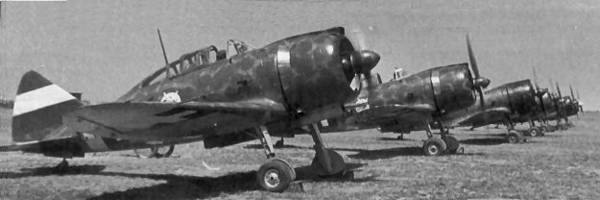
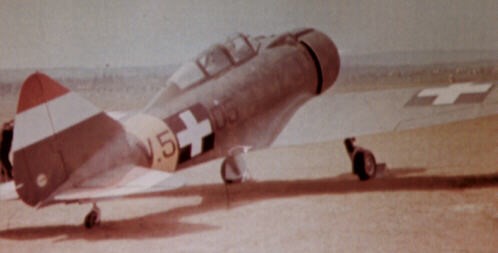
The Serie II and III aircraft were converted from Serie Is and were powered by 1025 hp P.XIbis RC 40 engines. All three versions carried a fixed armament of two 12.7 mm (0.54in) Breda-SAFAT machine guns in the fuselage decking over the engine. These aircraft were known by the Hungarian air force as the Heja 1 (Hawk).
Caprione-Reggiane Re.2000 Falco
German leaders were reluctant to supply the Royal Hungarian Air Force (Magyar Királyi Honvéd Légierő), MKHL, which was seen to be focused on home defence and the possibility of conflict with Romania. Adolf Hitler expressed this in early 1942 when Hungary requested German-built fighters. “They would not use the single-seaters against the enemy but just for pleasure flights!… What the Hungarians have achieved in the aviation field to date is more than paltry. If I am going to give some aircraft, then rather to the Croats, who have proved they have an offensive spirit. To date, we have experienced only fiascos with the Hungarians.”
The MKHL consequently became a significant purchaser of Italian aircraft and was the main operator of the Re.2000. Hungary bought 70 Reggiane Re.2000 Falco Is and then also acquired the licence-production rights for this model to produce a total of 200 aircraft, known as MÁVAG Héja (“Hawk”) II built between 1940 and 1942.
The first aircraft were delivered Debrecen airport unassembled July 1940. In mid-April 1940, representatives of the Hungarian Ministry of Defense, visited the plant Reggiane, saw only a single fighter finished. (delivered 21 May 1940 and designated401 V. (V – Vadasz; Fighter)). The remaining aircraft were not even started because of production problems, including a lack of high-quality aluminum sheet “Alkled”. By December 1940 only seven had been delivered. Thirteen has been prepared for shipment, and the remaining 9 were expected. The total supply of 48 Re.2000 was completed by February 1941, and production of the remaining aircraft and spare parts continued until the end of the year.
August 5, 1941 the Hungarian Ministry of Defence to establish the Independent Fighter Group (Independent Fighter Group – IFG), which consisted of a half squadrons armed with seven new fighters. Formed in Szolnok (Szolnok), she was inducted into the “mobile body” (“Fast Corp”) of the Hungarian army. It included 12 Hejja squadron 1/1 Dongo (“Wasp”) formed in the same Szolnok. ‘Wasps’ commanded by Colonel Kalman Kshukash. The aircraft departed from Hungary July 1, 1942, and reached the front three days later contributing to the German offensive Fall Blau. The flight lost one aircraft which crashed while landing at stake. Another was slightly damaged in Kursk. The case was subject to the German Army Group “South”. The first seven Re.2000 were sent to the front on an experimental basis on 7 August 1941. Under the command of Captain Genesha Laszlo (Laszlo Gyenes) they arrived at Sutiski airfield, 20 km south of Vinnitsa. Squadron III had a proper name – “Ludas Matyi” (Lyudash Mati – the hero of Hungarian folk tales.) Flying alongside the Fiat CR.32s of 1/3 Fighter Company, the Reggiane pilots claimed eight kills, for one loss, during three months of combat, against Soviet Air Force.
Hejja flew escort bombers and assault jobs from August 11 until October 21, 1941, but due to the practical absence of the enemy had only a few dogfights. During this time they lost only one aircraft.
In the summer of 1942, Hungarian Air Force contributed with its 1st Repülőcsoport (aviation detachment) to the German offensive Fall Blau. 1/1 Fighter Group (1./I Vadász Osztály) equipped with 13 Re.2000s or Héjas, reached its first front base near Kursk on 2 July. By 3 August, 2/1 FS joined the other Hungarian fighter unit, that had moved to Ilvoskoje airfield. The Hungarians arrived to the location, but sent one plane, “the bride” to exclude mistaken identity with I-16 by the neighbouring Germans. This was ineffective and Hungarian planes often fired by their allies. Two 1/1 Hejja and were shot down, but the crew managed to jump with parachutes. The task of 2/1 was to escort short-range reconnaissance aircraft, while 1/1 would support bombing missions. Combat performance against the Soviet Air Force was satisfactory. On 4 August the Hungarians claimed their first kills, when Ens Vajda shot down two enemy aircraft. Caught in the dense anti-aircraft fire one aircraft (tail number V-420 pilot Gyula) was lost. The first Hungarian ace of the war, 2/Lt Imre Pànczél, claimed his first air victories while flying the Re.2000, three of them in one sortie, in 1942. However, the Re.2000’s flight characteristics were markedly different to the Fiat CR.32, from which Hungarian pilots frequently converted. The Re.2000 was much more prone to handling difficulties, especially stalls and spins, as well as reliability issues. All the 24 Re.2000s had suffered accidents (minor and major) within a month of combat deployment. Piaggio P.XI engine proved to be a mechanical nightmare for the mechanics. Landing and takeoff accidents were common on the rudimentary Russian airfields and due to the Re.2000 not having a rugged landing gear, compared to that of the CR.32. After a steel plate was added behind the cockpit to protect pilots, the shift in the aircraft’s center of gravity led to more frequent accidents.
In the summer of 1942, Hungarian Air Force. 1/1 Fighter Group (1./I Vadász Osztály) equipped with 13 Re.2000s or Héjas, reached its first front base near Kursk on 2 July. The day after the arrival the Hejja began to make trial flights and on July 5, 1942 1/1 squadron was declared combat-ready. The Germans initially entrusted the Hungarians for intelligence, though later added bomber escort. The fighters were transferred on July 13 to Stary Oskol, and four days later, were involved in a combat operation to provide air cover for an armoured regiment operating in the area. Over the next few days the Hungarians escorted aircraft spotters.
On July 30, 1942 at Kolozsvar came second squadron – 2/1 “Keresztes Pok” (Spider Araneus) consisting of eleven and two Re.2000 Vi-131, commanded by Captain Kerestesha Bela (Bela Keresztes). 2/1 and 1/1 squadron was deployed to Ilovskoe 3 and 5 August, respectively. 1/1 was assigned to escort bombers, while 2/1 – on cover of spotters. 1/1 squadrons had difficulties because of problems in the maintenance of aircraft and frequent equipment failures. The aircraft of lieutenant Peterffi Andorra was lost on August 7 in a dogfight over Korotoyak. On August 8, the division had only four combat-ready Hejja. During the last month of summer, Hungarian pilots declared victory over the five Soviet aircraft. They also had two and a “probable” victory in September.
In a much publicized mishap, 1/Lt István Horthy (the son of the Hungarian regent Miklós Horthy), serving as a fighter pilot with the Hungarian Second Army died flying a Re.2000 V-421 with 1/3 Fighter Squadron on 20 (on 18, according to other authors) August 1942, on his 25th operational sortie. After a pilot flying above asked Horthy to increase height, he pulled up rapidly, stalled and crashed. Nevertheless, the determined Hungarian pilots kept on flying combat missions and scoring a number of kills against the Soviet fighter, if they managed to force their Russian opponents into a dogfight, thanks to the maneuverability of the Italian built plane. The Hungarians Re.2000s had their most successful day on 9 August 1942. That day, near the village of Davidovka, 16 Ilyushin Il-2s and a similar number of LaGG-3S were intercepted by four Reggianes. The Hungarians downed four LaGGs, suffering the loss of the Re.2000 of Lt Takács, who crash-landed behind his own lines, wounded.
In October 1942, the 1/1 squadron was withdrawn for conversion and retraining on the Bf. 109F and later became part of the group III 52 fighter squadron of the Luftwaffe. At the same time they continued to fly at 2/1 with Hejja Ilovskogo. However, in early November of the squadron 2/1 four pilots were selected for transfer to Bf. 109. In December the squadron ubyla Hungary.
On October 20 Reggiane five went to home, however, over the Carpathian Mountains, they were in a thick fog. As a result, two cars crashed into a mountain, and one was badly damaged during a forced landing.
December 25, 1942 came 5 th Fighter Division in the squadron 5/2 (there were 13 Re.2000 and Ag.96). But after two weeks, only six of these fighters considered suitable to operate as three Hejja required new engines, three others had significant, though not fatal damage, and one embarked “on its belly”, in serious need of repair. On January 12, 1943, Soviet troops launched an offensive in the area of the 2nd Hungarian Army northwest of Stalingrad. Re.2000, together with other aircraft tried in vain to stop the offensive. Two Re.2000 were sent to escort German bombers in the afternoon. The group left on purpose under the guise of cloud, but soon were linked fighters fight, but were able to avoid losses.
The Hungarian Reggianes flew their last sorties on the Soviet front on 14 and 15 January 1943, when they took off for uneventful patrols and reconnaissance missions. Between 16 and 19 January, with Red Army rapidly approaching Ilovskoje airfield, and with no time to heat the frozen Piaggio engine oil, mechanics blow up the last unserviceable Hejas.
The surviving Reggianes were kept in Hungary for home defence. Production of licence-built Hejas continued: 98 were completed in 1943 and 72 in 1944 although the variant was regarded as no longer suitable for combat against the latest Soviet fighters. Hungary requested an additional 50–100 Re.2000 airframes made in Italy, as suitable engines and armament could be locally manufactured and other countries expressed interest, including Finland (100 examples), Portugal (50), Spain, Switzerland and Yugoslavia. However, no airframes were available.
Re.2000 Serie I / MÁVAG Héja I Production model, 157 built. Serie I had modified windshield and slight equipment changes.
Re.2000 Serie II Ship-borne version, 10 built. Serie II had a 1,025 hp Piaggio P.XIbis engine and arrester gear.
Re.2000 (GA) Serie III Long-range fighter, 12 built. Serie III had redesigned cockpit, increased fuel capacity and option of a 170 l auxiliary fuel tank or a dispenser of 22 2 kg bomblets.
RE 2000 “Catapultabile” Re 2000 aircraft modified for catapult launch from Regia Marina ships. On the day of the armistice, 8 September 1943, 6 Re 2000 “Catapultabile ” were in service, with two on the battleship Roma and one each on the Vittorio Veneto and Italia (formerly the Littorio).
Variation: MÁVAG Héja II
Specifications:
Re 2000 Falco I (Falcon) / J 20 / Heja 1 (Hawk) Engine: Piaggio P.XI RC 40, 986 hp (736 kW) (1000 CV) at 4,000 m (13,125 ft) Propellers: Piaggion-D’Ascanio P.1001 three-bladed constant speed propeller Propeller diameter: 3.10 m (10 ft 2 in) Wing span: 11m (36 ft 1 in) Wing area: 20.40 m² (219.6 sq ft) Length: 7.99m (26 ft 2.5 in) Height: 3.20 m (10 ft 5⅞ in) Empty weight: 2,090 kg (4,585 lb) Normal T/O weight: 2595 kg (5,722 lb) Gross weight: 2850 kg (6285 lb) Maximum speed: 530 km/h (268 knots, 329 mph) at 5,300 m (17,400 ft) Cruise speed: 440 km/h (237 knots, 273 mph) Range: 545 km (296 nmi, 340 mi) Climb to 4,000 m (13,125 ft): 4 min Service ceiling: 11,200 m (36,745 ft) Endurance: 1.25 hours Armament: 2 x 12.7 mm (0.54in) Breda-SAFAT machine gun Crew: 1
Re 2000 Falco 1 Serie II Engine: 1025 hp P.XIbis RC 40 Armament: 2 x 12.7 mm (0.54in) Breda-SAFAT machine gun Crew: 1
Re.2000 Serie 3 long-range fighter Engine: 1025 hp P.XIbis RC 40 Hard point load: 2000-kg (4,405-lb) Armament: 2 x 12.7 mm (0.54in) Breda-SAFAT machine gun Hard point load: 200 kg / 440 lb Crew: 1
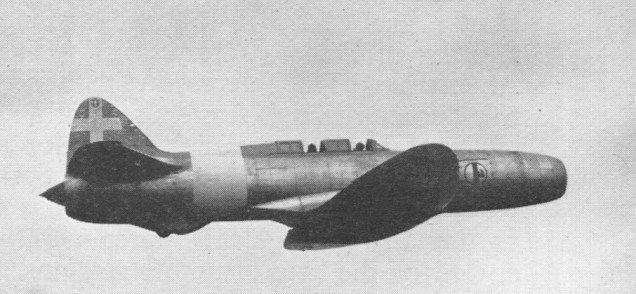
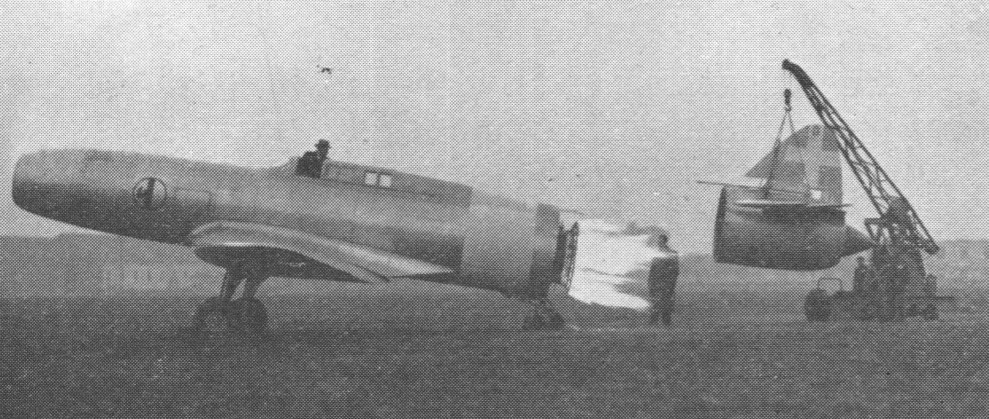
The engineer Secondo Campini had created a company in 1931 to pursue research into reaction propulsion and in 1939 persuaded Caproni to build an aircraft for an adaptation of an Isotta-Fraschini radial engine driving a ducted fan compressor. The compressed air was exhausted through a variable area nozzle in the aircraft’s extreme tail, and additional fuel could be ignited in the tailpipe to increase thrust. The N1 became a large aircraft design piloted by two personnel. It was a low-wing monoplane with a traditionally-designed empennage and a single vertical tail surface. The intake was open at the extreme forward position and exhaust jettisoned at the extreme rear of the aircraft. Landing gear was powered and fully retractable. Keeping with early “jet” designs of the time, wings were straight-wings and featured the distinct smooth curves of piston engine fighter designs. The N1 would achieve a top speed of only 233 miles per hour. The two seat low wing N1 (sometimes referred to as the CC.2) was first flown at Taliedo on 28 August 1940 by Mario de Bernadi. A number of set piece demonstration flights were undertaken, including one of 270 km (168 miles) from Taliedo to Guidonia at an average speed of 209 km/h (130 mph). It was clear from the outset that use of a three stage fan-compressor driven by a piston engine would limit further development, and the experiment was abandoned early in 1942 when Italy was faced with more serious priorities. The N1 survives in the Museo della Scienza Technica at Milan as a monument to ingenuity if not sophisticated technology.
Engine: one 900 hp (671 kW) Isotta Fraschini radial piston engine driving a three stage ducted fan compressor. Wing span: 15.85 m (52 ft 0 in) Length 13.10 m (43 ft 0 in) Wing area: 36.00 sq.m (387.51 sq.ft) Empty Weight: 8,025lbs (3,640kg) Maximum Take-Off Weight: 9,248lbs (4,195kg) Maximum Speed: 233mph / 375kmh / 202kts Service Ceiling: 13,123ft / 4,000m Crew: 2
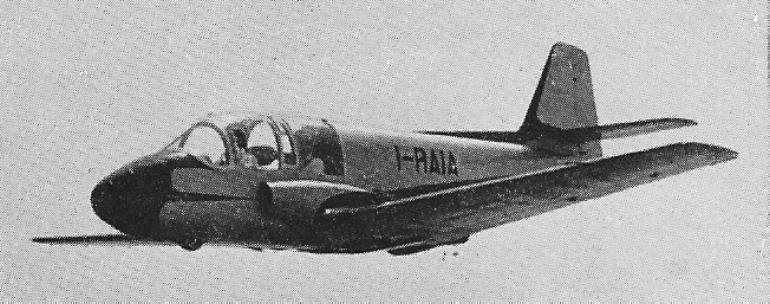
The F.5 tandem two-seat training monoplane designed by Stelio Frati was the first light jet aircraft of Italian design, flying for the first time on 20 May 1952.
Powered by a 330 lb Turbomeca Palas turbojet, the F.5 is of all wood construction, with dual controls and jettisonable canopies. A retractable nosewheel undercarriage is fitted.
Engine: 330 lb Turbomeca Palas Wing area: 107.63 sq.ft Wing span: 25 ft 8 in Length: 21 ft 7.5 on Empty weight: 1032 lb Loaded weight: 1650 lb Max speed: 224 mph at SL / 242 mph at altitude Time to 16,400 ft: 23 min Service ceiling: 23,300 ft
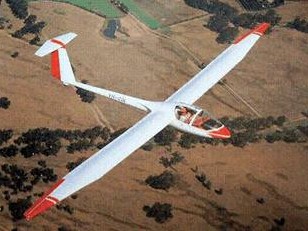
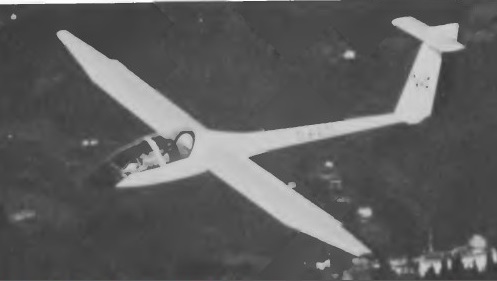
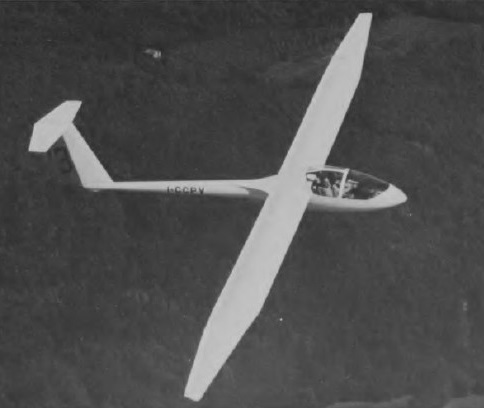
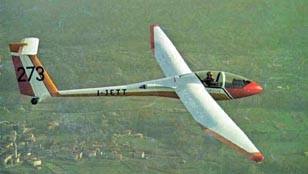
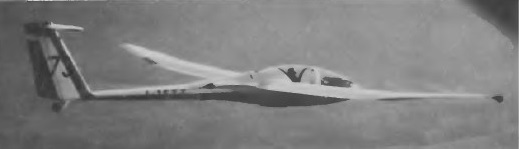
Designed by G. Ferrarin and L. Sonzio, the original A-21, the prototype of which made its first flight on 23 November 1970, was a high performance two-seat version of the A-14, from which it differed in having a slightly longer fuselage widened to accommodate two in luxurious side-by-side seating.
This version was succeeded by the A-21S, which held four world records for two-seaters; among these is the Class D2 speed record for women over a 300km closed circuit, set up on 18 August 1974 by Adele Orsi and Franca Bellingeri in an A-21S at a speed of 60.73mph.
Caproni Vizzola Calif A-21 S
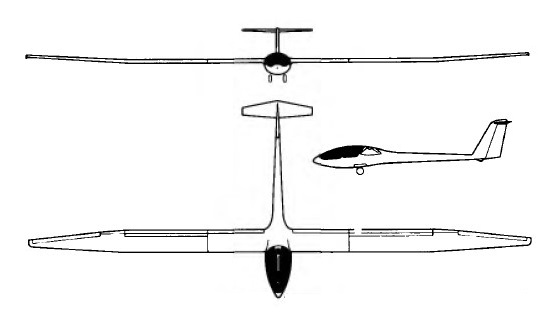
The cantilever mid wings have a wide constant chord centre section and tapered trapezoid outer panels, and are all-metal; the three-piece all-metal main spar is supplemented by two auxiliary spars in the centre section and one in each outer panel, the downturned wing tips being of glassfibre. The trailing edge flaps/spoilers can act as air brakes when deflected to 89 downwards, and as camber-changing surfaces between ±8°; the plain ailerons are differentially-operated. The forward fuselage is a glassfibre/foam plastics semimonocoque structure with a load-carrying light alloy frame, and the rear fuselage is a thin boom of all metal stressed skin construction. The distinctive high aspect ratio fin and rudder is all-metal, and has the all-moving metal tailplane and elevator, which both have glassfibre tips, mounted on top; the tailplane trim is spring-adjusted. The mechanically retractable twin main wheels have rubber-incompression shock absorbers and a brake, and there is a fixed steerable tailwheel, as well as a small wheel in each downturned wing tip. The two pilots have dual controls under a rearward-sliding two piece canopy, and sit in luxury seating equivalent to the best light plane standards.
Over 100 A-21S Califs had been built, production of a third batch of 54 being ordered by January 1980.
With 66.9 feet of wingspan, the A-21SJ is the only production turbojet-powered sailplane in the world. It offers side-by-side seating and all-metal construction. The engine retracts into the fuselage just aft of the cockpit. Cruise speed is 124 mph and climb is 945 fpm. On 36 gallons of fuel, range is about 217 miles, with a ceiling of 43,300 feet. Takeoff run requires only 1,181 feet. Up to 90 percent of the parts between the sailplane and the motorglider are common to both, so the glider can be transformed easily into a jet glider, even in retrofit. The landing gear for both aircraft features dual main gear that retract into the undercarriage. Two small wheels are built into the wingtips. The wing is all-metal with a single spar, stressed skin, and fiberglass tips; the wing is fitted with top-hinged, differentially operated ailerons plus lower-hinged, aerodynamically balanced flaps/spoilers. The fuselage has a monocoque forward section of fiberglass with a load-carrying lightweight alloy structure. The tailboom is an all-metal stressed-skin unit ending in an all-metal single-spar tailplane. Caproni (which built its first glider in 1908 at Vizzola Ticino, Italy) produced the first A-21 (designed by Carlo Ferrarin and Livio Sonzio) in 1970, and within two years had collected four world multi-place sailplane speed and distance records with it. A 2-place all-metal ship with a fiberglass forward fuselage, the A-21 was followed into production by the slightly improved S model. The ship features a roomy side-by-side cockpit and widely spaced retractable twin landing wheels. Aft-hinged brakes on the lower surface, and these, with large flaps (which deflect to +89 degrees) limit speed in a vertical five to 188 kph / 102 kt / 117 mph. The T-tail is all moving. A steerable tail wheel and water ballast were optional. The Calif A-21S was produced im a small-series produced (6 aircraft) at the Gomolzig Flugzeug- und Maschinenbau. The Italian construction offers good performance (comparable to Janus C) and good flying characteristics, giving the aircraft a broad range of applications reaching from advanced training and guest flights up to performance flights. Only for competition flights in the double-seater class, it is exceeding the 20-meter definition by a few centimeters. The A- 21S cost approximately 20000 Marks less than a Duo Discus and features a fixed tailplane. The A-21JA self launch jet model is a 2 place, side by side all metal sailplane. Forward fuselage is glass fibre. Dual, manually retracting undercarriage. Fixed tail wheel. Rudder pedals adjustable. Both seats adjustable. Extremely powerful trailing edge flap / brakes. Flaps have a thermal setting, cruise setting and fully variable down for landing. Automatic control hook up. No manufacturers fatigue life limit. A very high quality structure, built by an aircraft manufacturer not a glider manufacturer. It was well and truly “state of the art” in 1974.
First flying in late January 1972, the A21 J jet version added a SERMEL TR18 100 kp thrust (220 lb) jet engine. The span was reduced from 22.87 to 20 m, and overall length increased from 7.27 to 8m. The tare weight (equipped) is reduced from 484 to 434 kg. The engine is mounted in the lower part of the fuselage, behind the seat, the ejection of gas under the fuselage. The volume of wing and fuselage tanks hold 160 litres of kerosene. The engine is started with a compressed air bottle.
A21 J
In 1976 the first prototype of the A- 21J was purchased by Lockheed to be used in a research program conducted in cooperation with the Mississippi State University. The experiments concerned inter alia the effects of wind, dust, insects and rain on some wing sections, as well as measures and vortex noise rappport the fuselage. In the initial test phase, the A- 21J was towed to the appropriate altitudes.
The J was succeeded by the A-21SJ, which first flew in May 1977 and was based on the production A-21S sailplane. The main difference between the A 21A and A 21 SJ is the positioning of the 198 lb st Microturbo TRS 18-046 turbojet engine. In remains in the fuselage behind the pilot, but now in the top position. Its air intake is by a removable NACA inlet located on the back of the fuselage. The ejection of the exhaust is by a nozzle opening on each side of the fuselage. The A-21SJ has a metal fuselage with fiberglass monocoque forward section surrounding aluminum load-carrying structure; all metal wings and tail with minor fiberglass fairing.
Caproni Vizzola Calif A-21SJ
Up to 242.5 lb of fuel is carried in fuselage and wing tanks, and there is a starter/generator and batteries for in-flight and ground starting. Apart from the engine the A-21 SJ is very similar to the A-21S, but has larger mainwheels and tailwheel. Two A-21SJs had been completed by May 1979 and five more were being built. One A-21SJ was being tested with a more powerful Microturbo TRS 18 jet of 242.5 lb st.
Prototype A21J Span: 20 36 m Length: 7 84 m Height: 1.919 m Wing area: 16,19 m² Wing loading: 39.8 kg / m² Maximum weight: 644 kg Max speed: 255 km / h Climb speed: 63 km / h
A 21J Engine: Sermel TRS 18, 220 lb. Seats: 2. Wing loading: 8.91 lbs/sq ft. Wing aspect ratio: 25. Gross: 1,543 lbs. Empty: 957 lbs. Useful: 586 lbs. Max airspeed: 162 kts. Rough air speed: 162 kts. Stall: 41 kts. Lift / drag: 43 at 63 kts. Sink: 1.97 fps at 49 kts. Fuel: 236 lbs. Length: 26 ft 3 in. Wing span: 65 ft 7.5 in
A-21JA Glide ratio: 1:43 at 58 kt / 1:42 at 60 kt. Never Exceed Smooth Air: 138 knots Max Rough Air: 91 kts Stall: 34 /38 knots Climb rate: 650 ft/min Ceiling: 30,000 ft Power Cruise: 115 kts
A-21S Span: 66ft 10.5 in Length: 25ft 4.5 in Height: 5ft 8.5 in Wing area: 174.3 sqft Aspect ratio: 25.65 Empty weight: 961 1b Max weight: 1,419 lb Max speed: 156 mph Max aero-tow speed: 87 mph Min sinking speed: 1.97 ft/sec at 53 mph Best glide ratio: 43:1 at 65 mph
A-21 SJ Span: 66 ft 10.25 in Length: 25 ft 4.5 in Height: 5 ft 3.5 in Wing area: 174.3 sqft Aspect ratio: 25.65 Empty weight: 1,164 lb Max weight: 1,781 lb Max level speed: 143 mph (power on) Max rate of climb: 787 ft/min (sea level, power on) Take-off run: 985 ft (power on)