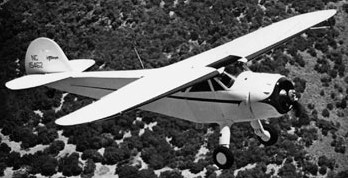
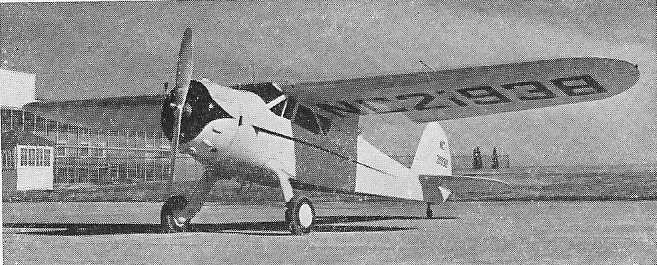
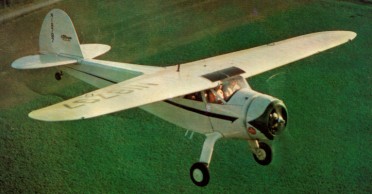
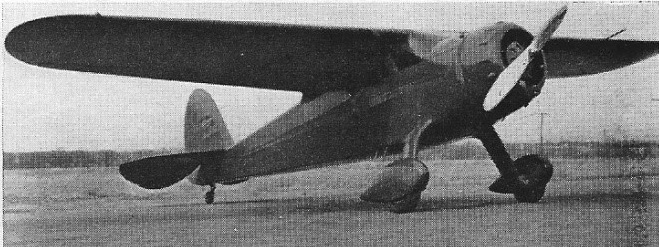
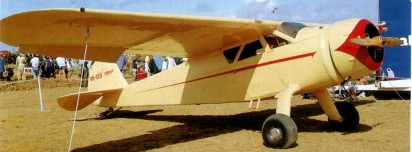
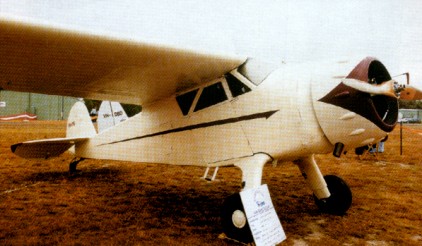
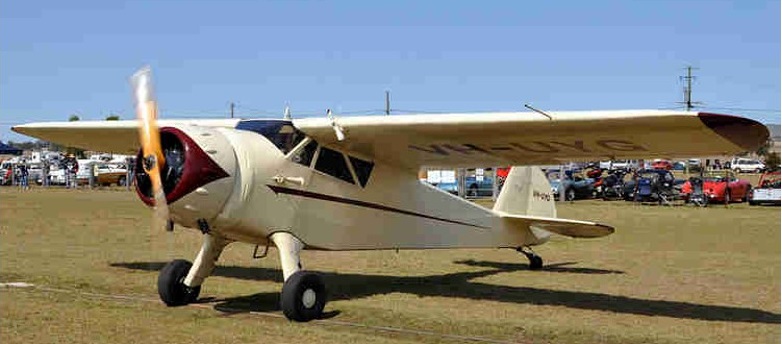
The C-145 Airmaster was basically a modified C-34 featuring revised flaps and a wider gear. In 1932, the Airmaster was made available with the 165-hp Super Scarab, and the line continued in production until 1942. Forty-two were built.
Engine 145-hp Warner Scarab radial Wingspan: 34 ft 2 in Length: 24 ft 8 in Gross wt. 2,450 lb. Empty wt. 1,380 lb. Top 162 mph. Cruise 150 mph at 8200 ft Stall 50 mph. Initial climb rate 1,000 fpm. Range 472-785 miles. Ceiling 18,000 ft. Seats 4.
A prototype of the C-38 is unveiled on October 11, 1937. It becomes the first Cessna airplane to be called the Airmaster. The 1938 Model C-38 again featured minor improvements, with some of the previously optional equipment fitted as standard; airframe changes included the provision of wider track landing gear and a large under-fuselage flap which served as an airbrake to reduce landing speed. It was very fast for its horse¬power – 140 to 150 mph with a 165 hp Warner, and it was the first of the small business planes with enough performance to be practical in instrument flying. Since the Airmaster came on late in the era, after suitable instruments and radios became available, most of them were equipped for weather flying and were instrumental in leading the way to really practical use of airplanes for business transportation. Production of the C-38 amounted to 16 aircraft.
C-38 Engine: 1 x Warner Super Scarab radial, 108kW Take-off weight: 1066 kg / 2350 lb Empty weight: 621 kg / 1369 lb Wingspan: 10.41 m / 34 ft 2 in Length: 7.52 m / 24 ft 8 in Height: 2.13 m / 6 ft 12 in Wing area: 16.81 sq.m / 180.94 sq ft Max. speed: 261 km/h / 162 mph Cruise speed: 230 km/h / 143 mph Ceiling: 5485 m / 18000 ft Range: 885 km / 550 miles
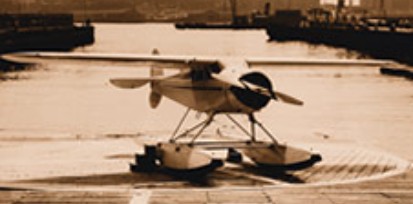
The C 34 success was followed by an improved version of the 34, the C 37, introduced in 1935. When equipped with Edo floats, it becomes the first Cessna model to receive seaplane approval. The Model C-37, introduced during 1937, brought in minor improvements to the furnishing of the cabin, which was widened by 12.7cm, and was fitted with electrically operated wing trailing-edge flaps. Some 46 C-37s were built, and one impressed in 1942 was designated UC-77C.
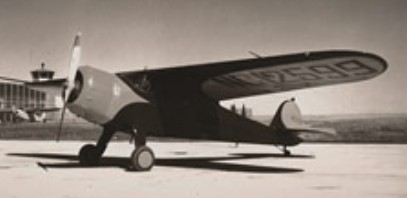
In 1933, Cessna was back in business again, this time with an improved version of the AW, featuring an improved landing gear and a 145-hp engine. This first model, designated the C-34, was possibly the most efficient airplane in its class, and nearly 100 were built.
The first production C-34 is sold in 1935.
C-34
Dwane Wallace, the nephew of Clyde Cessna, as a plant manager at no salary had the opportunity to design, build, test, fly, sell and race the company’s products. Wallace designed the C 34, a high-wing, four place cabin monoplane with a 108kW / 145 horsepower Warner Super Scarab engine. The airplane retained the fully cantilevered wing of earlier Cessnas but added flaps.
In June 1935 the prototype Model C-34 first flew, piloted by George Harte. It was capable of achieving a maximum speed of 261km/h. Wallace flew the C-34 for more than 4,000 hours in its first five years, including a trip to Mexico where it reportedly averaged 17 miles per gallon.
C-34
Among its racing wins was the Detroit News Trophy for “The World’s Most Efficient Airplane.” Eldon Cessna first won the race in 1931 in a Cessna model AW, after which was shut down due to the depression. However, four years later, it was restarted in 1935, and Cessna test pilot George Harte won the race, followed by another Cessna win in 1936. This triple-win meant that Cessna was allowed to keep the trophy permanently, and the C-34 was designated the world’s most efficient aircraft.
Forty-two were built, two being impressed for USAAF under the designation UC-77B.
The Cessna CR-3 custom racer makes its first flight on June 11, 1933. The plane wins the 1933 American Air Race in Chicago and later sets a new world speed record for engines smaller than 500 cubic inches by averaging 237.4 mph.
Johnny Livingston of “Seagull” fame had a CR-3 specially built for him with retractable landing gear, a cantilever wing and a 145 hp Warner engine. It was successfully flown by Johnny Livingstone in every race he entered in 1933.
Eldon Cessna, Clyde’s son, designed the single-seat 19kW Cleone-powered EC-1 and two-seat EC-2 with a 22kW E-107A engine, both intended as low-cost, cheap-to-operate aircraft to meet the new economic conditions. Only the glider achieved production status before the company ceased operations, not to resume until January 1934.
During 1931-33 the company produced several experimental models, and aircraft to special requirements, mostly racers. In 1932 the CR-2 appeared. It was powered by a 145 hp Warner engine and featured a retractable undercarriage and mid-wing. It was flown by Roy Liggett in the American Air Races that year.
During 1931-33 the company produced several experimental models, and aircraft to special requirements, mostly racers. Following the GC-1, the GC-2 of 1930 was a single-seat racer powered by a 110 hp Warner engine.
During 1931-33 the company produced several experimental models, and aircraft to special requirements, mostly racers. A third one-off special was the GC-1 single place racing monoplane, powered by an inverted 95 hp Cirrus Ensign.
During 1931-33 the company produced several experimental models, and aircraft to special requirements, mostly racers. The Cessna FC-1 was a one-off cabin monoplane. The two-place, powered by a 95 hp Cirrus Ensign engine, was used for racing.