A braced high-wing monoplane powered by a 100 hp Kinner radial engine.
1 engine
Avions Jacques Coupe JC-01 / JC-2 / JC-3 / JC-200

Designed by Jaques Coupé, the Coupé-Aviation JC-01 is the first of a series of very similar designs of two seat, single engine sports aircraft, amateur built from plans in France from 1976. These provided a range of engine sizes and undercarriage layouts, but total production was small. Design emphasis was placed on ensuring that homebuilders would find it easy to construct, and plans became available through Coupé-Aviation.
The first was designated JC-01, a side-by-side two-seat light-plane. It had a non-retractable tail wheel type landing gear and was powered by a 65 hp Continental A65-8F flat-four engine. It was flown for the first time on March 16, 1976, registered as F-PXKV (c/n 01).
The JC-01 and its variants were designed as conventional two-seat side by side light aircraft that could be built from plans by amateurs. The different models are chiefly distinguished by engine choice, though undercarriage configurations vary and there are slight alterations to the vertical surfaces. Coupé subsequently began construction of a derivative of the JC-01 in September 1976. Designated JC-2, it was generally similar to the JC-01 but had a 90 hp Continental A65-8F flat-four engine. It flew for the first time on May 7, 1981, registered F-WYJI (c/n 01), after gaining its CofA it was reregistered F-PYJI.
Of wooden construction, covered with plywood and fabric, the J-01 and the J-2 have identical spans, wing areas and lengths, though the J-2, with a 90 hp rather than 65 hp engine and a tricycle rather than conventional undercarriage weighs more: empty, the J-01 weighs 330 kg (728 lb), the J-2 500 kg (1,103 lb).
The J-2 has a constant chord, one piece low wing. Its inner panels have no dihedral but the outer ones are set at 4°. Both the main box spar and the rear spar have spruce booms and plywood webs. The leading edge is ply covered and fitted with fixed slots. The wing, including ailerons and flaps is Dacron covered overall. The empennage of the J-2 is conventional and cantilever, with the horizontal tail mounted on top of the fuselage; both fin and rudder are swept, the latter only slightly. The fixed surfaces are ply covered but control surfaces are fabric covered. The elevator has a trim tab.
The fuselage of the J-2 is a three frame truss structure with a ply covered forward section and fabric covering aft. A 67 kW (90 hp) Continental C90 flat four engine in the nose drives a two-blade, fixed pitch propeller. Its fuel is stored in a tank immediately aft of the engine firewall. The cockpit, placed over the wing, seats two side by side under a large, rearward sliding canopy, with a space behind the seats which can take up to 20 kg (44 lbs) of baggage. The J-2 lands on fixed tricycle gear. The mainwheels have oleo-pneumatic damping and mechanical brakes; the nosewheel swivels.
Plans were available to amateur builders for the construction of the JC-01 and its variants and about a dozen JC-01s were built. Two remained on the French civil aircraft register in 2010, together one example of each of the other variants making the total number of all variants built at least fifteen. Some builders included their own name and initials in the aircraft description, for example the Dessevres-Coupé JCD 01 and the Coupé-Brault JCFB 01.
The JC-200 was a refined version of the JC-2, the first example was flown on August 18, 1989.

Variants:
JC-01
Original version with 48 kW (65 hp) Continental A65 engine and unswept rudder. Later the prototype was modified with a swept rudder. At least one was built with a Limbach 1700 engine. Tailwheel undercarriage. First flown 16 March 1976.
JC-2
Similar to JC-01 but with a 67 kW (90 hp) Continental C90, 50% heavier, swept vertical tail and tricycle undercarriage. First flown May 1981.
JC-3
Lightened JC-01 with swept vertical tail and 51 kW (68 hp) Limbach L 1700 or 60 kW (80 hp) L 2000 engine.
JC-200
“Refined” version of JC-2 with a 75 kW (100 hp) Rolls-Royce Continental O-200 engine, first flown 18 August 1989.
Specifications:
JC-01
Engine: 1 × 48 kW (65 hp) Continental A65
Empty weight: 330 kg (728 lb)
JC-01
Engine: 1 × Limbach 1700 engine
JC-2
Engine: 1 × Continental C90, 67 kW (90 hp)
Propellers: two-bladed fixed pitch wooden
Length: 6.40 m (21 ft 0 in)
Wingspan: 8.35 m (27 ft 5 in)
Wing area: 11.70 m2 (125.9 sq ft)
Aspect ratio: 5.95
Airfoil: NACA 23012
Empty weight: 500 kg (1,102 lb)
Max takeoff weight: 750 kg (1,653 lb)
Fuel capacity: 90 L (20 Imp gal; 24 US gal)
Baggage capacity: 20 kg (44 lbs)
Maximum speed: 200 km/h (124 mph; 108 kn)
Cruising speed: 160 km/h (99 mph; 86 kn) economical
Stall speed: 45 km/h (28 mph; 24 kn) flaps down
Capacity: two
Undercarriage: Tricycle
JC-3
Engine: 1 × 51 kW (68 hp) Limbach L 1700
JC-3
Engine: 1 × 60 kW (80 hp) L 2000 engine.
JC-200
Engine: 1 × 75 kW (100 hp) Rolls-Royce Continental O-200
Country Air Space-Walker
Warner Aerocraft Inc made available plans and kits to build single-seat Revolution 1 and two-seat Revolution II low-wing monoplanes, based on former Country Air Space-Walker.
Coughlin SE-5A replica
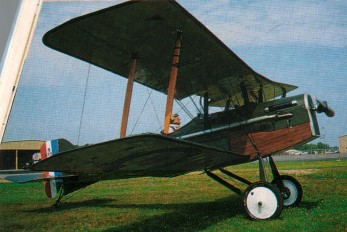
Dick Coughlin, a retired dentist, began building a full size SE-5A replica in the arly 1990s. Coughlin began with the original plans that he then revised for homebuilding.
Construction is of steel tube, wood and fabric. Power is supplied by a Dave Blanton conveted Ford V-6.
Cottle Ultra One

The aircaft was a Rans S4 Coyote Kit that was modified and registered N808KC with the FAA as a light sports Ultra One SN 101. Completed by Kenneth Cottle in 2005, the Ultra One has basic Instruments: airspeed, vertical speed, altimeter, rpm, cht, egt, external antenna, and electric start. The undercarriage has aluminium spring.
Engine: 1 x Rotax 503DC, 52 hp
Propeller: Warp Drive 2 blade ground adjusted
Wingspan: 29.5 ft
Length: 17 ft
Wing area: 127 Sq. ft
Empty Weight: 428 lbs
Gross Weight: 744 lbs
Fuel capacity: 12 USG
Cruise: 60-75 mph
VNE: 95 mph
VSO: 29 mph
VX: 50 mph
VY: 55 mph
Climb rate: 600-700 fpm
Take off and landing dist: <500 ft
Seats: 1
Cosvus Phantom

Stall: 35 kt / 40 mph / 65 kmh
Cruise: 97 kt / 112 mph / 180 kmh
VNE: 146 kt / 168 mph / 270 kmh
Empty Weight: 0 kg / 0 lbs
MTOW Weight: 214 kg / 472 lbs
Climb Ratio: 1600 ft/min / 8.1 m/s
Cosvus Corone Mk.I

The main aspect of contructing Corvus Corone aircraft was to create a spacious, economic. Two-seater light sport aircraft using high-tech composite technology. Primarily it is designed for long distance crooss-country flight and towing gliders.
The design of Corone is traditionai with the engine in the front and with nose-wheel. The fuselage is made with kevlar honeycomb sandwich structure containing carbon and glass fibre soaked with epoxy resin. All the elements of the fuselage are produced with vacuum technology using pre-preg textile and patterns.
The low position cantilever semimonocoque wings consist of two parts. The required torsion stiffness is provided by the wing skin panels. The Frise ailerons and the slotted trailing edge flaps provide outstanding performance. The removable fuel tanks are placed in the wings.
The horizontal and vertical fin, the ailerons, the flaps, the rudder and the elevator are of pure monocoque structure. The nose wheel can be controlled with the rudder pedals. The pedals can be adjusted to the size of the pilot. The two pilots are seated side by side in the cabin. Both seats are equipped with 4 attachpoint seat belts. Corone can be controlled from either seat. The throttle, the mechanical or electronic flap and elevator trim control are on the central console. The main gear differential breaks can be operated by tilting the pedals. The sport or deluxe canopy is actuated with electric motor or gas-telescope, opening forward.
In pieces the Corone can be stored even in a garage. It is easy to remove the wings and the horizontal stabilizator.
The computer which is located at the middle of the instrument panel collects all the engine and flight parameters and shows them on an LCD monitor. In case of emergency the computer gives light and audio alert signals. The Corone can be equipped with analog instruments.
Stall: 32 kt / 37 mph / 60 kmh
Cruise: 119 kt / 137 mph / 220 kmh
VNE: 143 kt / 165 mph / 265 kmh
Empty Weight: 320 kg / 705 lbs
MTOW Weight: 600 kg / 1323 lbs
Climb Ratio: 1600 ft/min / 8 m/s
Take-off distance (50ft obstacle): 950 ft / 290 m
Landing distance (50ft obstacle): 1050 ft / 320 m
Cosmos Helios
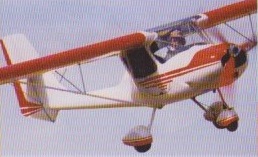
Built almost entirely of composited, it was planned, circa 198, to build the Helios from the new Cosmos factory at Darois Aerodrome.
Engine: Rotax 582, 64 hp
Wing span: 10.9 m
Wing area: 15.7 sq.m
MAUW: 450 kg
Empty weight: 154 kg
Fuel capacity: 60 lt
Max speed: 165 kph
Cruise speed: 130 kph
Minimum speed: 60 kph
Climb rate: 4 m/s
Fuel consumption: 10 lt/hr
Seats: 2
Price (1998): 142,500 Fttc
Kit price (1998): 122,280 Fttc
Cosmos Samba Topless

A small single seater for hang glider wings, circa 1998.
Empty weight: 79 kg
Wing span: 10.12 m
Wing area: 13.50 sq.m
Fuel capacity: 10 lt
Engine: Zenoah G25 B1, 22 hp
MAUW: 180 kg
Seats: 1
Max speed: 95 kph
Cruise speed: 60 kph
Minimum speed: 32 kph
Climb rate: 3 m/s
Fuel consumption: 4 lt/hr
Price (1998): 37 265 Fttc
Cosmos Phase

Manufactured in France, the strut-braced trike has gas shocks and can be fitted with factory options including floats, tow system, and spray system. The kit price includes engine and prop.

The Phase II 503 Chronos 16 uses the same basic trike unit and engine as the Zoom, but uses a double-surface wing.


The Phase II 618 ES Chronos 16 Float has the 76 hp Rotax and has enough power to handle floats. Without floats it is good for towing a hang glider.

Phase 2 / Zoom
Engine: Rotax 503, 52 hp.
HP range: 46-70.
Speed max: 75 mph.
Cruise: 48 mph.
Range: 175 sm.
ROC: 500 fpm.
Take-off dist: 150 ft.
Landing dist: 170 ft.
Service ceiling: 15,000 ft.
Fuel cap: 10 USG.
Weight empty: 315 lbs.
Gross: 750 lbs.
Height: 12 ft.
Length: 8 ft.
Wing span: 35 ft.
Wing area: 151 sq.ft.
Seats: 2.
Landing gear: nose wheel.
Cosmos Phase II 503
Empty weight: 130 kg
Wing span: 10.6 m
Wing area: 19 sq.m
Fuel capacity: 55 lt
Engine: Rotax 503 DCDI, 52 hp
MAUW: 350 kg
Seats: 2
Max speed: 105 kph
Cruise speed: 60 kph
Minimum speed: 40 kph
Climb rate: 5 m/s
Fuel consumption: 8 lt/hr
Price (1998): 80 900 Fttc
Phase II 503 Chronos 16
Empty weight: 132 kg
Wing span: 10.6 m
Wing area: 16 sq.m
Fuel capacity: 55 lt
Certification: Vz, B, NL
Engine: Rotax 503 DCDI, 52 hp
MAUW: 350 kg
Seats: 2
Max speed: 125 kph
Cruise speed: 90 kph
Minimum speed: 45 kph
Climb rate: 5 m/s
Fuel consumption: 7 lt/hr
Price (1998): 87 300 Fttc
Phase III 582 ES Top 12.9
Empty weight: 138 kg
Wing span: 9.87 m
Wing area: 13 sq.m
Fuel capacity: 55 lt
Certification: Vz, B
Engine: Rotax 582 DCDI, 64 hp
MAUW: 350 kg
Seats: 2
Max speed: 145 kph
Cruise speed: 100 kph
Minimum speed: 50 kph
Climb rate: 7 m/s
Fuel consumption: 9 lt/hr
Price (1998): 109 900 Fttc
Phase II 618 ES Chronos 16 Float
Empty weight: 158 kg
Wing span: 10.6 m
Wing area: 16 sq.m
Fuel capacity: 55 lt
Engine: Rotax 618 DCDI, 73 hp
MAUW: 400 kg
Seats: 2
Max speed: 130 kph
Cruise speed: 100 kph
Minimum speed: 55 kph
Climb rate: 4 m/s
Fuel consumption: 12 lt/hr
Price (1998): 176 000 Fttc

