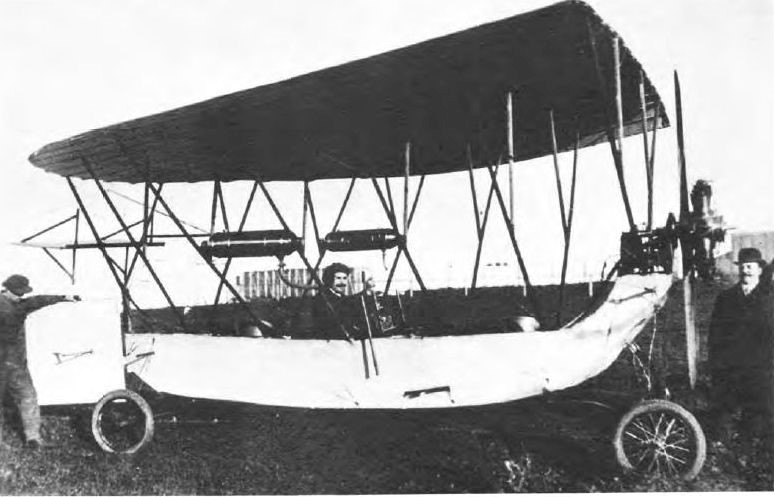
Cosmos Magnum 21 Bidlum

Engine: Rotax 503, 52 hp.
HP range: 40-70.
Speed max: 48 mph.
Cruise: 28 mph.
Range: 55 sm.
Stall: 22 mph.
ROC: 700 fpm.
Take-off dist: 50 ft.
Landing dist: 50 ft.
Service ceiling: 15,000 ft.
Fuel cap: 5 USG.
Weight empty: 310 lbs.
Gross: 850 lbs.
Height: 12 ft.
Length: 8.5 ft.
Wing span: 36 ft.
Wing area: 232 sq.ft.
Seats: 2.
Landing gear: nose wheel.

Cosmos Echo 12

Circa 1998, the single seat Echo 12 is of low overall height, and uses a one piece moulding for fuselage, tank and seat.

Engine: Rotax 447, 40 hp.
HP range: 40-65.
Speed max: 87 mph.
Cruise: 45 mph.
Range: 150 sm.
Stall: 24 mph.
ROC: 1000 fpm.
Take-off dist: 100 ft.
Landing dist: 150 ft.
Service ceiling: 15,000 ft.
Fuel cap: 9 USG.
Weight empty: 246 lbs.
Gross: 600 lbs.
Height: 9 ft.
Length: 8 ft.
Wing span: 32 ft.
Wing area: 139 sq.ft.
Seats: 1.
Landing gear: nose wheel.

Engine: Rotax 503 DCDI, 52 hp
Wing span: 9.87 m
Wing area: 12.9 sq.m
Empty weight: 126 kg
MAUW: 280 kg
Fuel capacity: 35 lt
Seats: 1
Max speed: 155 kph
Cruise speed: 110 kph
Minimum speed: 40 kph
Climb rate: 6 m/s
Fuel consumption: 7 lt/hr
Price (1998): 89 350 Fttc

Cornu Helicopter

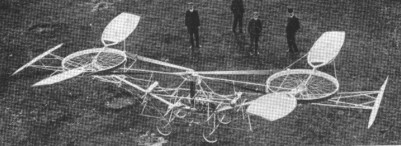
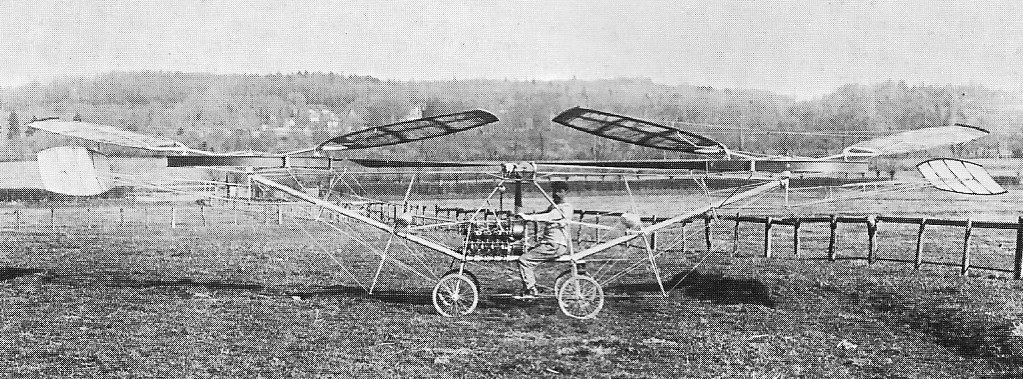
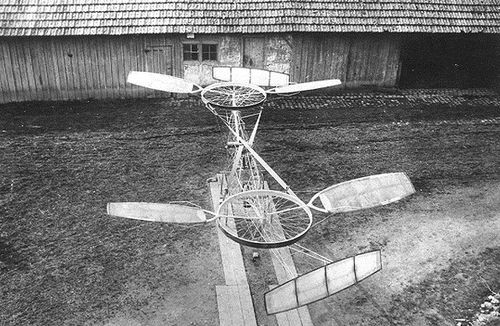
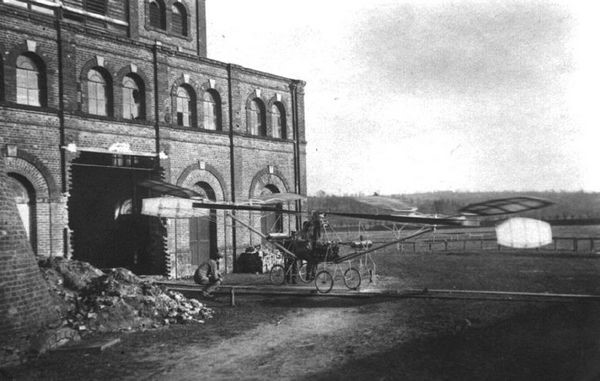
At Coquainvilliers, near Lisieux, France, Paul Cornu, a bicycle maker, built a practical heli¬copter with fore and aft rotors driven by belts from a 24 hp Antoinette engine, which made a free flight lasting about 20 seconds on 13 November 1907. The machine was stabilized with sticks by men on the ground because of its poor controllability. Powered by an Antoinette engine, it rose about 1 foot on its first flight, and then climbed to 5 feet carrying Cornu and his brother.

The central frame supported the engine, pilot seat and fuel tank, and the whole contraption weighed just over 250kg. To rock the ship from side to side, or to nose up and down, there were movable flat surfaces ‘control vanes’ mounted under the rotors so the airflow would push against them. The system on the Cornu machine was ineffectual.

The chassis rested on a four-wheeled landing gear. The rotors were paddle-shaped and fabric-covered, mounted on large horizontal, bicycle-type wheels situated one at each end of the machine. The design followed that of a small scale model made by Cornu a year or so previously with 2.25m rotors, a 2hp Buchet engine and a weight of 13kg. The full-scale machine made its second flight with Cornu’s brother hanging on to the framework, increasing the total weight to 328kg, and take-offs to about 2m were made later carrying the pilot only.

Cornu was unfortunate in that his flight came just as public hysteria was focusing on the fixed wing achievements of the Wrights. He was unable to obtain support for developing his helicopter.

Engine: Antoinette, 18kW, 24 hp
Rotor diameter: 6m approx
Empty weight: 203kg
Loaded weight: approx 250 kg

Cornelius Mallard

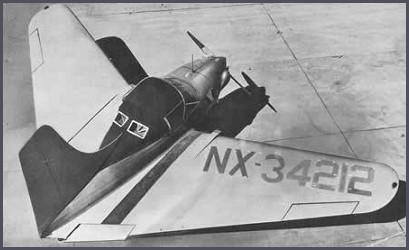
The Mallard (NX34212) was a forward swept-winged tailless monoplane with a 130 hp Franklin flat-four engine. With side-by-side two-seating it was demonstrated publicly by Alfred Reitherman. No production resulted. The 125 mph cruising speed quoted may have been projected rather than actual, considering it was described as 700 lb overweight and underpowered.

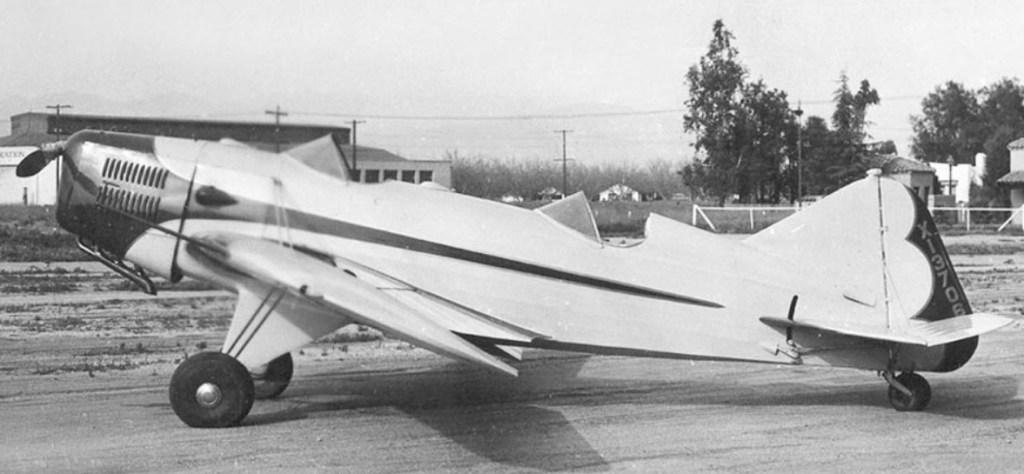
Cornelius LW-1

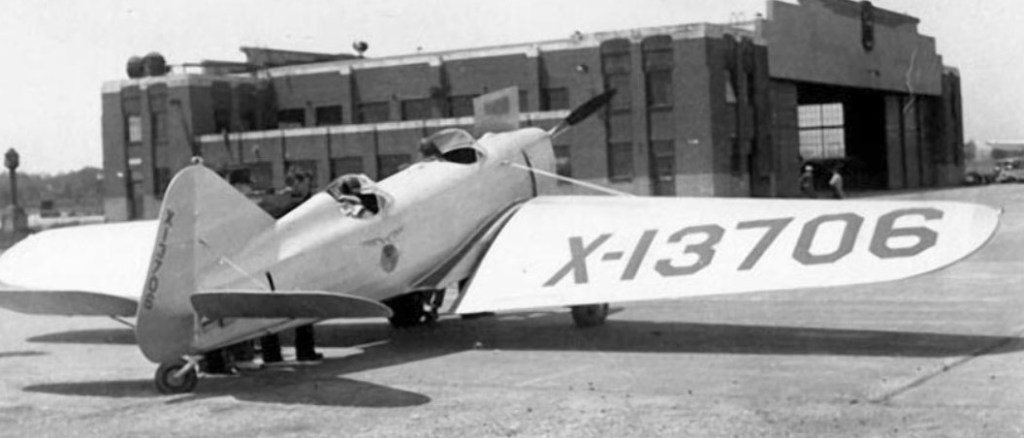
Continuing to experiment with a wing with a variable angle of attack (variable-incidence wing), American engineer George Wilbur Cornelius built his second aircraft in 1933, the designation LW-1 (from Low-Wing, and as a further development of the PW-1, from Parasol-Wing).

The low-wing two-seater LW-1 (X13706) used the short-lived four-cylinder inverted in-line 120 hp Martin 133 engine and had the same control system as the Cornelius FreWing. The incidence of the mainplanes was adjusted differentially like ailerons, and collectively like elevators in conjunction with a stabilator tailplane.

It was intended to improve performance by dispensing with the drag of the multiple strutting needed for its parasol predecessor.

The LW-1 NX13706 is one of a kind.

Gallery

Engine: Martin 333, 120 hp
Maximum speed: 237 km/h / 147 mph
Cruise: 201 km/h / 125 mph
Stall: 45 mph
Seats: 2

Cornelius FreWing

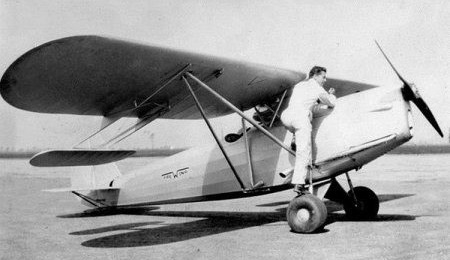
Cornelius FreWing (NX182W c/n PW-1)

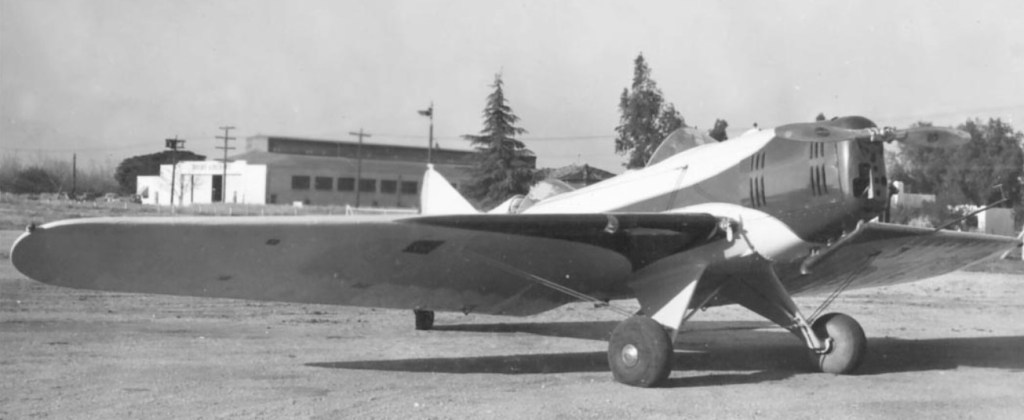
The first aircraft of the Cornelius Aircraft Co, the FreWing, was designed by Cornelius and C.C. Spangenberger. It was a parasol monoplane single-seater in which the incidence of the mainplanes was adjusted differentially like ailerons, and collectively like elevators in conjunction with a stabilator tailplane. Initially, each mainplane had a servo surface extending behind it on two booms attached to the undersurface, but these were later removed as unnecessary.

Engine: 125 hp Menasco B-4
Span: 30 ft 6 in (9.30m)
Length: 20 ft 6 in (6.25 m).

Corivi Aviation Vulcan C100

Vulcan C100 was a real aircraft available both fixed and retractile landing gear. Designed for Italian ultralight aviators it is inspired to Frati’s Falco lines. With all metal construction it can support engines from 80 hp to 150 hp. The suggested engine is the Rotax 912 series.
Main parts in 2024 Avional T3 Alloy
Landing gear and Engine mount in 4130 steel
Bolts in 8.8 steel
Engine cover and cockpit fairing in Fiberglas
Electric actuated Flaps
Retractile landing gear – pneumatic actuated
Stabilizer Trim – electric actuated

Engine: Rotax 912 ULS
Propeller: Carbon composite Three blade Ground adjustable
Wing span: 26.40 feet (8 m)
Length: 21,45 feet (6,50 m)
Height: 7.59 feet (2,30 m)
Wing area: 114.14 sq feet (10.61 sq.m)
Wheel track: 8.25 feet (2.50 m)
Empty weight: 621 lb (282 Kg)
Tanks capacity: 24.96 US gallons (96 litres)
MTOW Weight: 450 kg / 992 lbs
VNE: 167 kt / 193 mph / 310 kmh
Max horizontal speed: 140 Kts (260 Km/h)
Cruise speed (75% pwr): 124 Kts (230 Km/h)
Stall speed (Flaps down): 34 Kts (62 Km/h)
Climb rate: 1200 ft/min (6 m/sec)
Take off run: 726 feet (220 m)
Take-off 50 ft obstacle: 1617 ft
Landing run: 462 feet (140 m)
Max. range: 653 nm (1210 Km)
Endurance (with 30min reserve): 5 hr 30 min