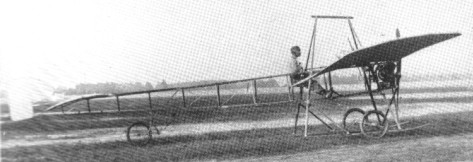
In Switzerland, on 28 August 1910, Armand Dufaux flew 80 km over the Lake of Geneva in the aircraft built by his brother Henri and himself.
In Switzerland, on 28 August 1910, Armand Dufaux flew 80 km over the Lake of Geneva in the aircraft built by his brother Henri and himself.
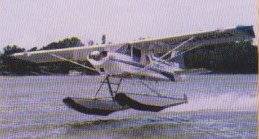
The Aerocruiser 2+2 has the same shape as the two seat version, with has identical dimensions but a redesigned cabin layout in which the rear bench seat folds back. The fuselage is fabric covered and the wings are all aluminium.
Aerocruiser 2+2
Engine: Lycoming O-360, 180 hp
Wing span: 9.75 m
Wing area: 16 sq.m
MAUW: 997 kg
Empty weight: 494 kg
Fuel capacity: 265 lt
Max speed: 260 kph
Cruise speed: 195 kph
Minimum speed: 65 kph
Climb rate: 5 m/s
Seats: 4
Fuel consumption: 38 lt/hr
Price (1998): Can$95,000
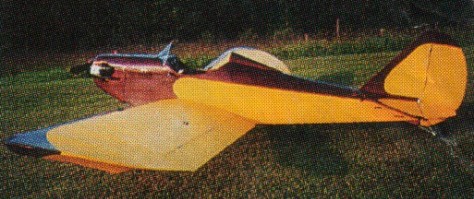
A 75% scale Fly Baby replica.
Engine: ½ VW, 48 hp.
HP range: 30-50.
Speed max: 75 mph.
Cruise: 60 mph.
Range: 150 sm.
Stall: 35 mph.
ROC: 650 fpm.
Take-off dist: 200 ft.
Landing dist: 400 ft.
Service ceiling: 10,000 ft.
Fuel cap: 5 USG.
Weight empty: 300 lbs.
Gross: 600 lbs.
Height: 4.75 ft.
Length: 16 ft.
Wing span: 27.5 ft.
Wing area: 121.5 sq.ft.
Seats: 1.
Landing gear: tail wheel.
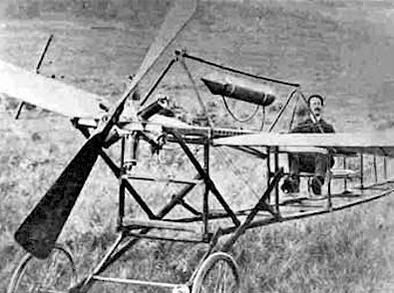
First airplane designed and constructed in Brazil – 100% made by Dimitri Sensaud de Lavaud; even the propellers and the engine were manufactured by him. It first flew on January 7, 1910 at Osasco: 6 seconds for 103 meters; also considered to be the first flight by an aircraft of complete South America design and construction.

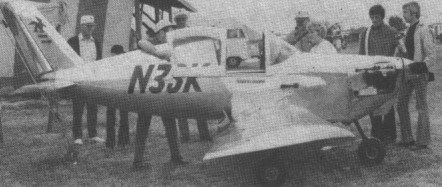
The Hawk is a single-seat, low-wing monoplane stressed to 9G’s. Originally it was designed by Dick Killingsworth to be built around a surplus 200-gal drop-tank, but plans also provide for a bulkhead and stressed skin structure, The wings are built with twin light-alley spars and the landing gear is the non-retractable tricycle type. Fuel is carried in a forward tank with the capacity of nine gallons, but an optional 14-gallon tank can be added in the aft section.
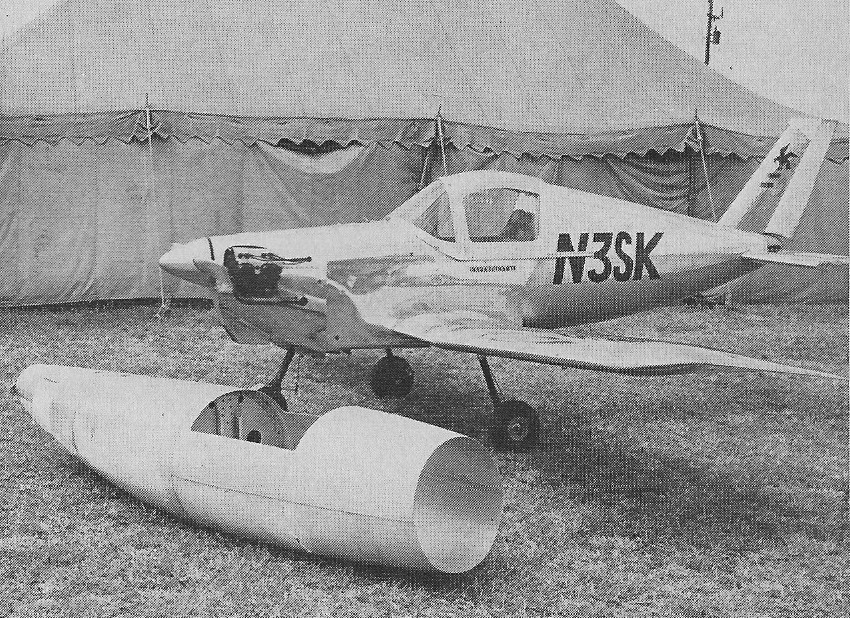
Powered by a Lycoming O-145B-2, the Hawk was designed to be built with ordinary hand tools, pop rivets and very little welding or machine work. By 1974 over 250 sets of plans had been sold, at $50 each.
Gross Wt. 893 lbs.
Empty Wt. 525 lbs.
Fuel capacity 9-23 USG.
Wingspan 20’4”.
Length 15’.
Engine 65-hp Lycoming.
Top speed 156 mph.
Cruise 141 mph.
Stall 50 mph.
Climb rate 1500 fpm.
Ceiling 12,000 ft.
Takeoff run 600 ft.
Landing roll 550 ft.
Range (14 gals) 480 sm.
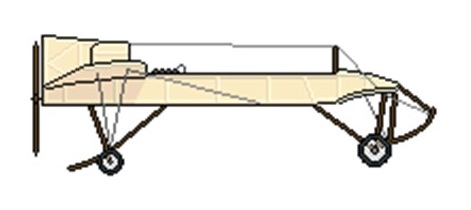
Aeronautics was also among Stefan Drzewiecki’s interests. His works regarding aircraft stability led to building in 1911-1912 a “self-stable” aircraft in canard layout. Interesting feature of the plane was lack of typical steering areas – altitude was adjusted by changing engine power while turning was done by adjusting AoA of either half of the nose wing. First flight was made in 1913, but because of this unusual steering feature pilots were reluctant to fly. Eventually Drzewiecki designed improved version, but outbreak of World War I stopped further development.

A later and larger successor to the D.5 Turbi, the D.6 Condor was similarly a low-wing, wooden-framed monoplane available as a licence-built product or as a home build from plans.
The initial version was designated D.61 and was designed for Continental engines of 65 or 75 hp.
The D.62 was, like the D.31, built under licence by Rollason in the UK from 1961. Variants include versions converted for glider towing.
First flow in 1961, the D.62A was a pre-production version of which two were built. The D.62B was the standard production version.

The D.62C was specially equipped for glider towing with wingtip endplates, larger wheels, raised cockpit canopy, and 130 hp Rolls-Royce Continental O-240 engine.
The Condor was given a dual system of c/ns when in production with Rollason. A number prefixed RAE was re-located using exactly the same number as the aircraft’s PFA number. Production was centred on Croydon, with first flights from Redhill. Production was transferred in 1973 to Shoreham although none wee finished there.
Versions:
D.61 – Basic version, Continental A65 or A75
D.62 – Initial UK version, Continental C90
D.62A – initial production version. Rolls-Royce/Continental O-200-A
D.62B – Refined D.62A, all after c/n RAE.612, fitted with flaps
D.62C- Glider tug, Rolls-Royce/Continental O-240-A
D.63 – Tricycle undercarriage
D.62A
D.62B
Engine: 1 x 75hp Continental A 75
Max take-off weight: 669 kg / 1475 lb
Wingspan: 8.72 m / 28 ft 7 in
Length: 6.95 m / 22 ft 10 in
Height: 1.75 m / 5 ft 9 in
Cruise speed: 160 km/h / 99 mph
Range: 627 km / 390 miles
D.62B
Engine: Continental O-200, 100hp
Wingspan: 27 ft 6 in / 8.38 m
Length: 22 ft 6 in / 6.86 m
Empty weight: 920 lb / 417 kg
MTOW: 1475 lb / 670 kg
Max cruise: 100 kt / 115 mph / 185 kph
ROC SL: 610 fpm / 185 m/min
Service ceiling: 12,000 ft / 3650 m
Range MAUW: 285 nm / 328 mi / 528 km
Seats: 2
D.62C
Engine: Rolls-Royce Continental O-240, 130 hp


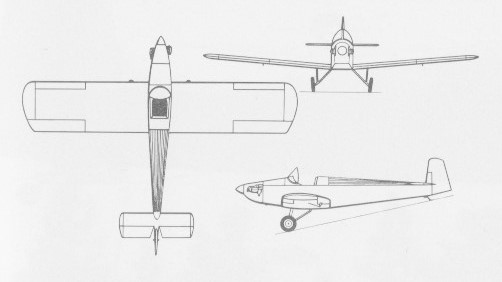
After designed the Turbulent, Roger Druine created the two-seat version, the D.5 Turbi. The prototype first flying in the late 1940s, powered by a Beaussier Bo2.
The Turbi tandem two-seater follows the same lines as the Turbulent and the construction is very similar. The rear turtle-decking on early models was fabric covered, but later models are plywood covered. Dual controls are fitted. The fuselage is of rectangular slab-sided construction with four spruce longerons and frames. The fin is built integral with the fuselage. The tailplane is non-adjustable and like the fin is plywood covered. The wings employ fixed slots, a box type main spar, drag spar, rear spar, lattice type ribs and plywood covering forward of the main spar. The remainder including the ailerons are fabric covered. The main undercarriage is of divided type and has coil springs for shock absorption. A variety of engines may be installed from 45 to 85 h.p.
Falconar plans show open cockpit with dual controls that can be flown solo from either the front or back seat, the original design was a dual windshield open cockpit. Early Turbi’s built in England were powered with the DH Gipsy Minor. The 4 cylinder 65hp Czech Walter LOM II AE has a dry weight of only 132 lbs – which is a similar configuration to the Gipsy Minor. Other popular engines can be a Continental or Lycoming 65 to 115 HP.
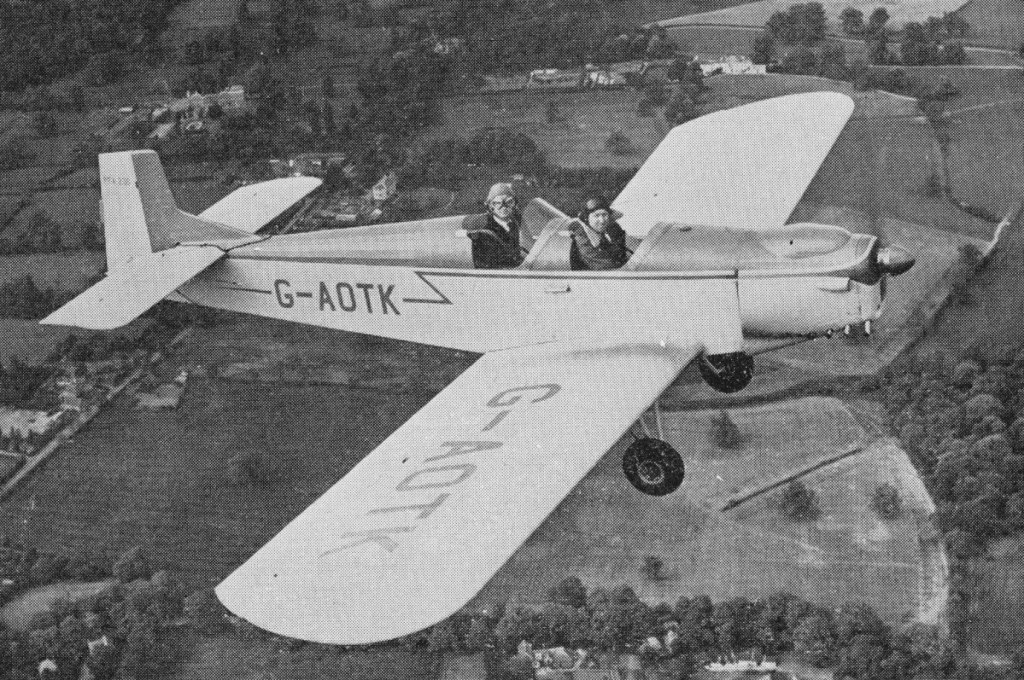

Falconar updated plans & kits for this light 2-seater tandem sportplane, in the LSA catergory.
Options include enclosed cockpit either with single curvature windows or vacuum formed bubble canopy.
Vne (never exceed speed): 108 mph
Cruise speed: 81 mph
Range: 400 miles
Stall: 34 mph
Length: 25 ft 9 in
Wing span: 28 ft 6 in
Wing area: 142 sq.ft
Plans 2010: $305
Engine: Mikron 11, 60 h.p.
Span: 28’6”.
Length: 22’ 6”.
Wing Area: 139 sq. ft.
Empty Weight: 684 lb.
Loaded Weight: 1200 lb.
Wing Loading: 8.6 lb/sq. ft.
Max. Speed: 100 mph.
Cruise Speed: 85 mph.
Stall Speed: 45 mph.
Initial Climb: 550 fpm.
Range: 320 miles.
Falconar Avia Turbi D5
Cruise: 90 mph
Stall: 34 mph
Range: 460 sm
Rate of climb: 700 fpm
Takeoff dist: 600 ft
Landing dist: 400 ft
Engine: Continental C-65, 65 hp
HP range: 65-115 hp
Fuel capacity: 16 USG
Empty weight: 600 lb
Gross weight: 1067 lb
Length: 25.8 ft
Wing span: 28.5 ft
Wing area: 142 sq.ft
Seats: 2
Cockpit width: 24 in
Landing gear: tailwheel
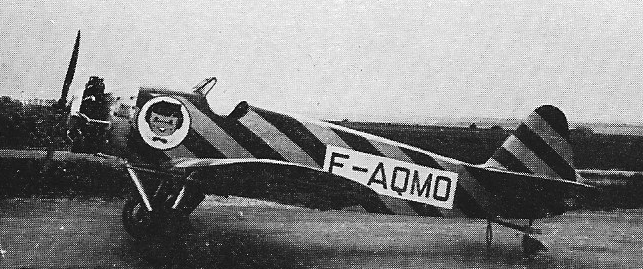
The D.482 side-by-side two-seat trainer was produced in 1932 as a higher-powered development of the D.480, the 95hp Salmson 7 Ac radial of the D.480 being replaced by a 135hp Salmson 9 Nc.
A number were produced by the Societe Aeronautique Francaise in the early 1930s.
D.480
Engine: 95hp Salmson 7 Ac
D.482
Engine: 135hp Salmson 9 Nc
Wingspan: 41 ft 8 in
Length: 24 ft 3.25 in
Height: 9 ft 3 in
Wing area: 204.5 sq.ft
Empty weight: 1424 lb
Loaded weight: 2005 lb
Max speed: 87 mph
Service ceiling: 14,673 ft
Range: 373 mi
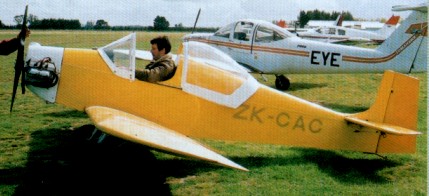
The Turbulent is an ultra-light single seat, low wing monoplane designed by M. Roger Druine in the mid 1950s, the Turbulent is normally fitted with a 30 h.p. Ardem or VW conversion, although engines up to 45 h.p. may be installed.
First flown in 1951, the initial French D.3 version, was powered by a 25 hp modified Volkswagen engine.

The fuselage is a rectangular box structure having four longerons, wooden frames, a curved turtle deck and plywood covering. The empennage structure is of wood, the tailplane and fin are plywood covered, the elevator and rudder being fabric covered. The wings are a one piece, two spar structure; the front spar having laminated spruce booms and plywood webs to form a box. A diagonal drag spar is also fitted between the front and rear spars. The ribs are of open lattice type, the aerofoil section being NACA 23012. A built-in fixed slot is located at the leading edge forward of each aileron. The leading edge is plywood covered, forming a D-nose torsion box, while the remainder of the wing is fabric covered. The main undercarriage is of divided type and uses coiled springs for shock absorption. An 8.8 Imp. gallon fuel tank is installed behind the firewall. The airframe being non-aerobatic.
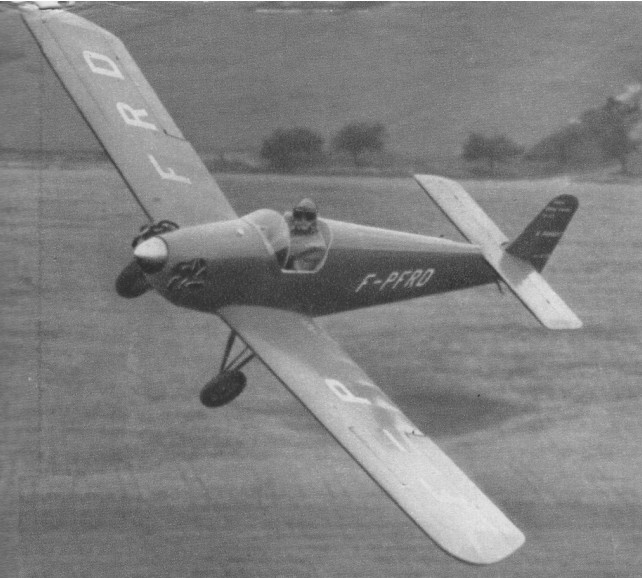
Powered by a 25 h.p. Volkswagen air-cooled car engine fitted with dual ignition and a two-bladed wooden airscrew, the Turbulent runs on 73-octane or premium car petrol, consuming 7.5 litres (1.7 gal) an hour whilst cruising, and has an extreme endurance of three hours.
This is an aircraft designed to be built by amateurs with no more than a reasonable knowledge of carpentry. Complete plans were on sale in France for 5,000 francs, and the materials bought from several firms there. The main difficulty lies in the engine. The Volkswagen is recognized in France but not abroad. (M. Druine intended to fit a 44 h.p. Lutetia vee-four and to fly his Turbulent over to England for a Coventry meeting). So far, 126 sets of plans have been sold all over the world and more than 20 Turbulents have been completed in France. M. Druine calculates that the materials cost about £150, the engine about £90, and that 800 man hours are required for construction.
In 1957 Rollason Aircraft & Engines Ltd was finding that sales of reconditioned Tiger Moths were dropping and Norman Jones was looking for another low cost aircraft for the company to manufacture. He decided that it should produce a licence built version of the Turbulent and, after introducing some mod-ifications, started to produce the aircraft in 1958. The modified D.31A, with improved main spar and an Ardem 4C02-10 was capable of gaining a full certificate of airworthiness. Over 30 were eventually produced by Rollason.
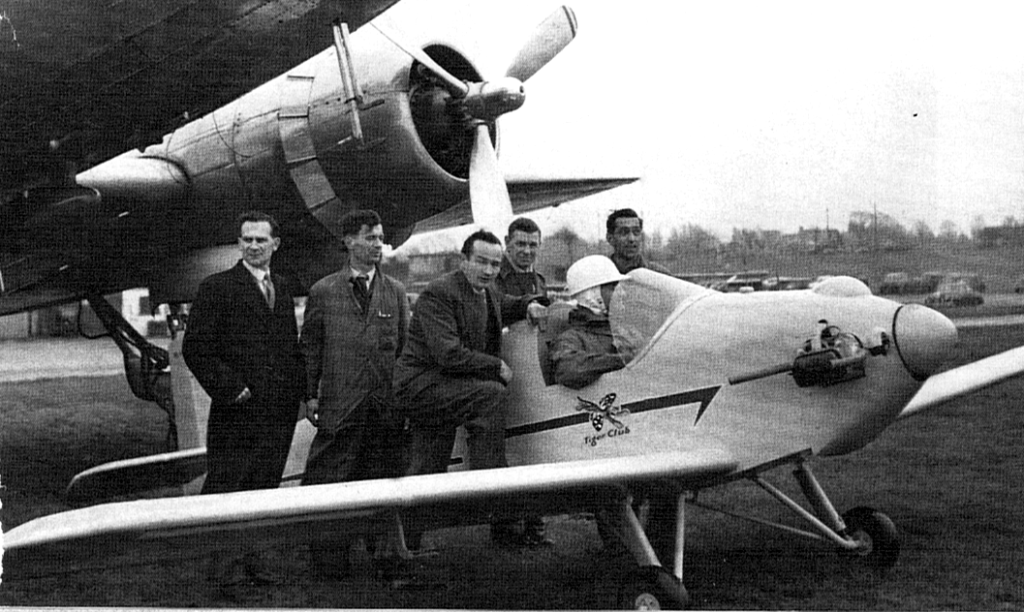
In 1955 Hans-Joachim Ludwig, a glider pilot, obtained thee licence rights from Druine to construct the Turbulent. As he did not have the financial means to construct the aircraft, he arranged to transfer the licence to Wilhelm Stark. As a result, Stark formed the Wilhelm Stark Flugzeugbau K.G. in Minder/Westfalen to undertake the quantity production of the Turbulent in Germany. But the official German aircraft regulations would not allow the original turbulent to receive a certificate of approval. Consequently, minor modifications were made to strengthen the design and at the same time a fully-enclosed cockpit was added. The first was built in Starks’ cellar, powered by a VW, it received the German certificate of approval.
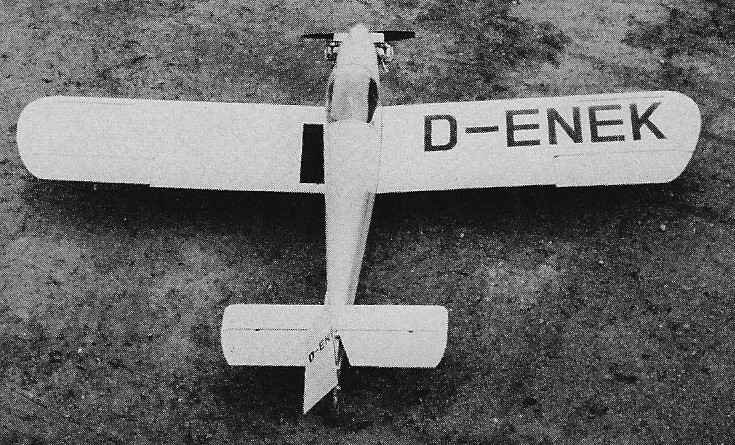
Stark established a small series production facility in a hanger on the Minden airfield. The prototype, D-EJON, after crashing from a stall was rebuilt with a slightly larger wing and became the second prototype, with the same registration.
By the summer of 1958 several Stark Turbulent D’s had been built. A total of 16 were built before production ended.
Experience
Turbulent F-PGYQ, which belonged to the designer, was kept in the Hurel-Dubois experimental hangar at the Villacoublay subsidiary airfield.
I climbed into the cockpit, fastened the lap-strap, lowered a pair of borrowed goggles and listened while M. Druine bent down and explained the cockpit to me. There were six instruments, from left to right: A.S.I. (km/hr), insensitive altimeter (metres), magnetic compass, rev counter, and V.S.I. (m/ sec). A ball-type slip indicator (below the compass), a magneto switch, throttle, stick and pedals completed the appointments.
I was told to cruise at 2,600 r.p.m. (maximum 2,800) and that was all. The airscrew was swung, and I taxied carefully out. The cockpit is just large enough, the view in all directions excellent and, although the undercarriage is a little hard, directional control is all that one could desire with the engine set at 1,600 r.p.m. The rudder is then effective and the speed over the ground about 4 m.p.h.
At the end of the grass runway I performed some Vital Actions. There was in fact nothing to do but (on this occasion) to turn the aircraft down-wind. I opened the throttle and it accelerated smoothly without any appreciable swing. The tail came up after 40 or 50 yd and after about 200 yd I flew the Turbulent off. I was immediately assailed by a series of sharp bumps and climbed away carefully, avoiding a hangar roof only to hit a violent bump over a road. But the little aeroplane rode the bumps well without any tendency to “fall out of one’s hands.” An aircraft of this size is naturally greatly affected by turbulence, but the Turbulent is eminently manageable under such conditions. The cockpit was quite warm and only one’s shoulders and forehead were exposed to a gentle slipstream. At 2,600 r.p.m. the speed built up to 110 km/hr (60 kt) indicated (120 km/hr, or 66 kt, actual). Stick forces are very light and although depending on the amount of fuel and the weight of the pilot, the trim will vary, the effect is never enough to cause any discomfort. There is a large P.E. on the A.S.I. and 16.5 kt indicated is about 27 kt actual.
I tried a slow run at 35 km/hr (19 kt) indicated with the nose well up and, into wind, almost succeeded in hovering relative to the ground. There was no decrease in control effectiveness and, on opening the throttle, cruising speed was rapidly regained. I next tried to turn the aircraft by taking my hands off the stick and holding one arm out sideways. This resulted in a slight yaw but no change in lateral attitude. One felt very free and cool; this would be the ideal occupation on a hot summer’s day.
Next I tried a stall. This is quite remarkable. I cut the power, held the nose a little way above the horizon, and waited. At no more than 28 km/hr (15.3 kt) indicated the Turbulent nodded sharply forward without dropping a wing; immediately the nose fell below the horizon the speed rose to just below 40 kmlhr (22 kt) and, being then unstalled, the nose came up again with the stick still held back. As it passed the horizon it stalled and nodded again-and so on for five or six stalls with the stick held back and without any sign of yaw or wing-drop. 1 tried it into wind and cross-wind with exactly the same results. The Turbulent simply “went downstairs” like a well-behaved child in a strange house. These characteristics are probably due to slotted ailerons and leading-edge slots forward of them, and to a very smooth plywood-covered wing leading edge.
I had to make the approach down-wind over a wood which was causing some vicious bumps. I settled down with a trickle of power at 70 km/hr (38 kt); despite the following wind, the angle of approach was quite steep and I had no difficulty in touching down by the caravan. It required very little round-out and there was not much float, and at no time did one lose a good view ahead over the nose. The landing run was about 150 yd.
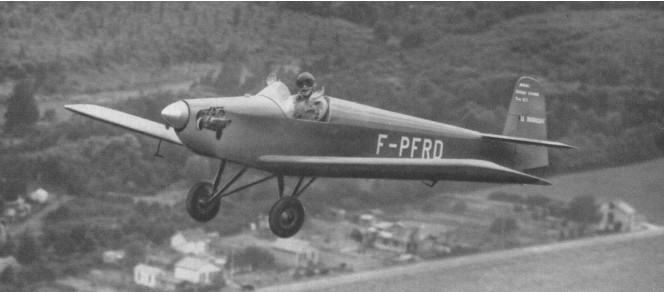
Some early standard Rollason-built D.31 were powered with 30 hp Ardem or Porsche engines. The Rollason D.31A developed version featured an improved main spar.
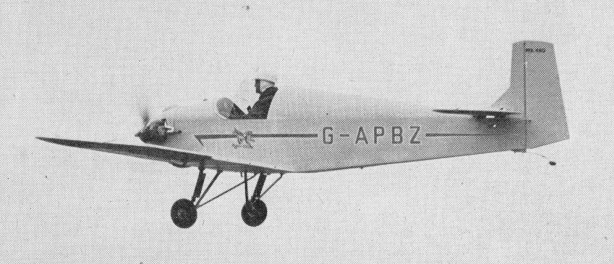
D.3
Engine: VW, 25 hp
Rollason D.31
Engine: Ardem or Porsche, 30 hp
Rollason D.31
Engine: Ardem 4C02 Mk.IV, 45 hp ot Mk.V, 55 hp
Wingspan: 21 ft 7 in / 6.58 m
Length: 17 ft 6 in / 5.33 m
Empty weight: 395 lb / 179 kg
MTOW: 620 lb / 291 kg
Max cruise 45hp: 87 kt / 100 mph / 161 kph
ROC SL 45hp: 450 fpm / 137 m/min
Service ceiling 45hp: 9000 ft / 2740 m
Range 45 min res, 45hp: 217 nm / 250 mi / 400 km
Seats: 1
Baggage capacity: 25 lb / 11.5 kg
Rollason D.31A
Engine: Ardem Mk.X, 45 hp
MTOW: 700 lb / 316 kg
Stark Turbulent D
Engine: Stamo 1400, 42 hp
Wingspan: 7.15 m
Length: 5.30 m
Height: 1.88 m
Empty weight: 200 kg
MTOW: 310 kg
Top speed: 175 kph
Cruise speed: 150 kph
Stall: 45 kph
Landing speed: 65 kph
Ceiling: 3600 m
Range: 500 km
Stark Turbulent D
Engine: Zundapp, 50 hp
Wingspan: 7.15 m
Length: 5.45 m
Height: 1.88 m
Top speed: 165 kph
Cruise speed: 145 kph
Ceiling: 3600 m
Range: 450 km
Engine: 25 h.p. Volkswagen dual ignition
Prop: two-bladed wooden
Fuel: 73-octane or premium car petrol
Wing span: 6 m 55 cm (21ft 6in)
Length: 5 m 25 cm (17ft 3in).
Consumption cruising: 7.5 litres (1.7 gal) an hour
Max endurance: 3 hours
Engine VW 45hp.
Gross weight: 620 lbs
Empty wt: 395lbs.
Fuel cap: 8.75gal.
Wingspan: 21’7”.
Length: 17’6”.
Wing area: 77.5 sq.ft.
Vmax 109mph.
Cruise 100 mph.
Climb rate: 450 fpm.
Ceiling 9000 ft
Range 250 sm.
Take off run: 500’.
Landing roll: 450’.
Seats: 1.
Engine: 1600 VW.
Cruise: 80 mph.
Climb: 500 fpm.
Range: 300 sm.
Span: 21 ft 7in.
Length: 16 ft 6 in.
Empty wt: 380 lbs.
Max wt: 620 lbs.
Engine: Ardem 4002, 30.7 h.p.
Span: 20’ 2”.
Length: 17’ 4”.
Wing Area: 80.7 sq. ft.
Empty Weight: 410 lb.
Loaded Weight: 660 lb.
Wing Loading: 8.2 lb/sq. ft.
Max. Speed: 95 mph.
Cruise Speed: 75 mph.
Stall Speed: 45 mph.
Initial Climb: 450 fpm.
Range: 340 miles.
Engine: VW 1500
Cruise: 78Kt