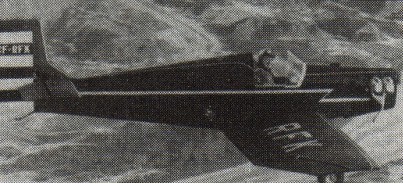
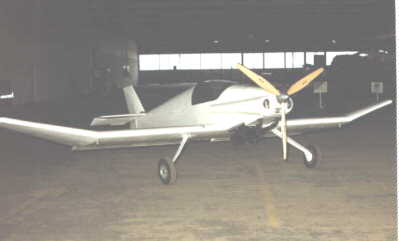
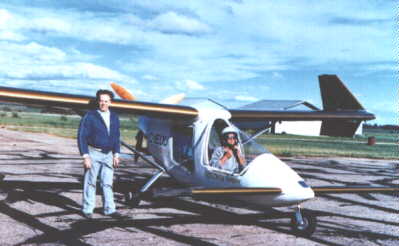
The Falcon Avia F9, F10, F11 and F12 series are derived from famous Jodel D9 and D11 from France – Cockpits larger, simplified fittings, shoulder harness, safer stall. The F10 plans have step by step manuals, full size layouts for ribs, bulkheads and small parts. Built of wood and plywood for ease of construction, no expensive or unique tools are required. The are a minimum of metal fittings – under 32 fittings assemblies. Equipped with maintenance free Delrin bearings and stainless steel hardware for control surfaces, the wing and tail easily removable. The F10A is like the F9A except heavier and stronger for Continental or similar engines 40 to 100 hp. Options include flaps and vertical coil spring main landing gear. The F10A is LSA legal. In 2010 F10A F Series plans cost Can $195.00.
On June 30, 2019, Falconar Avia Inc closed for business and assets dissolved. The Master Sets (Original Drawings, Plans, Info Kits, Documentation) sold included the F-9, F-10, F-11A, E, and E2, F-12A, and Minihawk Series to Manna Aviation
F10 Speed max: 145 mph Cruise: 120 mph Range: 250 sm Stall: 35 mph ROC: 750 fpm Take-off dist: 350 ft Landing dist: 230 ft Engine: Continental, 65 hp HP range: 40-100 Fuel cap: 12 USG Weight empty: 550 lb Gross: 875 lb Length: 19 ft Wing span: 23 ft Wing area: 99 sq.ft Seats: 1 Landing gear: tail wheel
F10A Engine: Continental C-65, 65 hp HP range: 40-100 Height: 4.8 ft Length: 19 ft Wing span: 23.5 ft Wing area: 100 sq.ft Empty weight: 550 lb Gross weight: 875 lb Fuel capacity: 12 USG Top speed: 145 mph Cruise: 90-130 mph Stall: 35 mph Range: 290 sm Rate of climb: 750 fpm Takeoff dist: 350 ft Landing dist: 230 ft Seats: 1 Cockpit width: 24 in Landing gear: tailwheel
The Falcon Avia F9, F10, F11 and F12 series are derived from famous Jodel D9 and D11 from France – Cockpits larger, simplified fittings, shoulder harness, safer stall.
The F9 plans have step by step manuals, full size layouts for ribs, bulkheads and small parts. Built of wood and plywood for ease of construction, no expensive or unique tools are required. The are a minimum of metal fittings – under 32 fittings assemblies. Equipped with maintenance free Delrin bearings and stainless steel hardware for control surfaces, the wing and tail easily removable The most important modifications are: A changed wing design. By moving the crank inboard, Chris Falconar could make the outer parts to fold inward and make it trailerable. This folding mechanism was a (rather heavy) option. Falconar also changed the spar and wing rib design. The original Jodel spar is not the simplest to construct due to the washout in the wing profile. The Falconar spar is more straightforward and uses different ribs to create the washout. Unfortunately, this wing seems to be less efficient than the original item. Much more power. The original D11 had anywhere from 45 to 90 hp. Mostly A-65’s and C-90’s. The F-11 uses up to the O-290, which has around 125 hp and is heavier, uses more fuel etc. Effectively, the flight characteristics of the plane will be severely altered by this engine.
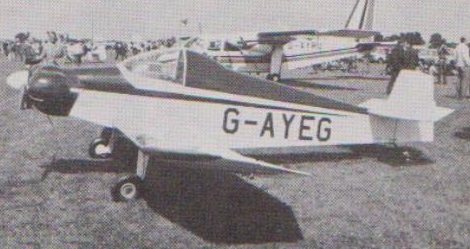
F-9 G-AYEG built by Reg Gladstone 1964-71. VW1500S, at Sywell 1972
There are options for different tail configurations. The possibility to build a 3th seat. The building time is 1500-¬3000 hours. In 2010 the F9A F Series plans sold for Can$190.00
On June 30, 2019, Falconar Avia Inc closed for business and assets dissolved. The Master Sets (Original Drawings, Plans, Info Kits, Documentation) sold included the F-9, F-10, F-11A, E, and E2, F-12A, and Minihawk Series to Manna Aviation
F9 Engine: VW, 60 hp HP range: 40-75 Length: 17.9 ft Wing span: 23 ft Wing area: 99 sq.ft Weight empty: 400 440 lb Gross: 660 lb Fuel cap: 10 USG Speed max: 140 mph Cruise: 100 mph Range: 420 sm Stall: 31 mph ROC: 600 fpm Take-off dist: 320 ft Landing dist: 220 ft Seats: 1 Landing gear: tail wheel Take off distance: 320ft Landing distance: 220ft
F-9A Engine: VW, 50 hp HP range: 40-75 Height: 4.6 ft Length: 17.9 ft Wing span: 23.5 ft Wing area: 100 sq.ft Empty weight: 360 lb Gross weight: 600 lb Fuel capacity: 10 USG Top speed: 140 mph Cruise: 80-100 mph Stall: 35 mph Range: 300 sm Rate of climb: 1000 fpm Takeoff dist: 320 ft Landing dist: 220 ft Seats: 1 Landing gear: tailwheel
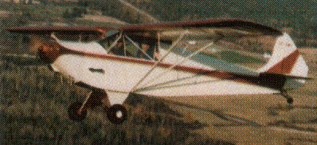
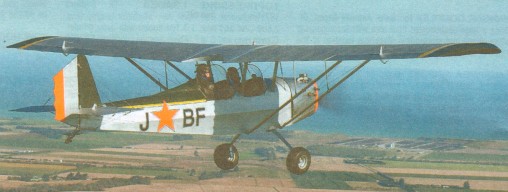
Of similar performance and size to a Piper Cub but all wood except steel tube upper cockpit section, the Cubmajor was available with open or enclosed cockpit. A 2 seat tandem aircraft with quick fold wings, options included sealed ailerons, light or heavy structure, Delrin bearings, and various engine options. The Cubmajor is LSA legal. The Majorette has open cabin struts.
On June 30, 2019, Falconar Avia Inc closed for business and assets dissolved. The Master Sets (Original Drawings, Plans, Info Kits, Documentation) were available for sale and full transfer of rights included the Cub Major and Cub Majorette for $2500 USD.
Cabin Engine: Continental C-85, 85 hp HP range: 65-100 Height: 6.8 ft Length: 23.8 ft Wing span: 35 ft Wing area: 163 sq.ft Weight empty: 900 lb Gross: 1400 lb Fuel cap: 14 USG Speed max: 116 mph Cruise: 105 mph Range: 275 sm Stall: 43 mph ROC: 860 fpm Take-off dist: 250 ft Landing dist: 150 ft Seats: 2 Landing gear: tail wheel.
Cubmajor Vne: 116 mph Cruise: 105 mph Stall: 43 mph Range: 275 sm Rate of climb: 800 fpm Takeoff dist: 400 ft Landing dist: 250 ft Engine: Continental C-85, 85 hp HP range: 85-125 Fuel capacity: 14 USG Empty weight: 800 lb Gross weight: 1300 lb Height: 6.8 ft Length: 23.8 ft Wing span: 35 ft Wing area: 153 sq.ft Seats: 2 Cockpit width: 24 in Landing gear: tailwheel
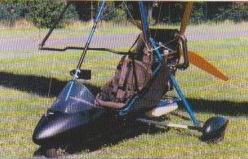
The 1996 ARV-1K has seating for two in a heated cabin for cold weather flying. With short landing capability the ARV has HIPEC covering. Easy to dismantle and haul by trailer.
ARV-1 Vne: 110 mph Cruise speed: 100 mph Range: 200 mi. Stall: 40 mph Takeoff distance: 250 ft. Landing distance: 250 ft. Gross weight: 990 lbs Wing span: 34 ft. Wing area Total lift area including canard: 168 sq ft.
ARV-1K Golden Hawk Engine: Hirth 2703, 55 hp HP range: 50-60 Height: 7 ft Length: 14 ft Wing span: 34 ft Total lift area including canard: 168 sq ft. Weight empty: 500 lb Gross weight: 990 lb Fuel cap: 9 USG Vne: 130 mph Cruise: 100 mph Range: 200 sm Stall: 40 mph ROC: 800 fpm Take-off dist: 250 ft Landing dist: 250 ft Seats: 2 Landing gear: nose wheel
ARV-1L Golden Hawk Engine: Hirth 2703, 55 hp HP range: 55-75 Height: 7 ft Length: 14 ft Wing span: 34 ft Wing area: 155 sq.ft Empty weight: 500 lb Gross weight: 890 lb Fuel capacity: 9 USG Top speed: 130 mph Cruise: 100 mph Stall: 40 mph Range: 250 sm Rate of climb: 1000 fpm Takeoff dist: 250 ft Landing dist: 250 ft Seats: 2 Landing gear: nose wheel
Based on the Pietenpol Aircamper, Andy Fairhall built all the woodword, metal fittings, and deigned and carved the propeller. The Fairhall Special features a lengthened wingspan and the cabane struts were moved slightly outward and angled. Andy added a spring steel undercarriage and steerable tailwheel. First flown in 1997, the Special is a Class 2 microlight with a MTOW of 453 kg. The Special is powered by a Toyota 4Y Hilux engine of 80 hp and runs mainly on Avgas, giving a three hour endurance. The water cooling allows a ducted hot air system from the radiator to heat the cockpit.
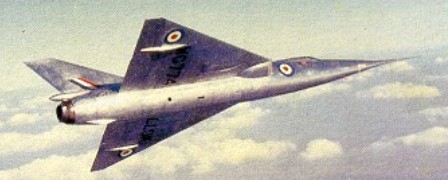
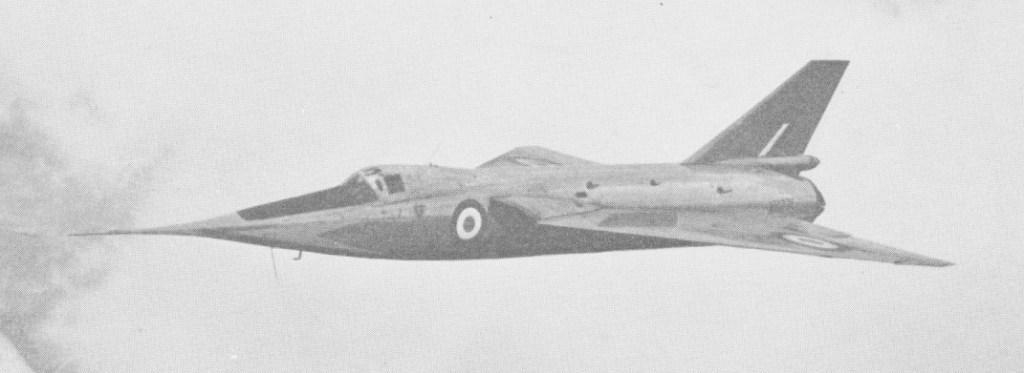
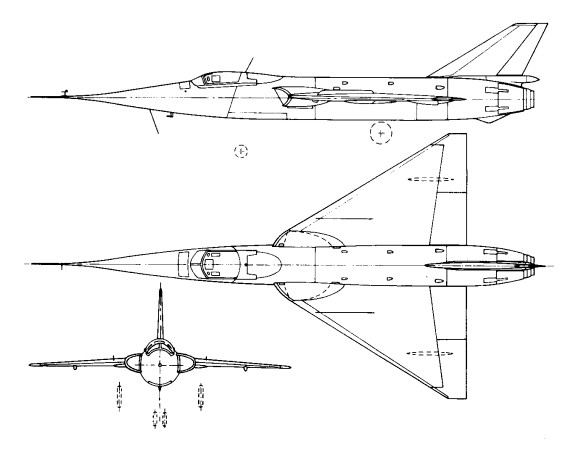
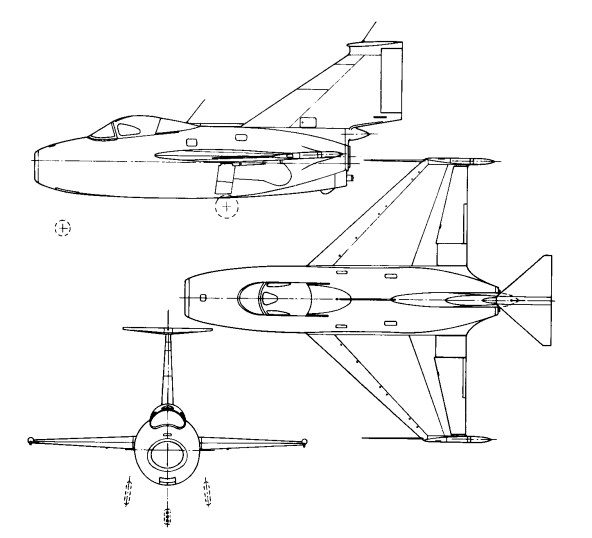
The Delta 2 was built to investigate the characteristics of flight and control at transonic and supersonic speeds. A 60 degree delta, one feature was a nose that drooped 10 degrees for landing for visibility.
The first made its maiden flight on 6 October 1954. Powered by a 12,000-lb (5443-kg) afterburning thrust Rolls-Royce Avon RA.5, the initial F.D.2 secured the first world air speed record at more than 1000 mph (1609 km/h) in March 1956, when an average of 1132 mph (1821 km/h) was recorded in two flights, piloted by Peter Twiss.The second aircraft had the 13,000-1b (5896-kg) afterburing thrust Avon RA.28 and helped to expand the F.D.2’s flight envelope in an important research programme.
On 10 March 1956 the RA.5-powered aircraft (flown by Peter Twiss) became the first aircraft to set an over-1,000mph world speed record, with an average of two flights of 1,821km/h.
The first machine was later revised as the British Aircraft Corporation 221 to evaluate the ogival wing proposed for the Anglo-French supersonic airliner that finally appeared as the BAC/Aerospatiale Concorde. The Concorde also adopted another F.D.2 feature, the drooping nose that gave the pilot an adequate field of vision for takeoff and landing.
Fairey F.D.2 Engine: 1 x Rolls-Royce “Avon” 200 turbo-jet, 44.5kN Max take-off weight: 6298 kg / 13885 lb Empty weight: 4990 kg / 11001 lb Wingspan: 8.18 m / 26 ft 10 in Length: 15.74 m / 51 ft 8 in Height: 3.35 m / 10 ft 12 in Wing area: 33.44 sq.m / 359.94 sq ft Max. speed: 2092 km/h / 1300 mph Range: 1336 km / 830 miles Crew: 1
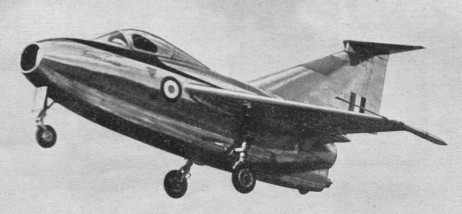
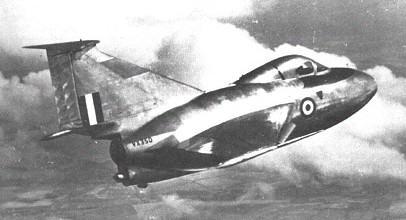
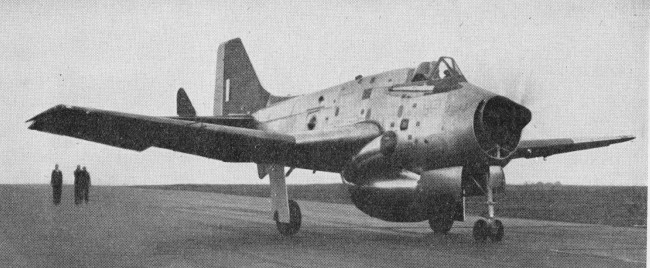
The Fairey FD.1 was produced as a prototype for the investigation of the handling characteristics of a planned vertical take-off fighter (using an inclined ramp). For that reason had provision for four small rocket engines mounted round the efflux of the Derwent engine. These rocket engines were never fitted, and with its very small wing and high wing loading, the F.D.1 required a very long run to take off.and first flew on 12 March 1951, but then adapted for research into the flying qualities of delta-winged aircraft. Powered with a 3600lb (1633-kg) thrust Derwent 8 turbojet. The type had poor handling qualities and was soon abandoned.
Engine: 3600lb (1633-kg) thrust Derwent 8 turbojet Empty weight: 3084 kg / 6799 lb Wingspan: 5.95 m / 19 ft 6 in Length: 7.99 m / 26 ft 3 in Max. speed: 1011 km/h / 628 mph
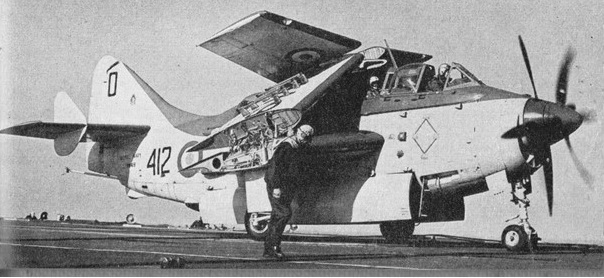
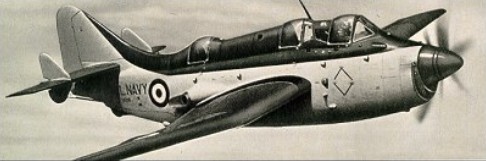
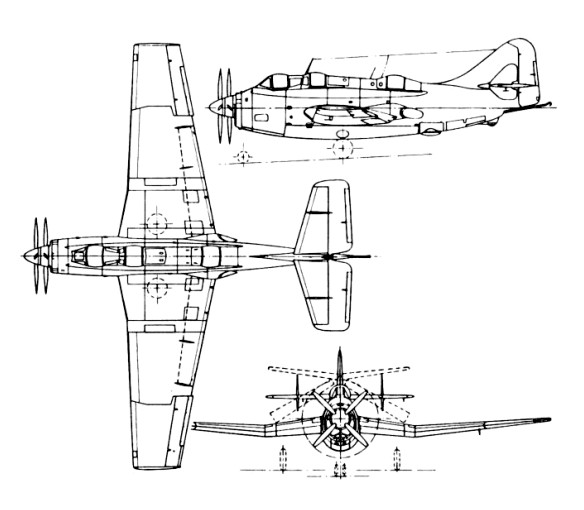
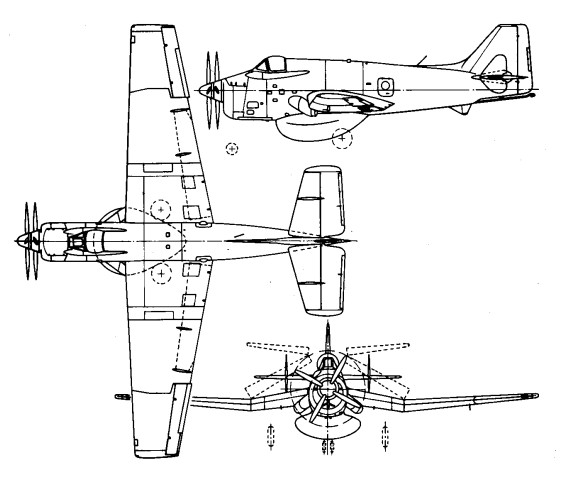
Built as a carrier-based anti-submarine warfare (ASW) aircraft, Fairey’s prototype was known initially as the Type Q. First flown on 19 September 1949, the first and second prototype were of two-seat configuration. The third prototype (which first flew on 10 May 1951) was more representative of production aircraft with three cockpits to accommodate the pilot (forward), observer/navigator (centre), and radio-radar operator (aft).
Of all-metal stressed-skin construction, this large mid-wing monoplane had mechanically folding wings to facilitate carrier stowage, and its deep fuselage was able to carry all its major strike weapons internally. Up to 16 air-to-surface rockets could be carried beneath the wings. The Armstrong Siddeley Double Mamba turboprop engine, comprised two turbine engines with individual co-axial contra-rotating propellers. Either engine could be shut down independently and its propeller feathered so that the aircraft could cruise economically. It was the first aircraft in FAA service to combine the ‘hunter/killer’ role for ASW.
The first operational squadron was formed on 17 January 1955. AS.1 and AS.4 aircraft, as well as T.2 and T.5 trainers, served with the FAA until gradually superseded by Whirlwind helicopters from 1958.
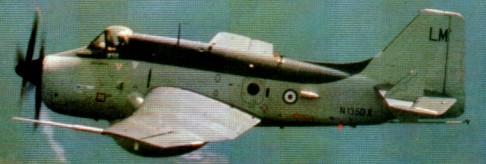
The Gannet AEW.3 was first flown from Northolt on 20 August 1958, designed for airborne early-warning duties with the Royal Navy. One of the newcomers at the 1958 Farnborough display was the prototype Gannet AEW.3.
Gannet AEW.3
On 1 February 1960 the Gannet AEW.3 early-warning variant began to enter service, having a more powerful Double Mamba engine and a large radome mounted beneath the fuselage. Its pilot was accommodated in a forward cockpit and the two radar operators were seated within the fuselage. A total of 44 of these were built, the later examples by Westland Aircraft which took over the Fairey factories in 1960. The AEW.3 which went to sea aboard HMS Ark Royal in the summer of 1970 were the last Fairey-designed first-line aircraft to serve with the FAA.
The RAAF operated 36 Gannet, ordered in 1953. Four Gannet T.2/T.5 were also ordered in 1953. The first delivered to the RAAF during October 1955 and the last in September 1958.
The AS.4 was also used by the German Navy (15) and Indonesian Navy (16).
Fairey Gannet AS1/4 Engines: One 1,950 eshp Armstrong Siddeley Double Mamba 100 turboprop / One 3,035 eshp Armstrong Siddeley Double Mamba 101 turboprop Wing Span: 54 ft 4 in Length: 43 ft Height: 13 ft 8.5 in Empty weight: 15,069 lb Loaded weight: 19,600 lb Initial Rate of Climb: 2000 ft/min Ceiling: 25,000 ft Speed: 299 mph Range: 662 miles Crew Three Armament: 2 x torpedoes in bomb bay / 16 x 60 lb rocket projectiles under wings
AS.4 Engine: One 3,035 eshp Armstrong Siddeley Double Mamba 101 turboprop Wingspan: 54 ft 4 in Length: 44 ft 6 in Wingarea: 482.8 sq.ft Empty weight 15,069 lb MTOW: 21,600 lb Max speed: 310 mph Service ciling: 25,000 ft Max range: 943 mi at 196 mph
Fairey Gannet T.2 Engines: 1,950 eshp Armstrong Siddeley Double Mamba 100 turboprop – T2 Empty weight: 15,069 lb Loaded weight: 19,600 lb Wing Span: 54 ft 4 in Length: 43 ft Height: 13 ft 8.5 in Crew: 4 Initial Rate of Climb: 2000 ft/min Ceiling: 25,000 ft Speed: 299 mph Range: 662 miles Armament: Guns: None / Bombs: 2 x torpedoes in bomb bay / 16 x 60 lb rocket projectiles under wings
Fairey Gannet T.5 Engines: 3,035 eshp Armstrong Siddeley Double Mamba 101 turboprop – T5 Empty weight: 15,069 lb Loaded weight: 19,600 lb Wing Span: 54 ft 4 in Length: 43 ft Height: 13 ft 8.5 in Crew: 4 Initial Rate of Climb: 2000 ft/min Ceiling: 25,000 ft Speed: 299 mph Range: 662 miles Armament: Guns: None / Bombs: 2 x torpedoes in bomb bay / 16 x 60 lb rocket projectiles under wings