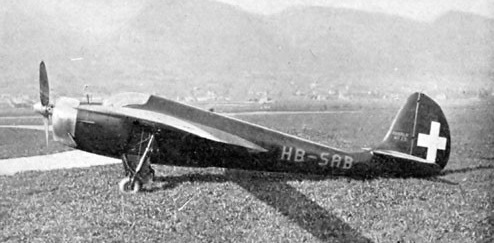
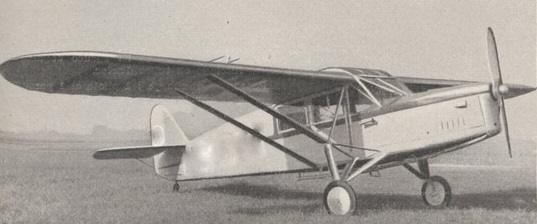
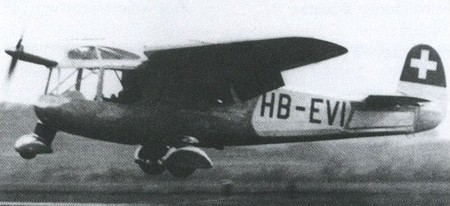
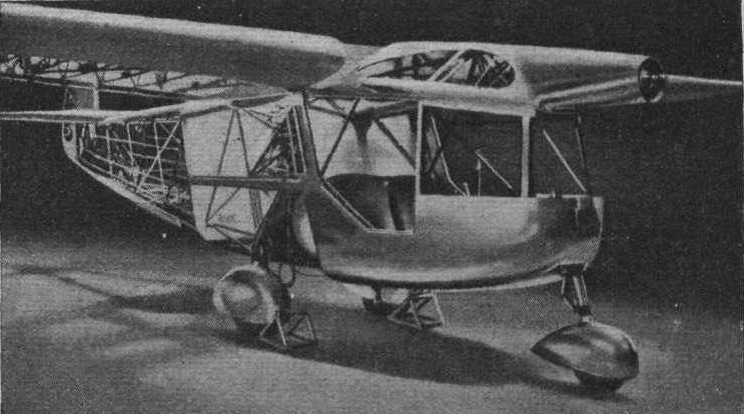
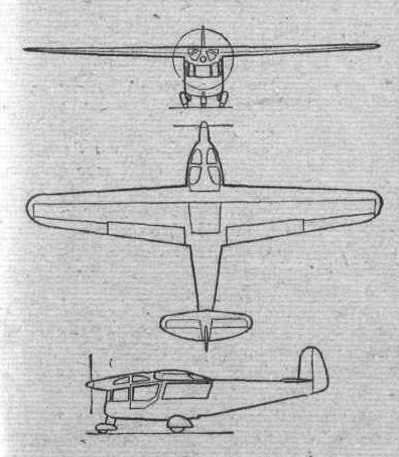
The W.F.12 two-seater trainer and touring aircraft is a high-wing monoplane with a fixed and faired undercarriage and a nose wheel landing gear. The cabin has side-by-side seating accommodation with dual controls.
In the prototype WF.12 built 1943, the Blackburn Cirrus-Minor 4-cylinder air-cooled in-line engine of 90 h.p. for take-off and of 82 h.p. cruising power at 2,300 r.p.m. is mounted in the fuselage aft of the cabin. The airscrew extension shaft comprises two parts linked together and connected with the airscrew shaft by means of universal joints; it runs over the top of the cabin and is supported forward in a structure projecting ahead of the top of the fuselage nose section. In this manner the airscrew axis lies in a plane with the wing and the view forward and downward is unimpaired.
Engine: Blackburn Cirrus-Minor, 90 hp Span: 36.1 ft / 11.00 m Length: 24.4 ft Height: 8.5 ft Wing area: 172 sq.ft Empty weight: 1,235 lb Gross weight: 1,765 lb Wing loading: 10.24 lb./sq.ft Power loading: 19.6 lb/hp Maximum speed: 109 mph Landing speed (with flaps): 46.6 mph
Henry Farman was a supporter of pusher biplanes, but he realized that his business needed to gain expertise in the field of tractor monoplanes.
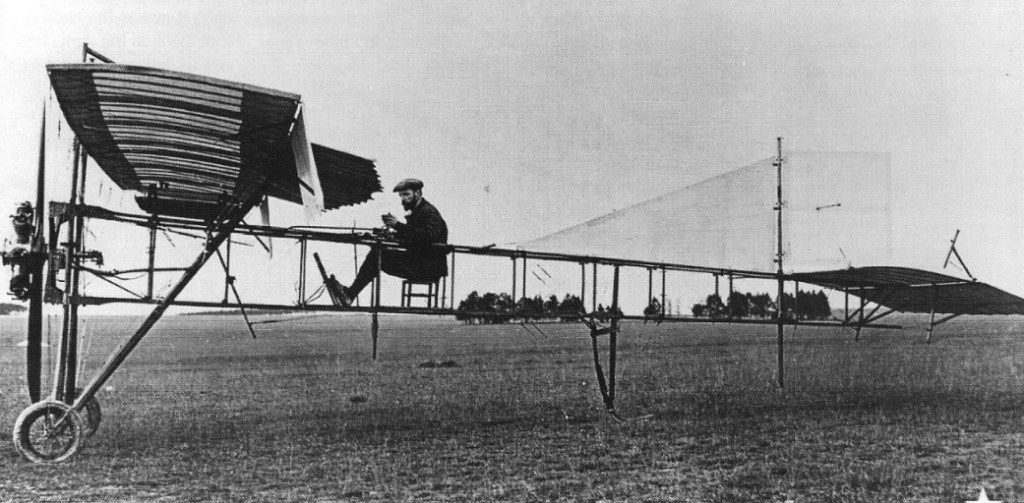
His first tractor monoplane was produced in the beginning of 1911. It was an ultra light high wing monopplane where the pilot sat in a fully open fuselage on a very basre chair. In the end this paid back in a monoplane with a total weight of 300 kg. The 50 hp developed Gnôme rotary engine gave this monoplane a top speed pf 115 km/hr,
The monoplane was tested at Bouy (Camp du Chalons)
It consisted of a rectangular wing of 23 ft span with a chord, including ailerons, of 6 ft 6 in. about 13 ft behind is a tail, composed of a small horizontal surface, and vertical and horizontal rudders. The Gnome motor, with propeller, is in front, while to pilot’s seat is located on a level with the main plane and just behind it.
It is mounted on a steel chassis with two wheels.
The monoplane carries 48.5 lb/sq.m at more than 25 mph.
This design got the factory identification HF.2/2. This development monoplane model was followed in due course by at least two other tractor monoplanes.
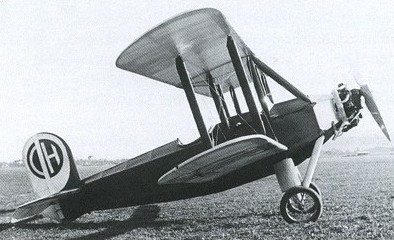
The Farman David was a light sport biplane introduced to the aviation world via the 1919 Paris Salon. Power was provided by a 37 kw (50 hp) Gnome rotary engine and the type was quite successful. Although publicised as a single-seater, it had accommodation for a pilot and passenger in cramped conditions. It was placed in production by Farman and soon became known as the Farman Sport, the name by which it was usually known. The 1920 model became available with a 45 kw (60 hp) Gnome engine, but eventually the Anzani engine seems to have become the norm.
A number were exported to Australia. The first of the type was imported by Shaw-Ross Engineering & Aviation Company Ltd of Port Melbourne, VIC. This aircraft G-AUBV (c/n 8 – later VH-UBV) arrived on 4 March 1921 and was registered from June 1921 but was destroyed by a fire at Essendon, VIC on 7 August 1931, the same fire which destroyed VH-UDL (c/n 24).
Farman Sport G-AUBV (c/n 8) in the mid-1920s at Port Melbourne, VIC, Australia
A further aircraft VH-UFX (c/n 7085) was registered to Industrial Indent Pty Ltd of Melbourne on 29 June 1927. It was damaged when it undershot landing at Essendon on 24 November 1930.
Another aircraft VH-UDC (c/n 25) was registered on 28 June 1921, also to Shaw-Ross Engineering & Aviation Company Ltd of Port Melbourne. It was destroyed in a crash at Cowes, VIC on 9 February 1923.
VH-UDL (c/n 24) was registered to Shaw-Ross Engineering & Aviation Company, also on 28 June 1921. Ownership was transferred to Shaw Aviation on 27 June 1930. It was destroyed in a fire at Essendon, VIC on 7 August 1931.
Two Farman Sports were obtained by Airgold Ltd in Papua New Guinea, G-AUHL (c/n 30) and G-AUHM (c/n 31). In May 1928 the two Farmans arrived in Port Moresby in crates. The intention was to assemble and then fly them to Lae to be operated in the freight role. However, on examination of the aircraft they were found to be too frail for the conditions prevalent in Papua New Guinea.
VH-UHL, named ‘Butterfly’, was assembled at Lae and flown to Wau. Fitted with a 34 kw (45 hp) Anzani radial engine, although Department of Civil Aviation (DCA) records indicated it, and VH-UHM, were fitted with the 60 kw (80 hp) Anzani 6A engine, the Farman Sport VH-UHL swung on landing on its first flight and a wheel collapsed. A further flight to Wau was made nine days later and on this occasion the undercarriage collapsed on landing. As well, many problems were experienced with the engine and VH-UHL was re-crated and shipped south for disposal. The second Farman Sport aircraft VH-UHM was never assembled and flown in Papua New Guinea and was also shipped back to Australia.
After returning from New Guinea VH-UHL had a number of owners, including L Mitchell of Wycheproof, VIC in May 1929, H Sweeney of East St Kilda, VIC in July 1930, C H Frazer of St Kilda, A H Wilkins of Blackwood, SA in November 1934, and R J Weston of North Adelaide, SA in October 1938. It was struck off the register in December 1947.
Farman Sport VH-UHM eventually ended up with Mr G N Wikner of Brisbane, QLD who loaned it to the Aero Club of NSW at Mascot for a period in 1929. He eventually rebuilt it, making various improvements to the airframe, the aircraft eventually being written off in an accident on 20 March 1930 at Dayboro in Queensland. Later a wing was used in the construction of a glider known as the Golden Arrow.
A catastrophic fire wiped out three of the Australian registered Farman Sport aircraft on 7 August 1931 when it broke out in the Shaw Aviation Company hangar at Port Melbourne, four aircraft, including three Farman Sports (VH-UBV, VH-UDL and VH-UFX) and a de Havilland DH.6 (VH-UBW) being destroyed.
Engine: Anzani 52 kw (70 hp) Wingspan: 7.11 m (23 ft 4 in) Wing area: 26 m² (279.87 sq ft) Length: 6.13 m (20 ft 1¼ in) Empty weight: 200 kg (441 lb) Loaded weight: 400 kg (882 lb) Max speed: 140 km/h (87 mph) Service ceiling: 2,000 m (6,560 ft) Endurance: 4 hrs 20 mins Seats: 2
The Farman F.1020 was built to test a novel wing design, the study of which had begun in 1926. Its plan was essentially semicircular, with the straight edge leading. The chord was thus broad and the aspect ratio very low. Such a wing has high induced drag but was thought to offer good transverse stability and low speed behaviour. It has such features in common with some tailless and delta designs.
The wing of the F.1020 had a near circular trailing edge which squared off into straight tips. The leading edge was a little further forward than the diameter of the idealised semicircle would have been and was slightly swept; it was also extended beyond the rest of the wing, carrying conventional ailerons. The maximum chord, at the wing root, was 5 m, compared with a span of 7.2 m; the aspect ratio was 2.1. The trailing edge carried deep chord control surfaces, two per side: the outer pair were used differentially like ailerons and the inner ones as flaps.
This wing was mounted on the fuselage of a Farman F.402, retaining the empennage, undercarriage and the 110 hp (82 kW) Lorraine 5-cylinder radial engine. As on the F.402, the wing was placed on top of the cabin with two square windows in the roof for upward visibility. The control system enabled the pilot to switch between conventional (aileron, elevator, rudder) control and that provided by the trailing edge surfaces.
The first flight of the F.1020, nicknamed the Pelle-bêche (en:Digging-shovel or Spade) and registered as F-AMOG, was in December 1933, piloted by Lucien Coupet. Thereafter it was only flown by Henry Farman who found it almost impossible to spin, but without any other particular merits. A design study was made for a variant with a shorter, 4 m, chord, designated F.1021, but this was not built.
Powerplant: 1 × Lorraine 5 Pb, 82 kW (110 hp) Wingspan: 7.50 m (24 ft 7 in) Wing area: 27 m2 (290 sq ft) Aspect ratio: 2.1 Length: 8.27 m (27 ft 2 in) Height: 2.22 m (7 ft 3 in) Maximum speed: 200 km/h (120 mph, 110 kn) Crew: 2