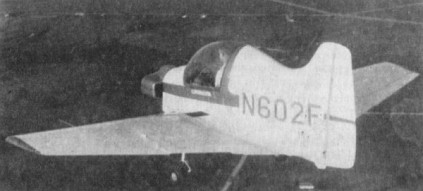
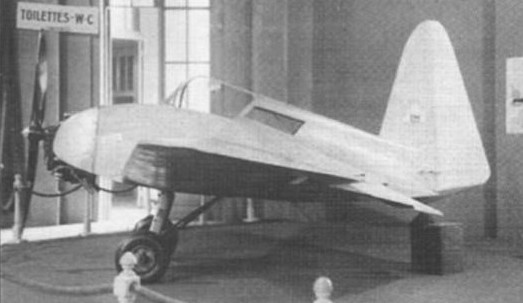
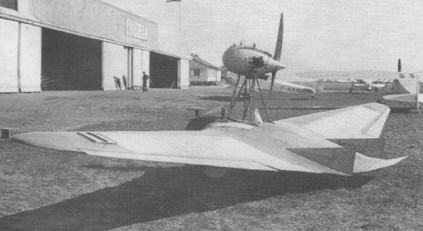
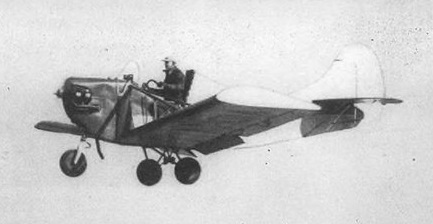
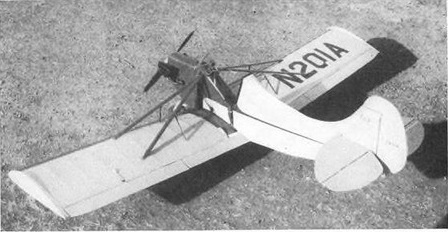
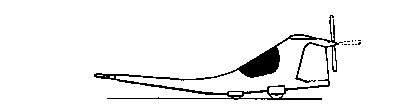
This small one-seater airplane, comparable to the Jodel D-9 bébé or to the Druine Turbulent, was designed specifically for amateur builders. The prototype was constructed by Leonard D. Wolff (assisted by his friend Davidson) at Houston, Texas in the United States. The AV-60 made its first flight on July 14, 1963, piloted by Davidson, when it actually became airborne during a “planned high speed taxi run”. The plane was exhibited at the National Air Show in Texas on November 3, 1963, where it was a big success. Christened as Leprechaun (the imp of Irish folklore), the AV-60 had been developed by Charles Fauvel in collaboration with G. Jacquemin, an aeronautical engineer working in Canada. The construction plans were produced in English. It is a low aspect ratio flying wing, with a nose-mounted Volkswagen engine (converted for aircraft use) of 1300 cc, weighing 48 kg and developing 40 Horsepower at 3500 RPM. A formed plexiglas bubble canopy covers the cockpit which is located over the low wing. The most remarkable characteristic is the absence of a long conventional fuselage structure with a laminated wood shell structure comprising the vertical stabilizer and the rudder attach beam being further braced by a triangular tubular beam from the wing itself. The prototype was equipped with a standard fixed tricycle landing gear, based on that of the TIPPSY Nipper.
Wing Span: 7 m Length: 4 m Empty Weight: 220 kg Max Gross Weight: 350 kg Maximum Speed: 157 km/h Cruise speed: 128 km/h Takeoff Distance: 180 m
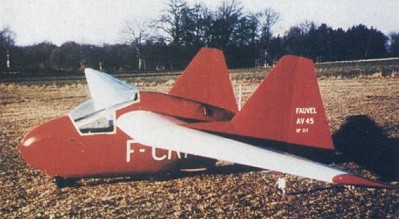
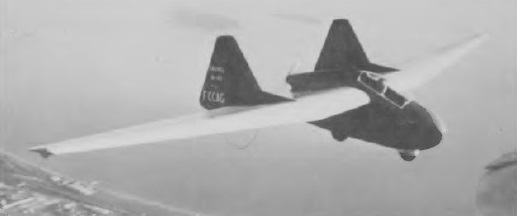
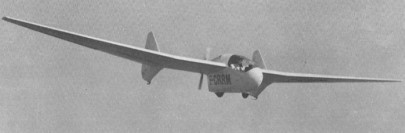
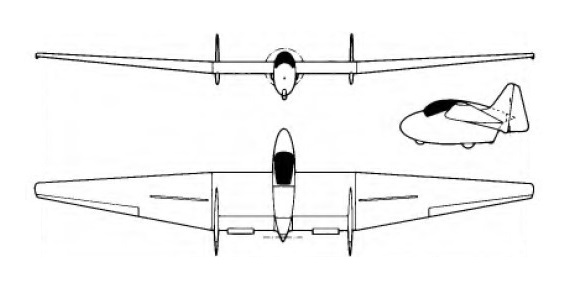
Inspired by two previous German experiences of motorizing the AV-36, and greatly motivated by the concept of the motorglider, Charles Fauvel flew the new AV-45 on May 4, 1960, an AV-36 very modified and powered by a pusher Nelson motor of 37 hp driving a two blade propeller. Later a 45hp Nelson engine was fitted. The second improved prototype, built by the SAN (Société Aéronautique Normande) in Bernay, took off with Charles Fauvel in command in 1962. This copy was equipped with a Solo engine of 23 hp that permitted, in spite of its low power output, enough power to take off in less than 100 ms and to climb at up to 3 m/sec.
This second prototype was representative of production AV 45s, which are intended for amateur construction, and it incorporated several changes, including the introduction of additional windows under the cockpit canopy, moving the pilot’s seat 2.4in further forward, lengthening the fuselage by 3.5 in, and fitting larger vertical tail surfaces carrying at the bottom small steerable skids which replace the underwing curved wire ‘bumpers’ of the first prototype. Hoerner wing tips were also successfully tried on the AV 45, and the original two-blade fixed-pitch airscrew was later replaced by an automatically feathering prop.
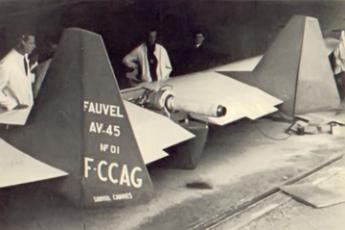
Microturbo was anxious to test this 78 Kp turbojet on a glider and Fauvel made available AV45 # 1. In 1967, the Nelson H 59A motor was replaced by a Microturbo Eclair 012-01 turbojet of 68 Kg / 150 lb of thrust in the summer of 1967. It was equipped with an electric starter and battery (NiCd 9.5 kg) for a self-starting it (both in the ground and in the air). The installation was characterized by the need to have a very long nozzle to allow ejection of the jet behind the fuselage.
Fauvel AV45-01R Microturbo Éclair
The first flight was by Charles Fauvel, and the second he was joined by Jacques Hemet Stampe as a photographer filming the event. In this form the prototype was redesignated AV 45-01R and the Eclair gave it a maximum level speed of over 140mph at 2,625ft and the maximum rate of climb 990ft/min, the time to 10,000ft being 15min. The Eclair’s battery permitted repeated restarts in flight as well as ground starting, and this turbojet was also seen as a possible powerplant for two other Fauvel tailless powered glider projects.
The prohibitive price of this jet engine did not allow its use for practical reasons. The prototype was later fitted with a 30hp Rockwell-JLO engine by an amateur builder. The standard engine recommended for production aircraft is the 40-55hp modified Hirth 0-280R ‘flat four’, there being integral wooden fuel tanks in the wing leading edges.
AV45
The first AV-45 motorglider of amateur construction, equipped with a Solo engine, was constructed in Japan and flew in South Africa (with Hirth Solo engine), while several copies were begun in the United States, in Finland, Germany and Spain. A French homebuilt AV 45 was flying with a Nelson engine. In France alone, even though some copies were constructed by amateurs, most glider pilots remained for the most part unconvinced of the charms of this motorglider. In early 1978 11 more AV45s were being built by amateur constructors, four in France, three in the USA, and one each in Finland, Germany, Martinique and Spain, the German one having a Solo engine. Like the AV 361, the AV 45 can be fitted with a wing of Wortmann laminar flow section, which gives an improved best glide ratio of 30:1.
Not discouraged, Charles Fauvel further improved the motorglider with the AV-451 version. This ship had its span extended to 15 m (49ft 2.5 in), incorporated a new airfoil design from Wortmann : the Laminar FX 66-H 159, a new fuselage shape obtained by using an existing glass canopy design (the one on the Grob Astir glider). The nose is more tapered, the wheel fairings more streamlined, and the vertical tail surfaces are of Wortmann symmetrical section. The propeller was automatically folded rearward by airflow effect when the engine was stopped.
The Gross (Fauvel) AV 451, actually the first AV 451, was designed and built by Mons Francois Gross with his son’s help and is a modification of AV45 F-CCRM with the 15m wing span and new Wortmann wing section of the AV451, a longer fuselage modified in the cockpit area to take the canopy from a Grob Astir, and with a 38hp Rotax 642 two-cylinder two-stroke engine aft of the cockpit, driving a two-blade Hoffmann pusher propeller. It made its first flight in the beginning of September 1978. The cantilever shoulder wings are of Fz 17% thickness/chord ratio section or Wortmann profile, with no dihedral on the centre section and 5° 13′ on the outer wings. The wings are single-spar wooden structures, with a plywood leading edge torsion box and fabric covering aft of the spar; there are conventional ailerons and the elevators are in the trailing edge of the centre wing, with a large trim tab in the port one. Schempp-Hirth air brakes are fitted in the upper and lower surfaces of each outer wing, just outboard of the fins. The fuselage consists of a short wooden nacelle with glassfibre covering, the pilot sitting under a sideways-hinged blown plastic canopy. The wooden twin fins and rudders are inset at the junctions of the centre section and the outer wings, there being no tailplane; the fins are plywood-covered and the rudders fabric-covered. The undercarriage consists of two wheels in tandem, a steerable front wheel and a rear wheel with mechanical brake, supplemented by small steerable skids at the bottom of the vertical tail surfaces. Endowed with a L/D of 32:1, the AV-451 was the last flying wing of Fauvel. An entirely fibreglas composite version (AV-48) had been considered, but a fire at the shop where the prototype was to be constructed put an end to this adventure.
AV.451
The death of Charles Fauvel explains in part the fact that the AV-451 didn’t attain the success of the AV-36 and AV-361.
AV 45 second prototype Span: 45 ft 1 in Length: 11 ft 9 in Height: 6 ft 0 in Wing area: 171.7 sqft Aspect ratio: 11.84 Empty weight: 476 lb Max weight: 772 lb Economical cruising speed: 80 mph Min sinking speed: 2.62 ft/sec at 43.5 mph Best glide ratio: 27:1 at 53 mph Rate of climb at sea level: 550 ft/min Take-off run: 492 ft
AV.45 Wing span: 13.75 m Length: 3.6 m Wing area: 14.80 sq.m Airfoil: Fauvel F4 17% Aspect ratio: 10.8 Empty weight: 219 kg Maximum gross weight: 350 kg Glide ratio: 26:1 Min sink rate: 0.82 m/sec
AV.45 Engine: Hirth O-280R, 30-41 kW / 40-55 hp Wing span: 13.74 m / 45 ft 1 in Length: 3.59 m / 11 ft 9 in Wing area: 15.95 sq.m / 171.7 sq.ft Wing section: F2 17% Aspect ratio: 11.84 Empty weight: 216 kg / 476 lb Max weight: 350 kg / 772 lb Water ballast: None Max wing loading: 21.94 kg/sq.m / 4.49 lb/sq ft Max speed: 77 kt / 142 km/h Min sinking speed: 0.8 m/sec / 2.62 ft/sec at 37.5 kt / 70 km/h Best glide ratio: 27 at 45.5 kt / 85 km/h T-O run: 493 ft / 150m Rate of climb: 168 m/min / 550 ft/min
AV45-01R Engine: Microturbo Éclair, 68 kg thrust Best glide: 29 @ 85 Km / h Min rate of descent: 0.78 m / s Performances tinkering usage provisioning engine Rate of climb: 240 m / min @ 120 Km / h Maximum speed (800 m): 225 km / h Time to 3000 m: 15 min Fuel capacity: 31 lt Endurance: 22 min
AV.451 Wing span: 15.0 m Length: 3.84 m Wing area: 16.68 sq.m Airfoil: Wortmann FX-66 H 159 Aspect ratio: 13.5 Empty weight: 250 kg Maximum gross weight: 380 kg Glide ratio: 32:1 Min sink rate: 0.72 m/sec
In 1935 Fauvel flew the AV-10, a light two-seater touring craft with a Pobjoy engine. Concentrating his efforts on this machine, Fauvel improved its performance, and in 1937 the AV-10 took the world altitude record in its category, while becoming the first flying wing to receive a Certificate of Navigability. The AV-10 was the first airplane-only design of Fauvel to be flown. Designed as a two-seater side-by-side and equipped with a Pobjoy engine of 75 Horsepower, it first flew in 1935. It was exhibited at the 25th Salon de L’Aéronautique at the Grand-Palais of Paris, on the 13th to the 29th of November, 1936, along with other light planes of the era : the Salmson Cricri, the Potez 60, the Leopoldoff Colibri and the Peyret Taupin. In 1937, the AV-10 set a new altitude record for it’s category when it reached 5791 meters, and became the first government-certified flying wing. The AV-10 remained a unique prototype, allowing Charles Fauvel to expand his knowledge and expertise in designing flying wings. The AV-10 disappeared in 1940, when it was taken by German troops.
Charles Fauvel modified an Abrial airfoil section for his projects (the Abrial / STAé 230-231, thickened to 17%) and Georges Abrial helped him for the development of his AV-2. The Abrial reflex airfoils were very efficient and the various tests at the St Cyr wind tunnel gave enough data to use them successfully for tailless aircraft. Charles Fauvel decided, after having obtained a patent on his formula for the flying wing, to put into work a prototype incorporating his theories. The designation was AV-2 (“AV” for Aile Volante, French for Flying Wing), the AV-1 having been intended only as the model to study the formula in laboratory studies. The construction of the AV-2 started about the year 1932, and the work was performed at the Guerchais factory. Equipped with a self-stabilizing airfoil designed and drawn by Georges Abrial, this aircraft was aimed at amateur pilots of motorized flight as well the glider pilot. The engine, mounted on a pylon on top of the back of the fuselage, could be disassembled from the craft in a few minutes to transform the plane into a pure glider. With the unexpected bankruptcy of the Guerchais enterprise and the end of financial support from the main investor, the Makhonine company, the development of the AV-2 stopped and was ultimately never finished. In a parallel effort, Charles Fauvel designed another prototype, a pure glider designated the AV-3.
Wing span: 12.85 m Length: 3.6 m Wing area: 20 sq.m Airfoil: Fauvel Aspect ratio: 8.3 Empty weight: 243 kg Max speed (Vno): 160 km/h
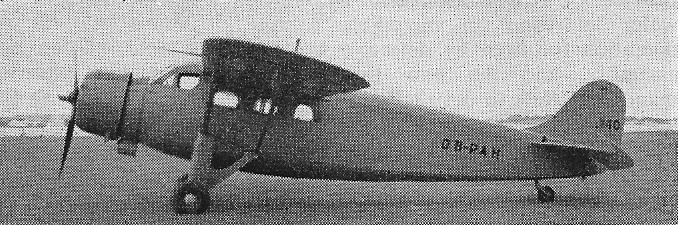
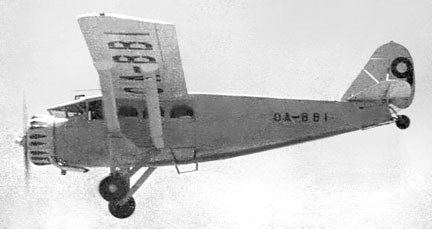
The Faucett F-19 was a larger and stronger version of the Stinson SM-6B built in Lima, Perú, by Elmer J “Slim” Faucett’s Compania de Avación Faucett.
Built with a 600hp P&W Wasp S1H1-G, using a supplied pattern aircraft, NX219W, from Stinson.
The eight-passenger cabin monoplane was built in small numbers immediately after WW2, used for internal routes by the Faucett airline. Some were refitted with an 875hp P&W Hornet S1E3-G engine.
Stinson-Faucett F-19 Perú OB-BBI
Thirty were built between 1934-46, of which three were reportedly still active in the late 1990s.
They were also available as a twin-float seaplane.
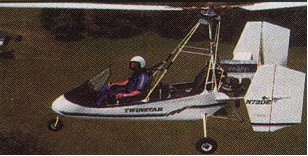
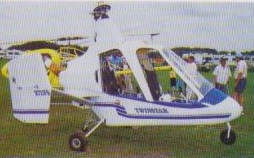
Farrington has developed an amateur-built kit gyrocopter with some features of the Umbaugh U-18 known as the Farrington “Twinstar”. This has an open fibreglass cockpit shell, a large twin-fin tail unit and a main rotor mounted on a tubular steel pylon. It is powered by a 110kW Lycoming 0-320 and the first prototype first flew in 1991.
A two seat tandem, enclosed autogyro with a pre-welded (tig) tube structure and full dual controls.
Engine: Lycoming O-320, 150 hp. HP range: 135-200. Height: 8 ft. Length: 12 ft. Disk span: 28 ft. Fuel cap: 19 USG. Weight empty: 700 lbs. Gross: 1200 lbs. Speed max: 90 mph. Cruise: 65 mph. Range: 90 sm. ROC: 900 fpm. Take-off dist: 200 ft. Landing dist: 0-50 ft. Service ceiling: 10,000 ft. Seats: 2. Landing gear: nose wheel.
Engine: Lycoming O-320, 150 hp Rotor span: 9.14 m MAUW: 560 kg Empty weight: 340 kg Max speed: 145 kph Cruise speed: 110 kph Minimum speed: 32 kph Seats: 2 Fuel consumption: 25 lt/hr Kit price (1998): US$9995
Hans U. Farner was a Swiss aircraft designer whose footlaunched canard ultralight sailplane had briefly reached production in 1966. In November 1974 he filed a patent for a novel control system, particularly suitable for canards. This suggested mounting the canard on a slender tube which slid snugly within a second long forward tube that, together with a pod containing an engine, pilot and bearing mainplanes, formed the fuselage. Extension of the canard-carrying tube by means of fore and aft control column movement increased the canard’s moment arm and increased pitch. The angle of attack of the canard was automatically altered as this happened. Rotating the tube about its long axis by rudder pedal movement turned the canard away from the horizontal and caused yaw, removing the need for a vertical rudder. Wing mounted ailerons controlled roll in the usual way.
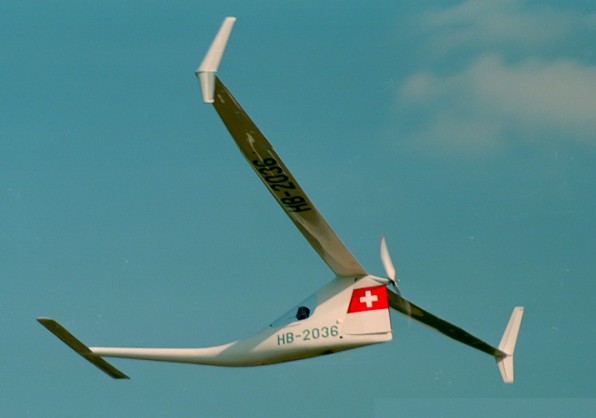
The Farner HF Colibri 1 SL motor glider, designed, built and test flown by Hans Farner in the late 1970s embodied these ideas. It had a very high aspect ratio (31.7) wing with a constant chord centre section carrying dihedral. Outer panels, with anhedral, combined with the inner section to form a cantilever gull wing. Thes outer panels had straight taper on the leading edges only, and rotated as all-moving ailerons or “tiperons” for roll control. The retractable tricycle landing gear is of narrow track limited by the fuselage width, and short wheelbase.
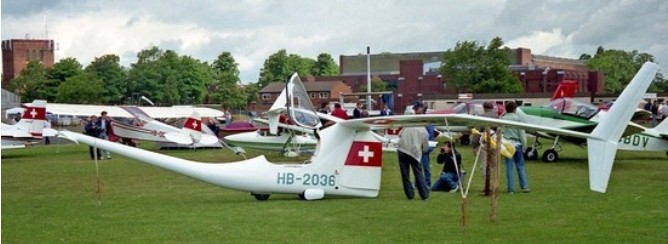
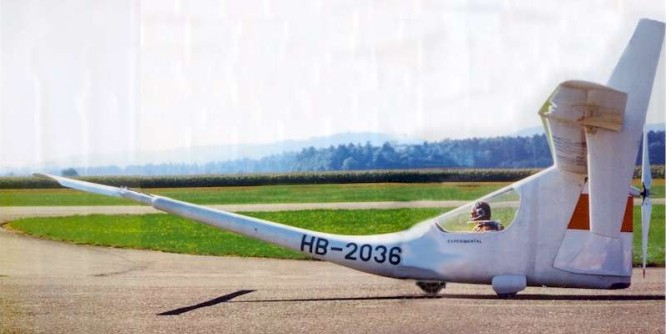
The wing was mounted on top of a narrow fuselage pod, with the pilot under a rear hinged canopy well forward of its leading edge. The Colibri was a twin engined motor glider, with two single cylinder two stroke McCulloch MC-101A, each of 10.1 kW (13.6 hp) driving a two blade pusher configuration propeller via reduction gear and a high positioned shaft, just below and a little way behind the trailing edge. The propeller blades can be folded to the rear when not in use, for soaring flight. Under the drive shaft the fuselage remained deep but tapered rearwards into two door like aerofoils with straight, vertical trailing edges that could be opened symmetrically outwards as an airbrake. Positioned well behind the centre of gravity, they closed together as the only fin. Forward of the cockpit the fuselage curved gently upwards into a tubular, straight, tapering, rising boom. The parallel chord, unswept, high aspect ratio canard, carried on its constant diameter tube in the manner described in the patent, providing lift and both yaw and pitch control. The main gull wing is of very high aspect ratio (31.7) mounted on top of the fuselage at the rear, and unbraced. It has dihedral on the constant chord and constant section (Wortmann FX-61-184) inner panels, and anhedral on the all moving outer panels which have leading edge taper and a Wortmann FX-60-1261 aerofoil section, the same as that of the canard foreplane. No flaps or ailerons are fitted.
The first flight date is uncertain but the Colibri was complete by late 1979. The written record post-1980 is sparse but photographs show it was still flying in 1990, when it appeared at a display in Belgium. It had visited the UK in 1989, coming to the PFA meeting at Cranfield. During the 1980s it had undergone considerable modification to the novel control system, with high aspect ratio, swept fins on the wings first at the outer end of the centre section, just before the start of the rotating tiperons, and then at the wing tips. These images suggest that conventional flight control surfaces were added to both fore and aft wings as well as to the fins. The extensible fuselage also seems to have been abandoned by 1989. It was still flying in 1990.