FFA P-16

FFA was awarded development contract July 1952 for P-16.04 interceptor/ground-attack aircraft with Armstrong Siddeley Sapphire, first flown April 28,1955. Fitted with leading-edge flaps, the first prototype had a wing thickness/chord ratio of between 5 and 6%. The second prototype was reduced to 4% and a higher powered turbojet.
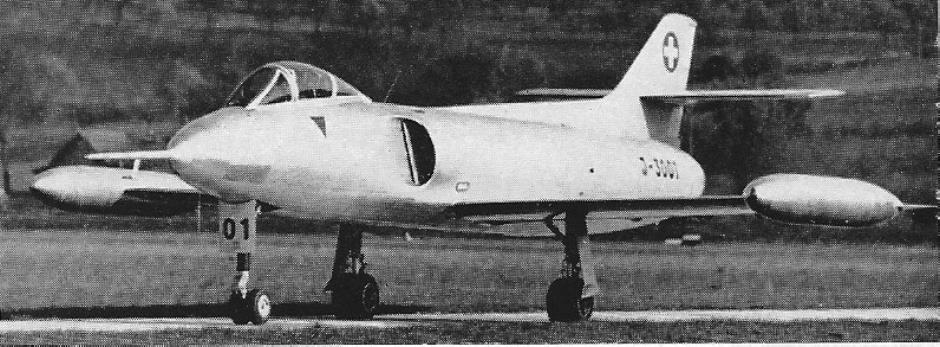
P-16.04

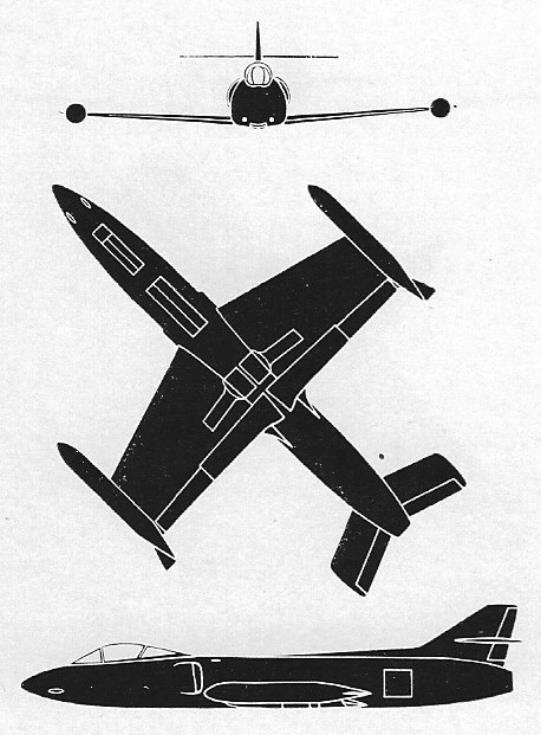
The airframe is low wing, with 20o sweepback. Swept tail surfaces, have a variable incidence tailplane mounted mid-way up the fin, with conventional rudder and elevators. The ailerons can be lowered with Fowler flaps to provide additional flap area. Full-span leading edge flaps and an air-brake is fitted on each side of the rear fuselage. A tricycle undercarriage, with twin wheels on each unit, main wheels retracting inwards into the fuselage and the nose wheel retracts reward.

Internal fuel capacity is 550 gal, including fixed wingtip tanks. The is provision for two 100 gal underwing jettisonable tanks. Armament is two 30mm Hispano cannon in the nose and 44 air-to-air unguided rockets in fuselage pack.

The prototype Mk.III first flew in March 1960.
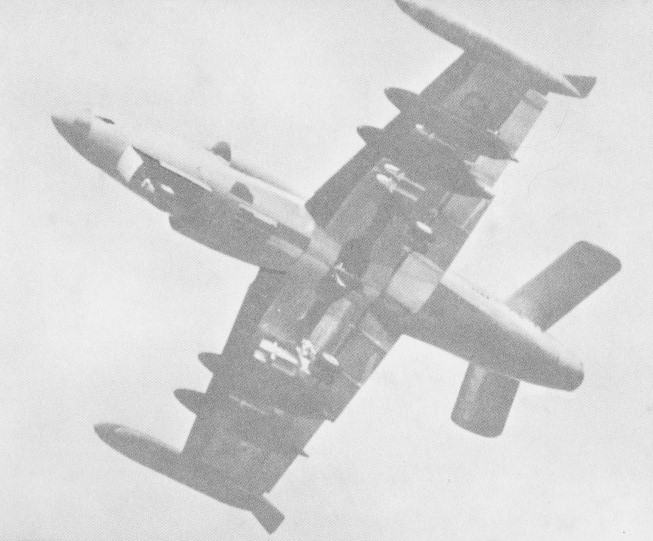
Mk.III

Program cancelled by Swiss Government but continued as private venture until June 1960; five aircraft built.

The P-16 wing formed the basis of the Gates Learjet design.
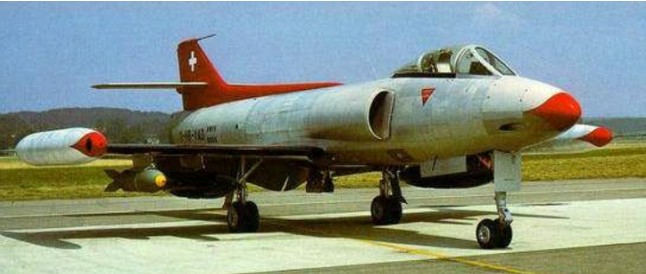
1st prototype
Engine: Armstrong Siddley Sapprire A.S.Sa.6, 7900 lb
Loaded weight: 17,857 lb
Max speed: 630 mph approx.
Armament: 2 x 30mm Oerlikon 302RK cannon

Engine: Armstrong-Siddeley Sapphire Sa.7
Length: 11.14 m
Span: 12.3 m
Max T/O weight: 11700 kg
Weapons load: 3000 kg
Max. horizontal speed: 1140 km/h / M 0.92
Altitude: 14000 m
T/O and Landing roll: < 500 m
Range: 1480 km

P-16 Mk.III
Engine: Bristol Siddeley Sapphire, 11,000 lb
Wingspan: 36 ft 7 in
Wing area: 320 sq.ft
Length: 46 ft 9 in
Height: 13 ft 5 in
Empty weight: 15,520 lb
MTOW: 27,795 lb
Internal fuel: 550 gal
Max speed: 696 mph SL
Service ceiling: 46,000 ft
Max range: 620 mi
Armament: 2 x 30mm Hispano cannon
Hardpoints: 4
Wheel track: 10 ft 2 in
Wheel base: 18 ft
Fetterman Chickadee

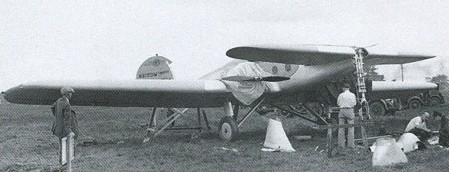
Fred Fetterman, a 38 year old high school instructor in aviation, worked for more than a year to build an all-metal sports plane. Fetterman built the plane in his spare time in a garage near his home at 1372 East 92nd St, Brooklyn.

The plane was an all-metal, two seat low wing monoplane, powered by a 50 hp Franklin engine.

He took it out to Floyd Bennett airport for an official take-off several weeks earlier but was prevented from flying by bad weather. On 3 March , Fetterman rose to around 1500 ft on the first flight.

At an altitude of 500 ft, according to Kenneth Behr, field manager, and other observers, the plane slid into a tail-spin and Fetterman struggled with it briefly as it dropped. He tried to straighten out, partly succeeded at about 250 ft and then jumped.

Fetterman’s parachute failed to open properly and he fell head first into a marsh half a mile southwest of the airport. He was instantly killed.

The plane drifted slowly down, landing on its nose in the soft ground, almost undamaged.

Ferguson F-II Fergy / Precision Tech Aircraft Fergy

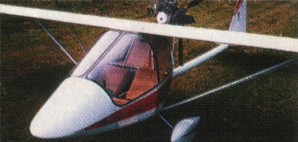
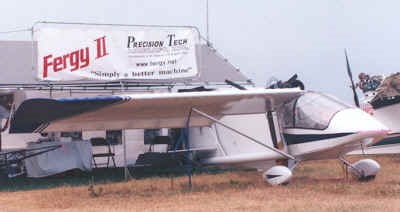
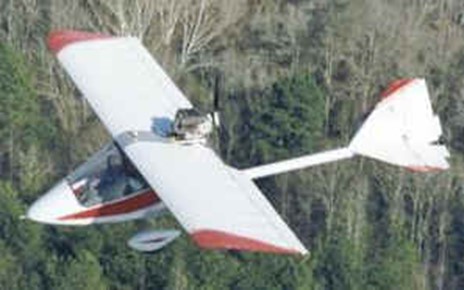
Designed by Bill Ferguson and first flown in 1991, the Fergy was developed from the Kolb Mark III and introduced to the market in 1991. The Fergie won the Grand Champion title at Sun ‘n Fun in 1991. Reviewer Andre Cliche describes it as a “clone”, whilst Noel Bertrand et al. claim it was “inspired by the Kolb Twinstar”. The aircraft differs from the Kolb design in that it has a revised cockpit pod, with centerline-hinged doors and a square-tipped rudder. The horizontal stabilizer was also raised a few inches to give better ground clearance.

The Precision Tech Fergy F-II B is a two-seat side-by-side, conventional landing gear, strut-braced, high-wing, pusher configuration ultralight aircraft that was manufactured by Ferguson Aircraft and later Precision Tech Aircraft in kit form for amateur construction.

Ferguson Aircraft manufacturers of the Fergie, sold the design to Precision Tech Aircraft out of Cartersville Georgia.

Precision Tech has made some design changes, changing to a new airfoil, landing gear, and tail section. The airfoil change was required when the wing spar was changed to a 6 inch spar.

The aircraft is constructed from aluminium tubing, covered with aircraft fabric. The wings fold for storage or trailering. The standard engine supplied with the kit was the 50 hp (37 kW) Rotax 503, with the liquid-cooled 64 hp (48 kW) Rotax 582 optional, although the Fergie can accept engines that range in output from 50 to 80 hp (37 to 60 kW).

The average construction time from the kit was reported by the manufacturer as 350 hours and 40 had been completed by 2001. The unit cost was US$10,900 in 2001.

The aircraft was out of production circa 2002 and no longer available.

Ferguson F-II
Engine: Hirth 2704, 55 hp.
HP range: 46-70.
Height: 5.5 ft.
Length: 21.25 ft.
Wing span: 30 ft.
Wing area: 160 sq.ft.
Fuel cap: 12 USG.
Weight empty: 425 lbs.
Gross: 900 lbs.
Speed max: 90 mph.
Cruise: 70 mph.
Range: 200 sm.
Stall: 32 mph.
ROC: 1200 fpm.
Take-off dist: 200 ft.
Landing dist: 200 ft.
Service ceiling: 10,000 ft.
Seats: 2.
Landing gear: tail wheel.

Ferguson F-II
Engine: Rotax 503, 55 hp.
HP range: 46-70.
Height: 5.5 ft.
Length: 21.25 ft.
Wing span: 30 ft.
Wing area: 140.2 sq.ft.
Fuel cap: 12 USG.
Weight empty: 425 lbs.
Gross: 900 lbs.
Speed max: 90 mph.
Cruise: 70 mph.
Range: 200 sm.
Stall: 32 mph.
ROC: 1200 fpm.
Take-off dist: 200 ft.
Landing dist: 200 ft.
Service ceiling: 10,000 ft.
Seats: 2.
Landing gear: tail wheel.

Ferguson II-B
Wingspan: 29ft. 6 in.
Wing Area: 140 sq. ft
Length: 22 ft.
Height: 5ft. 8in with 2 blade prop
Empty Weight: 400 lbs.
Gross Weight (65 hp): 900 lbs.
Useful Load: 500 lbs.
Fuel Cap: 12.5 gal.
Take-off Roll Pilot only 46 hp: 175 ft
Rate of Climb 46hp: 800 ft/min
Rate of Climb 65hp: 1200 ft/min
Cruise: 50 – 80 mph
VNE: 100 mph
Landing Speed w/Flaperons: 28mph
Landing Speed wo/Flaperons: 34mph
Seats: 2
Storage Aft of Seats: 4 cubic feet

Precision Tech Fergy F-II B
Engine: 1 × Rotax 503, 50 hp (37 kW)
Propeller: 3-bladed ground adjustable
Wingspan: 29 ft 6 in / 8.99 m
Wing area: 140 sq ft / 13 sq.m
Length: 18 ft 8 in / 5.7 m
Empty weight: 400 lb / 181 kg
Gross weight: 1,000 lb / 454 kg
Fuel capacity: 12.5 US gallons / 47 lt
Maximum speed: 90 mph / 145 km/h / 78 kn
Cruise speed: 75 mph / 121 km/h / 65 kn
Stall speed: 28 mph / 45 km/h / 24 kn
Range: 220 mi / 191 nmi / 354 km
Rate of climb: 1,000 ft/min / 5.1 m/s
Wing loading: 7.14 lb/sq ft / 34.9 kg/sq.m
Crew: one
Capacity: one passenger

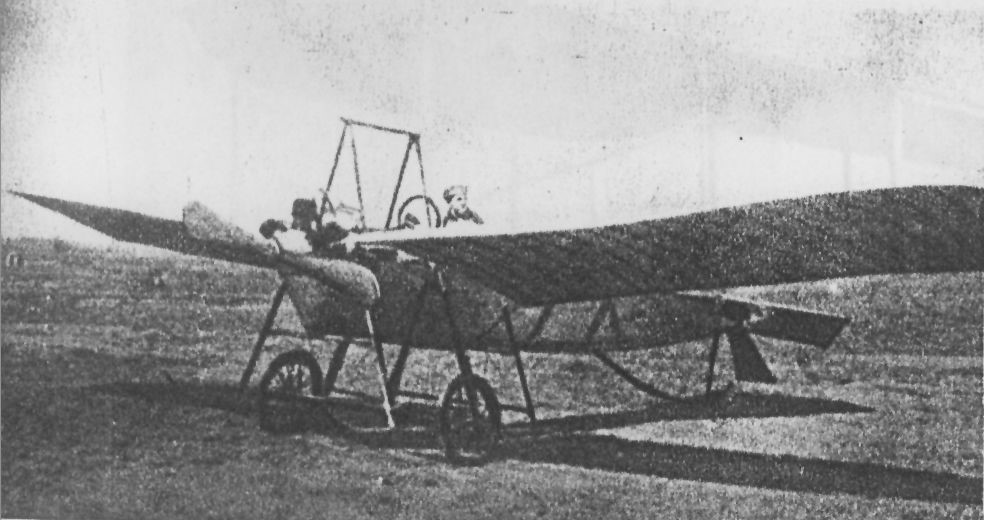
Ferguson Monoplane

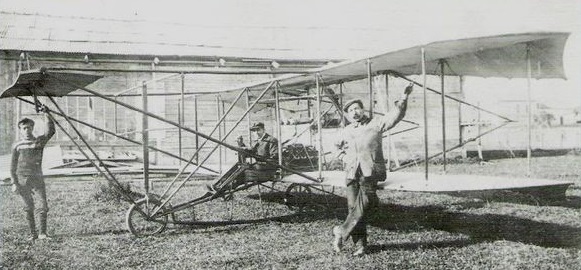
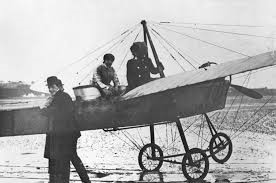
The exploits of the Wright Brothers fascinated Harry Ferguson and during subsequent years he visited many air shows and exhibitions. Two he attended were Rheims and Blackpool where he took measurements from the aircraft there. On his return to Belfast he persuaded his brother Joe that it would be good for their garage business to build and fly planes.

Throughout 1909 construction took place, with various changes and improvements being made as work progressed, one being the replacement of the original Green engine by an eight cylinder, air cooled 35hp JAP engine.

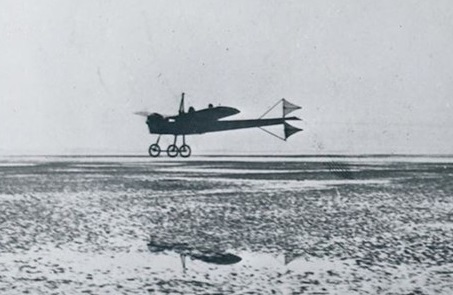
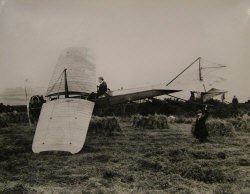
The day of the first flight attempt arrived and with wings detached and the tail resting in the back of a car the aircraft was towed through the Belfast streets up to Hillsborough Park. First efforts to get off the ground failed due to propeller trouble. It was replaced but again this and bad weather prevented attempts for nearly a week.

Finally, on the 31 December 1909 Ferguson was ready to go. A reporter from the Belfast Telegraph described the scene:

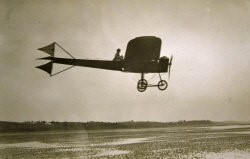
The roar of the eight cylinders was like the sound of a Gatling gun in action. The machine was set against the wind, and all force being developed the splendid pull of the new propeller swept the big aeroplane along as Mr Ferguson advanced the lever. Presently, at the movement of the pedal, the aeroplane rose into the air at a height from nine to twelve feet, amidst the heavy cheers of the onlookers. The poise of the machine was perfect and Mr Ferguson made a splendid flight of 130 yards. Although fierce gusts of wind made the machine wobble a little twice the navigator steadied her by bringing her head to wind, successful initial flight that has ever been attempted upon an aeroplane.

A few unsuccessful attempts, one of which was at Magilligan Sands, the Ferguson monoplane took to the air from Hillsborough. However, while his attempts at Hillsborough and Magilligan are well documented, it is believed that Ferguson tested his plane at the site of what is now Ards Airfield.

Harry Ferguson had thus made the first flight in Ireland and was the first Briton to build and fly his own aeroplane.

The machine was rebuilt and flown in 1911 and 1912.

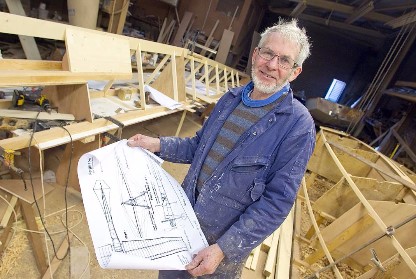
Allastair Duffin in his Belfast workshop

Allastair Duffin, a Newtownards boatbuilder and woodworker, was building a replica of the Harry Ferguson monoplane commissioned by the BBC. The BBC approached Alastair about with their idea of filming a documentary about Ferguson, which would include flying a replica of the original plane.

There are no original plans and it appears Harry Ferguson marked it out on the floor and said to the men, right, there you are, build it. Plans were drawn up using a model at a museum as its basis. Once completed it is hoped the plane will fly.

Engine: JAP 8-cyl, 35 hp
Wing span: 32 feet
Length: 26 feet