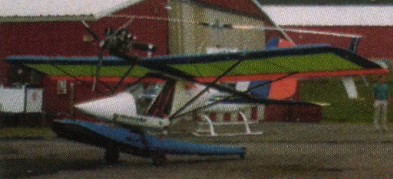
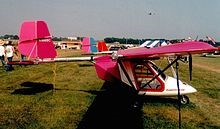
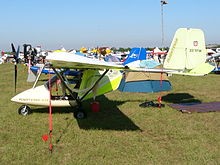
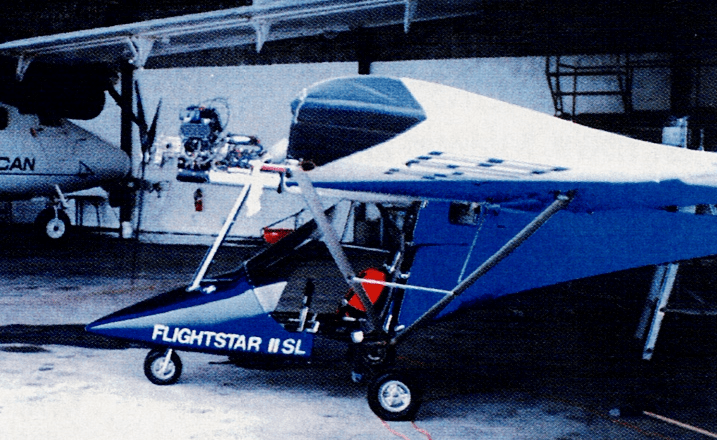
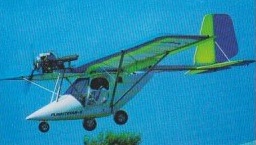
Flightstar designer Tom Peghiny built the first Flightstar in the mid-1980s for the US FAR 103 Ultralight Vehicles category with its maximum 254 lb (115 kg) empty weight requirement. The two-seat Flightstar II soon followed to fill the role of a trainer. The designs quickly became commercial successes and the basic design has been extensively developed over time. By 2007 over 700 single seaters had been sold.
All models are constructed from anodized aluminum tubing assembled with bolts. The fuselage is suspended from a keel tube that also mounts the engine at the front, the tail at the back and the wings. The wings are strut-braced and utilize jury struts. The wings and tail surfaces are covered in pre-sewn Dacron envelopes, which reduces construction time. The wings have full-span ailerons, while the tail features conventional elevators and rudder. The landing gear is a tricycle gear arrangement with bungee suspension on the main wheels. The nosewheel is steerable and mainwheel brakes are an available option. The reported construction time for the single seat models is 100 hours.
The Flightstar II is LSA legal.
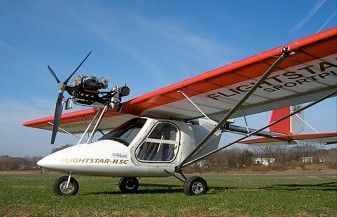
The Flightstar-IISC is the Sport Cabin version of the IISL. The IISC includes all that’s needed to enclose the plane for more comfort and all season flying. The cabin parts include the Fastback rear enclosure, composite cabin fairings, door posts, Lexan roof and zippered sport doors. The IISC was developed with the sport pilot in mind. The large wing allows predictable slow flight handling and quiet low throttle cruising. The IISC features the 54HP dual carb, dual ignition, Rotax 503 with the Flightstar 503 Super Cowl. The optional engines include the 64HP Rotax 582 liquid-cooled twostroke and the 60HP HKS 700E four-stroke engine. The Flightstar II was shown at the ’98 Sun ‘n Fun with an HKS 700 engine.
The Rotax 503 engine installation on a Flightstar II
Standard equipment includes high lift wing with streamlined struts, Flightstar wingfold system, vibration isolated instrument panel, 10 USG rotational molded fuel tank w/sump, full dual control system, chromemoly cage and landing gear, heavy duty stamped dynofocal engine mount, anodized airframe for corrosion protection, and point pilot restraint harnesses.
Optional equipment includes, full instrument package, 4 point harnesses, complete electrical system. in-flight adjustable trim, 3 blade composite propeller, azusa drum brake system, and brs ballistic parachute system. The Flightstar II SC airfoil is the Flightstar FS-II-2 13% thick.
Flightstar IISC
The Flightstar-IISL combines the open air freedom of ultralight type flying and the fun of being side by side with your passenger. With a 120 hour assembly time and the Flightstar wingfold system, the IISL is fitted with full dual controls. The wide stance landing gear for cross wind landings and light wing loading offers easy handling and landings. The airframe is designed for the rigors of flight training and is tested to last. The IISL offers the same standard and optional equipment as the IISC.
The full engine options are the Rotax 503FA (496 C.C. 54HP @ 6800 RPM) with 2.58 TO1 reduction ratio, and the HKS 700E (680 C.C. 60 HP @ 6200 RPM) with 3.47-1 reduction ratio. Propeller options include Tennessee prop. Co. 2-blade, 68” dia, Ivo-prop. 3-blade 68”, and Powerfin F model 70” diameter.
March 1993
The Flightstar II kit, including engine, cost US$15,395 in 1997. The Flightstar II-SL kit, including engine, cost US$13,795 in 1997.
Flightstar IISL
The two seat models all have side-by-side seating and have folding wings. The aircraft were also produced under licence in India by Albatross Flying Systems.
In 2009 the Flightstar single and two-seat, high wing, single engined kit aircraft produced by Flightstar Sportplanes of South Woodstock, Connecticut, rights, tooling and parts inventory were sold to Yuneec International of China when Flightstar Sportplanes’ business was wound up.
In July 2009 a new single seat model was exhibited at EAA AirVenture Oshkosh as the Yuneec e-Spyder electric-powered version.
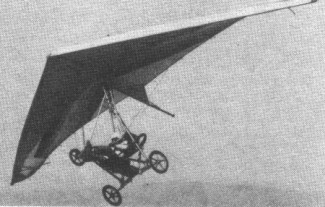
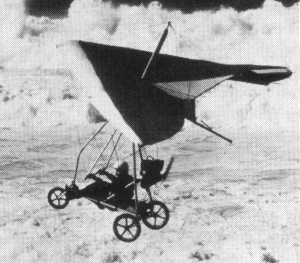
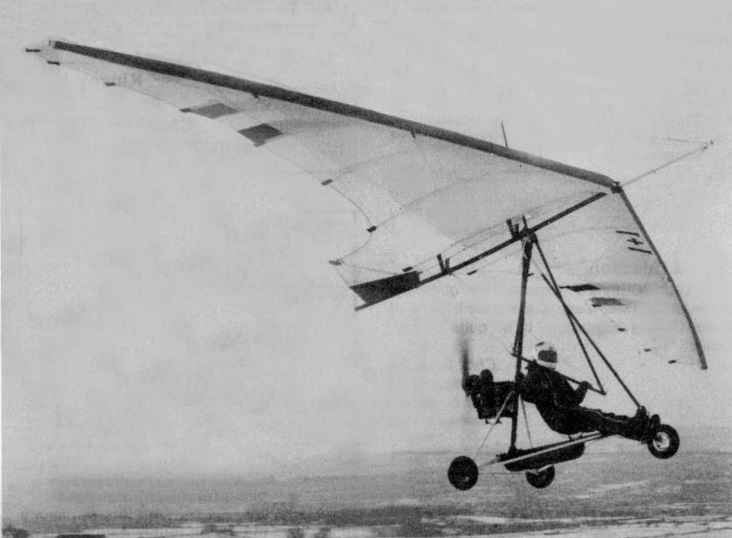
Single seat single engined flex wing aircraft with weight shift control. Rogallo wing with keel pocket. Pilot suspended below wing in trike unit, using bar to control pitch and yaw/roll by altering relative positions of trike unit and wing. Wing braced from above by kingpost and cables, from below by cables; rigid cross tube construction; 60% double ¬surface enclosing cross tube; pre formed ribs. Undercarriage has three wheels in tricycle formation; steel spring suspension on nose¬wheel and bungee suspension on main wheels. Push right go left nosewheel steering indepen¬dent from yaw control. Brakes on main wheels. Aluminium tube trike unit, without pod. Engine mounted below wing driving pusher propeller. Wing has foam insert in leading edges.
The Jetwing ATV (All Terrain Vehicle) is an original concept: it is not purely a trike in the conventional sense, because its wheels can be replaced by floats. By removing the wing and fitting the rear of the floats with a triangular tubular structure supporting a large rudder, the Jetwing can be transformed into a speedboat. Using its pusher propeller it can be turned into a go kart by refitting the wheels but leaving the wing off, while also available as an option are skis.
The price of the trike unit was US$3000 in 1982 and bought together with the Demon hang glider wing it costs a total of US$4995. Flight Designs does not recommend the use of any other Rogallo with its trike unit and it is worth noting that its Demon Rogallo is not related to the British wing of the same name, made by Hiway. The later Jetwing ATVs had a belt reduction drive of 2.2/1 ratio, with a max static thrust of 220 lb (100 kg).
Engine: Kawasaki TA440, 30 hp at 5500 rpm. Prop¬eller diameter and pitch 36 x 16 inch, 0.91×0.40 m. No reduction. Power per unit area 0.17hp/sq.ft, 1.8hp/sq.m. Fuel capacity 5.0 US gal, 4.2 Imp gal, 18.9 litre. Length overall 12.0 ft, 3.65 m. Height overall 12.0ft, 3.65m. Wing span 33.5ft, 10.18m. Mean chord 5.3ft, 1.60m. Total wing area 175 sq.ft, 16.27 sq.m. Wing aspect ratio 6.3/1. Nosewheel diameter overall 16 inch, 40 cm. Main wheels diameter overall 20 inch, 50 cm. Empty weight 216 lb, 98 kg. Max take off weight 480 lb, 218 kg. Payload 264 lb, 120 kg. Max wing loading 2.74 lb/sq.ft, 13.4 kg/sq.m. Max power loading 16.0 lb/hp, 7.3kg/hp. Load factors; +4.0, 2.0 ultimate. Max level speed 47 mph, 76 kph. Never exceed speed 52 mph, 84kph. Max cruising speed 37mph, 60kph. Stalling speed 22 mph, 35 kph. Max climb rate at sea level 400 ft/min, 2.0 m/s. Min sink rate 350 ft/min at 23 mph, 1.7 m/s at 37 kph. Best glide ratio with power off 7/1 at 25 mph, 40 kph. Take off distance 50 ft, 15 m. Landing distance 75ft, 23 m. Service ceiling 10,000ft, 3050 m. Range at average cruising speed 160 mile, 257 km.
The company’s four-seat C4 project has slowed down its planned U.S. certification schedule to take advantage of anticipated streamlining of the Part 23 process by FAA, so deliveries could slide into 2015.
Flight Design entered receivership in 2016. Work on the C4 had come to a standstill after the company ran into financial difficulty. Production had also slowed to a trickle as the company workforce was trimmed to 10 people in Germany and around 60 in the Ukraine.
Flight Design completed the sale of all major company assets to the German investment group Lift Holding, allowing for the resumption of work on the C4, a Part 23-certified four-seater with a projected selling price of $250,000.
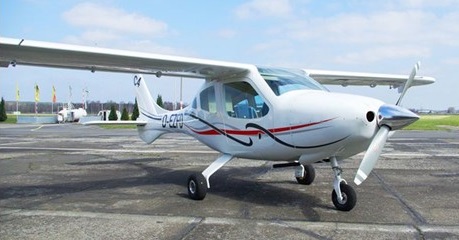
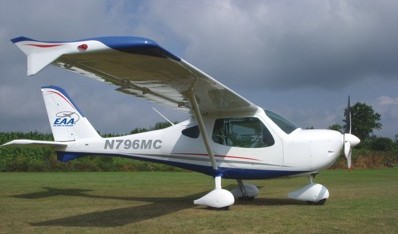
Created to complement the existing CTsw and CTLS, the MC offers utility and performance in a metal airframe. Constructed from Aluminum, steel and composites, the MC features a steel space frame, all aluminum flying surfaces and a composite cabin and cowling. The focus with the MC was to provide more utility with a giant cabin and easy-to-maintain modular construction. Designed with training and commercial fleet uses in mind, the MC visibility, baggage area and easy cabin entry are features. The metal flying surfaces of the MC are buck riveted and corrosion proofed for maintenance free flying. The steel pilot cage is covered with easy to remove composite shells to allow quick access to the landing gear and controls for annual or 100 hour inspections. The main landing gear is the Flight Design nobounce composite gear introduced on the CTLS. The cabin of the MC has a width of nearly 52 inches, 2-way adjustable seats and extra-wide cabin doors. The four-point safety harnesses, wing located fuel tanks and the BRS 1350 parachute system are standard. Standard features include 2 blade composite propeller, conventional three-axis controls, electric pitch trim system, cabin door gas struts, two large capacity baggage compartments, two cockpit storage compartments, electric pre-selector flap system, one piece molded windshield, steerable nose wheel, hydraulic brakes, durable, two-part urethane paint.
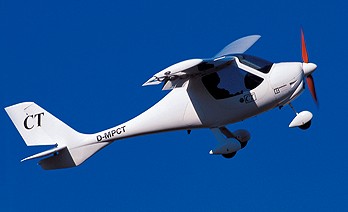
An ultralight composite aircraft, the Flight Design CT2K has been developed, and now has less weight, increased power and higher performance, with additional load-carrying capability. The design of the wing and the aircraft structure has been tested for a take-off weight up to 600 kg, so the Flight Design CT2K can comply with different certification criteria in different countries. 2009 CT2K price: 55862 EURO In spring 2003 CT2K was complimented with the CTSW (CTSW = CT Short Wing). Due to 80 cm shorter wings and increased ground effect CTSW has even greater aerodynamic stability and is easy to land. This aircraft had 5 km/h increased maximum level-flight speed while having slightly reduced climb speed. Both CT2K and CTSW were also available as VLA versions. 2009 price for the CTSW was 60000 EURO.
CT 180
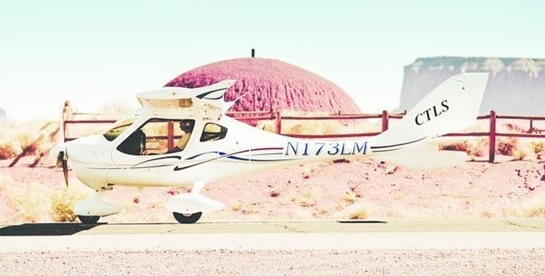
In 2012 Flight Design had 11 registrations in the US. CTLSi (with the fuel-injected Rotax 912iS engine) are selling well, and the CTLS, MC and CTLS-Club models continue in the popular lineup. 2012 Prices: US$156,500 (CTLSi); US$143,800 (CTLS); US$136,860 (CTLS-Club).
CTLS
CT 180 Engine: Rotax 912, 80 hp Wing span: 9.30 m Wing area: 10.80 sq.m MAUW: 450 kg Empty weight: 275 kg Fuel capacity: 100 lt Max speed: 225 kph Cruise speed: 210 kph Minimum speed: 64.4 kph Climb rate: 5 m/s Certification: VZ Seats: 2 Fuel consumption: 15 lt/hr Price (1998): 60 000 DM
Flight Design CT Engine: Rotax 912S, 100@SL TBO: 1500 hrs. Fuel type:100/100LL Propeller: Neuform FP Landing gear type: Tri./Fixed Max ramp weight: 1320 lb Gross weight: 1320 lb Landing weight: 1320 lb Empty weight, std: 646 lb Useful load, std: 674 lb Useful fuel, std: 34 USgals Payload, full std. fuel: 470 lb Wingspan: 28 ft Overall length: 20 ft. 4 in Height: 7 ft. 11 in Wing area:107 sq. ft Wing loading: 12.3 lbs./sq. ft Power loading: 13.2 lbs./hp Wheel size: 6.00 x 6 in Seating capacity: 2 Cabin doors: 2 Cabin width: 49 in Cruise speed 75% power: 112 kt Max range (w/ reserve) 75% power: 600 nm Fuel consumption 75% power: 4.5 USgph Vso: 39 kt Best rate of climb SL: 960 fpm Service ceiling: 14,000 ft Takeoff ground roll: 295 ft Takeoff over 50-ft. obstacle: 525 ft 2006 price: US$92,900
At least two other Flettner helicopters were under development when the war ended. These were the Fl 285, another fleet spotter with an Argus As.10C engine, capable of making a 2-hour flight and carrying two small bombs; and the Fl 339, a large transport helicopter project powered by a BMW 132A engine.
In 1940, Hitler ‘s Kriegsmarine (German Navy) made a request for a naval helicopter for operate from its units.
The Flettner Fl 282 Kolibri was designed from the outset as a two-seater, so that, at the expense of range, an observer could be carried, with obvious benefits in the roles of army and navy spotting and anti-submarine work. The observer was to be accommodated in a seat facing rearwards and positioned behind the rotor shafts, and the design provided for a permissible c of G travel which allowed the helicopter to fly with or without the observer without trim changes. The design was finalized by about July 1940 and work began on 30 prototypes and 15 pre-production machines at Flettner’s Johannisthal and Bad Tolz factories. For early flight trials, which began in 1941, the first three Fl 282 prototypes were built as single-seaters and had enclosed Plexiglas-panelled cabins.
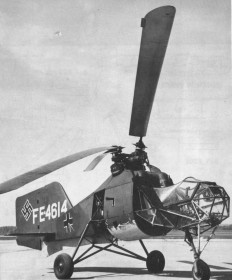
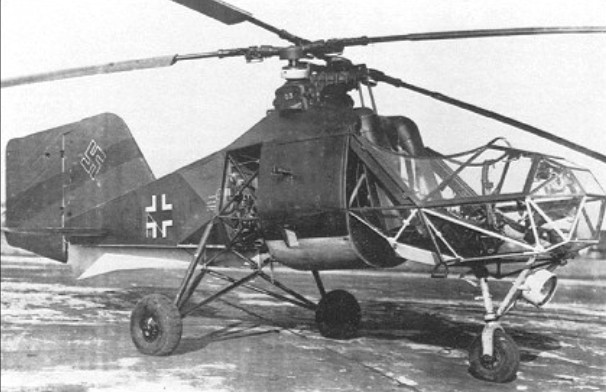
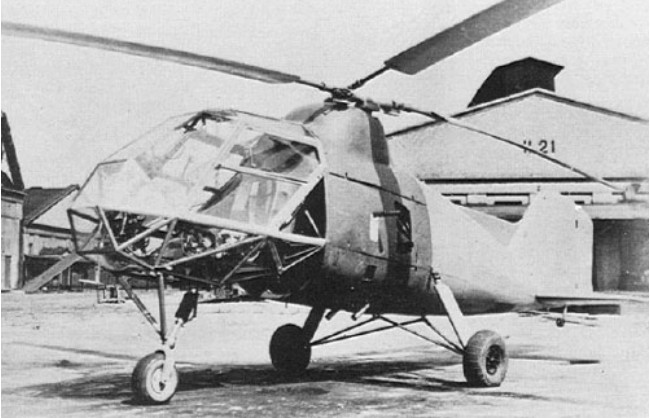
The first three prototypes were completed as single-seaters and had fully enclosed cabins made up of a series of optically flat Plexiglas panels, faired-in rotor pylons and well-contoured fuselages. The Fl 282V3 was fitted with endplate auxiliary fins and a long underfin beneath the rear fuselage. Later two-seater machines had more utilitarian bodies and some had semi-enclosed cockpits; others, like the example illustrated, had a completely open pilot’s seat.
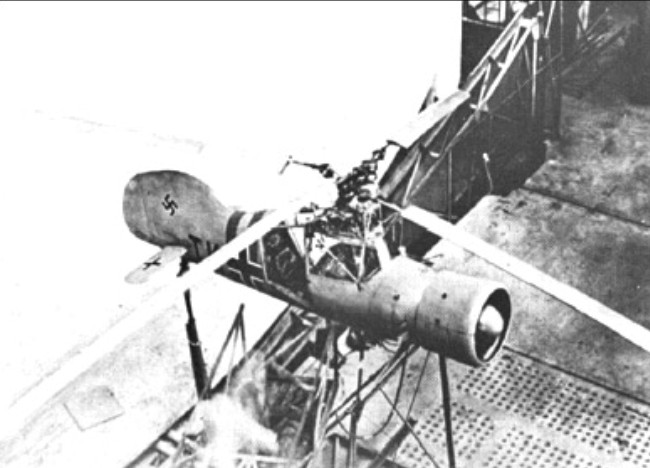
By mid-August 1941 work on the Fl 282 V1 had progressed to the point where it could be used on the ground as a transmission unit test bed. The test bed was anchored but could climb the length of the restraint to a certain height and hover. 125 hours and 39 minutes were spent in these tests, which lasted until November 21, 1941. In the event of the destruction of the V1 or a lengthy interruption of testing due to some other problem, it was planned to use the Fl 282 V4 as a replacement test bed.
For early flight trials the first three Fl 282 prototypes were built as single-seaters and had enclosed Plexiglas-panelled cabins.
The first three prototypes were completed as single-seaters and had fully enclosed cabins made up of a series of optically flat Plexiglas panels, faired-in rotor pylons and well-contoured fuselages. The Fl 282V3 was fitted with endplate auxiliary fins and a long underfin beneath the rear fuselage. Later two-seater machines had more utilitarian bodies and some had semi-enclosed cockpits; others had a completely open pilot’s seat.
The first free flight was made by the Fl 282 V2 on October 30, 1941. At the controls was test pilot Ludwig Hoffmann, who had joined Flettner as the successor to company pilot Perlia. Tests resumed in March 1942 following design changes to the cardan shaft; the tests revealed a significant improvement in the helicopter’s handling. The Fl 282 V2 was taken out of service on May 25, 1942; the aircraft’s transmission and engine were removed for use in other prototypes.
Hoffmann carried out two altitude flights in the Fl 282 V3 on April 27, 1942. On the first he reached a height of 3,500 meters over the takeoff point and on the second (from 1517 to 1610 hours) 3,800 meters in 36 minutes.
The Fl 282 V5, which featured a number of changes compared to the V3 (tail surfaces, fuselage, pilot seat), began flying in January 1942. It also remains to be mentioned that the Fl 282 V2 and V3 had a fully-glazed cockpit. From the V5 on the pilot seat was either entirely open or had a plexiglass shield in front or on the sides.
Various empennage arrangements were also tested. The V3 had a horizontal stabilizer right and left with end fins. A V-shaped stabilizer, similar to that of the Cierva C 30, was installed on the V23.
Calculations revealed that reversing the direction of rotation of the rotor should significantly improve directional stability, especially at low power settings. The V8 was rigged up as a test bed to confirm this. Flight tests with the V9 and V15 began in September 1942 and confirmed the theoretical findings. Directional stability was so good, that the entire fuselage section aft of the firewall was simply left off the V9. Flight tests were problem free. The V9 was the prototype for a version to be operated by the Navy from large submarines and designated “Modified Model in Form of a Standing Cylinder” (Fl 282 U).
The Fl 282 was more highly developed and flew more hours than any other German helicopter, and very extensive tests and measurements were made of all flight aspects. Most of this test work was done by Flettner’s chief pilot, Hans E. Fuisting, who also undertook blind flying and trained many of the 50 pilots who learned to fly the Fl 282. Some new pilots ran into trouble when flying near the ground, because, as they turned with the wind, they lost lift and struck the ground. One new pilot had a fatal accident when flying his Fl 282 blind in cloud, and the assumed cause of the accident was that the machine had been dived and the controls then pulled back so violently that the blades were forced into each other or into the tail. The diving speed thereafter was restricted to 175km/h. On occasions, the Kolibri was landed autogyro fashion and without the use of collective pitch. This was done by descending vertically, diving nose-down and then pulling back on the controls to land, but, on one occasion at least, the tail hit the ground and was damaged.
Extremely manoeuvrable and very stable, even in gusty conditions, the machine could be flown hands-off in forward flight above 60km/h for indefinite periods by making an adjustment to neutralize the loads on the controls. However, in forward flight at speeds below 60km/h there was some longitudinal instability which reached a maximum at about 40km/h. Another slight criticism of the Fl 282 was that it vibrated rather badly while the rotor was running up on the ground, but this vibration decreased upon lifting off, although there was still a certain amount of vibration transmitted to the control column, which was sluggish and tended to overshoot the requisite amount of movement. Although many of the mechanical components were unnecessarily complicated and heavy, the general design and workmanship were of excellent quality, and, as an endurance test, one machine was flown 95 hours in all without replacements or repairs. The engine was said to be capable of 400 hours between overhauls.
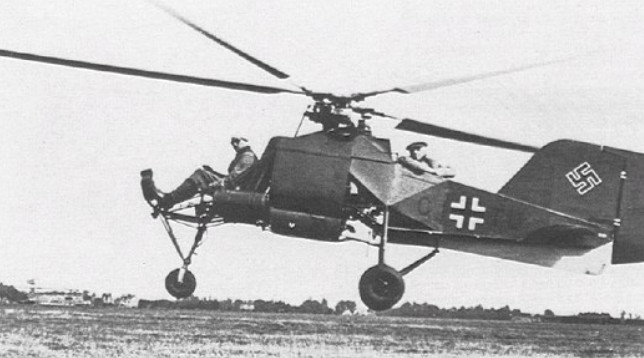
The Fl 282 V21 and V23 were built as two-seaters; an observer sat with his back to the pilot in the fuselage behind the engine block. This made necessary the removal of the fuselage fuel tank; it was replaced by two unprotected, cylindrical tanks mounted externally on both sides of the pilot seat. Furthermore, a different rotor arrangement – two three-blade rotors – was tried out on the test bed. It proved to run extraordinarily smoothly, however this was not a consideration for military use.
The entire Fl 282 flight test program was not conducted at Rechlin, as was customary for land-based aircraft; instead, from August 1942, trials were carried out at E-Stelle See Travemünde. In charge of helicopter and autogiro testing there was Fliegerstabsingenieur Dipl. Ins. Hans Fischer; his assistant was Fliegerstabsingenieur Dipl. Ing. Otto Dumke. After Fischer was badly hurt in the crash of one of the E-Stelle’s Do-217’s, Fliegerstabsingenieur Dipl.lng. Gerhard Geike assumed responsibility for the workings of this group.
Travemünde was selected because the air traffic safety ship Greif was based there and could be used for deck landing trials. The site also simplified helicopter sea trials with the navy, it was also imperative to move the site of the trials from Flettner’s facility in Berlin, where there was a greater risk from the growing Allied bombing raids.
One special experiment took place in cooperation with the DVL’s Institute for Marine Aviation. It involved “towing tests with a 50kg gliding body.” The proposal originated from the director of the Erprobungs- und Lehrkommando (Testing and Instruction Detachment) 20, Hauptmann von Winterfeldt, who carried out the towing flights from an antisubmarine vessel in Gotenhafen on May 3 and 4,1943. In addition to its role as a reconnaissance aircraft in support of the sub-chasers, armed with bombs the Fl 282 was also to participate actively in the anti-submarine role.
The following extract from the E-Stelle Travemunde’s monthly report of June 1944 is also worthy of mention:
“A mock combat between the Fl 282 (Flettner company pilot Fuisting) and a Fw 190 (pilot Ltn. Eisenlohr of E.Kdo.25) took place at Schweidnitz on 22.06.1944, in order to investigate the chances of a fighter hitting a helicopter. At present the evaluation of the film and the pilot reports have not yet arrived. At heights above 100 meters the fighter was able to get the helicopter in its sights briefly. Near the ground, especially in difficult terrain, the fighter has little chance against a helicopter.”
Vulnerability to gunfire was also investigated, whereby they proceeded on the assumption that the mathematical probability of a moving rotor blade being hit was much less than that of a fixed wing. Another consideration was that it should be extremely difficult to fire on and hit the slow-moving helicopter from a fast fighter. The latter could escape by making brief evasive movements, which the fighter could not follow. Furthermore, tests involving ground firing at the moving rotor blades were carried out, as the helicopter was felt to be more vulnerable to gunfire from the ground than from the air. An unmanned, tethered Kolibri was used; in spite of several hits in the rotor blades ground fire failed to bring down the helicopter.
Fl 282 V2 with fully glazed cockpit. First flight October 30, 1941
The Fl 282 was more highly developed and flew more hours than any other German helicopter, and very extensive tests and measurements were made of all flight aspects. Most of this test work was done by Flettner’s chief pilot, Hans E. Fuisting, who also undertook blind flying and trained many of the 50 pilots who learned to fly the Fl 282. Some new pilots ran into trouble when flying near the ground, because, as they turned with the wind, they lost lift and struck the ground. One new pilot had a fatal accident when flying his Fl 282 blind in cloud, and the assumed cause of the accident was that the machine had been dived and the controls then pulled back so violently that the blades were forced into each other or into the tail. The diving speed thereafter was restricted to 175km/h. On occasions, the Kolibri was landed autogyro fashion and without the use of collective pitch. This was done by descending vertically, diving nose-down and then pulling back on the controls to land, but, on one occasion at least, the tail hit the ground and was damaged.
Extremely manoeuvrable and very stable, even in gusty conditions, the machine could be flown hands-off in forward flight above 60km/h for indefinite periods by making an adjustment to neutralize the loads on the controls. However, in forward flight at speeds below 60km/h there was some longitudinal instability which reached a maximum at about 40km/h. Another slight criticism of the Fl 282 was that it vibrated rather badly while the rotor was running up on the ground, but this vibration decreased upon lifting off, although there was still a certain amount of vibration transmitted to the control column, which was sluggish and tended to overshoot the requisite amount of movement. Although many of the mechanical components were unnecessarily complicated and heavy, the general design and workmanship were of excellent quality, and, as an endurance test, one machine was flown 95 hours in all without replacements or repairs. The engine was said to be capable of 400 hours between overhauls.
Beginning in 1942 with the Fl 282 V5, the German Navy held a series of trials in the Baltic, the machine behaving well under the worst weather conditions. The Fl 282s in these trials operated from a platform mounted on one of the gun turrets of the cruiser Köln.
The German navy, finding the type extremely manoeuvrable, stable in poor weather conditions, and so reliable that in 1943 about 20 of the 24 prototypes were operating from warships in the Aegean and Mediterranean for convoy protection duties. It was discovered that as pilots gained experience the Fl 282s could be flown in really bad weather, leading to an order for 1,000 production aircraft.
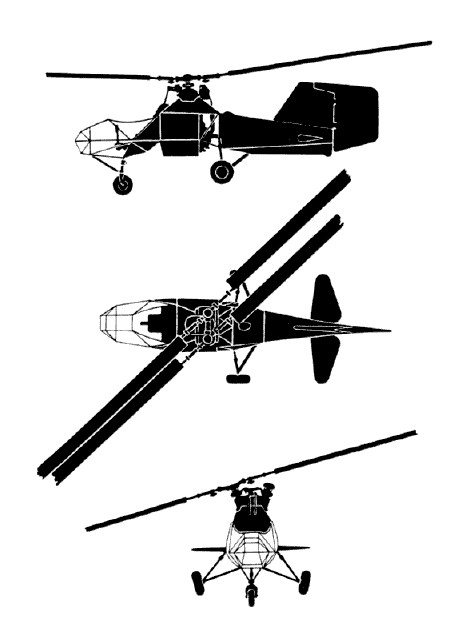
The fuselage consisted of a welded tubular-steel structure with metal panelling enclosing the centre (engine) section and fabric the rear section and vertical surfaces. The undercarriage was of the non-retractable tricycle type with the nosewheel connected to the rudder pedals for steering.
Fl 282 V21, a two-seater, with company pilot Fuisting at the controls. In the rear seat is Anton Flettner
It is known that Luft-Transportstaffel 40, based at Ainring in April 1945, had at least three Fl 282s (and also three Focke Achgelis Fa 223s) at its disposal. It was possibly one of this unit’s Fl 282s that flew Gauleiter Hanke out of besieged Breslau just before the capture of that city.
The great success of the Kolibri, which was even better than the Fl 265, resulted in a production order for 1,000 machines being given in 1944 to the Bayerische Motorenwerke (BMW), which prepared the requisite tooling-up only to have production forestalled by Allied bombing of the Munich and Eisenach works. The Flettner Johannisthal factory was also bombed, and, by the end of the war, only 32 preproduction aircraft in all were completed. Of these, only three were discovered by the Allies in a serviceable condition for testing, the Fl 282 V15 and V23 being taken to the USA and a third machine to the USSR. The remainder having been destroyed to prevent them being captured. Examples known to have survived are the Fl 282 (c/n 28368) at the Cranfield Institute of Technology, and the Fl 282 V23 at the United States Air Force Museum, Dayton, Ohio.
During 1944, when the Fl 282 was considered fully developed, Anton Flettner turned to the design of the Fl 339, using all the experience gained with the Fl 282. The Fl 339, which never got beyond the project stage, was to have been a much larger helicopter weighing some 3,000kg empty, carrying about 20 passengers and being powered by a single engine.
Technical description of the Fl 282 B-0 and B-1 (as of 23.12.1943)
Purpose: I. Reconnaissance aircraft (land); II. Shipboard reconnaissance aircraft.
Design: Single-engined helicopter and gyroplane of mixed construction with two rotors.
(a) Fuselage: Welded steel tube, truss-type construction. Forward section with open (B-0) or enclosed (plexiglass] cockpit (B-1). Recess for back-type parachute in rear wall of seat. The fuselage center-section contains the entire power plant, the outer skin consists of removable doors, hoods and panels. Oval cross-section. The rear fuselage is fabric-covered with a rectangular cross-section.
(b) Rotor Blades: A tubular steel spar with riveted-on wooden ribs and plywood skin with fabric covering. Rectangular outline with rounded tips. Attached to rotor head with delta and alpha hinges. Receptacle for balance weight at end of spar (scrap). The axes of both rotors are angled outboard at 12° from the vertical. Seen from above, the right rotor rotates clockwise, the left counterclockwise.
(c) Control Surfaces: No elevator. Two-part horizontal stabilizer with single spar. Tubular steel spar with riveted-on wooden ribs. Plywood leading edge, fabric-covering, cantilever construction. Angle of incidence adjustable between -15 and +5° from cockpit.Rudder: wooden construction, fabric-covered, deflection to 40°. Vertical stabilizer: wooden construction with plywood leading edge and fabric covering, bolted to fuselage frame. No ailerons.
(d) Undercarriage: Braced fixed nosewheel with VDM oil shock-absorber leg, coupled with rudder foot pedals (steerable nosewheel). Nosewheel: EC tire 350 x 150mm. Mainwheels: EC tires 465 x 165mm.
Power Plant
(a) Engine Type: 1 BMW 314 E. Output: 160hp, compression ratio 1:6.0, rotor reduction ratio: 1:12.
(b) Transmission: Lower transmission flange-mounted on front of engine, in front cooling fan on extended crankshaft. Upper transmission, linked to the lower by a double cardan shaft. Firewall over and behind the engine.
(c) Fuel Tank: An unprotected metal tank located behind the firewall in the aft fuselage, consumable content 105 liters.
(d) Oil Tank: An unprotected 10-liter metal tank flange-mounted on the lower gearbox. Oil content of upper gearbox = 5l.
(e) Type of Fuel: 87 octane aviation gasoline.
(f) Cooling System: Continuous cooling provided by an eight-blade wooden cooling fan with direct drive from the engine. Oil cooler which is switched off for cold-weather operalion.
(g) Control System: Control about all three axes by means of periodic or constant changes in angle of incidence of the rotor blades by means of stick and rudder pedals, to which the rudder is connected. Change-over from helicopter to autogiro (autorotation) flight and reverse achieved by means of a speed-sensitive hydraulic regulator controlled by a hand-operated control lever; change-over to autorotation mode is automatic in the event of engine failure.
(c) Radio and Signalling Equipment: 1 FuG 19 radio installation, 1 rigidly-mounted single-barrel flare pistol, 1 rigidly-mounted signal lamp (shipboard reconnaissance version).
(d) Bomb-Release Mechanism: 1 bomb magazine for two 5kg explosive devices (ship board reconnaissance version). 1 magazine for smoke buoys (shipboard reconnaissance version).
Special Equipment: Deck-landing equipment, consisting of: 1 tether with landing cable and electrical release.
Dimensions: Length of aircraft: 6150mm. Width, including undercarriage and tail surfaces: 2400mm. Height with rotor blades removed: 2400mm. Rotor diameter: 12000mm.
Technical Data: (a) construction group: H 3; (b) maximum allowable flying weight: 1.000kg; (c) wing loading: 8.84 kg/m2 (based on rotor surface area); (d) maximum allowable speeds: as helicopter: forward: 80 km/h, backward: 30km/h, sideways: 20km/h; as autogiro: 60km/h; (e) minimum allowable speeds: as helicopter: no limitations; as autogiro: 40km/h, aerobatic forbidden!
Performance: (a) Speed: Speed is temporarily limited to 80km/h in horizontal flight in helicopter mode for reasons of structural strength, 60km/h in autogiro mode.
(b) Rate of climb: 4.5m/s at sea level, 3.5m/s at 1000m, 3.0m/s at 1500m. Maximum altitude temporarily restricted to 1500 meters for flight safety reasons.
(c) Takeoff and Landing Performance: Takeoff and landing are made vertically. Autorotation landing in event of engine failure. Landing distance from height of 20m: 50m, stopping distance 15m (with wind speed of 5m/s).
Range: Endurance of 2 hours 5 minutes at maximum allowable speed of 80km/h and a range of 168km. The “Technical Description Fl 282 B-0 and B-1” presented above was prepared with the Fl 282 V12.
Flettner FL 282 Kolibri Engine: Bramo Sh 14A radial 7 cylinders, 160 hp Speed: 150 km/h Service Ceiling: 3300 m Range: 170 km Empty weight: 760 kg Max weight: 1000 Width: 25.55 m Length: 6.56 m Height: 2.20 m Rotor Span: 11.96 m Disc Area: 224 sq.m each
Fl 282 V21 Engine: 1 x Bramo Sh.14A 7-cylinder radial, 119kW Rotor diameter: 11.96m Fuselage length: 6.56m Height: 2.2m Max take-off weight: 1000kg Empty weight: 760kg Max speed at sea level: 150km/h Hovering ceiling: 300m Service ceiling: 3300m Range with one pilot: 300km Range with full crew: 170km
In 1937 Flettner began to design the first helicopter to use intermeshing contra-rotating synchronized rotors. Many of his advisers thought that the airflow disturbed by the intermeshing blades would make this system less efficient than one using a single rotor; but Flettner believed that any problems thus encountered would be more than offset by the reduced drag resulting from having no external rotor-carrying structure.
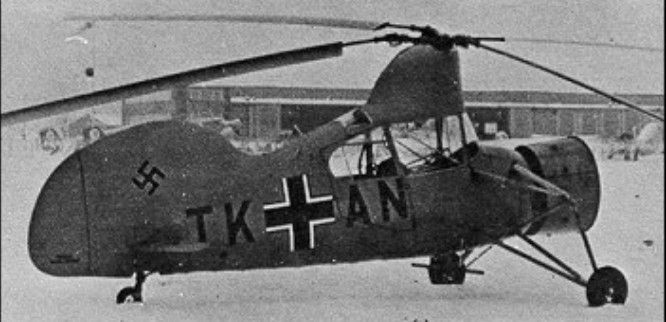
Six Fl 265’s were ordered in 1938 with a view to developing a machine suitable for shipboard reconnaissance and anti-submarine patrol for the German Navy. They were to be powered by a 7-cylinder air-cooled engine to drive its two intermeshing two-bladed rotors and with an inertia damping system to reduce the shake of the control stick. The six prototypes were built (Werk-Nr. 1579 -1584), one of which (TK+AN) was tested in the large wind tunnel at Chalais Meudon (Paris) in the summer of 1940.
This was of similar airframe configuration to the Fl 185, but dispensed with the outriggers and propellers, and introduced two two-bladed counter-rotating inter-meshing and synchronised main rotors which, because they were rotating in opposite directions, each cancelled the effects of the other’s torque. To simplify control problems a tail unit incorporated an adjustable tailplane for trimming purposes, and for steering a large fin and rudder to augment the use of differential collective-pitch change on the two rotors.
The 160hp Bramo Sh 14A radial engine provided the power for the two two-blade rotors, which had inclined shafts mounted close together and had an inertia-damping system to reduce the vibration reaching the control column.
The Fl 265 V1 D-EFLV took off on its maiden flight in May 1939 in the hands of Flugkapitan Richard Perlia following an extensive series of ground tests (first full-power run on 17.01.1939, first tethered flight at a height of 20 cm on 14.03.1939). D-EFLV made its first autorotative descents the following August, The aircraft was lost in an accident some three months later when the counter-rotating blades struck each other, but the Fl 265 V2 was used successfully for a variety of military trials. It was used for extensive military testing in conjunction with the Kriegsmarine (for example deck landings on an approximately 25-meter-square landing platform on the cruiser Köln and even made landings on U-boat decks) in the Baltic and Mediterranean. The aircraft was removed from service on April 29, 1940.
One Fl 265 was lost due to its refuelling being overlooked. The Fl 265 V3 crashed due to pilot error on August 21, 1939 and was destroyed in the ensuing fire. The Fl 265 V5 (retired on 26.11.1941) and the Fl 265 V6 (retired 25.03.1942) were still on hand at the Flettner Company in November 1942. Their return to service was postponed and eventually abandoned.
The Fl 282 exhibited significant improvements compared to preceding designs, for example the double rotor with intermeshing blades, automatic changeover from helicopter to autogiro flight (autorotation, from the V4), and the ability to switch back to helicopter flight.
Although the Fl 265 had performed its duties well, had flown in adverse conditions and had no trouble going into and out of autorotation, natural doubts were expressed concerning its vulnerability to aerial attack. Consequently, a test was made in which a Messerschmitt Bf 109 and a Focke Wulf Fw 190 fitted with camera guns made determined simulated attacks on an Fl 265 for 20 minutes but failed to score one hit because of the helicopter’s manoeuvrability.
All the Fl 265 prototypes accumulated the following in the course of testing: pure flight time 126 hours, 32 minutes; takeoffs 1.180; running time 518 hours, 44 minutes (flight time + tethered flights + engine run-up time). At the time this represented a record number of hours of operation for a helicopter.
In 1940, an order was placed for quantity production. By then, however, Flettner had designed a more advanced two-seat helicopter and it was decided instead to proceed with the development and manufacture of this improved aircraft.
Flettner Fl.265 Engine: 1 x Bramo Sh.14A, 119kW Rotor diameter: 12.3m Max take-off weight: 1000kg Empty weight: 800kg Speed: 160km/h