By 1944 Dushkin, who was working on the NII-1 of the NKAP, created a new version of the RD-2MZV reactive engine. This new power plant used a fuel pumping system, consisting of kerosene and nitric acid. Its main feature was the presence of two chambers, a large 1,100 kg thrust and a small 300 kg.
This allowed taking off and reaching the maximum height with the two chambers and then using the force of the small one in horizontal flight. This was able to save fuel and achieve a considerable increase in engine operating time.
Initially it decided to install this engine in the interceptor “Malyutka” of NN Polikarpov, which was projected in 1944, but his sudden death did not allow the builder to finish the job.
During state tests of the RD-2MZV, developed in May 1945, a joint thrust force of 1500 kg was achieved at take-off, 1250 kg as normal thrust and 500 kg as minimum thrust. Working only the small chamber, a thrust of 300 kg was achieved and the minimum thrust was 100 kg. The weight of the engine with all its aggregates reached 224 kg. The production of 30 power sets was approved with the delivery of the first on March 10 and the last on August 10, 1946.
Factory No. 165 was selected as the engine manufacturer, which was to work closely with other plants. Assembly and control tests were entrusted to the NII-1.
At that time, the experimental aircraft with a liquid reactive engine designed by IF Florov was already being built in the NII-1. This aircraft had begun to be projected two years ago, when by GOKO resolution No. 5201 issued on February 18, 1944, the Reactive Technique Institute (NII-1), transferred to the NKAP, was given the task of dedicating itself to the development of reactive engines. The leadership of the NII-1 was assigned to the head of the NII VVS PI Fiodorov and as his replacement was appointed VF Boljovitinov.
The new managers of the NII-1 enjoyed aeronautical construction. For this reason, in parallel to the main tasks of the institute, linked to the creation of reactive engines by the Isayev and Dushkin collectives and turbojets by AM Lyulka, it was decided to build an experimental aircraft from a project developed by Boljovitinov and Florov. This task was approved by the 18 Principal Directorate of NKAP, responsible for the reactive technique.
It was proposed to build two variants of the aircraft: one with an Isayev powerplant, which was named “4302” and another with the Dushkin engine, which was named 4303.
According to the project, the “4302” should have a flying weight of 2320 kg. The maximum speed at sea level had to reach 1010 km / h (M = 0.82), 1015 km / h (М = 0.88) at 5000 meters and 1050 km / h (М = 0.99) at 15000 meters. The ascent time at 15,000 meters was calculated at 2 minutes 22 seconds and the practical ceiling at 18,850 meters. The expected flight time was 46 minutes.
Both projects were conceived to test the powerplant itself, as well as the aerodynamic characteristics of flying at high speeds. Another primary objective was the study of the pressure distribution laws by the wing profile and the calculation of overloads in flight, especially in turbulence generation areas.
It was planned to build a total of six copies of which the first two would be used for the preparation of the flight personnel and the rest for the development of the experiments.
The institute’s productive capacities were scarce, so the construction was contracted to Factory No.21 named in honor of Sergo Ordzhonikidze and located in Gorky city.
Working drawings were ready on 1 January 1946 and once delivered the factory started production. The first two were ready for delivery in March.
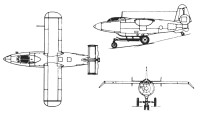
The “4302” was designed as an experimental all-metal monoplane. The wing design was straight, with a constant section throughout the span. In order to improve directional stability and reduce the effect of turbulence at high speeds, the wingtips were angled 45º downwards. The wing profile used was the TsAGI 13145 with laminar flow and thickness of 13%.

The fuselage, also metallic, had a cigar shape with a circular cross section, with a diameter of 1,150 mm at its widest part. At the bottom of the nose was the towing hook.
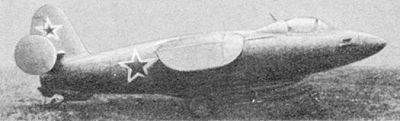
The tail unit was cantilever type and terminated in vertical washer-like surfaces. The empennage was constructively integrated into the fuselage. All the coating, including the rudders and ailerons, was metallic.
The landing gear was one of the most complex elements. For the first flights a fixed gear with three wheels obtained from a Lavochkin La-5 was used. Later, the “4302” was equipped with a retractable ski for landing and took off using an ejectable forklift. The landing ski was constructed of stainless steel and featured a hydraulic release system. In the middle portion of the ski profile were two grooves to fix the trolley, which was constructed of steel tubes.
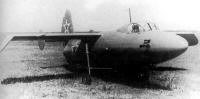
The main 650x200mm wheels featured disc brakes. The 400x150mm double wheel front unit had a hydraulic damper. To reduce the lift of the truck once it was separated from the plane, the braking system was activated automatically after release. When the truck was detached, the ski was retracted.
By this time the leadership of NKAP had changed (instead of AI Shajurin, MV Jrunichev had been appointed) and this structure became the Ministry of Aviation Industry (MAP). The new MAP managers had a negative reception towards the plane, considering that the NII-1 had “meddled” in a task that was not within its competence. For this reason, as of February 1946, all financing for this project was withdrawn.
The new director Ya. L. Bibikov and VF Boljovitinov wrote directly to Stalin, explaining that at 1 April of 1941 the first issue of flight he was at 70% completion and continue the work the prototype would be ready for state tests for the month of July.
The vice-president of the Council of Ministers of the USSR, NA Bosniecienski, who after Malenkov’s departure, attended the aviation, ordered Khrunichev and Vershinin to seek a solution to the dilemma. Reluctantly, Khrunichev was forced to give in.
The new VVS chief, Marshal Vershinin reacted differently. On the one hand, he appreciated scientific work, especially in the field of military aviation, but on the other hand he was offended, since the experimental production plan was approved by the NKAP during the period of his taking office, he decided to support the NII-1.
Together with the new VVS chief engineer, IV Markov issued a communication in which he recognized the great value that an interceptor with these features would have for the VVS and requested that state tests be carried out in 1946.
In response, Khrunichev replied that the data presented by the NII-1 should be subject to a review and created a ministerial commission to do so.
The commission was chaired by Professor IV Ostoslavski and included the main builder of OKB-155, AI Mikoyan, the head of department of TsAGI VN Matvieyev, the group head of the 7th MAP Directorate, IV Loktiev and the head of the (Directorate of the MAP, VV Yakolievsky The result of the commission, presented in June 1946, yielded the following results:
“… the maximum speed of the plane will be between 900 and 950 km / h instead of 1000 – 1100 km / h and the ceiling will be limited to 12000 – 13000 meters instead of 20 000 m, due to the absence in the airplane from a sealed cabin. The duration of the flight presented in the letter is 46 minutes. The commission considers that the maximum flight autonomy will be 5 minutes. “
The commission’s results were based on the results obtained with the straight-wing Bisnovat 5, which had been unable to obtain the proposed speed. Florov replied that his aircraft had been designed with the latest strength requirements in mind and with the correct wing selection recommended by TsAGI.
Despite the commission’s report the MAP was instructed to finish and test the experimental specimen “4302”.
In response to the MAP meeting in September 1946, Khrunichev severely criticized the NII-1 leadership and demanded to reorganize the institute’s activity on a purely scientific and not practical profile. The minister ordered to separate the group of builders from the institute and give them a constructive base to continue their activity.
As the new director of the NII-1, MV Keldysh was appointed and in its new structure were three collectives: OKB-1 from LS Dushkin, OKB-2 from AM Isayev and OKB-3 from MM Bondaryuk and a department of gunpowder accelerators.
Jrunichev decision of the bureau of buildings Florov was renovated. The personnel and the productive base were placed under the direction of Bisnovat. Under these conditions, NII-1 survived one more year, until in 1948 it was absorbed by TsIAM. The Dushkin and Bondaryuk groups passed to this institute. Isayev’s group would go to NII-8 of the Ministry of Armaments, dedicating itself to the construction of reactive rocket engines.
By the fall of 1946 one in glider configuration without an engine) was ready for testing and was sent to the LII. Another Isayev-powered example was in the completion phase. Under pressure from the military, the MAP was forced to continue the construction of this copy to deliver it to the LII. With so much pressure, the works on the “4302” could not be carried out to the expected magnitude. It is stated that three examples were completed.

The flights were started in 1947. In total, 20 flights were executed, of which 19 were carried out in the version without an engine. The Isayev jet engine flight was executed by test pilot AK Pajomov in August. This flight started smoothly, but towards the end of the engine work pieces were damaged and nitric acid fumes filled the cabin.
Pajomov managed to land the plane. After this flight, the jet engine aircraft development program was closed. By then, significant progress had been made in the development of turbojet engines capable of high thrust.
After this Ilya Florov went on to dedicate himself to scientific activity, defended his candidacy thesis and later his doctorate, going on to direct a scientific group. He would never design airplanes again.
4302
Powerplant: A 1,100 kg thrust AM Isayev liquid reactive engine
Wingspan: 6,932 m
Wing area: 2 m²
Length: 7.152 m
Height: 3.06 m
Maximum takeoff weight: 2398 kg
Maximum speed achieved: 520 km / h
Calculated top speed: 950 km / h
Accommodation: 1