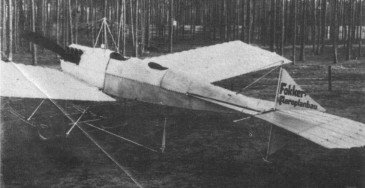
A picture postcard of 1913 depicted a Spin with enclosed cockpit. A variation of the Spin about which little is known. The fuselage is enclosed, like that of the M.II, but in a totally different manner.
A picture postcard of 1913 depicted a Spin with enclosed cockpit. A variation of the Spin about which little is known. The fuselage is enclosed, like that of the M.II, but in a totally different manner.
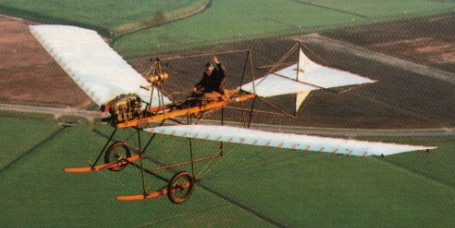
Fokker set to work on a new aircraft, at Nieder Walluf on the Rhine, with the help of boat builder Jacob Goedecker, who also wanted to fly. It was on this second Spin that Fokker taught himself to fly on the Grosser Sand at Gonsenheim. At the beginning of May 1911 he flew a few curves, following them with a complete cir¬cle a few days later. On May 12th von Daurn finally got his money’s worth when Fokker took him along as a passenger.
Fokker Spinne (Spin / Spin II / Spin variation) Article
Another goal was reached on May 16th, when Anthony Fokker obtained his pilot’s licence. He had agreed with von Daum that the latter would become the owner of the aircraft as soon as Fokker had gained his licence. Von Daum wanted to start training right away, but Fokker tried to talk him out of it because he had received an invitation from his former home, Haarlem, to give a flying demonstration on the Queen’s Birthday. There was money to be made, and he was afraid that von Daum would crash “his” aircraft again.
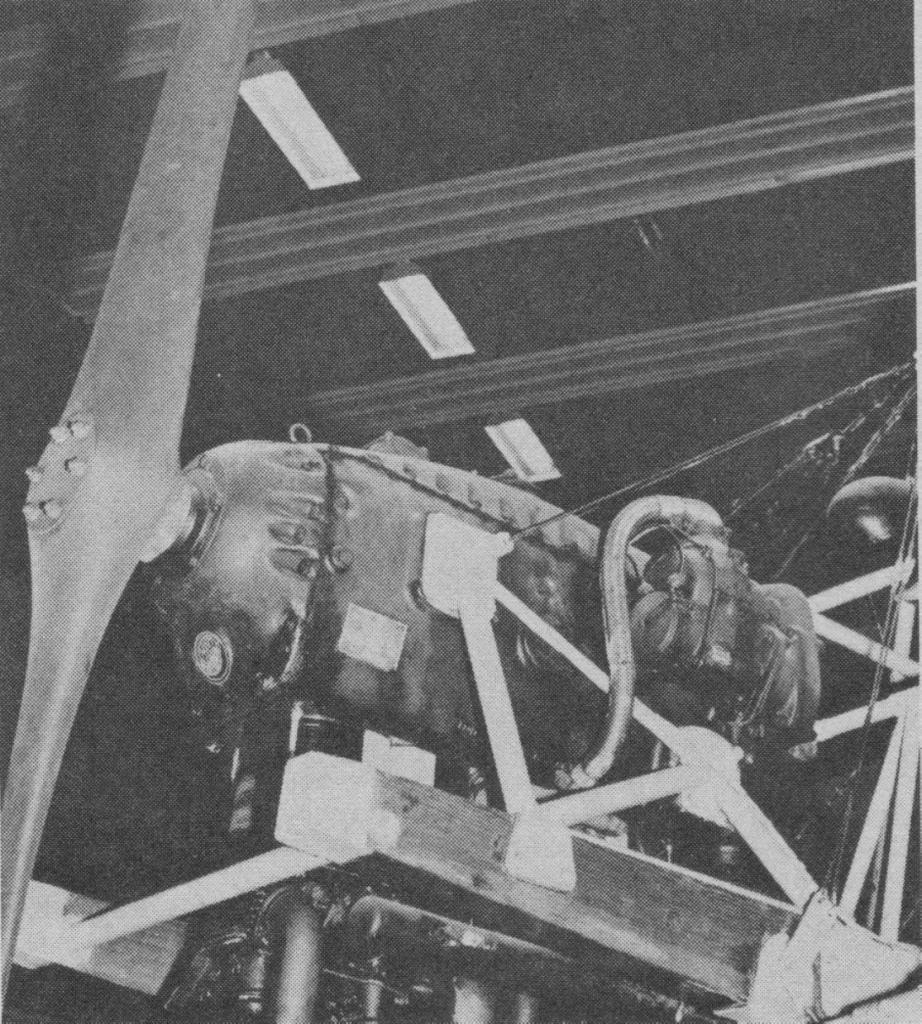
However, von Daurn could not be dis¬suaded. After a reasonable start to his fly¬ing attempts he suddenly seemed to forget everything he had previously learned, and dived into the ground from a height of 10 metres. He shook the bits and pieces from him, and advised Fokker to “take his damned aircraft away, and fly to hell with it”. Fokker purchased von Daum’s share in the venture for 1200 Marks, and so became the owner of the wreckage and, more importantly, the 50 h.p. Argus engine.
Meanwhile, a third Spin was being made by Goedecker, and on August 31, 1911 Fok¬ker gave his first flying demonstration over Haarlem.
The military version of the Spin was called the M.I.
The initial version was the A 1912; the later B 1912 had a 100 hp engine, and a few others were fitted with 70 hp Renaults.
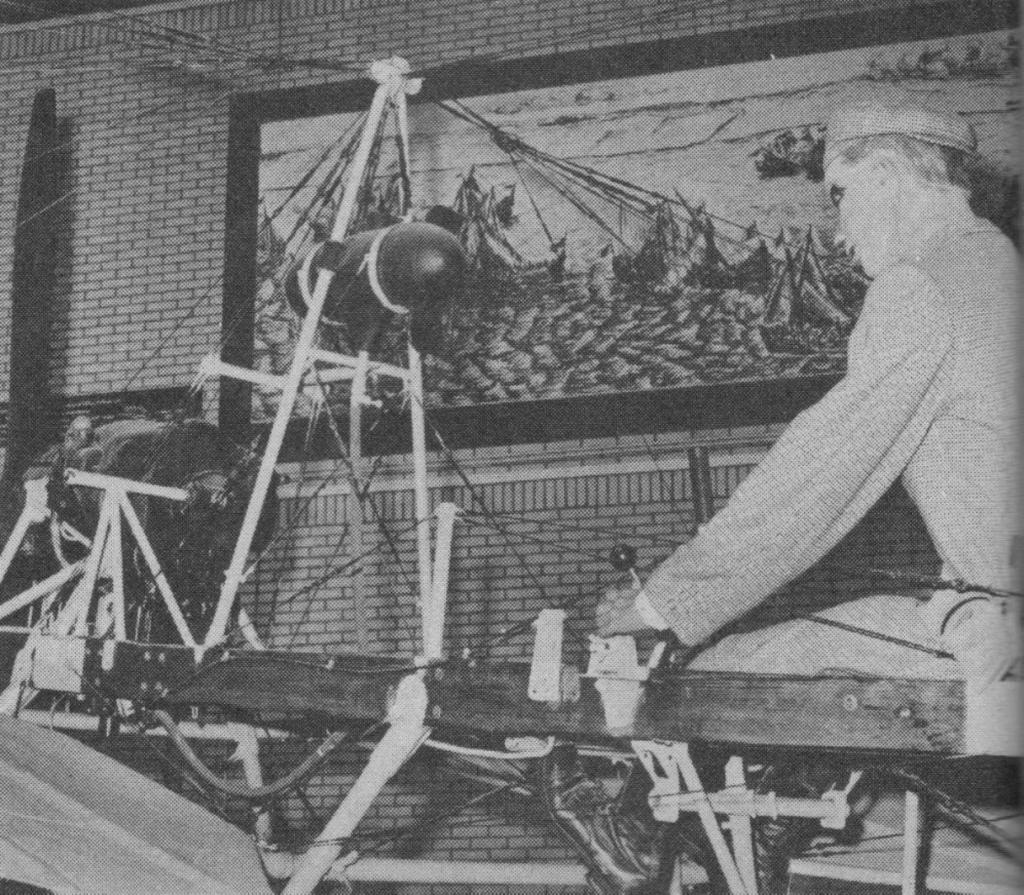
A replica of the 1911 Haarlem aircraft was made by the Fokker works in 1936. It was similar tubular steel and wood construction with same quality fabric cover, but the engine a more powerful Hirth 504 A-1 of 105 hp. Stored through WW 2 it was reassembled and reconditioned in 1953, then reconditioned again in 1959 for exhibition at the Aeroplanorama.
Gallery
1911 M1 2-seater monoplane
Span: 36’1″
Length: 26’3″
Weight empty: 849 lbs
Speed: 49 mph
Seats: 2
1911 Spinne (Spider)
Span: 36′
Length: 25’5″
Weight: 900 lb gross
Speed: 70 mph
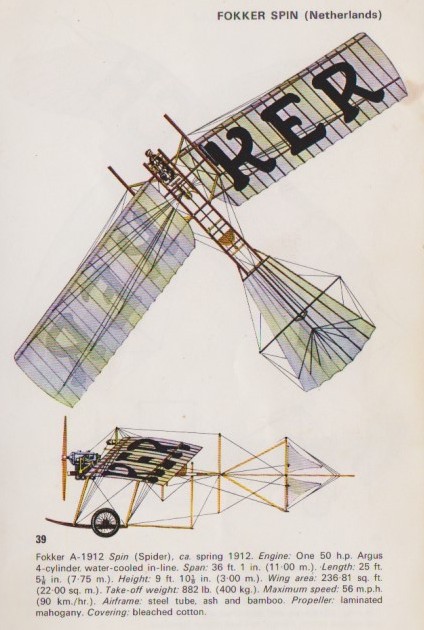
A-1912
Engine: One 50 hp Argus four¬ cylinder in line.
Prop: 2-¬blade.
Wing span: 36 ft 1 in (11.00 m).
Length: 25 ft 5 in (7,75 m).
Wing area: 236.81 sq.ft (22.00 sq.m).
Gross weight: 882 lb (400 kg).
Max speed: 56 mph (90 km/h).
Crew: 1.
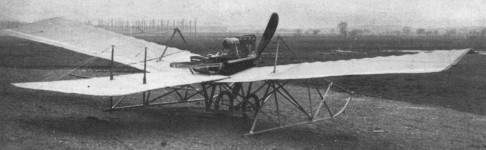
The first aircraft built by Anthony Fokker, the Spin of 1910. Anthony Fokker decided to build his own aeroplane. A fellow pupil from the school at Zahlbach, the 50 year old Lieutenant von Daum, became his partner, donating the cash for the engine, and Fokker contributed his knowledge, his labour and 1500 Marks. The machine, named the ‘Spin’ (Spider), was constructed in an empty Zeppelin shed at Baden Baden. By the end of 1910 it had been completed, and Fokker was able to make the first hops in it. To start with, the ‘Spin’ had no rudder, but this did not mat¬ter to Fokker, who went almost out of his mind with joy.
At Christmas 1910 he went home, only to be greeted with the sad tidings that von Daum had tried to fly the ‘Spin’ in Fokker’s absence and smashed into the only tree on the airfield during take off.
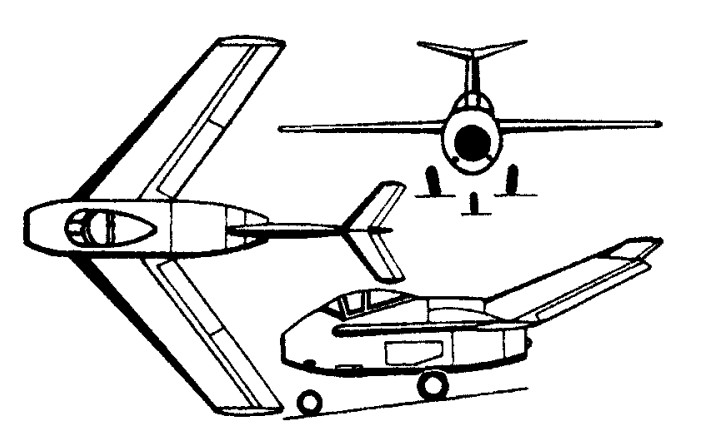
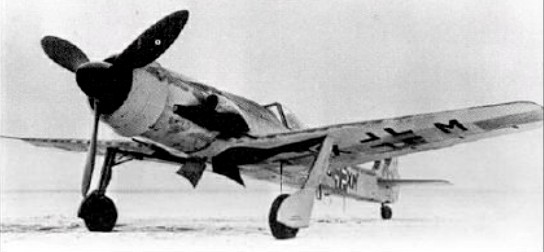
The Ta 152 was a development of the Fw 190D. Though the Ta 152 looked superficially like a Dora 9, it was actually intended to be an almost completely new design, with quite different structure and a DB 603 engine. The Ta 152A single prototype, GH+KW, first flew on 12/07/1944, but was destroyed the following day by accident.
V21/U1 (then V21/U2), V6 Werk NR 110006, V7 Werk NR 110007, and V8 Werk NR 110008), were tested between November 1944 and Febuary 1945.
Later much of the original 190 structure was restored, to speed production, and the 152 was built with both the DB 603 (152C) and Jumo 213 (152H) engines. The wings of the Ta 152C being similar in planform to those of the Dora 9, while those for the Ta 152H are of the high aspect ratio, long span variety. The FW 190C prototypes went on to be modified and used as prototypes for the Ta 152 H.
The Ta 152H was a high-altitude fighter, but appeared too late, and few became operational. The Ta 152s were
often used to protect jet fighter bases. 215 built.
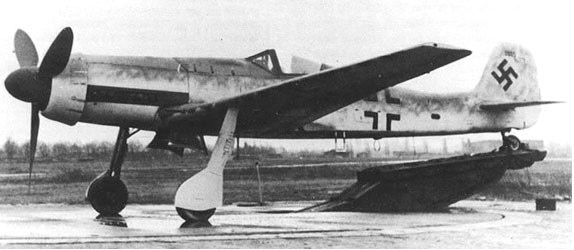
The Ta 152H-0 high-altitude version had a series of prototypes: V18/U2 (GH + KB), destroyed 08/10/1944, during its first flights; V20, Werk NR 0042, (GH + KQ), with 1 Jumo 213A; V21 Werk NR 0043; V29 W NR 0054, become the V29/U1 with cabin pressurisation; V1 W NR 11001, built in June 1944; V2 W NR 11002 in July 1944; V33/U1 W NR 0058,12/07/1944; V30/U1 W NR 0055 1 Jumo 213A (GH + KT), 06/08/1944; V3, V4 and V5; V 25 W NR 110025; Fw 190 V32/U2 with engine Jumo 213E-1. Followed up with Ta 152H-0 Werk NR 15001 – 150020, 10/1944. General armament of 3 guns, some with 5. Werk NR 15004 was the first of the R/11 with an automatic pilot.
Ta 152 V20
Engine: Junkers Jumo 213C, later, Junkers Jumo, 1750 hp, 1320 hp at 7000m, 1740 hp with GM-1
Ta 152A
Engine: Junkers Jumo 213C, 1780 hp at SL, 1600 hp at 5500 m, 2200 hp with water-methanol MV 50 injection
Prop: three-bladed wood Junkers VS-111 fixed pitch 3,50 m dia.
Wingspan: 14,44 m
Length: 10,192 m
Height: 3,37 m
Wingarea: 23,30 sq.m
Empty weight: 3473 kg
Normal takeoff weight: 4284 kg
Maximum takeoff weight: 4840 kg
Wing loading: 183.862 kg/sq.m
Power loading: 2.4 kg/hp
Vmax: 704 Kmh at 11300 m, 681 Kmh at 6500 m, 634 Kmh at 3000 m, 580 Kmh at SL
Vcruise: 480 Kmh at 4000 m
ROC: 2000 m in 2 min 15 sec, 10000 m in 7 min 15 sec
Ceiling: 13200 m
Range: 840 km
Armament: 2 x MT Rheinmetall MG 131, 13 mm, 2 x Mauser MG 151/20, 20 mm, 1 x Mk 108, 30 mm
Ta 152B-4/R-1
Engine: Junkers Jumo 213E
Armament: 3 x Mk 108, 30 mm
Prototype.
Ta 152B-4/R-2
Engine: Junkers Jumo 213E
Armament: 3 x Mk 108, 30 mm
Prototype.
Ta 152B-5/R-11
Engine: Junkers Jumo 213E-1, 1750 hp, 1320 hp at 9500m, 1740 hp with MW 50
Prop: metal three-blade fixed pitch
Wingspan: 11,00 m
Length: 10,80 m
Height: 3,38 m
Weight: 5450 kg
Vmax: 529 km/h at SL, 710 km/h at 9000 m, (with MW 50)
Ceiling: 11600 m
Range internal fuel: 1165 km
Armament: 2 x Mk 103, 30 mm / 1 x Mk 108, 30 mm (80 rds)
Seats: 1
Ta-152C
Engine: Junkers Jumo 213C
Wingspan: 36 ft 1 in
Length: 35 ft 5.5 in
Max speed; 463 mph at 34,000 ft
Range: 745 miles
Armament: 1 x 30mm cannon, 4 x 20mm cannon
Ta 152C-0
Engine: Daimler-Benz dB 603E, 1800 hp
Prop: three-bladed wood Junkers VS 111 fixed pitch
V21/U1 (then V21/U2)
V6
Werk NR 110006
V7
Werk NR 110007
V8
Werk NR 110008
Ta 152C-0/R-11
Prototype V 7 CI +XM
Engine: Daimler-Benz DB 603L, 1750 hp
Flown: 03/1945
Ta 153B
Engine: Junkers Jumo 213E with GM1 injection
Vmax: 706 Kmh at 10780m
Ta 152C-1
Engine: Daimler-Benz DB 603LA, 1750 hp or DB 603EM, 1800 hp
Flown 04/1945
Ta 152 C-1/R11
Engine Daimler-Benz DB 603LA, 2100 hp, 1750 hp at 9000 m, 1900 hp with MW 50
Prop: metal three-blade fixed pitch
Wing span: 11,00 m
Length: 10,80 m
Height: 3,38 m
Weight: 5300 kg
Maximum speed: 547 km/h at 0 m, 740 km/h at 9500 m (with MW 50)
Ceiling: 12200 m
Range: 1165 km
Armament: 2 x MG 151/20 (160 rds each), 2 x MG 151/20 (150 rds each), 1 x MK 108 (90 shells)
Seats: 1
Ta 152C-3
Engine Daimler-Benz DB 603LA, 2100 hp, 1750 hp at 9000 m, 1900 hp with MW 50
Prop: metal three-blade fixed pitch
Wing span: 11,00 m
Length: 10,80 m
Height: 3,38 m
Weight: 5300 kg
Maximum speed: 547 km/h at 0 m, 740 km/h at 9500 m (with MW 50)
Ceiling: 12200 m
Range: 1165 km
Armament: 2 x MG 151/20 (160 rds each), 2 x MG 151/20 (150 rds each), 1 x MK 103, 30mm
Seats: 1
Ta 152C-11/R-11
Reccon version with vertical camera
Abandoned in Febuary 1945
Ta 152E
As B-5 with vertical camera Rb-75/30
Engine: Junkers Jumo 213E
Nov 1944
2 protototypes: V 9 Werk NR 11009 and V 14 Werk NR 110014.
Ta 152H
Engine: Junkers Jumo 213E-1 with MW-50 injection and GM-1 boosting
Horsepower:
Take-Off: 1,750 hp at 3,250 RPM (2,050 hp w. MW 50)
Climb And Combat: 1,580 hp at 3,000 RPM
Maximum: 1,320 hp at 32,810 ft. (1,740 hp with GM 1 boost)
Propeller: Junkers wooden three 3.6 m (11 ft 9.75 in) dia.
Fuel Capacity: 364 Imperial Gallons (1618 lt)
Type: B4 (87 Octane)
Oil Capacity: 72 lt
GM-1 (Nitrous Oxide) Capacity: 85 liters
MW-50 (Methanol-Water) capacity: 140 lt
Wing span: 14.5m / 47 ft 6.75 in
Wing Area: 23.5sq.m (252.95 Sq. Ft.)
Length: 10.8m (35ft 5.25 in.)
Height: 4m (13 ft. 1.5 in.)
Wheel Track: 3.95m (12 ft. 11 in.)
Empty weight: 3,600kg (7,940 lbs.)
Loaded weight: 5,500kg (12,125 lbs.)
Maximum speed:
695km/h (431mph) at 10,500m (34,451 ft.)
750km/h (466mph) at 9,000m (29,529 ft.) with MW-50
760km/h (472mph) at 12,500m (41,012 ft.) with MW-50 and GM-1
Climb rate: 1000m/minute
Ceiling: 14,800m (48,560 ft.)
Range (Internal fuel): 1200km (745 Miles)
Armament:
One 30mm MK 108 mounted between the cylinder heads, firing through the propeller hub
Ammunition: 90 Rounds
Two inboard wing mounted 20mm MG151/20
Ammunition: 175 Rounds Each
(Occasionally outboard MG 151/20s as well, depending on model, some reconnaissance models were unarmed)
Bomb load: None
Avionics:
Revi 16B Gunsight
FuG 125 Navigation equipment (H-1/R-11 Only)
LGW-Siemens K 23 Autopilot
FuG 16ZY Radio Transmitter/reciever
BSK 16 Gun Camera
Crew: One
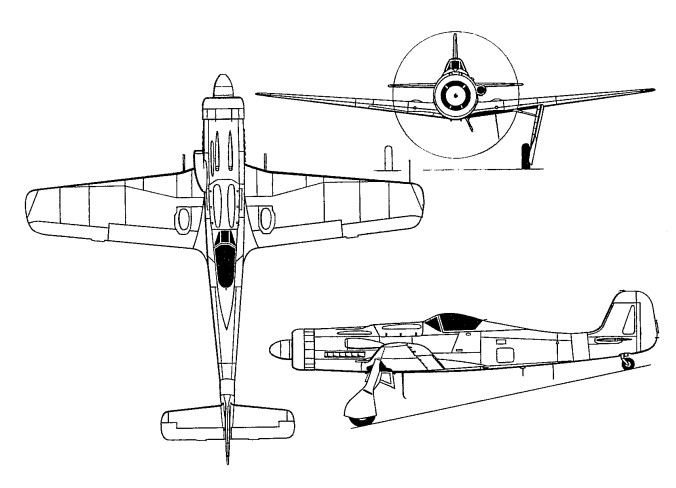
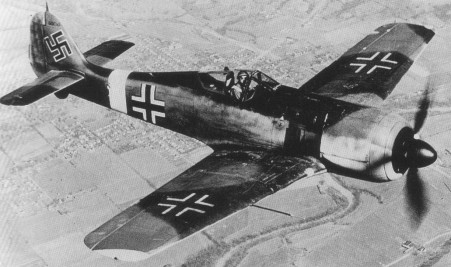
Kurt Tank, technical director of Focke-Wulf Flugzeugbau (aircraft factory) at Bremen, was invited to propose a new fighter design to the German Air Technische Amt (technical dept) in April 1938, not because there was any urgency but because a second type to back up the Bf 109 was deemed prudent.
Tank personally convinced the officials of the suitability of using a large air cooled radial engine, one major factor being the existence of the BMW 139, promising powers well beyond the capacity of the leading liquid cooled units, the DB 601 and Jumo 211. Focke Wulf was awarded an order for three prototype Fw 190 V series (Versuchs) or trial aircraft in June 1938. Tank himself sketched the original basic configuration, a shape reminiscent of the Hughes racer with a very small wing, slim body, and extremely tall, wide track landing gears. Detailed engineering design was headed by R Blaser who imprinted his brilliance on every part of the aircraft.
The only obvious shortcoming was that the close coupled engine and cockpit precluded fuselage armament, and also risked unbearably high cockpit temperatures, and the latter were borne out on the first flight on June 1, 1939. But by this time BMW had succeeded in getting permission to drop the BMW 139 in favour of a more advanced radial, the BMW801. This was of slightly larger swept volume, and though heavier and longer than the 139 promised eventually to yield some 2000 hp. The Fw 190 was therefore grossly reengineered to take the new engine. In June 1939 it was decided to fly the Fw 190 V2 with the original engine, scrap the next two aircraft in an agreed pre-production batch of 40, and build the V5 as a BMW 801 powered machine with a different forward fuselage.
Early flight trials with Fw 190 V I showed superb handling, but the advanced engine installation with ducted VDM propeller spin¬ner lacked the ten blade cooling fan and this overheated the engine as well as the cockpit. With the V2, flown on October 31, 1939, two MG 17 machine guns were added to the wing roots, and the engine installation eventually had the cooling fan geared up from the pro¬peller shaft, plus a normal air inlet flowing around a small spinner. Much larger changes were seen in V5, flown in April 1940, which apart from the definitive BMW 801 engine had a restressed airframe for considerably increased weights, a smaller and rearranged cockpit moved considerably further back over the trailing edge of the wing, changed main landing gears raked sharply forward with the wheels housed in swept forward wing roots (with fairing doors moved from the legs to the belly) and several other alterations. An advantage of moving the cockpit back was that guns could be installed in the top decking, but the view for taxiing was made worse than before, though it was still acceptable.
An even more fundamental factor was that the bigger engine, and other changes, had substantially raised the weight; in fact the Fw 190 was ever afterward generally heavier than either a Bf 109 or a Merlin Spitfire though it was exceptionally small and compact. Tank decided as early as May 1939 to increase the size of the wing, which had always been more appropriate to a racer than a dogfighter. In about October 1940 this wing, with area raised from 16 to 18.3 sq m (161 to 197 sq ft) was flown on V5, and became standard. The Fw 190A 0 pre-production batch that followed had the 1600 hp BMW 801C engine and four 7.92 mm (0.312 in) MG 17 machine guns. Deliveries to Rechlin and other test centres began in February 1941, and II/JG 26 (a wing of the group selected to be first with the new fighter) assisted in unearthing problems and refining operational procedures.
Focke Wulf had named the new fighter Die Wurger (shrike, or butcher bird), but this did not catch on. But its outstanding qualities led to urgency in getting it into production, and while Focke Wulf established a production line at Marienburg, Arado at Warnernfinde and Ago at Oschersleben also tooled up for production. But initial operational evaluation by II/JG 26 at Le Bourget (Paris) and Maldeghem (Belgium) was a disaster, hardly any flight being completed without overheating and engine seizure and most not even getting airborne. An official investigation recommended that the Fw 190 should be cancelled; but all that was needed was more cooperative effort between Focke Wulf and BMW. Within a month the situation was dramatically improved.
The FW 190 V18 was designed and built as a prototype for the high-altitude FW 190 C, and in V18/U1 form it had the DB 603 A engine driving a four-bladed propeller. The FW 190 C was a projected high-altitude fighter that never came to fruition; even so five prototypes were completed, the FW 190 V18, V29, V30, V32 and V33. Each of these aircraft had DB 603 inline engines, annular radiators, Hirth 9-2281 turbochargers and four-bladed propellers. The FW 190 V18 was coded CF + OY and received a white outline Balkenkreuz and Hakenkreuz. By 1944 the project had been halted by technical problems and opposition to use of the DB 603 (which was needed for other aircraft types). The FW 190C prototypes went on to be modified and used as prototypes for the Ta 152 H.
Delivery of the four MG 17 Fw 190A-1 was followed by the A 2 from Arado in August 1941. Many A 1 were given two 20 mm (0.79in) MG FF cannon outboard of the landing gear, most as a modification, while the A 2 had two of the new 20 mm (0.79 in) Mauser MG 151 cannon instead of MG 17s in the wing roots. This formidable armament combined with outstanding all round performance and manoeuvrability to make the 190 the greatest air superiority aircraft in the sky in 1941. One of its first major actions, with JG 26, was air cover for Scharnhorst, Gneiseprau and other ships on February 12, 1942. JG 26 annihilated 825 Squadron’s Swordfish. Against the Spitfire V it established immediate supremacy, the British fighter being outclassed in every respect except turn radius, where the rivals were closely comparable. But the early model Fw 190 gave the RAF the largest combat shock in its entire history. The superiority of the German fighter was accentuated by the fact that it was virtually unknown even though it had been flying well before the war. When the first Fw 190A 1s of 6/JG 26 clashed with Spitfires on 27 September 1941, it was realized that the new German fighter had the advantage both in speed and manoeuvrability.
By 1942 production was centred on the A 3, with many changes and introducing the first of a fantastic variety of external armament options which made the Fw 190 the most versatile fighter of the war.
Later, on June 23, 1942, Oberleutnant Arnim Faber, adjutant of III/JG 2, achieved an unsought place in history by mistaking his bearings in a dogfight over the Bristol Channel and making a perfect landing at RAF Pembrey in South Wales, thereby giving the RAF what was probably its most welcome prize and enabling a thorough and sobering flight evaluation to be made. Dissecting the Fw 190 if anything increased the respect in which it was held. Likewise on the Eastern Front a growing force of Focke Wulfs battled with Soviet fighters and soon became highly regarded. In fact, the Fw 190 was not exactly small and light in the Soviet style, but compact; it seldom turned the scales at under 4000 kg (8800 lb) and nearly all had a laden weight of around 4900 kg (10800 lb), much of which was accounted for by the heavy armament, equipment, armour and external tanks or ordnance.
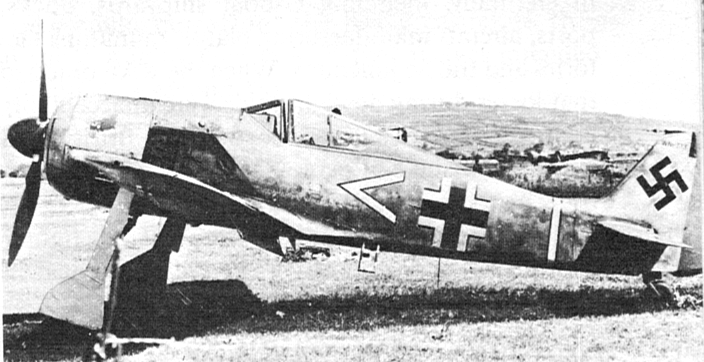
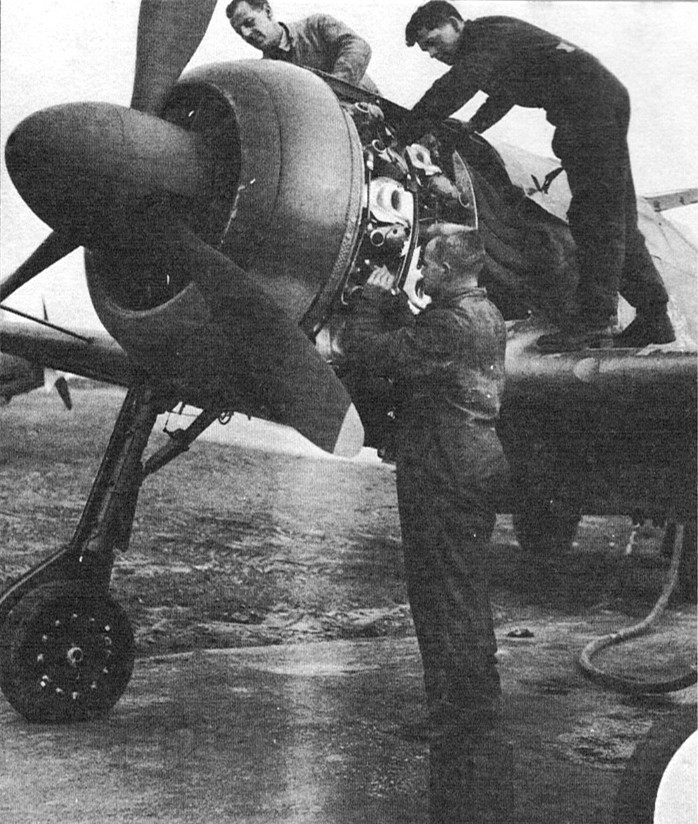
In 1941 the German and Turkish Governments negotiated an arms agreement with Germany supplying 100 Fw-190A-3s by 1943. The Turkish Fw-190 remained in service until 1947 when supplanted by Republic P-47Ds.
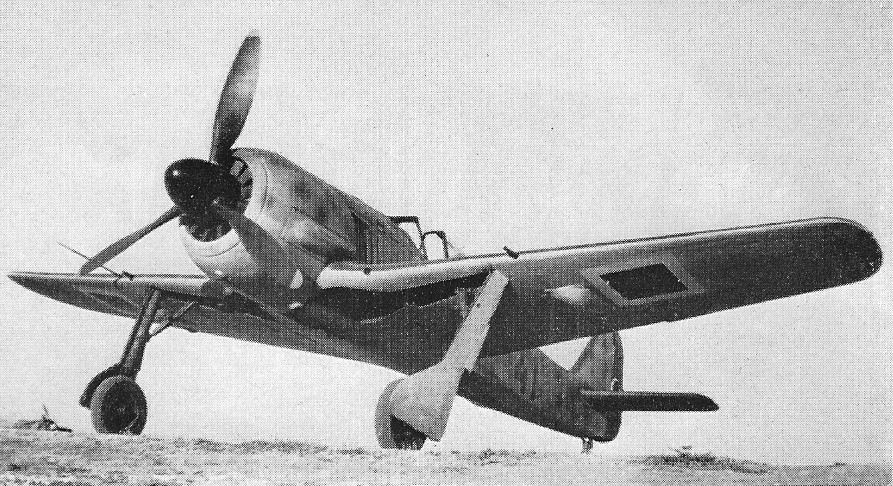
In the summer of 1942, the A 4 introduced methanol/water (MW 50) injection for brief bursts of power up to 2100 hp, and new radio resulted in a changed aerial mast on the fin. One subtype, the A4/R6 (R being the suffix for field modification kits), was first to carry the 21 cm (8.27 in) WGr 21 rocket tubes which did more than anything else to break up the B 17 formation of the disastrous first raid on Schweinfurt on October 14, 1943. The American target had been a ball bearing works, and precisely six months earlier a British ball bearing factory at Chelmsford had been destroyed by Jabo (fighter/bomber) Fw 190A4/U8 aircraft of SKG 10, each racing in at low level with four SC50 or one SC250 in one of the more damaging of hundreds of ‘tip and run’ attacks by the nimble Fw 190 on southern England. So successful was the Jabo 190 that special versions were developed for this duty, and these gradually supplanted the Ju 87 and all other Luftwaffe attack aircraft for almost every kind of battlefield mission. Very small numbers (for example, five of the A 5/U2) were built as night fighters, and used by Major Hajo Herrmann’s famed Wilde Sau free ranging JG 300 wing, followed by JG 301 and 302, but suffered high attrition in brief careers.
By 1943 the variations numerous, but new armament included the 13 mm (0.51 in) MC 131 in the top decking of the fuselage (making a shallow bulge from windscreen to engine) and various wing arrangements of 20 mm (0.79 in) and 30mm (1.18 in) cannon. From the A 5 the length was increased, and the most numerous of all Fw 190 versions, the A 8, even included a tandem trainer version, supplemented by the Fw 190S series high speed communications transport. Other new features included turbo-charged engines, various reconnaissance installations, Doppelreiter overwing drop tanks, torpedoes, spin stabilized rockets, recoilless guns (firing horizontally or almost vertically), heavy underwing cannon, the X 4 wire guided air to air missile and armoured leading edges for ramming.
Two important families placed in production in early 1943 were the F series Schlachtflugzeug (tactical attack and close-support) and G series Jabo Rei (long range bomber). By the end of 1943 these were the most important Luftwaffe attack aircraft in Italy and on the Soviet front, progressively re equipping all except one of the former Stukagruppen and carrying out every kind of front line sortie as well as providing for air superiority fighting (a task for which the under gunned G was not suited). On the Eastern Front a variety of special weapon installations were tested against armour, including the Zellendusche SG 116 (three 30mm [1.18 in barrels), HF/15 (five 15 mm [0.59 in barrels under each wing), Panzerschreck 88 mm (3.46 in) rockets, Panzerblitz (eight longer range rockets), WGr 28 (special hollow charge rockets) and Forstersonde SG 113A, consisting.of two pairs of 77¬mm (3.03 in) recoilless guns mounted vertically in the wings, triggered by a tank’s magnetic field. Other late war installations included the Kurt SB 800RS roller drum bomb, Hagelkorn (Hailstone) Bv 246 guided glide bomb with slender concrete coated wings, and the various BT (Bomben-Torpedo) antishipping weapons. None of these saw as much action as the various bombs of weights seemingly fantastic for so small a fighter, which included the Luftwaffe’s largest conventional weapon, the SC 1800 of 1800 kg (3970 lb). No other fighter of the Second World War went into action with such massive weapons, and the SC 1800 needed special tires, and a long takeoff. On March 7, 1945, NSG 20 (night attack wing) used SC 1800 bombs against the vital Remagen bridge. Various Fw 190s, including the A 8 and F 8, were used as the piloted upper component of Mistel composite attack aircraft.
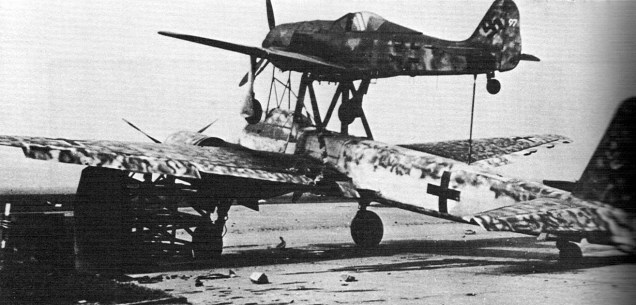
“Mistletoe” aircraft (officially codename “Beethoven”), also known as father-and-son or piggy-back aircraft, were composite aircraft, made up of two planes, one riding on the other’s back. There were two basic types of Mistletoe. Both used a pilotless Ju.88 bomber as the bottom plane; it carried a 3.5 ton explosive warhead and was guided to the target by a fighter pilot on top. The guide plane was either a Me.109 (as the S-1 Mistletoe), or a Fw-190 (as the S-2 Mistletoe), which would abandon the Ju.88 shortly before it exploded. The Mistletoe composite aircraft were tested at Nordhausen and Peenemünde at the beginning of 1944. On the night of 24-25 June 1944, five S-1 Mistletoes were first used operationally. Approximately 250 Ju.88 were converted to Mistletoes.
In 1941 Tank and the air ministry had discussed ways of improving high altitude performance. Tank pushed use of the liquid-cooled DB 603 (an engine developed after the 190 was designed), and in 1942 43 numerous prototypes flew with this engine, nearly all having circular ring cowls and the coolant radiator variously under the engine or under the rear fuselage. Many had pressure cabins, and the majority a four bladed propeller with broad blades. Rather gradually a vast experience of extremely fast high altitude flight was built up which, via the Fw 190B and C series, resulted in the definitive model, the long-nosed Fw 190D (‘Dora’). The engine was not to be the Daimler Benz at all, but the fast revving Jumo 213, the A 1 version of which was rated at 1776 hp (2240 with MW 50 injection) and could deliver 1880 hp at 4750 m (15500 ft) and almost twice the power of the original 1939 BMW radial at twice this altitude. To counter the length of the nose, an extra section was added to the rear fuselage, and in all production D versions the area of the fin and rudder was increased. Most examples had a bulged canopy giving better rear view. The Fw 190D 9 began to roll off Focke-Wulf’s Cottbus assembly line in quantity in August 1944, and the pilots of III Gruppe of Jagdgeschwader 54, which was the first unit to fully equip with the fighter on which it achieved operational status during October. From August 1944, 1805 D-9s were built.
Though only slightly faster than earlier Fw 190s at medium altitudes, and certainly no more manoeuvrable, the Dora 9 was faster in the climb or dive and significantly better at altitudes above 8000 m (26 250 ft). Most were comparatively lightly armed, with two MG 151 and two MG 131, plus an SC500 bomb or tank, and only about 700 had been completed when the Allied advance progressively overran the vast complex of Fw 190 production factories. Right to the end, production of the radial engined aircraft was on a much greater scale, the output of the F and G rising to unprecedented levels in 1944 and outstripping the Dora 9 by a factor of roughly ten to one. Total production of all versions is impossible to give with precision, especially as Albert Speer’s ministry added in the totals of aircraft incorporating fuselages or wings from machines previously counted but damaged by bombing of the factories before completion. A good guess for aircraft delivered to the Luftwaffe is 19 600, while Focke Wulf’s figure for overall production of all versions, including the great diversity of prototypes, is 20001. This does not include the Ta 152 but it does include the many intermediate aircraft that led to it in 1942 43.
Although the company manufactured a prototype two-seat Fw190 to help with the conversion of pilots from slower ground attack units, all the other two-seaters were produced by modifying existing aircraft.
Though manufacture of the Fw 190 was naturally halted by capture of the German factories, which by 1944 extended throughout Germany, Czechoslovakia, Austria and, especially, Poland, there remained a network of plants in France that saw in the 190 a useful stop gap fighter for their own Armee de l’Air. Most of the French factories involved were nationalized into .SNCAC or SNCASO, the assembly line being at the SNCAC underground plant at Cravant, near Auxerre. When liberated, the Fw 190A3 was on the line, and after a slight hiccup this continued in low rate production with the French designation NC 900. Later in 1944 the A 8 was substituted and some 64 NC 900 fighter/bombers were delivered by 1946. They equipped Armee de l’Air GC III/5 Normandie Niemen, but were not popular. Other users of the Fw 190 included the Spanish Blue Division on the Eastern Front, the Turkish air force and Argentina.
The code name ‘Fred’ was originally allocated in error in 1942 although the Fw-190 was not a Japanese operational type. In the Summer of 1943 a Fw.190A5 was imported by the JAAF for evaluation to become the only ‘Fred’ in Japanese service.
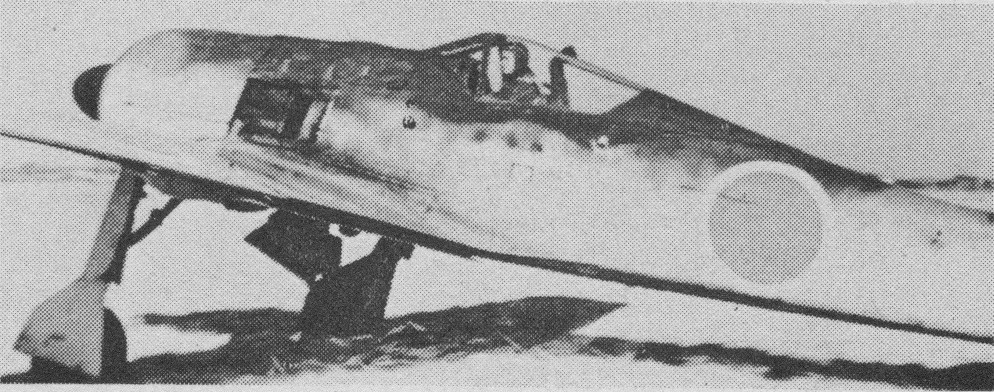
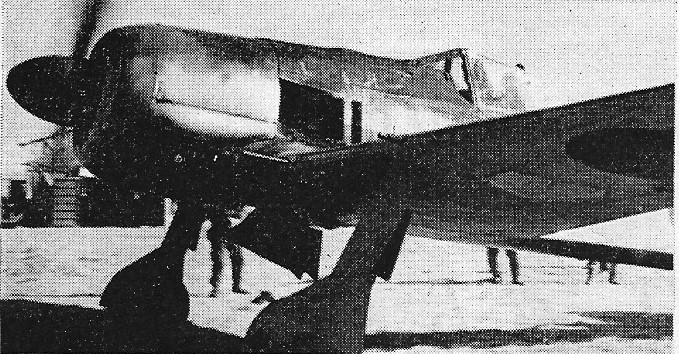
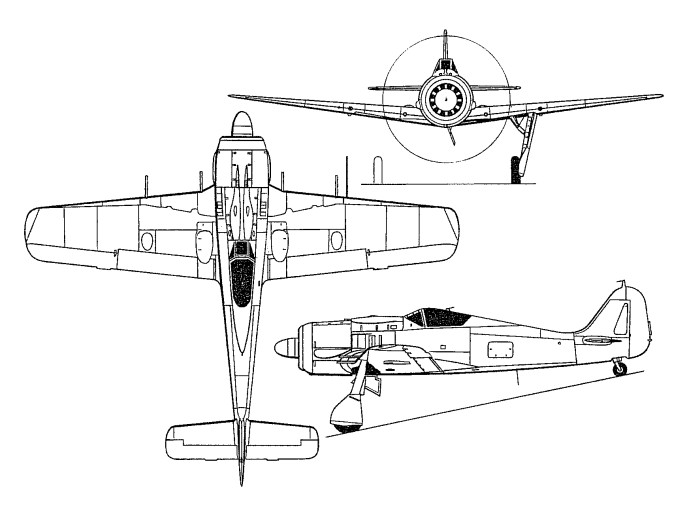
Fw-190A-0
Engine: BMW 801D 2, 1700 hp.
Prop: 3 blade.
Span: 10.5 m (34ft 5.5 in)
Length: 8.8 m (28 ft 10.5 in).
Wing area: 196.98 sq.ft. (18.30sq.m).
Gross weight: 10,800 lb (4,900 kg).
Max speed: (clean, override boost, typical) 673 km/h (418 mph).
Max speed (clean): 408 mph (656 kph) at 20,670 ft (6,300m)
Max range (clean): 497 miles (800km).
Crew: 1.
Armament: Four 20 mm cannon in wings, two 13 mm machine guns in fuselage; various underwing or under¬fuselage loads of small bombs.
Fw-190A-1
Engine: BMW 801D 2, 1700 hp.
Prop: 3 blade.
Span: 10.5 m (34ft 5.5 in)
Length: 8.8 m (28 ft 10.5 in).
Wing area: 196.98 sq.ft. (18.30sq.m).
Gross weight: 10,800 lb (4,900 kg).
Max speed: (clean, override boost, typical) 673 km/h (418 mph).
Max speed (clean): 408 mph (656 kph) at 20,670 ft (6,300m)
Max range (clean): 497 miles (800km).
Crew: 1.
Armament: Four 20 mm cannon in wings, two 13 mm machine guns in fuselage; various underwing or under¬fuselage loads of small bombs.
Fw-190A-2
Engine: BMW 801D 2, 1700 hp.
Prop: 3 blade.
Span: 10.5 m (34ft 5.5 in)
Length: 8.8 m (28 ft 10.5 in).
Wing area: 196.98 sq.ft. (18.30sq.m).
Gross weight: 10,800 lb (4,900 kg).
Max speed: (clean, override boost, typical) 673 km/h (418 mph).
Max speed (clean): 408 mph (656 kph) at 20,670 ft (6,300m)
Max range (clean): 497 miles (800km).
Crew: 1.
Armament: Four 20 mm cannon in wings, two 13 mm machine guns in fuselage; various underwing or under¬fuselage loads of small bombs.
Fw-190A-3
Engine: BMW 801D 2, 1700 hp.
Prop: 3 blade.
Span: 10.5 m (34ft 5.5 in)
Length: 8.8 m (28 ft 10.5 in).
Wing area: 196.98 sq.ft. (18.30sq.m).
Max speed: (clean, override boost, typical) 673 km/h (418 mph).
Gross weight: 10,800 lb (4,900 kg).
Max speed (clean): 408 mph (656 kph) at 20,670 ft (6,300m)
Max range (clean): 497 miles (800km).
Crew: 1.
Armament: Four 20 mm cannon in wings, two 13 mm machine guns in fuselage; various underwing or under¬fuselage loads of small bombs.
Fw-190A-4
Engine: BMW 801D 2, 1700 hp.
Prop: 3 blade.
Span: 10.5 m (34ft 5.5 in)
Length: 8.8 m (28 ft 10.5 in).
Wing area: 196.98 sq.ft. (18.30sq.m).
Gross weight: 10,800 lb (4,900 kg).
Max speed: (clean, override boost, typical) 673 km/h (418 mph).
Max speed (clean): 408 mph (656 kph) at 20,670 ft (6,300m)
Max range (clean): 497 miles (800km).
Crew: 1.
Armament: Four 20 mm cannon in wings, two 13 mm machine guns in fuselage; various underwing or under¬fuselage loads of small bombs.
Fw-190A-5
Engine: BMW 801D 2, 1700 hp.
Prop: 3 blade.
Span: 10.5 m (34ft 5.5 in)
Length: 8.95 m (29ft 4.5 in).
Wing area: 196.98 sq.ft. (18.30sq.m).
Gross weight: 10,800 lb (4,900 kg).
Maximum speed: (clean, override boost, typical) 673 km/h (418 mph).
Max speed (clean): 408 mph (656 kph) at 20,670 ft (6,300m)
Max range (clean): 497 miles (800km).
Crew: 1.
Armament: Four 20 mm cannon in wings, two 13 mm machine guns in fuselage; various underwing or under¬fuselage loads of small bombs.
Fw-190A-6
Engine: BMW 801D 2, 1700 hp.
Prop: 3 blade.
Span: 10.5 m (34ft 5.5 in)
Length: 8.95 m (29ft 4.5 in).
Wing area: 196.98 sq.ft. (18.30sq.m).
Gross weight: 10,800 lb (4,900 kg).
Maximum speed: (clean, override boost, typical) 673 km/h (418 mph).
Max speed (clean): 408 mph (656 kph) at 20,670 ft (6,300m)
Max range (clean): 497 miles (800km).
Crew: 1.
Armament: Four 20 mm cannon in wings, two 13 mm machine guns in fuselage; various underwing or under¬fuselage loads of small bombs.
Fw-190A-7
Engine: BMW 801D 2, 1700 hp.
Prop: 3 blade.
Span: 10.5 m (34ft 5.5 in)
Length: 8.95 m (29ft 4.5 in).
Wing area: 196.98 sq.ft. (18.30sq.m).
Gross weight: 10,800 lb (4,900 kg).
Maximum speed: (clean, override boost, typical) 673 km/h (418 mph).
Max speed (clean): 408 mph (656 kph) at 20,670 ft (6,300m)
Max range (clean): 497 miles (800km).
Crew: 1.
Armament: Four 20 mm cannon in wings, two 13 mm machine guns in fuselage; various underwing or under¬fuselage loads of small bombs.
Fw-190A-8
Engine: BMW 801D 2, 1700 hp.
Prop: 3 blade.
Span: 10.5 m (34ft 5.5 in)
Length: 8.95 m (29ft 4.5 in).
Wing area: 196.98 sq.ft. (18.30sq.m).
Gross weight: 10,800 lb (4,900 kg).
Maximum speed: (clean, override boost, typical) 673 km/h (418 mph).
Max speed (clean): 408 mph (656 kph) at 20,670 ft (6,300m)
Max range (clean): 497 miles (800km).
Crew: 1.
Armament: Four 20 mm cannon in wings, two 13 mm machine guns in fuselage; various underwing or under¬fuselage loads of small bombs.
Fw-190A-8
Engine: BMW 801 D-2, 1700 hp
Prop: 3 blade.
Span: 10.5 m (34ft 5.5 in)
Length: 8.95 m (29ft 4.5 in).
Height : 12.959 ft / 3.95 m
Wing area: 196.98 sq.ft. (18.30sq.m).
Gross weight: (typical) 4900 kg (10800 lb).
Maximum speed: (clean, override boost, typical) 673 km/h (418 mph).
Max speed (clean): 408 mph (656 kph) at 20,670 ft (6,300m)
Max range (clean): 497 miles (800km).
Service ceiling : 34777 ft / 10600 m
Crew: 1
Armament: 2 MK 20mm, 2 MK 13mm, 2 MG 7,62mm
Fw 190D-9
Engine: 1 x Junkers Jumo 213A-1, 1324kW / 1776 hp
Wing span: 34 ft 5.5 in (15.24 m)
Length: 33 ft 5.25 in (10.24 m)
Height: 11 ft 0.25 in (3.35 m)
Wing area: 18.3 sq.m / 196.98 sq ft
Max TO wt: 10,670 lb (4850 kg).
Empty weight: 3490 kg / 7694 lb
Max level speed: 426 mph (685 kph).
Ceiling: 12000 m / 39350 ft
Range: 835 km / 519 miles
Crew: 1
Armament: 2 x 20mm cannons, 2 x 13mm machine-guns, 1 x 500kg bomb
Fw-190F-3
Span: 10.5 m (34ft 5.5 in)
Length: 8.95 m (29ft 4.5 in).
Gross weight: 4900 kg (10800 lb).
Max speed: (clean, override boost, typical) 673 km/h (418 mph).
Fw-190G
Engine One 1,700 hp BMW 801 D.
Length 29 ft. (8.84 m.)
Wing span: 34.6ft. (10.54m.)
Weight empty: 7,000 lb. (3,175 kg.)
Gross weight: G-1 with SC1800; 6300 kg (13900 lb).
Armament 2 x 7.9mm machine guns 4 x 20 mm. cannon.
Top speed: 375 mph between 18-20,000 ft
Emergency boost max speed: 390 mph (max 1 minute)
Max speed 408 mph (655 kph).
Ceiling 37,400 ft. (11,400 m.) fully loaded.
Range 950 miles (1,500 km.)
Scale replica – WAR FW-190
Full size replica – Flug Werke FW-190
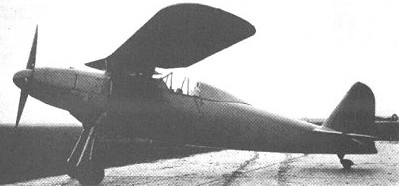
The Fw 159 was a parasol-wing fighter with retractable landing gear, competing with the Messerschmitt Bf 109. Three were built, the first flying in 1935. They suffered from serious problems with their landing gear, the second prototype being reinforced.
V 1
Engine:
Junkers Jumo 210A, 610 hp
Prop: metal three-bladed variable pitch
Wingspan: 12,40 m
Length: 10,00 m
Height: 3,75 m
Wingarea: 20,20 sq.m
Empty weight: 1875 kg
MTOW: 2250 kg
Power loading: 111,38 kg/sq.m
Power loading: 3,688 kg/hp
Vmax: 385 km/h
Ceiling: 7200 m
Range: 650 km
Armament: 2 MT MG 17, 7.92 mm.
V 2
Engine: Junkers Jumo 210B, 640 hp
Prop: Schwartz two-blade wood variable pitch
Wingspan: 12,40 m
Length: 10,00 m
Height: 3,75 m
Wingarea: 20,20 sq.m
Empty weight: 1875 kg
MTOW: 2250 kg
Wing loading: 111,38 kg/sq.m
Power loading: 3,515 kg/hp
Vmax: 333 kph @ SL, 370 kph @ 1500 m, 385 kph @ 4000 m
Vcruise: 365 kph @ 2700 m
ROC: 6000 m in 12 min 30 sec
Ceiling: 7200 m
Range: 650 km
Armament: 2 MT MG 17 7,92 mm
V 3
Engine: Junkers Jumo 210G, 730 hp
Vmax: 405 kph @ 4500 m.
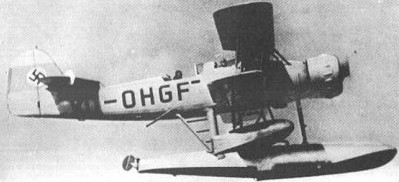
Reconnaissance floatplane, a biplane intended for shipboard duties. The Ar 196 was preferred, and the Fw 62 was merely a back-up design. Only four were built. In 1937 2 standard prototypes were built, V1 and V2.
The first prototype having two floats.
V1
Engine: 1 x BMW 132 cd, 880 hp
Prop: metal two-blade
Wingspan: 12,35 m
Length: 20 m
Height: 3,40 m
Empty weight: 2300 kg
MTOW: 2850 kg
Power loading: 3,238 kg/hp
Vmax: 280 km/h
Ceiling: 5900m
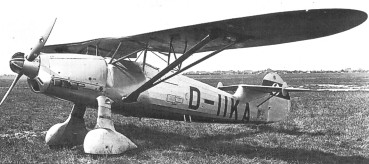
The Stosser (hawk) was the first Focke-Wulf design undertaken by Kurt Tank, and resulted for a German requirement for an advanced trainer with the As 100 engine. The resultant Fw 56 prototype that flew in November 1933 was a parasol-winged aeroplane of mixed construction with cantilever main landing gear units powered by a 179kW Argus As. 10C engine: two more prototypes followed. The V2 prototype had a modified undercarriage and metal wing. The V3 prototype had a further modified undercarriage, similar to the V1, first flying in 1934.
Three Fw 56 A-0 were built with various modifications to the aerofoil. Two MT MG 17 of 7,92 m/m were fitted and provision for 3 bombs of 10 kg.
In the summer of 1935 the Stosser was selected in preference to the Arado Ar 76 and Heinkel He 74, so three Fw 56A-0 pre-production and about 900 Fw 56A-1 production aircraft followed up to the end of production in 1940. These were extensively used as advanced trainers in fighter schools, though after trials that helped to validate the concept of dive-bombing the type was also used in dive-bomber schools. Austria ordered the type before its annexation by Germany, and 12 Stossers were also delivered to Hungary.
Fw 56 V1
Engine: Argus As 10C, 240 hp
Prop: 2 blade fixed pitch
Seats: 2
1 prototype
Fw 56 V2
1 prototype
Fw 56 V3
1 prototype
Fw 56 A-0
Armament: 2 MT MG 17 7,92 mm / 3 bombs 10 kg
Fw 56 A-1 Stosser
Engine: Argus Aces 10c, 240 hp / 179kW
Prop: two-bladed variable pitch
Wingspan: 10,50 m (34ft 5.5 in)
Length: 7,70 m (25ft3in).
Height: 3,55 m
Wingarea: 150.696 sq.ft / 14 sq.m
Empty weight; 695 kg
MTOW: 995 kg
Max. payload weight : 145.5 lb / 66.0 kg
Fuel capacity: 22 gal / 84 l
Vmax: 173 mph / 278 kph @ SL
Landing speed: 49 kt / 90 km/h
Cruising speed : 132 kt / 245 km/h
Take off distance: 551 ft / 168 m
Initial climb rate : 1496.06 ft/min / 7.6 m/s
Service ceiling : 20341 ft / 6200 m
Range: 400 km / 249 miles
Crew: 1
Armament: 1 or 2 Mg 17, 7,92mm plus provision for 3 x 10-kg (22-lb) bombs carried externally.
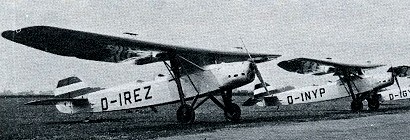
Developed to meet the requirements of the German meteorological service, the two seat, open cockpit prototype Focke-Wulf A 47 weather reconnaissance aircraft was first flown in June 1931 by Cornelius Edzard. Powered by a 164kW Argus As 10 engine, the A 47 was a parasol-wing monoplane with a wing of wood construction and a fabric-covered steel-tube fuselage. It was tested extensively by the Reichsverband der Deutschen Luftfahrtindustrie (predecessor of the present BDLI, or Federation of the German Aerospace Industries) and then evaluated operationally at the Hamburg weather centre, beginning in December 1932. Successful completion of the programme led to production orders, delivered between 1934 and 1936, and used by the meteorological service all over Germany.
Engine: Argus Aces 10, 220 hp
Prop: two-blade variable pitch 2,80 m diameter
Wingspan: 17,76 m
Length: 10,50 m
Height: 3,04 m
Wingarea: 35,00 sq.m
Empty weight: 950 kg
MTOW: 1475 kg
Fuel: 2x 75 lt
Wing loading: 42,142 kg/sq.m
Pwr loading: 6,704 kg/hp
Vmax: 172 km/h
Stall: 77 km/h
ROC: 1000 m in 6 min, 2000 m in 13,3 min, 4000 m in 34 min

