
The M.10E two seat trainer went into service with the Austrians in April 1915, designated B.1.
The M.10E two seat trainer went into service with the Austrians in April 1915, designated B.1.
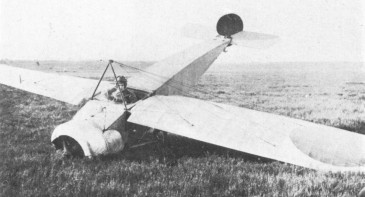
Fokker built 30 to 40 M.8 (A.1) trainer aircraft and artillery spotter of September 1914. Halberstadt later built them under license as the Halberstadt A.2.
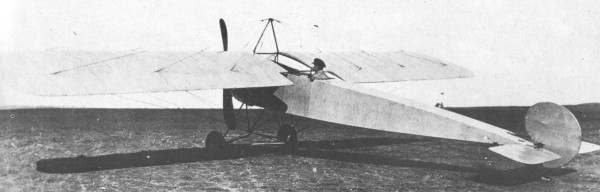
Fokker received his first wartime order for the M.7. The first large order came from Austria, and was for a dozen M.7 scouts. About 20 were built, the first being completed in Jan¬uary 1915.

The parasol winged, two seat M.6 made its debut in June 1914. The machine had an 80 h.p. Oberursel engine. The only one built crashed at Schwerin and was destroyed.
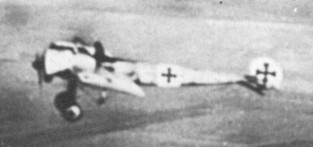
In May 1914 Fokker produced a light, maneuverable aeroplane, the M.5. It was designed by Kreutzer and based on a French Morane Saulnier type H which Fokker had bought second hand. Fokker adapted an untested patent design by Franz Schneider of the LVG company dating from 1913 that interrupted the stream of bullets as the propeller blade passed in front of a machine-gun muzzle to work with a standard Parabellum 08/14 7.02mm weapon.
The Eindecker (monoplane) was a version of the M.5k general-purpose aeroplane fitted with a forward-firing machine-gun and interrupter gear to prevent bullets from hitting propeller blade(s). The inspiration for this otherwise combat aeroplane was Roland Garros’s Morane-Saulnier Type L, which came down behind the German lines on 19 April 1915 and was then found to be fitted with a gun and steel deflector plates. The High Command ordered 30 as the Fokker E.I, with the 60-kW (80-hp) Oberursel U.0 rotary, and was the world’s first true fighter. Deliveries were from June 1915.
M.5K/MG. The K means Kurz = (short wing) and MG means Maschinengewehr (machine gun).
The Fokker E.I was a mid-wing monoplane with externally braced wings and a tapered box-section fuselage. There was no rudder or elevator as such, the entire fin and tailplane being moveable surfaces. There were no ailerons, lateral control being effected by wing warping. External cables that ran through a king post in front of the cockpit moved the controls. The basic structure was steel, but there was no armour protection for the pilot or fuel tanks. Power came from a 59.7 kW / 80 hp nine-cylinder Oberurel rotary engine.
E.I (the later designation the M. 5K/MG). E.I means Eindecker (monoplane) number one. The M.5K/MG, or E.I had an 80 hp. Oberursel engine and was armed with an LMG 08 machine gun. Span 8.95m, the length 6.75m, height 2.88m. Maximum speed 130 kph.
M.5L L means Lang = (long wing).
Some of the first E.Is were issued in ones and twos to various frontline units and flown by experienced pilots. The first to score in an Eindekker was Lt. Kurt Wintgens. His first confirm victim was a Voison downed on 15 July 1915.
Two other early recipients were Max Immelman and Oswald Boelcke of Feldflieger Abteilung 67. On August 1st, 1915 Lieutenant Max Immelmann achieved his first air combat victory flying a Fokker M.5K/MG, and was followed 18 days later by Boelcke. At the end of October Immelmann and Boelcke gained their fifth and sixth victories respectively.
A total of 54 E.Is was produced for the German army, navy and the Austro-Hungarian army by June 1916. The E I was soon superseded by the generally similar E II. The E.I and E.II were built in both armed and unarmed versions, and mainly used for training, before the armed versions were re-engined with a 74.6 kW / 100 hp Oberursel rotary and re-designated E.III.
Engine: Oberursel U.0 rotary, 60-kW (80-hp)
Wing Span: 8.95 m
Length: 6.75 m
Height: 9 ft 1¾ in / 2.4 m
Empty Weight: / 358 kg
Gross Weight: 563 kg
Max Speed: 130 km/h
Ceiling: 3,000 m
Endurance: 1½ hours
Crew: 1
Armament: 1 Spandau machine gun, 7.92 mm

The succes¬sor to the W.I, the W.II, floatplane, made only a few flights before it was dismantled.
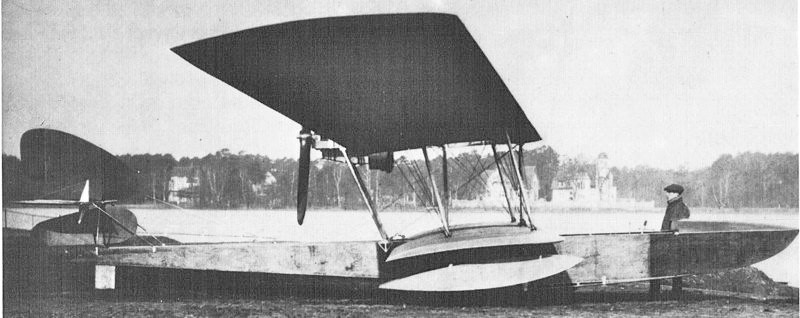
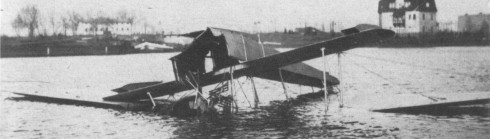
The first Fokker flying boat – identified as the W.1 – dating from February 1913. A characteristic two-seat sesquiplane biplane with a Renault engine of 70 hp fitted in pusher configuration on the top wing. The machine was intended by Fokker to participate in the Monaco seaplane contest of 1913. During an early test flight the W.1 crashed in the water being completely destroyed, with Fokker and his mechanic narrowly escaping. Fokker never turned to flying boats during WW1 again.
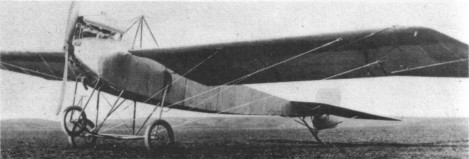
The M.I to M.IV were designed at the instructions of Fokker by a Mr Palm. With the failure of the M.IV he was fired, to be succeeded by Martin Kreutzer.
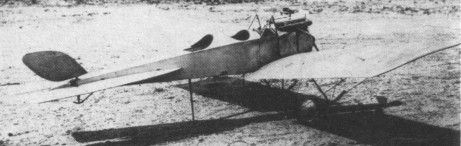
The M.I to M.IV were designed at the instructions of Fokker by a Mr Palm.
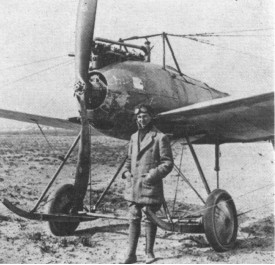
Fokker’s first big order was for ten M.II with a total value of 299,800 Marks. The aircraft had a 100 h.p. Argus or Mercedes engine. Its span was 13.2 metres, length 8.5 metres and the maximum speed was 100 kph.
Engine: 100 h.p. Argus or Mercedes
Wingspan: 13.2 m
Length: 8.5 m
Maximum speed: 100 kph

