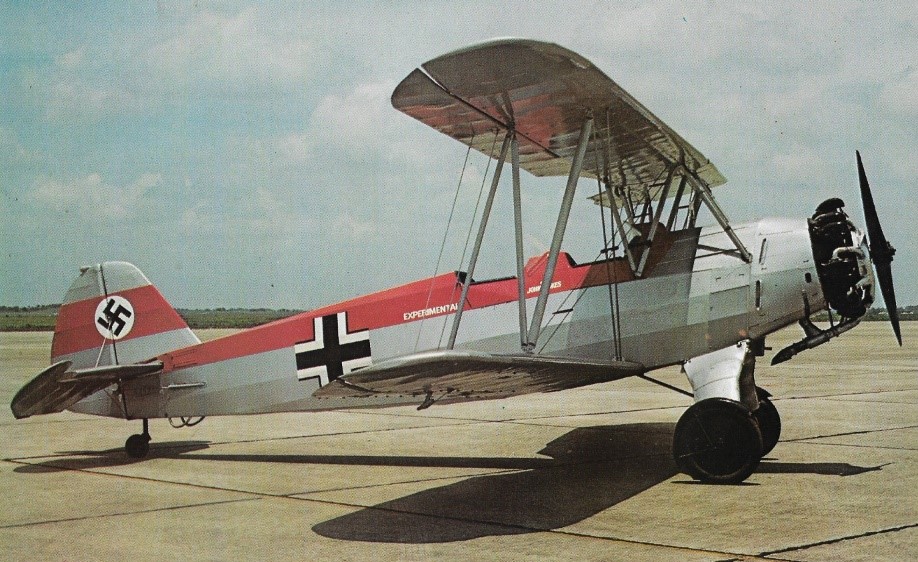
The development of the Fw.44 with the Focke-Wulf Flugzeugbau started in 1931, and the Fw 44A prototype first flew in the summer of 1932 powered by Argus As-8 in line engine which was replaced by the Siemens-Haiske Sh 14a radial engine in the production aircraft. Aerobatic champion Gerd Achgelis conducted the maiden flight of the Fw 44 Stieglitz (goldfinch) trainer late summer 1932.
In its basic form the type had severe handling problems, and these were eradicated by the newly arrived Kurt Tank in an intensive development programme that turned the Stieglitz into a superb aerobatic machine.
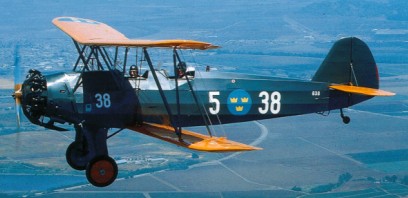
In addition to export orders from Bolivia, Chile, China, Czechoslovakia, Finland, Romania, Switzerland and Turkey, the Fw 44 was built under licence in Argentina, Austria, Brazil, Bulgaria and Sweden (85 designated Sk-12). The major operator was the Luftwaffe with the Fw 44B using the 109-kW (135-hp) Argus As 8 inline, followed by the Fw 44C that reverted to the Sh 144. Variants of the Fw 44C with detail improvements were the Fw 44D, F and Fw 44J. The Sk 12 Swedish license built Focke Wulf Fw 44J was first delivered to the Swedish Air Force Flying School in 1938.
Fw 44A Engine: Sh 144, 112kW (150hp) Span: 9m (29ft 6.25in) Length: 7.3m (23ft 11.5 in) Armament: none Max TO weight: 900 kg (1,984 lb) Max speed: 115 mph at sea level Operational range: 419 miles.
Fw 44B Engine: Argus As 8, 109-kW (135-hp)
Fw 44C Engine: Argus Aces 10C, 240 hp Prop: two-blade fixed pitch 2,80 m diameter Wimgspan: 17,76 m Length: 10,57 m Height: 3,04 m Wing area: 35,00sq.m Empty weight: 1065 kg MTOW: 1580 kg Fuel: 2 x 75 lt Vmax: 191 Kmh Vcruise: 175 km/h ROC: 1000 m in 4 min Ceiling: 5000 m Range: 640 km
Fw 44D Engine: Argus Ace 10D or E, 270 hp Prop: two-blade fixed pitch 2,80 m diameter Wingspan: 17,76 m Length: 10,57 m Height: 3,04 m Wingarea: 35,00 sq.m Empty weight: 1095 kg MTOW: 1475 kg Fuel: 2xX 75 lt
Fw 44E Engine: Argus Ace 10D or E, 270 hp Prop: two-blade fixed pitch 2,80 m diameter Wingspan: 17,76 m Length: 10,57 m Height: 3,04 m Wingarea: 35,00 sq.m Empty weight: 1095 kg MTOW: 1475 kg Fuel: 2xX 75 lt
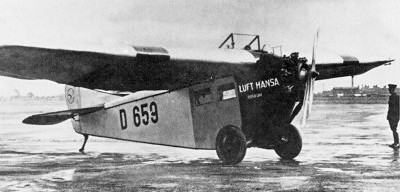
Engine; 1 x Siemens Sh.11 7-cylinder radial, 56kW Wingspan; 13.90 m / 45 ft 7 in Length; 8.50 m / 27 ft 11 in Height; 2.30 m / 7 ft 7 in Max take-off weight; 970 kg / 2138 lb Max. speed; 135 km/h / 84 mph Ceiling; 2500 m / 8200 ft Range; 550 km / 342 miles Crew; 1 Passengers; 4
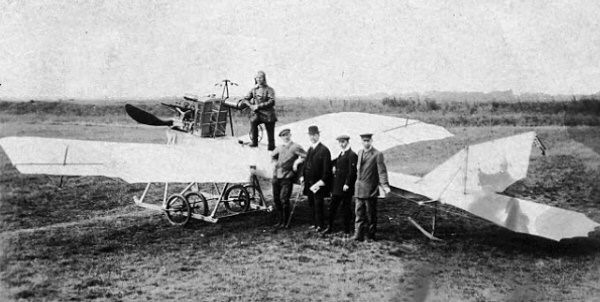
This monoplane with Taube-like wings tips and a big rudder (sometimes identified as the A.V) was built in 1912 in Bremen (Germany). The engine was a 50 hp Argus, and it flew for the first time on July 28th, 1912.
Experimental Helicopter, Germany, 1958 The automobile manufaturer Borgward in Bremen tried to expand its operations with helicopters and the Kolibri was designed together with Prof. Heinrich Focke. The project was shut down because of economical problems of the Borgward factories.
Engine: Lycoming, 237 hp Rotor diameter: 30.84 ft / 9.4 m Max take off weight: 2646.0 lb / 1200.0 kg Crew: 1+2
After termination of the work on the Fa.330 “Wagtail” it was next decided to transform the Fa.330 into a helicopter with engine. It was soon determined as unfeasible. Instead the Focke Achgelis engineers developed a new helicopter, which received the designation Fa.336. It was a single-seat device with outside features, reminiscent of the Fa.330.
Like the Fa.330, the Fa.336 could be stowed away and dismantled in a similar manor. Instead of a swash plate, a new design was applied to increase blade angle. This new design was developed for Focke Achgelis by Mr. Wewoloschky, an engineer who was conscripted to help solve this problem.
Deviating from Focke’s building principle, the Fa.336 had a tail rotor with horizontal drive shaft. The construction from steel tube corresponded to that of the Fa.330. The Fa.336 remained only a design, because there were very few specialists in the whole design engineering department, and those were divided and indispensable for the care of the Fa.223 and its development.
Despite the great success of the Fa 61 and the large amount of publicity its noteworthy flights received, it was in reality no more than an experimental machine to put Prof Focke’s ideas to the test. There was, however, to have been a two-seat sports version of the Fa 61, designated Fa 224, which would have had performance augmented by use of the more powerful 270hp Argus As 10C engine, but this was shelved with the advent of war.
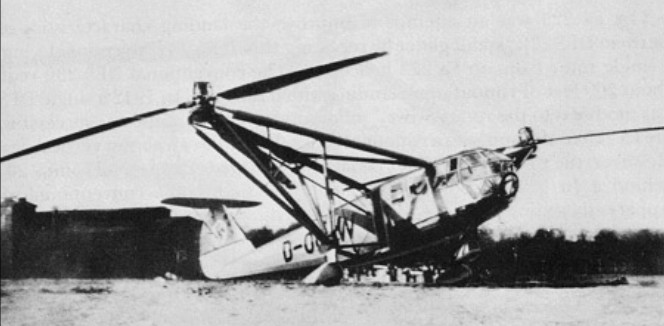
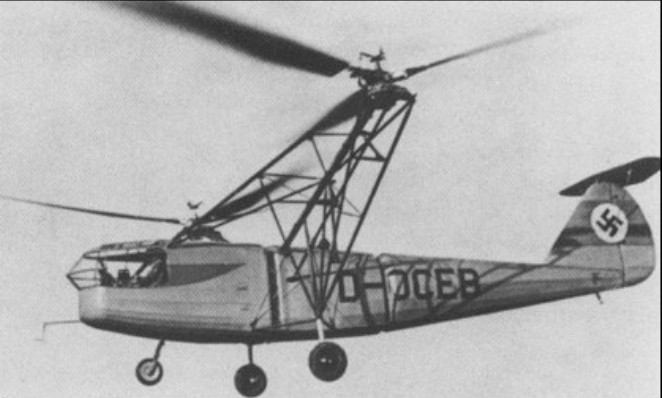
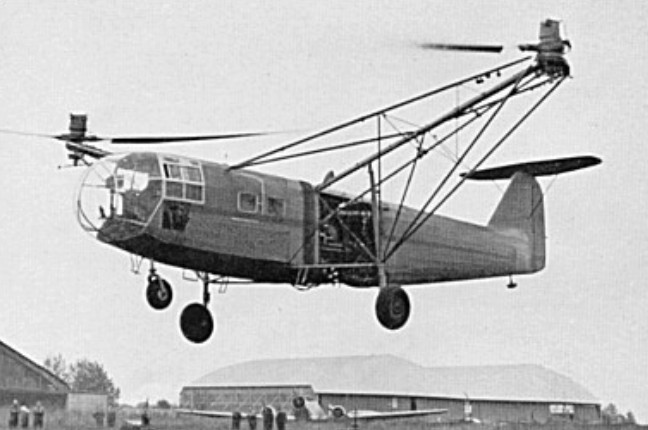
At the outbreak of WW2 Heinrich Focke created the twin-rotor Fa223 helicopter. The Fa 223 was fundamentally an extension of the concept which had produced the smaller Fw 61 and employed a generally similar arrangement of twin counter-rotating rotors mounted on outriggers from the main airframe and driven by a fuselage-mounted radial engine. In the Fa 223 the engine was installed amidships in the fabric-covered steel-tube fuselage to the rear of the 4-seat passenger compartment. The forward part of this cabin was a multiple-panelled enclosure made up of flat Plexiglas panels, and the aircraft was fitted with a tricycle undercarriage.
The fuselage of the Fa 223 was divided into four compartments, these being the extensively-glazed nose cockpit which afforded an excellent view for the pilot and observer, the load compartment with starboard entrance door and self-sealing fuel and oil tanks, the engine compartment and, last, the tail section. The fuselage structure was of welded steel tubes, and fabric covering was used except for the metal panelling of the engine compartment. The engine was a 1,000hp BMW Bramo 323 Q3 Fafnir (later redesignated BMW 301R) with a supercharger and cooling fan and, together with a gearbox, was mounted as one unit in two rings, which in turn were attached to the four longitudinal fuselage members by adjustable cables. Struts prevented fore and aft movement of the engine. The front fireproof bulkhead of the engine compartment was separated from the rear wall of the load compartment by a 0.20m gap. This gap was open at the top and sides of the fuselage, with a wire mesh covering, and engine-cooling air was drawn in through this gap and exhausted from an annular opening behind the rear edge of the compartment panelling. Engine exhaust was piped out through the fuselage roof and ejected aft.
Tubular-steel outriggers extended from the fuselage sides to support the two rotor heads, the centres of which were 12.5 metres apart. Power from the engine was transmitted via a friction plate clutch to the gearbox and then by long hollow shafts to the rotor head gears, the lower end of the starboard shaft having a rotor brake and both shafts having a stabilizing friction clutch at their centres to damp any tendency to whip. The total reduction between engine and rotors was 9.1:1, the normal speed of the rotors being 275 rpm.
The rotor axes were inclined inwards by about 4.5° and slightly forwards, and each rotor head had a free-wheel device to allow the rotors to revolve in the event of the drive transmission jamming. Flapping and dragging hinges were provided for the rotor blades, the drag hinges having friction dampers, and inertia dampers reduced vibration in the cyclic pitch control. Each blade consisted of wooden ribs attached to a conically-drawn high-tensile steel tube, the covering being a mixture of plywood and fabric.
The orthodox fin and rudder was surmounted by a strut-braced tailplane which was adjustable for longitudinal trimming only. Hydraulic brakes, operated from the rudder pedals, were fitted to the mainwheels only, and the nosewheel was self-centring and could turn through 360°.
The control column was used to give longitudinal control by equal cyclic-pitch change of the rotor blades, and lateral control by differential collective-pitch change of the rotor blades. The rudder pedals were used to give yaw control by differential cyclic-pitch change of the rotor blades, the control effect being increased by use of the rudder during forward flight. A trimmer wheel was provided for tailplane adjustment, and all control links were by cables. Two machines (numbered 13 and 16) were experimentally fitted with a separate collective-pitch lever next to the throttle, and a throttle governor to maintain a constant engine speed, but this arrangement was under development only. On all other machines, the pilot had a lever with only two positions for collective pitch, one for powered setting and one for autorotation. In addition, an automatic device adjusted the tailplane and altered the blade pitch from the powered setting to the autorotation setting for a glide landing in the event of a power failure, but the pitch could not be reset in the air. Thus, apart from pitch adjustments for attitude control, the rotors must be regarded as having had a fixed pitch, the lift being controlled by the engine throttle. This fact reduced the safety, handling, and performance characteristics and, in order to maintain a constant rotor speed during a climb, progressive engine throttling was necessary and this cancelled out the benefits of an engine supercharger. Considerable skill and experience was also necessary during hovering and low-speed flight because of the very sluggish lift control; more than one Fa 223 was lost when making downwind turns at low level.
After 100 hours’ ground running, and tethered hovering tests, the Fa 266 made its first free flight in August 1940, by which time it was redesignated Fa 223 Drache. Manufacturer’s trials with the Fa 223V1 revealed slight instability at the lower end of the speed range, but the helicopter’s general handling and controllability were excellent and on 28 October 1940 D-OCEB was flown to a record height of 7100m. The machine was to be tested in these roles using 30 pre-production Fa 223s, which the RLM ordered from the Focke Achgelis Bremen factory.
Most of the equipment required for the various roles the Fa 223 was to perform could be fitted to or removed from the basic machine. For all roles except training, an FuG 17 radio, FuG 101 radio altimeter, nose-mounted MG 15 machine-gun, and an observer’s seat were fitted. Additional equipment required was a rescue cradle, winch and electric motor operating through the fuselage floor, for reconnaissance and rescue; a hand camera pointing through the cockpit floor, for reconnaissance and anti-submarine duties; a jettisonable 300 litre (66 Imp gal) auxiliary fuel tank, for reconnaissance; fuselage racks and two 250kg bombs for anti-submarine work. For cargo transport a load-carrying beam was used to carry heavy or bulky loads suspended beneath the helicopter by cable, which had a pilot-operated, electric quick-release mechanism at its lower end. The maximum load actually carried by an Fa 223 by this method was 1,280kg, which was greater than by any other contemporary helicopter. However, carrying loads suspended by cable proved tiring for the pilot on long flights, and, during troop-supplying trials, stabilizing surfaces fitted to the loads were found to give some improvement. The remaining equipment which could be fitted was a Luftwaffe dinghy stowed in the tail section, respirator racks and, for training purposes only, dual controls.
Of the 30 pre-production Fa 223s ordered from Bremen, only ten or eleven were completed before the factory was bombed, destroying other machines in various stages of construction, and in total they flew about 400 hours, including about 9,985km of cross-country flying. The firm then moved to Laupheim, near Stuttgart, where seven more Fa 223s were built. Early in 1942, the Fa 223 was considered ready for operational testing, and trials began, although by July 1942, because of constant losses and setbacks caused by bombing, only two machines had actually flown. Successful trials with the Fa 223, primarily in the assistance of troops, resulted in the ordering of 100, but only eight were test flown, and six of these were destroyed by bombs in July 1944 at Laupheim. Once again a new production factory was established, in Berlin, with a production capacity of 400 aircraft a month, but only one was completed by the end of the war. The maximum flying time, in Germany, on any one machine was about 100 hours.
The fate of one Fa 223 (No. 12) is perhaps particularly interesting; this helicopter, after completing a long cross-country flight from Germany, was flown to Mont Blanc to perform a mountain rescue of 17 people trapped in the snow. Unfortunately, a mechanical link failure resulted in a rotor disintegrating, and, although the machine touched down on its wheels, it was hurled against an embankment and the crew was killed.
It is known that the few machines available were used on a small scale in general transport and communication work, Luft-Transportstaffel 40 having three Fa 223s on hand at Ainring in April 1945. It was probably these three machines which were the only ones serviceable at the end of the war, and one of these was finally destroyed by its pilot. The remaining two (Nos. 14 and 51) were taken over by American Forces at Ainring in May 1945 for evaluation. One Fa 223 (No. 14), which had first flown in July 1943, was flown by its German crew (consisting of the pilot H. Gersenhauer, the engineer H. Zelewski, and the mechanic F. Will) to England and made history by being the first helicopter to cross the English Channel. It arrived at Brockenhurst, Hampshire, in September 1945 and began flight trials but was destroyed the following month, having had a flying life of 170 hours. The accident occurred when the automatic pitch change mechanism malfunctioned and switched the rotors to the autorotation condition. Since this occurred when the Fa 223 was hovering only about 20m from the ground, it had neither the altitude nor the forward speed for an autorotative landing.
SNCASE SE3000
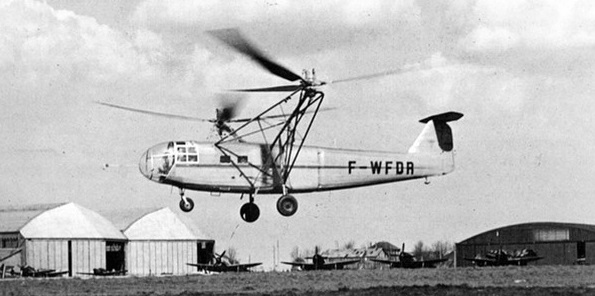
Three known examples were completed after the end of World War 2, all from captured or salvaged components. One of these was built, with the assistance of Doktor Heinrich Focke, by the SNCA du Sud-Est in France with the designation SE.3000 and flown on 23 October 1948. Registered F-WFDR, power was by one 1000hp BMW-323-R2 engine.
Sud-Est SE.3000
The other pair, designated UR-1, were built at the Ceskoslovenske Zavody Letecke (formerly Avia) factory in Czechoslovakia. A start was made on helicopters in the autumn of 1945 by reconstructing two Fa 223s from salvaged parts, the resulting machines being more or less standard.
Uncompleted German wartime projects included proposals to produce a 4-rotor helicopter by joining two Fa 223’s together in tandem with a new fuselage centre-section; and the much larger Fa 284 crane helicopter to be powered by two 1600 or 2000hp BMW engines and capable in the latter form of lifting a 7000kg payload.
Fa 223 Engine: 1 x BMW 301R, 746kW Rotor diameter: 12.0m Fuselage length: 12.25m Height: 4.35m Width with rotors turning: 24.5m Max take-off weight: 4310kg Empty weight: 3175kg Max speed: 175km/h Cruising speed: 120km/h Ceiling: 2010m Range with external fuel tanks: 700km
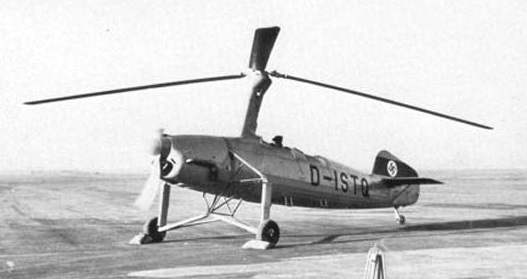
German helicopter development began with Focke Wulf’s acquisition of the rights to manufacture Cierva autogyros during the 1920’s. Over 30 Cierva C.19 and C.30 autogyros were built during the late twenties and early thirties, and from this experience, Heinrich Focke, the engineering half of the Focke Wulf organization, decided to develop an original autogyro design to compete in the Luftwaffe’s contest to provide a utility-liaison aircraft. The Fa 186 was a one-man autogyro built by Focke-Wulf in 1937 with backing from the RLM (ReichsLuftfahrtMinisterium – Reich Aviation Ministry).
The Fa-186 was essentially a FW-56 “Stosser” parasol wing advanced trainer, with the wings removed, tail unit and landing gear redesigned and configured for two seats in tandem. The engine remained unchanged, with a clutch arrangement installed to start the blades rotating for takeoff. An autogyro uses the main powerplant for forward thrust while the rotors freewheel in flight. The aircraft could take off and land in very short distances, but it could not hover or take off and land vertically. Although the Fa-186 was successfully flown it was beaten out by the Fieseler Fi-156 Storch for the Luftwaffe contract. Only one prototype of the aircraft was constructed, and the project was abandoned when the RLM preferred the Fieseler Fi 156 Storch over the Fw 186.
The ilmavoimat / Maavoimat team did evaluate the Fa-186 very early in 1938, and while it was considered not suitable for the intended role and was removed from consideration, one of the Maavoimat Officers on the evaluation team (who was also familiar with the Glider Program underway) considered the gyrocopter interesting enough to recommend further discussions with the FockeWulf company to his own immediate Command.
Engine: Argus As 10C, 240 hp Maximum speed: 112 mph
In December 1934 talks were held by the development group of the RLM (LC II) in the presence of State Secretary Milch which were to lead to important decisions concerning future air armaments.
The following is noted in the minutes under Section 4 “Rotary Wing Aircraft”: “The development of rotary wing aircraft is to receive preferential treatment. Consequently all work now under way is to be accelerated, as these aircraft will presumably be of significance for land and sea use in the future.”
In the LC II.1’s general working plan (Dec. 1935) “rotary wing aircraft” appeared under the heading: “Sport, basic training, advanced training and special aircraft” (Report II/1a). The following types are listed: Fi 184, Fw 61, Focke Wulf project (the later Fw 186) and LC 30 Focke-Wulf license.
Focke-Achgelis became licensed by Cierva to manufacture his patented components. For a number of years before the outbreak of World War II, Focke-Achgelis produced the C-19 Autogyro, and they drew heavily from the knowledge and experience gained from Cierva’s design to rapidly advance the development of their FA-61 helicopter.
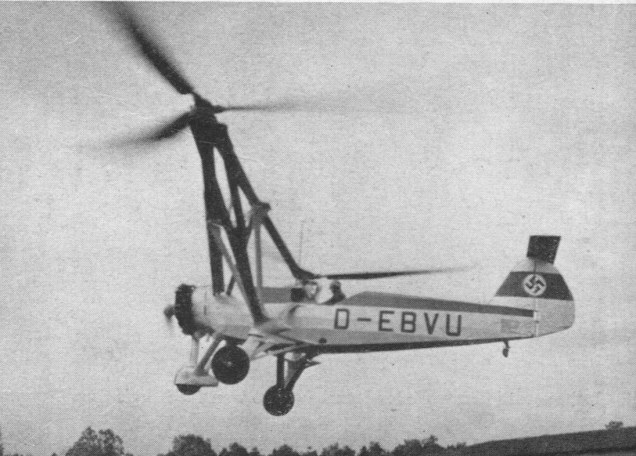
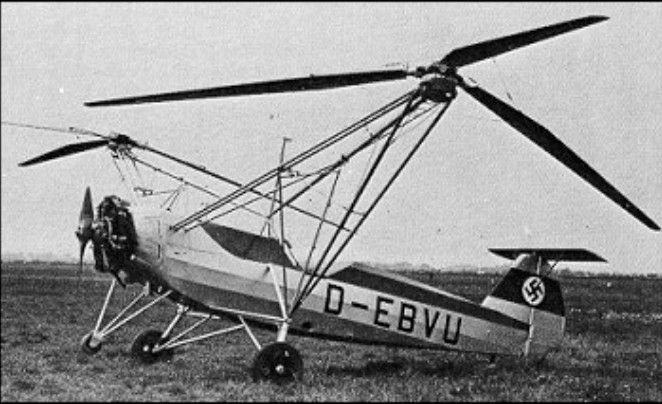
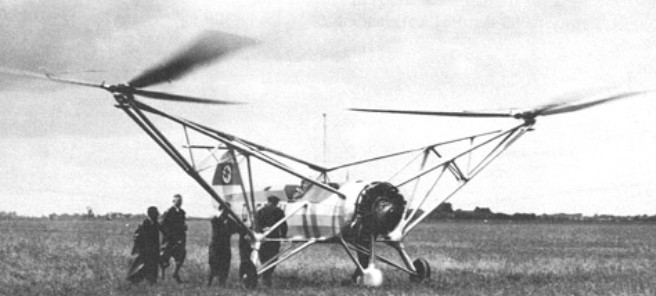
On 26 June 1936, Germany’s first successful helicopter flew, lasting 28 seconds, with test pilot Ewald Rohlfs at the controls. Professor Heinrich Focke’s Fa 61 was a true helicopter. Registered D-EBVU, the Fw 61V1 utilised a nose-mounted 160 hp Siemens engine driving two outrigger mounted fully-articulated three blade rotors via gears and torque shafts; the propeller was merely for cooling. The twin rotor blade angle could be increased or decreased so as to provide lateral movement of the aeroplane by creating a lift differential between one side and the other. Having been adapted from a Focke Wulf Stieglitz trainer, the Fa 61 none the less proved more tractable than any previous vertical lift aircraft.
On 25 June 1935, test pilot Edwald Roffifs set altitude and duration records of 2440 m (8002 ft) and 80 minutes 49 seconds. Next day he flew at 123 kph (76.15 mph) over 20 km (12.4 miles) and set a closed circuit record of 80 km (49.7 miles).
In May 1937 the Fw 61 made its first landing using autorotation, and in February 1938 the aircraft’s controllability was convincingly demonstrated by Germany’s celebrated aviatrix Hanna Reitsch flew the helicopter inside Berlin’s Deutschlandhalle at the 1938 German Motor Show. On 14 successive evenings Flugkapitdn Hanna Reitsch demonstrated the machine in front of audi¬ences of 20,000 people, including some interested foreign military attaches.
Meanwhile a second prototype, D-EKRA, had been completed, and from mid-1937 the Fw 61 established the following list of FAI world records for helicopters:
25/26 June 1937 (pilot Ewald Rohlfs): 2439m altitude; 1 hr. 20 min. 49 sec. endurance; 80.604km distance in a straight line; 122.553km distance over a closed circuit; 16.40km/h speed over a closed circuit.
25 October 1937 (pilot Hanna Reitsch): 108.974km distance in a straight line between Bremen and Berlin.
20 June 1938 (pilot Karl Bode): 230.348km distance in a straight line.
29January 1939 (pilot Karl Bode): 3427 m (11,243 ft) altitude.
This model could reach a 122 km/h speed.
Engine: 1 x Bramo Sh.14A, 119kW Rotor diameter: 7.0m Length: 7.3m Height: 2.65m Max take-off weight: 950kg Empty weight: 800kg Max speed: 112km/h Cruising speed: 100km/h Service ceiling: 2620m Range: 230km Crew: 1