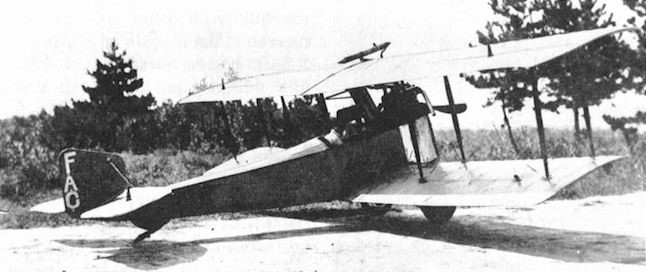
To help Fukunaga establish a flying school of his own, ltoh released the Emi 2 Aeroplane to him and took it to Osaka. Using numerous fields in trying to find a suitable place for his flying school, the aeroplane was frequently damaged and repaired. Eventually Fukunaga settled on the dry river bed of Tenryu River in Kakezuka-cho, Iwata-gun, Shizuoka Prefecture, near his family’s place of origin, where he established in November 1919 what was at first the Fukunaga Aeroplane Research Studio. Because of the many repairs and modifications, his aeroplane was so unlike the original Emi 2 Aeroplane that he renamed it the Tenryu 3 Aeroplane, a name he applied in retrospect to the two previous aircraft and continued to use, numerically sequenced, to those that followed.
The Tenryu 3 was used to provide flying training for his younger brothers, Shiro and Goro, followed by other students who were merely allowed to taxi the aeroplane since the 1911 Gregoire Gyp engine was all but worn out and difficult to adjust.
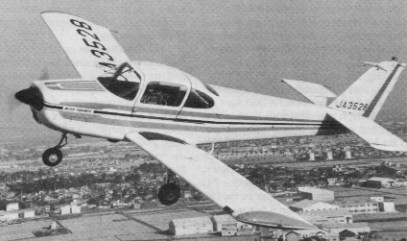
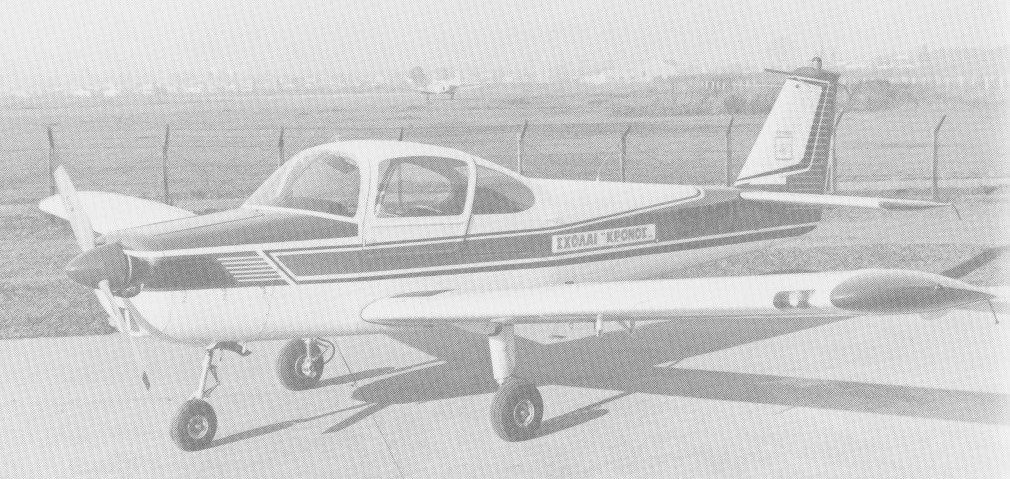
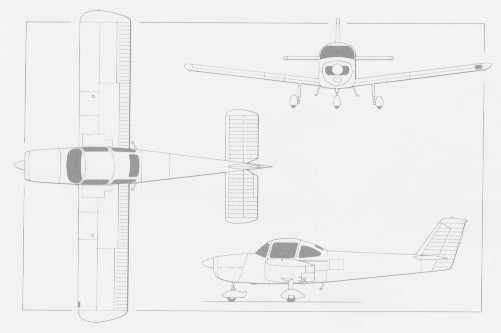
Fuji Heavy Industries builds a two seat aerobatic light trainer, the FA 200 Aero Subaru, of which over 250 have been sold in Japan and in Europe. Expensive to produce because of its heavy reliance on handwork and imported hardware, and rather homely in appearance, the Fuji has not been as great a success, but it has not been a failure.
FA-200-160
The FA-200-160 is a basic version with a Lycoming O-320-D2A engine and certified as a two-seater (aerobatic category) and three-seater (utility) or four-seater.
The FA-200-180 was a developed version certificated as a two-seater (aerobatic category) and four-seater (utility and normal categories).
The FA-203S was an experimental STOL verion with leading-edge slats and full-span trailing-edge flaperons. Only one was built.
FA-200-180 Engine: Lycoming IO-380-B1B, 180 hp Wingspan: 30 ft 11 in / 9.42 m Length: 26 ft 2.25 in / 7.98 m Empty weight: 1433 lb / 650 kg MTOW NormCat, 4 seat: 2535 lb / 1150 kg Max cruise 75% 5000 ft/1535m: 110 kt / 127 mph / 204 kph ROC SL: 760 fpm / 232 m/min Service ceiling: 13,700 ft / 4175 m Range max fuel: 534 nm / 615 mi / 970 km Seats: 4 Baggage capacity: 44 lb / 25 kg (shelf), 176 lb / 80 kg (compartment) Cabin length: 5 ft 8.5 in / 1.74 m Cabin width: 3 ft 4.5 in / 1.03 m
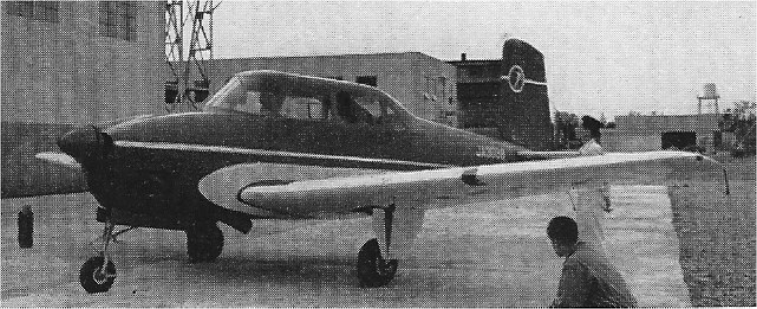
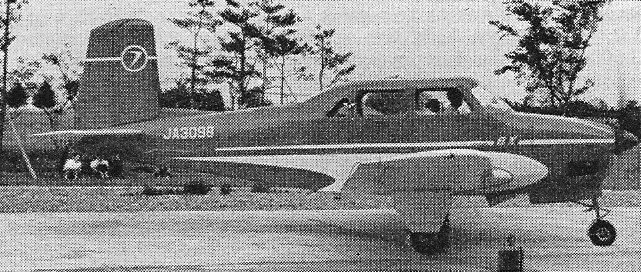
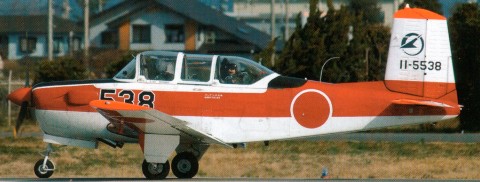
The Fuji LM-1 Nikko is a four-seat liaison aircraft adapted from the design of the Beech T-34 Mentor which was built under licence by Fuji for the Japanese Self-Defense Force.
Flown for the first time on 6 June 1955, the LM-1 employs the wing, undercarriage and tail assembly of the Mentor, and a new centre fuselage.
Engine: 225 hp Continental O-470-13 Wing span: 32 ft 9.5 in Wing area: 177.6 sq.ft Length: 25 ft 11 in Height: 9 ft 7 in Empty weight: 2234 lb Loaded weight: 3375 lb Max speed: 185 mph Cruise: 157 mph Service ceiling: 17,399 ft
The original LM/KM series aircraft were four-seat developments of the Beech T-34A Mentor, the first flying in 1955, and large numbers were delivered to the JMSDF and JGSDF for liaison and training. A tandem two-seat derivative of the Beech T-34 with a Lycoming IGSO-480-AIA6 piston engine entered production in the mid¬1970s as the KM-2B for the JMSDF, and later as the T-3 for the JASDF. Fuji in Japan flew the prototype (JA3725) of the KM-2B two-seat primary trainer on 26 September 1974; this development of the earlier KM-2 combined the airframe and powerplant of that aircraft with the tandem-seat cockpit arrangement of the Beech T-34A Mentor.
Ten KM-2 were ordered for the JMSDF, for delivery by February 1963. Further contracts were to follow, to replace the 45 North American SNJs (Harvards) then in naval service. The prototype KM-2 received its certificate of airworthiness February 1961.
T-5
Fuji has tested a company owned four-seat KM-2 utility aircraft with an Allison 250-B17 turboprop, under the designation KM-2D.
The first KM-2D, flown on 28 June 1984, was a straight conversion of a company-owned piston KM-2 retaining the original four-seat cabin structure.
The JMSDF considered re-engining its fleet of tandem-seat KM-2B trainers, but has now elected to purchase new-build KM¬2Kais, with the first funded in 1986/87. These will be turboprop powered, and will retain the tandem seating of the KM-2B. Deliveries are scheduled for 1988, to begin replacement of the oldest KM-2Bs.
The Japanese Maritime Self-Defence Force took delivery of the definitive turbo-prop powered KM-2D prototype (first flown on 27 April 1988) in August 1988 which was to be tested by the service until March 1989. This prototype, a conversion of a MSDF KM-2B, embodied extensive cabin redesign.
KM 2 Engine: Lycoming IGSO-480 A1A6, 340 hp. Max speed: 227 mph (365 kph) at 16,400ft (5000 m) Cruise, 183 mph (295 kph) Initial climb, 1,560 fpm (7.92 m/sec) Service ceiling, 29,200ft (8900 m) Range, 765 mls (1235 km). Empty weight, 2387 lb (1083 kg) Loaded weight, 3,296 lb (1495 kg). Span, 32 ft 9.75 in (10 m) Length, 26 ft 0.75 in (7.95 m) Wing area, 177.6 sq.ft (16.49 sq.m).
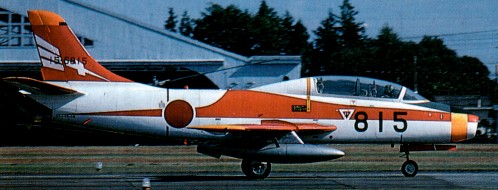
First post-war jet aircraft of Japanese design, the prototype T1F2 flew for the first time on January 19, 1958, powered by a 4,000 lb thrust Bristol Siddeley Orpheus 805 turbo-jet. Two production batches of 20 of this version were built as standard two-seat intermediate jet trainers for the Japanese Air Self-Defence Force, under the designation T1A.
They were followed by the all-Japanese T1F1 (JASDF designation TIB) with a 2,645 lb thrust J3 IHI 3 turbojet produced by Ishikawajima-Harima. The prototype of this version flew on May 17, 1960, and 20 production models were ordered by the JASDF for delivery between August 1962 and March 1963.
Fuji T1F2 (T1A)
T1A / T1F2 Engine: 1 x 4,000 lbs.t. (1814 kgp) Bristol Siddeley Orpheus 80506. Span: 34 ft 5.5 in (10.5 m) Length: 39 ft 9.25 in (12.12 m) Wing area: 239 sq.ft (22.22 sq.m) Height: 13ft 3in Empty weight: 5,335 lb (2 420 kg) Loaded weight: 9,150 lb (4 238 kg) Gross weight: 10,6701b Max speed: 576 mph (921 kph) at 20,000ft (6100 m) Cruise: 397 mph (640 kph) Initial climb: 3,460 fpm (17.3 m/sec) Ceiling: 52,490 ft (16000 m) Range: 806 mls (1297 km). Max rate of climb at SL: 6,100 ft/min
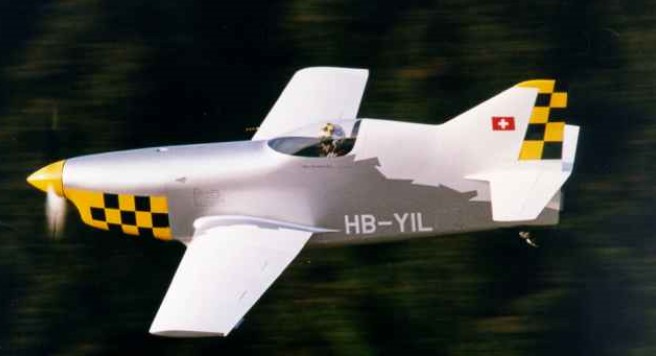
The Valentino Fry Esprit VFII has flaps on rear fuselage, both sides, mechanically actuated. The Al 6061 landing gear has hydraulically actuated brakes, with 500×5 Celeveland units.
The VF-II SC is the supercharged version of the VF-II. It is equipped with a LOM Praha M-332 AK Engine and a MTV 175-7 3 blade propeller.
Esprit VFII Engine: Rolls-Royce O-200A Wing Span: 6.090 m Length: 5.600 m Height @ Cockpit: 1.200 m Height @ Tail: 1.750 m Wing Area: 6.056 sq.m Elevator Area: 0.79 sq.m Empty Weight: 358 kg MTOW: 490 kg Wing Load: 81 kg/sq.m Fuel capacity: 65 lt AVAGAS 100 LL Propeller: MTV-1F / 170-08 VF II (Mühlbauer) Electrical Constant Speed Propeller Prop Diameter: 1700mm Top level speed @ 500ft MSL: 185 kt Design speed vd: 230 kt Never exceed speed vne: 206 kt Manouver speed va: 133 kt Stall speed, power off vso: 54 kt Best rate of climb speed vy: 74 kt Practical climb speed: 100 kt Best rate of climb: 1800 ft/min max. positive load: 6g max negative load: 3g
Esprit VFII SC Engine: LOM Praha M-332 AK Propeller: MTV 175-7 (Mühlbauer) Constant Speed Propeller (electrical) 3 blade Prop Diameter: 1750mm Wing Span: 6.090 m Length: 6.000 m Height @ Cockpit: 1.200 m Height @ Tail: 1.750 m Wing Area: 6.056 sq.m Elevator Area: 0.79 sq.m Empty Weight: 365 kg MTOW: 490 kg Wing Load: 81 kg/sq.m Fuel 65 lt, 78-98 oct Automotive Max speed: 205 kt (IAS) Max speed @ 7000 ft: 195 kts (TAS) Max speed @ 12000 ft: 210 kts (TAS) Design speed vd: 230 kt Manouver speed va: 133 kt Stall speed, power off vso: 54 kt Best rate of climb speed vy: 74 kt Practical climb speed: 100 kt Best rate of climb: 2700 ft/min max. positive load: 6g max negative load: 3g
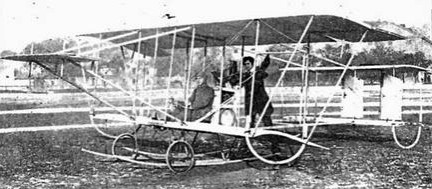
This small biplane of generally Farman-like configuration was built in Pressburg, Austria-Hungary (today Bratislava, Slovakia). The elevators and the ailerons were operated by a lever, while the rudder was operated by a separate lever. It was powered by a German-built 25 hp 3-cylinder engine, driving a propeller of 1.8 m diameter.
Engine: 25 hp Prop diameter: 1.8 m Span: 6.5 m Length: 7.5 m Wing area: 25 sq.m Take-off weight: 250 kg