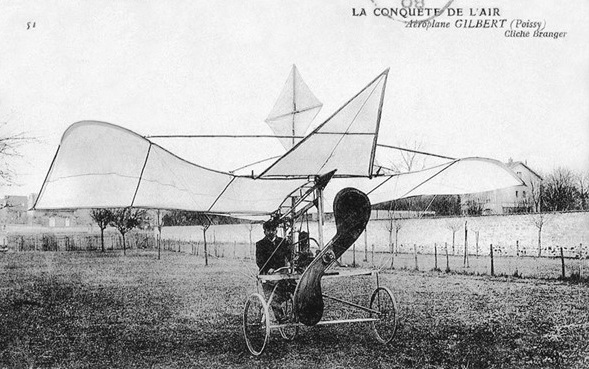
France 1906. Eugene Gilbert (19 July 1889-1918) became interested in flight in his teens and attempted to build his own version of a flying machine in 1906. The effort appears to have been unsuccessful.
France 1906. Eugene Gilbert (19 July 1889-1918) became interested in flight in his teens and attempted to build his own version of a flying machine in 1906. The effort appears to have been unsuccessful.
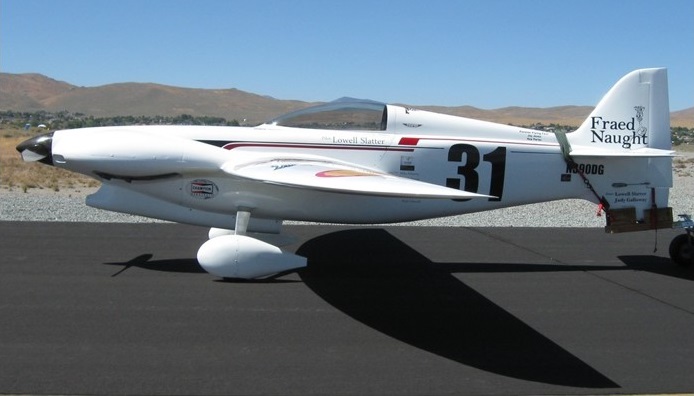
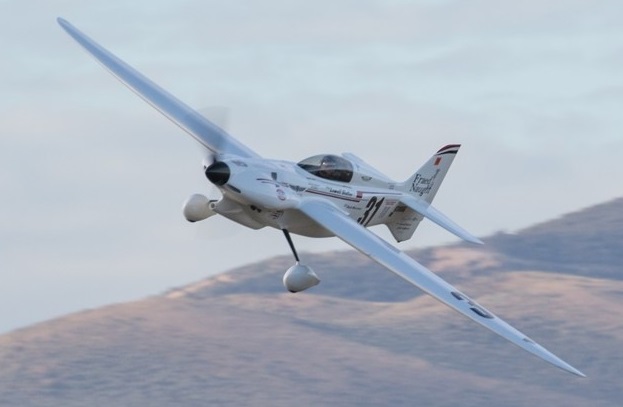
Constructed as a DG2 it was registered to Lowell J. Slatter, Buhl, ID on 18 June 2011 with new c/r N390DG. Originally designed and built by Dan Gilbert and incorporating the lessons learned from his DG-1 (last raced by Charlie Greer as Miss B Haven), this aircraft has a fuselage similar to Nemesis but significantly scaled down and with a ventral fin to raise the tail wheel up. Lowell had done considerable developmental flying and enlarged the rudder to improve directional control.
From 9 September 2013 to 15 September 2013 it raced as #31, named Fraed Naught. Competed at the National Championship Air Races in the Formula One class. The primary pilot was Lowell Slatter from Brookville, OH. Finished in 4th place with an average speed of 227.225 mph.
From 12 September 2016 to 18 September 2016 competed at the National Championship Air Races in the Formula One class. The primary pilot was Lowell Slatter from Buhl, ID. Qualified in 1st place with an average speed of 253.787 mph. Raced in the Gold race. Finished in 1st place with an average speed of 256.728 mph.
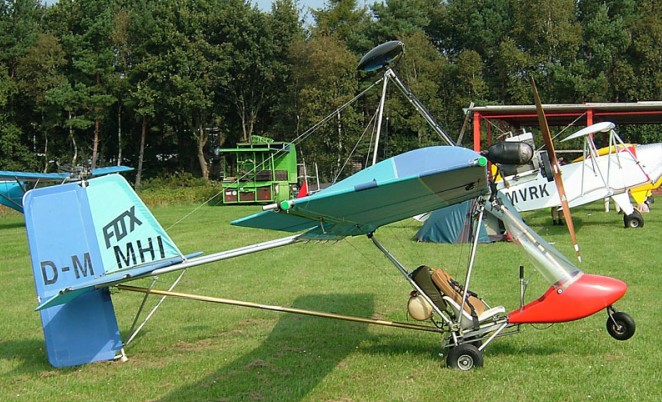
The Fox was designed by Hans Gigax in Switzerland in 1982. Single seat single engined high wing mono-plane with conventional three axis control. Wing has unswept leading edge, swept for¬ward trailing edge and tapering chord; cruci¬form tail. Pitch control by elevator on tail; yaw control by fin¬-mounted rudder; roll control by half span ailerons; control inputs through stick for pitch/roll and pedals for yaw. Wing braced from above by kingpost and cables, from below by cables; wing profile double surface. Undercarriage has three wheels in tricycle formation; suspension on all wheels. Push right go right nose-wheel steering connected to yaw control. Hand actuated brake on nosewheel. Aluminium tube framework, with pod. Engine mounted at wing height driving tractor propeller.
The Fox single seater made its first flight in December 1982 and underwent a programme of test flights with the intention of obtaining certification in West Germany. It was only a prototype. Rigging and derigging take 20 minutes and when folded it is transportable on a roof rack. The noise measured on the ground with the machine flying at 492ft (150m) with the motor at maximum power is 58dB; West German regulations stipulate 60 dB maximum.
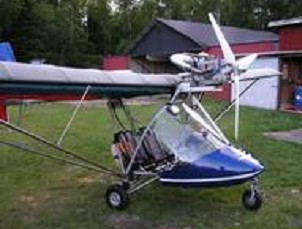
Evektor-Aerotechnik also is marketing the braced high-wing two-seat Fox (a variant of the German Ikarusflug Eurofox, with Evektor of the Czech Republic having undertaken important design work, and Aeropro of Slovakia building airframes for Fox and Eurofox).
The single-seater Comco-Ikarus Fox D is a first generation micro-light aircraft. The single-seat Sherpa I was the first motorised Ikarus micro-light aircraft and entered serial production in 1982. In 1983, the single-seater Sherpa I was replaced in production by the Fox D, an open single-seater constructed out of aluminium tube covered with sailcloth. The nose of the plane is made out of glassfibre composite as used by the 2-seater Sherpa II. The prop of the Fox D is driven by a Göbler-Hirth F263 engine.
Length overall 15.6 ft, 4.75 m.
Height overall 8.7ft, 2.65m.
Wing span 33.1ft, 10.10m.
Chord at root 4.8ft, 1.45 m.
Chord at tip 4.5ft, 1.36m.
Dihedral 3deg.
Sweepback 0deg.
Tailplane span 10.1ft, 3.08m.
Fin height 5.5 ft, 1.69 m.
Total wing area 142 sq.ft, 13.2 sq.m.
Total aileron area 12.7 sq.ft, 1.18 sq.m.
Fin area 5.1 sq.ft, 0.47 sq.m.
Rudder area 5.5 sq.ft, 0.51 sq.m.
Tailplane area 18.2 sq.ft, 1.69 sq.m.
Total elevator area 10.5 sq.ft, 0.98 sq.m.
Wing aspect ratio 7.7/1.
Wheel track 5.1 ft, 1.54 m.
Wheelbase 4.7 ft, 1.40 m.
Nosewheel diameter overall 12 inch, 30 cm.
Main wheels diameter overall 12 inch, 30 cm.
Engine: Hirth 383 cc, 22 hp at 4200 rpm.
Propeller diameter and pitch 55 x 28 inch, 1.40 x 0.70 m.
Belt reduction, ratio 1.5/1.
Max static thrust 166 lb, 75 kg.
Power per unit area 0. 15 hp/sq.ft, 1.7hp/sq.m.
Fuel capacity 2.6 US gal, 2.2 Imp gal, 10.0 litre in main tank; 2.6 US gal, 2.2 Imp gal, 10.0 litre in res.
Empty weight 190 lb, 86 kg.
Max take off weight 442 lb, 200 kg.
Payload 252 lb, 114 kg.
Max wing loading 3.11 lb/sq.ft, 15.2kg/sq.m.
Max power loading 20.1 lb/hp, 9.1kg/hp.
Load factors; +6.0, 3.0 ultimate.
Max level speed 53 mph, 85 kph.
Never exceed speed 81 mph, 130 kph.
Max cruising speed 47 mph, 75 kph.
Economic cruising speed 31 mph, 50 kph.
Stalling speed 24 mph, 40 kph.
Max climb rate at sea level 400ft/min, 2.0m/s.
Take off distance 82ft, 25m.
Landing distance 33ft, 10m.
Range at average cruising speed 171 mile, 275 km.
Comco Ikarus C-22 Fox
Stall: 23 kt / 27 mph / 43 kmh
Cruise: 49 kt / 56 mph / 90 kmh
VNE: 65 kt / 75 mph / 120 kmh
Empty Weight: 204 kg / 450 lbs
MTOW Weight: 390 kg / 860 lbs
Climb Ratio: 700 ft/min / 4 m/s
Take-off distance (50ft obstacle): 660 ft / 200 m
Landing distance (50ft obstacle): 660 ft / 200 m
Ikarus Comco Ikarus C 22
Empty weight: 185 kg
Wing span: 10.4 m
Wing area: 15.2 sq.m
Fuel capacity: 40 lt
Engine: Rotax 582, 64 hp
MAUW: 400 kg
Seats: 2
Max speed: 145 kph
Cruise speed: 130 kph
Minimum speed: 55 kph
Climb rate: 5 m/s
Fuel consumption: 14 lt/hr
Price (1998): 33 000 DM
Ikarus Comco Ikarus C 22
Empty weight: 185 kg
Wing span: 10.4 m
Wing area: 15.2 sq.m
Fuel capacity: 40 lt
Engine: Rotax 582, 64 hp
MAUW: 400 kg
Seats: 2
Max speed: 145 kph
Cruise speed: 130 kph
Minimum speed: 55 kph
Climb rate: 5 m/s
Fuel consumption: 14 lt/hr
Price (1998): 33 000 DM
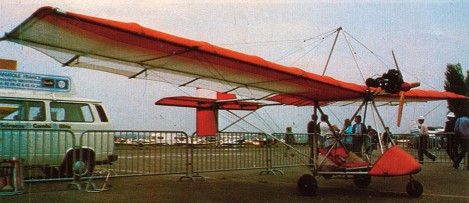
Hans Gigax developed his Sherpa using experience acquired with the earlier Microstar, the two machines sharing a similar configuration and technology. The Sherpa made its first flight as a single seater in May 1982 and the two seater took to the air in July of the same year. Since then both have been put into production by the West German Ikarus company, under which heading we give greater detail. Briefly, however, the Sherpas are provided with a cage where the tubes form a double triangular structure ensuting excellent rigidity whilst offering considerable passive security. The aircraft also exhibits the peculiarity of having been designed from the start to be usable either as a single seater, with the seat fitted in the central position, or as a two seater, its frame being large enough to be fitted either with a double bench seat or two separate seats, the pro¬totype being equipped with a central stick.
Single seat single engined high wing mono¬plane with conventional three axis control. Wing has unswept leading and trailing edges, and constant chord; cruciform tail. Pitch control by elevator on tall; yaw control by fin mounted rudder; roll control by one third ¬span ailerons; control inputs through stick for pitch/roll and pedals for yaw. Wing braced from above by kingpost and cables, from below by cables; wing profile double ¬surface. Undercarriage has three wheels in tricycle formation with additional tailskid; rubber suspension on nosewheel and suspension on main wheels. Push right go-¬right nosewheel steering connected to yaw control. Optional brake on nosewheel. Alumi¬nium tube framework, without pod. Engine mounted at wing height driving tractor prop¬eller.
A manufacturer of hang¬-gliders for many years, Ikarus has just acquired the licence to produce and sell the Sherpa designed by the Swiss Hans Gigax. The first Sherpa single seater flew for the first time in May 1982 and Hans made the first flight with the Sherpa two-¬seater on the way to the amateur constructors convention at Brienne le Chateau in France at the end of July 1982.
The prototype used a Konig SD570 four¬ cylinder engine of 570cc, but this was aban¬doned on the commercial versions. Instead, Ikarus chose to fit its single seater, the Sherpa I, with a twin cylinder Hirth 263R 383cc engine developing 22hp. By February 1983, Ikarus had already delivered eleven machines and in March at the Friedrichshafen show the firm announced orders for 200 machines.
The Sherpa I options include electric starter (with alterna¬tor and battery) and a package allowing the single seater to be transformed into a two ¬seater. This package contains a second seat fitted with belts, dual controls, and the Hirth 438cc engine and costs an extra DM2150.
Though very similar to the Sherpa I, the Sherpa II differs by the addition of a second seat, dual controls (on production models), structural reinforcements and a more powerful engine. Otherwise few changes are needed, as the Sherpa was designed from the outset to be a two seater. The Sherpa II can be turned back into a single seater in a few minutes and uses the Hirth 438cc engine developing 42hp. Following three pre production models built during the first quarter of 1983, produc¬tion started. A pod and instrument panel are optional.
Sherpa I
Length overall 16.2 ft, 4.95 m.
Height overall 9.3ft, 2.82m.
Wing span 34.4ft, 10.50m.
Constant chord 5.2 ft, 1.60 m.
Sweepback 0deg.
Tailplane span 9.8 ft, 3.00 m.
Total wing area 169 sq.ft, 15.7 sq.m.
Wing aspect ratio 7.0/1.
Wheel track 5.9 ft, 1.80 m.
Wheelbase 4.3 ft, 1.30 m.
Engine: Hirth 263R, 22hp at 4200rpm.
Propeller diameter 55 inch, 1.40 m.
Toothed belt reduction, ratio 1.8/1.
Max static thrust 143 lb, 65 kg.
Power per unit area 0.13hp/sq.ft, 1.4hp/sq.m.
Fuel capacity 3.4 US gal, 2.8 Imp gal, 13.0 litre in main tank; 3.4 US gal, 2.8 Imp gal, 13.0 litre in res.
Empty weight 221 lb, 100 kg.
Max take off weight 475 lb, 215kg.
Payload 254 lb, 115kg.
Max wing loading 2.81 lb/sq.ft, 13.7kg/sq.m.
Max power loading 21.6 lb/hp, 9.8kg/hp.
Load factors; +6.0, 3.0 ultimate.
Max level speed 56 mph, 90 kph.
Never exceed speed 68 mph, 110 kph.
Max cruising speed 50 mph, 80 kph.
Economic cruising speed 37 mph, 60 kph.
Stalling speed 24 mph, 40 kph.
Max climb rate at sea level 300 ft/min, 1.5 m/s.
Min sink rate 400 ft/min at 31 mph, 2.0 m/s at 50 kph.
Best glide ratio with power off 7/1.
Take off distance 200ft, 60m.
Landing dis¬tance 130 ft, 40 m.
Range at average cruising speed 93 mile, 150km.
Sherpa II
Engine: Hirth 263R, 22hp at 4200rpm.
Propeller diameter 55 inch, 1.40 m.
Toothed belt reduction, ratio 1.8/1.
Max static thrust 143 lb, 65 kg.
Power per unit area 0.13hp/sq.ft, 1.4hp/sq.m.
Length overall 16.2 ft, 4.95 m.
Height overall 9.3ft, 2.82m.
Wing span 34.4ft, 10.50m.
Constant chord 5.2 ft, 1.60 m.
Sweepback 0deg.
Tailplane span 9.8 ft, 3.00 m.
Total wing area 169 sq.ft, 15.7 sq.m.
Wing aspect ratio 7.0/1.
Wheel track 5.9 ft, 1.80 m.
Wheelbase 4.3 ft, 1.30 m.
Fuel capacity 3.4 US gal, 2.8 Imp gal, 13.0 litre in main tank; 3.4 US gal, 2.8 Imp gal, 13.0 litre in res.
Engine: Hirth 276R, 42 hp at 4200 rpm.
Propeller diameter 63 inch, 1.60 m.
Toothed belt reduction, ratio 1.8/1.
Max static thrust 232 lb, 105 kg.
Power per unit area 0.25 hp/sq.ft, 2.7 hp/sq.m.
Length overall 16.2 ft, 4.95 m.
Height overall 9.3ft, 2.82m.
Wing span 34.4ft, 10.50m.
Constant chord 5.2 ft, 1.60 m.
Sweepback 0deg.
Tailplane span 9.8 ft, 3.00 m.
Total wing area 169 sq.ft, 15.7 sq.m.
Wing aspect ratio 7.0/1.
Wheel track 5.9 ft, 1.80 m.
Wheelbase 4.3 ft, 1.30 m.
Fuel capacity 3.4 US gal, 2.8 Imp gal, 13.0 litre in main tank; 3.4 US gal, 2.8 Imp gal, 13.0 litre in res.
Empty weight 254 lb, 115kg.
Max take off weight 662 lb, 300kg.
Payload 408 lb, 185
Max wing loading 3.91 lb/sq.ft, 19.1 kg/sq.m.
Max power loading 15.8 lb/hp, 7.1 kg/hp.
Load factors; +6.0, 3.0 ultimate.
Max level speed 50 mph, 80 kph.
Max cruising speed 44 mph, 70kph.
Economic cruising speed 37mph, 60kph.
Stalling speed 26mph, 42kph.
Max climb rate at sea level 400 ft/min, 2.0 m/s.
Min sink rate 400ft/min at 31mph, 2.0m/s at 50 kph.
Best glide ratio with power off 7/1.
Take off distance 150ft, 45m.
Landing distance 115ft, 35m.
Range at average cruising speed 93 mile, 150 km.
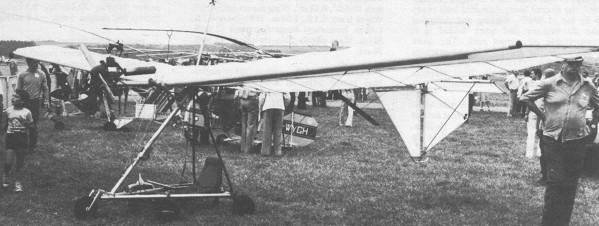
Single seat single engined high wing mono¬plane with conventional three axis control. Wing has unswept leading and trailing edges, and constant chord; cruciform tail. Pitch control by elevator on tail; yaw control by fin mounted rudder; roll control by spoilers; control inputs through stick for pitch/roll and pedals for yaw. Wing braced from above by kingpost and cables, from below by cables; wing profile 80% double surface. Undercarriage has three wheels in tricycle formation with additional tailskid; no suspension on nosewheel and steel spring suspension on main wheels. Push right go right nosewheel steering connected to yaw control. No brakes. Aluminium tube framework, without pod. Engine mounted at wing height driving tractor propeller. Leading edges of the wing are stiffened with polyester under the Dacron covering.
Designed and built by Hans Gigax, the Microstar, which made its first flight at the beginning of 1981 and was shown by Hans at the annual homebuilders’ meet at Brienne le Chateau in France. The machine went on sale in 1982 from ASW, which has ceased to produce aircraft in Switzerland at the beginning of 1983. The Microstar was directly involved in a fatal accident in West Germany in 1982 which led the maker to stiffen its empennage by two additional tubes.
Having acquired the licence to build and sell the single seater Microstar as designed by Hans Gigax, the ASW company embarked in 1982 on the production of several examples as the Microstar Mark I. The distribution seems to have been very small, but at least one Microstar was exported to France, bought by the French agent of the Swiss parent company.
Length overall 17.1ft, 5.20m.
Wing span 33.6ft, 10.20m.
Constant chord 4.4ft, 1.32 m.
Sweepback 0 deg.
Total wing area 145 sq.ft, 13.4 sq.m.
Wing aspect ratio 7.8/1.
Engine: Konig SC430, 24 hp at 4200 rpm.
Propeller diameter 43 inch, 1.09 m.
No reduction.
Max static thrust 132 lb, 60 kg.
Power per unit area 0.17 hp/sq.ft, 1.8 hp/sq.m.
Fuel capacity 5.3 US gal, 4.4 Imp gal, 20.0.
Empty weight 154lb, 70kg.
Max take off weight 441 lb, 200 kg.
Payload: 287 lb, 130 kg.
Max wing loading: 3.05 lb/sq.ft, 14.9 kg/sq.m.
Max power loading 18.4 lb/hp, 8.3kg/hp.
Load factors: +6.0, 3.0 ultimate.
Max level speed 50 mph, 80 kph.
Never exceed speed 68 mph, 110 kph.
Max cruising speed 44 mph, 70 kph.
Economic cruising speed 24mph, 40kph.
Stalling speed 17 mph, 28 kph.
Max climb rate at sea level 250ft/min, 1.5m/s.
Take off distance 65ft, 20m.
Landing distance 50ft, 15 m.
Service ceiling 11,480 ft, 3500 m.
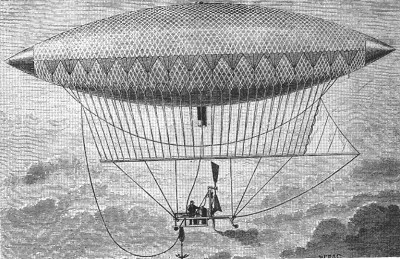
The first practical airship was the work of Frenchman Henri Gifard who in 1852 constructed a 143 ft long craft. Pointed at both ends and driven by a 3 hp steam engine; weighing, with its boiler, 350 lb and suspended 20 ft below the envelope, driving an 1 ft diameter propeller at 110 rpm to give it a still air speed of 6 mph.
On 14 September 1852 Giffard lifted off from the Hippodrome in Paris and, in near perfect weather conditions, flew 17 miles to Trappes, south of Paris in around 3 hours.
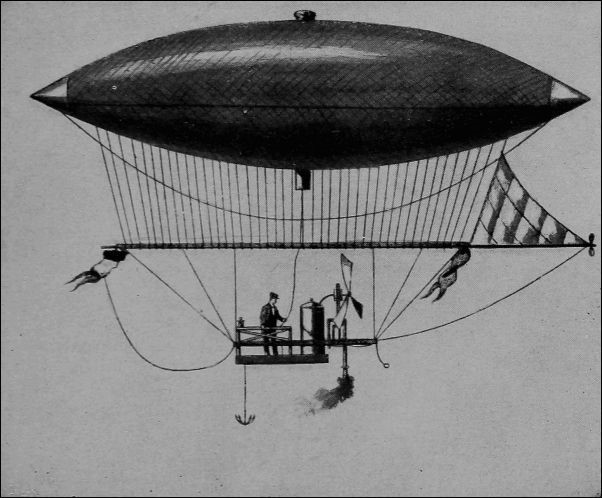
Whilst Giffard was able to effect a degree of control with the triangular sail that performed the function of a rudder in directing his flight, he was unable on this or later flights to either navigate in a circle or return to his starting point due to the low power of the engine.
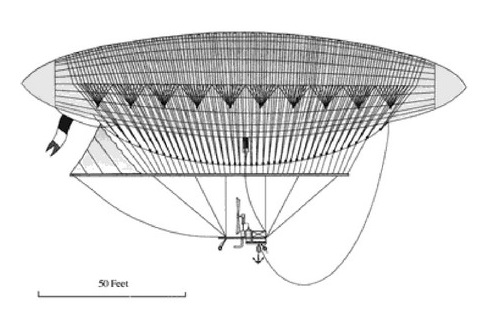
Engine: 3 hp
Length: 144.357 ft / 44.0 m
Width of hull: 39.37 ft / 12.0 m
Contained volume: 88300 cu.ft / 2500 cu.m
Max. speed: 5 kts / 10 kph
Gross lift: 2500 kg
Four-seat derivative of Che-22 first flown 1996 but not selected for further production.
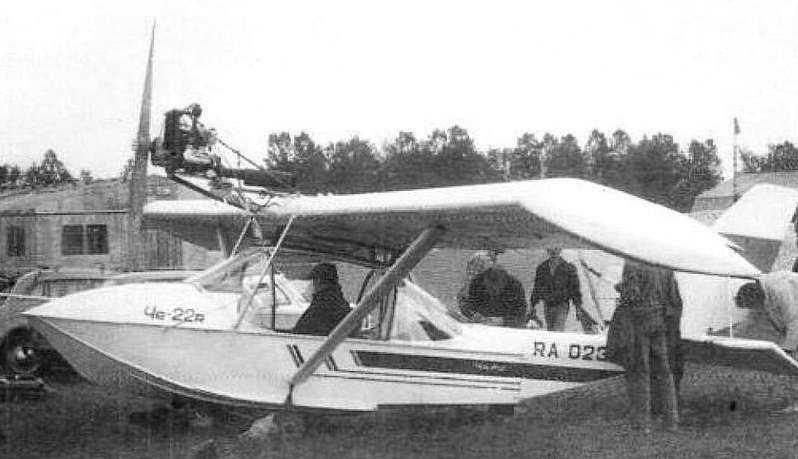
The Gidroplan Che-22 Korvet (English: Corvette) is one of several parasol wing light flying boat Boris Chernov designs of similar appearance, stemming immediately from the Che-20.
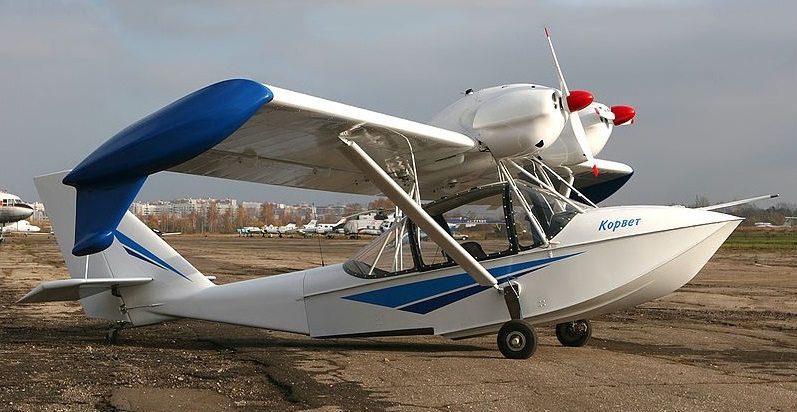
The wing of the Korvet has no sweep and is of constant chord, with 1.5° dihedral; its thick airfoil section has a thickness-to-chord ratio of 0.15. It is a single spar, riveted duralumin covered structure, apart from its full span slotted flaperons, which are fabric covered, and GFRP sandwich, down turned, buoyant wing tips which support the wings when the aircraft is moored. Later aircraft have remodelled tips which include integral miniature float bodies to provide stability at speed on the water; they may also have separate flaps and ailerons. The wing is braced to the mid-fuselage by a single streamlined strut on each side, with the assistance of jury struts. Cabane struts carry the wing over the cabin. The tail unit is a GFRP structure with a straight edged, tapered, swept fin and balanced rudder which carries the unswept, straight edged tailplane, braced from above, a little above the upper fuselage line. The elevators are split by the rudder; the port surface has a trim tab.
The three-seat Che-22 Korvet made its first flight in 1993 and achieved certification in December 2001, with significant structural, control and instrumentation revisions made along the way. It proved successful, with 80 completed by January 2011. Since 1995 Chernov’s designs have either been built by the Gidroplan (Hydroplane) Company or by Gidrosamolet.
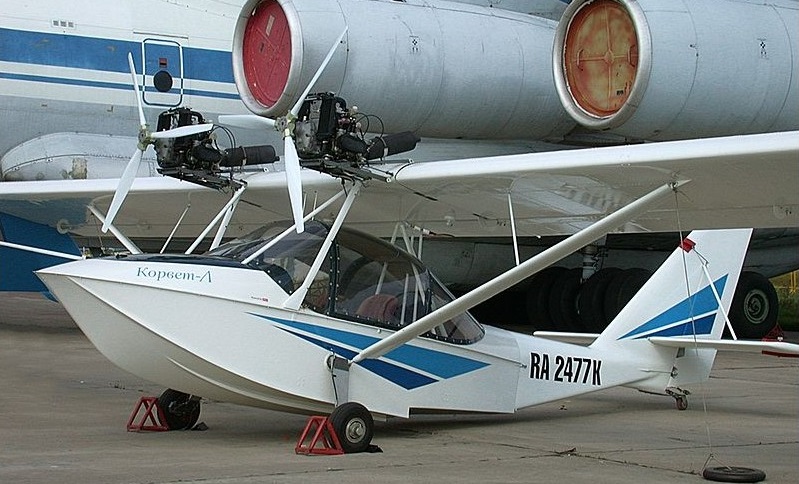
Different variants of the Korvet have been fitted with several different engine types; some have a single engine and some are twins. In all cases the engines are mounted over and above the wing leading edge. Twins have their engines as close together as the 1.5 m (59 in) propellers diameters will allow. Most engines have been from the Rotax range: the 37 kW (49.6 hp) Rotax 503 UL-2V and the 47.8 kW (64.1 hp) Rotax 582 UL two cylinder two strokes, the first air-cooled and the latter with mixed air and water cooling, and the 59.6 kW (79.9 hp) Rotax 912 UL water-cooled flat four. The 59.7 kW (80.1 hp) Jabiru 2200 has also been fitted. Some drive two blade propellers, though others have three blades.
The Korvet’s fuselage is a flat sided, two step hull design, built from GFRP. The cabin is completely enclosed in a blister canopy which is all transparent apart from the underwing roof, giving all round views. Entry is by upward canopy sections on each side. The flying boat can be equipped as an amphibian with short spring cantilever legs with small mainwheels, the legs rotating through 90° for water touch-downs. There is a small tailwheel below the rudder. Skis are another option.
The first delivery of a Korvet was in 1990, when a pre-production aircraft went to a forest control organization. The first production aircraft flew in 1993, four years after the prototype. After receiving Russian certification at the end of 2001 and JAR/FAR certification a few months later, the Korvet sold quite well, with 60 built by the end of February 2002. An early Korvet 582 was sold in the Philippines, then bought by the Vietnamese and used as a model for the locally built A41 Factory VNS-41. Two Korvet-Js went to Cuba in military markings in 2008. Another Korvet-J was equipped for Earth resource survey with large underwing aerials; after successful trials these aerials were internally accommodated. By January 2011, eighty had been sold, the latest to Costa Rica. Of the eighty built, seventeen were Jabiru powered.
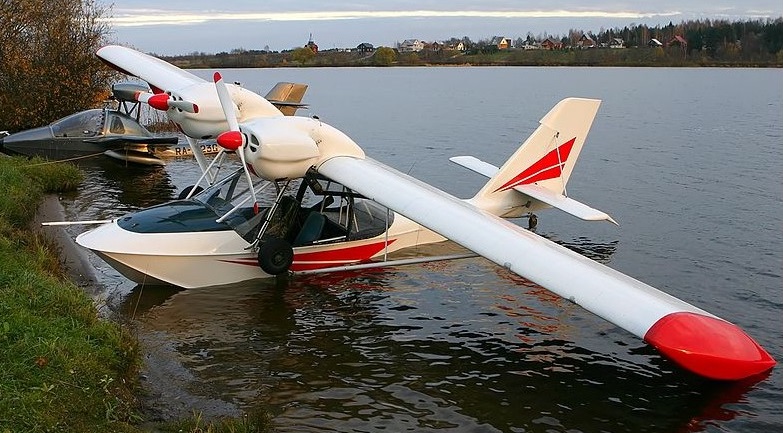
As well as selling flyaway aircraft, Gidroplan also sell kits in different stages of finish.
Che-22P1
Engine: One Rotax 582
Korvet 503 (Che-22P2)
Engines: Two Rotax 503 UL
Discontinued by 2013
Korvet 582 (Che-22RS)
Engines: Two Rotax 582 UL
Precursor to the Korvet-L
Korvet 912 (Che-22D)
Engine: One Rotax 912 UL
Discontinued by 2013
Korvet-J
Engines: Two Jabiru 2200
Tip floats as Korvet-L
Flown by 2003
Korvet-L (Che-22RS)
Engines: 2 × Rotax 582 UL, 47.8 kW (64.1 hp)
Propellers: 2-bladed, 1.50 m (4 ft 11 in) diameter fixed pitch
Wingspan: 10.53 m (34 ft 7 in)
Wing area: 16.40 m2 (176.5 sq ft)
Airfoil: TsAGI P-IIIA
Length: 7.25 m (23 ft 9 in)
Height: 2.40 m (7 ft 10 in)
Max takeoff weight: 675 kg (1,488 lb)
Fuel capacity: 100 L (22.0 Imp gal; 26.4 US gal)
Optional enlarged tanks 130 L (28.6 Imp gal; 34.3 US gal); fuel weight 58 kg (127 lb).
Maximum speed: 159 km/h (99 mph, 86 kn)
Cruise speed: 130 km/h (81 mph, 70 kn)
Range: 450 km (280 mi, 240 nmi)
Service ceiling: 3,000 m (9,800 ft)
g limits: +3.8/-1.5
Rate of climb: 7.0 m/s (1,380 ft/min)
Take-off run on land: 80 m (262 ft)
Take-off run on water: 90 m (295 ft)
Crew: One
Capacity: Two passengers
Static buoyant tips revised to include miniature hydrodynamic float extensions
Flown by 2003
Korvet single
Engine: One Jabiru 2200
Propeller: three blade
Flown by 2008
Korvet Kabriolet
Engine: one Jabiru 2200
Open cockpit version, under development in 2010
Refly Pelican
Appeared at Oshkosh 2000, but not authorised by Gidroplane
Engine: Two Rotax 582 UL
Chernov Che-23
Two seat version, 75 mm (3.0 in) shorter and 170 kg (375 lb) lighter empty than the similarly powered Korvet 912. Raised tailplane; combined tailwheel and water rudder just aft of rear step. One Rotax 582 UL or 912 UL; three blade propeller.
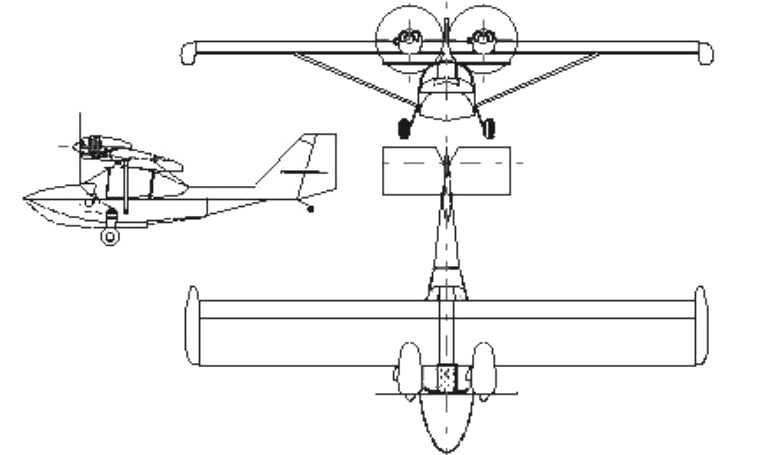
The single Boris Chernov Che-20 two-seat homebuilt prototype was tested 1989-1992.
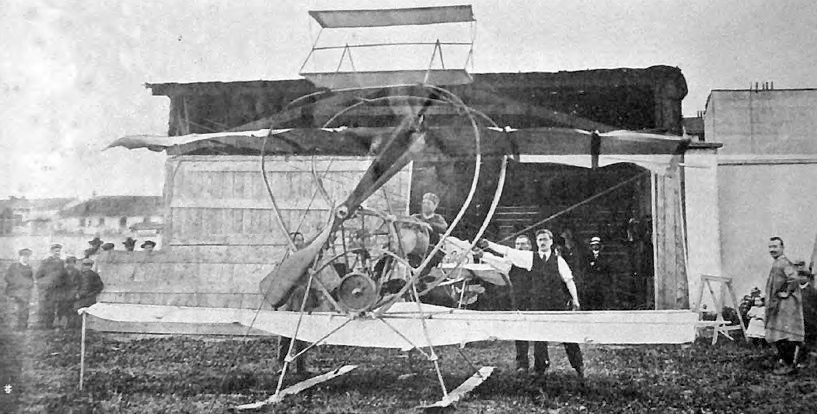
This plane was built by the Milanese, Italy, firm Gibus e C. and was tested privately in 1910. Not much is known about the machine, which was a tractor biplane with a circular strut arrangement between the wings and a very high-mounted front elevator. The propeller was driven via chain by a five-cylinder Gibus engine mounted on the lower wing.

