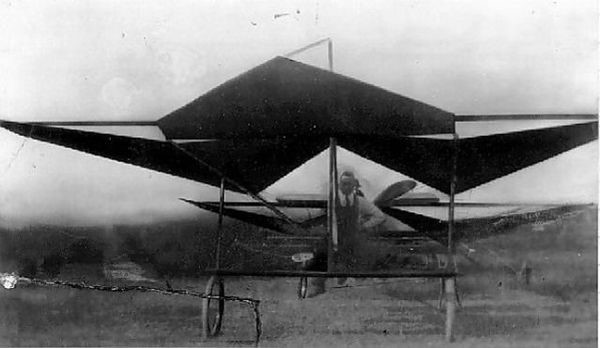
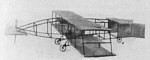
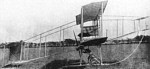
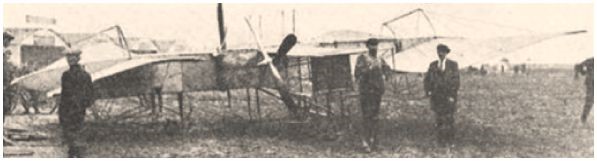
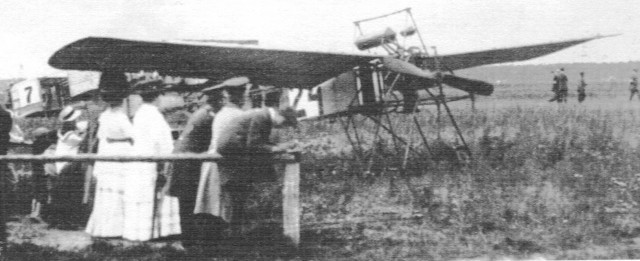
The Gibson Twinplane of 1910 was designed and constructed by Canadian merchant and businessman William Wallace Gibson, the “Balgonie Birdman”. The first heavier-than-air machine flown in western Canada (at Victoria, B.C.).
The first Canadian designed and built airplane, he also built his own engine
Following the crash of the Twinplane, Gibson resolved to build another aircraft. Although he used the same engine and some parts from the Twinplane, to pay for the new machine he had to sell his house.
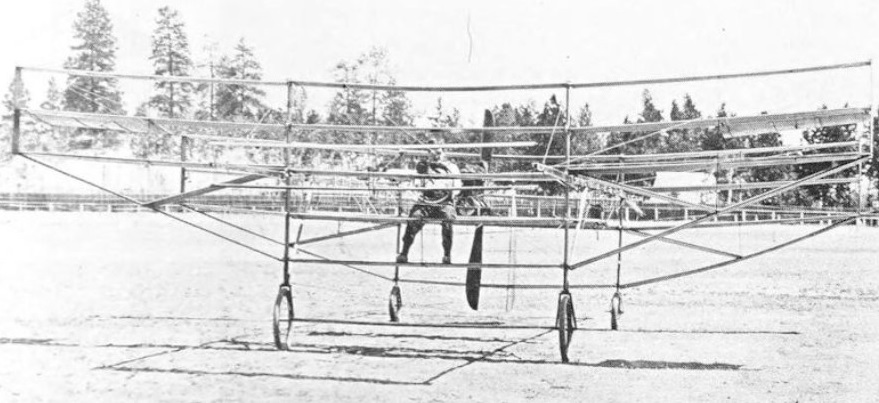
The new design retained much of his original concept and used the four-wheel undercarriage with the engine mounted approximately centrally between the wheels but this time driving a single pusher propeller.
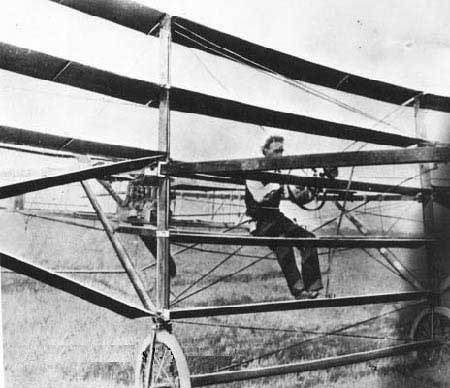
The design change was in the wings and control system. Gibson had read Sir Hiram S. Maxim’s Artificial and Natural Flight and became convinced of the value of high aspect ratio wings. So for the tandem monoplane wings of the Twinplane he substituted two sets of very narrow triplane wings (Gibson was quoted as saying ‘None of the lifting parts are over 12in (30cm) in width’), and the forward elevator was altered to a narrow-chord biplane structure. Ailerons were placed on the outer ends of the centre plane of the front set of wings. The pilot’s controls now consisted of foot pedals to operate the rudder, and a wheel to operate the ailerons when rotated and the elevators when moved fore and aft.
The Multi-plane was built at Ladner, near Victoria, on the ranch of British Columbia’s Lt-Governor Pattison, and $10,000 was reported to have been spent on its construction. It was shown at a Made-in-Canada Fair at Vancouver on 8-14 June, 1911. Its exhibition was the responsibility of Jack Woods who was associated with Gibson but whose role in the construction of the machine is not known. At the Fair, Gibson met Alexander M. Jaap of Forest, Ontario, and he joined Gibson in his experiments. The aircraft was then shipped to Kamloops, British Columbia, where it was exhibited again, and between the two exhibitions some modifications were made to the rear undercarriage.
The Multi-plane was then shipped to Calgary and taken by horse to Jack Hayes’ ranch about three miles north of the city. It was reported that, beginning early in July, the Multi-plane made a number of successful short flights, with Jaap at the controls as Gibson had promised his wife that he would not fly.
The most successful flight was the last on 11 August, 1911, and the Calgary Herald reported it as follows: ‘While attempting to make a landing from a height of over 100 feet in the air – Alex Jaap – crashed down into a swampy coulee – and narrowly escaped death. His machine was badly wrecked. Jaap, who had flown about a mile in a test flight, miscalculated the ground on which he proposed to descend, and when within 50 feet of the earth noticed that the turf was honeycombed with badger holes. He attempted to ascend – but it was tod late. His engine had stopped and refused to start again. His only chance – was to drop obliquely into the swampy ground of a nearby coulee. When the machine swooped down into the soft soil the wheels stuck in the mud and the terrific momentum literally tore the aeroplane to pieces. Had it not been for the unusual construction of the machine the motor would have fallen upon him [Jaap] and crushed his life out. As it was he escaped with a few bruises.’
After the accident Gibson announced that he would ‘rebuild my machine with pressed steel plates’ which he was going to have made in Toronto. It was also reported that when rebuilt it would be flown by P. Julien Chatel, a Calgary man who was stated to have worked with Louis Bleriot in France. The machine was never rebuilt. Thanks to the efforts of the well-known Canadian aviation historian, the late Frank H. Ellis, the Gibson engine, Canada’s first aviation engine, was located and is now in the National Aeronautical Collection at Ottawa.
Engine: One 40 hp Gibson. Empty weight: 700 lb (318 kg).
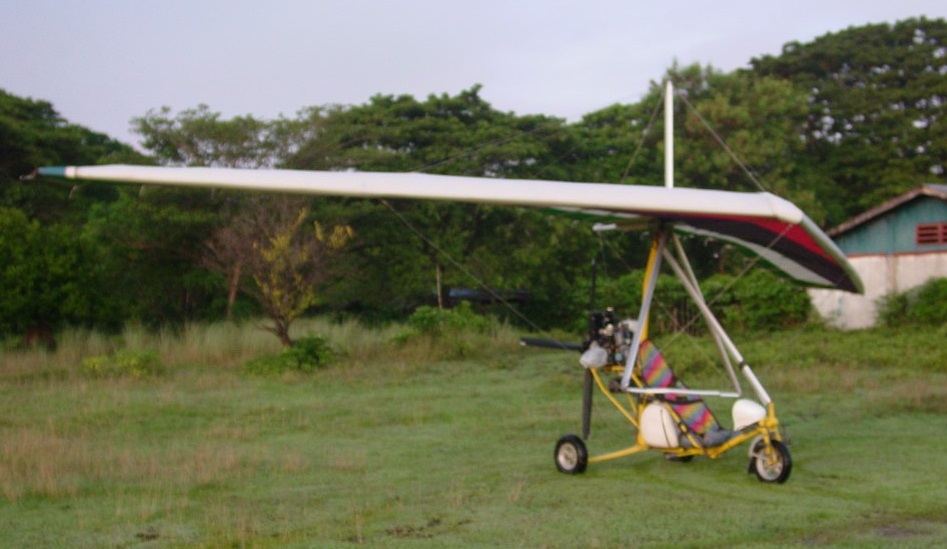
The aircraft was designed by Mark Gibson and produced by his company, GibboGear of Winter Haven, Florida, for the Fédération Aéronautique Internationale microlight class, with the intention of reversing the trend of its period of trikes becoming heavier, more expensive, stall faster, be harder to fly and thus require more flight training. The Butterfly addresses these issues by being a simple design and by employing a single surface wing with a large 240 sq ft (22 m2) area. Similarly the carriage is simple and lacks options, to reduce cost and weight. The resulting aircraft has a low landing speed of 20 mph (32 km/h) at the cost of a low cruise speed of 25 mph (40 km/h).
The Butterfly features a cable-braced hang glider-style high-wing, weight-shift controls, a single-seat, open cockpit, tricycle landing gear and a single engine in pusher configuration. The aircraft’s single surface wing is made from bolted-together aluminum tubing, covered in Dacron sailcloth. The wing is supported by a single tube-type kingpost and uses an “A” frame control bar. When the aircraft was in production the wing was also available from the factory as a kit, as well as fully assembled. The landing gear uses tubular suspension and the nose wheel is steerable. The engines that were factory-supplied included the twin-cylinder, two-stroke air-cooled 40 hp (30 kW) Rotax 447 and 50 hp (37 kW) Rotax 503.
The aircraft was supplied as a kit for amateur construction at a 2000 price of US$10,000 but buy 2017 was out of production.
Engine: 1 × Rotax 447, 40 hp (30 kW) Wingspan: 32 ft 10 in (10 m) Wing area: 240 sq ft (22 sq.m) Empty weight: 290 lb (132 kg) Gross weight: 660 lb (299 kg) Fuel capacity: 10 U.S. gallons (38 L; 8.3 imp gal) Cruise speed: 25 mph (40 km/h; 22 kn) Stall speed: 19 mph (31 km/h; 17 kn) Rate of climb: 750 ft/min (3.8 m/s) Crew: one
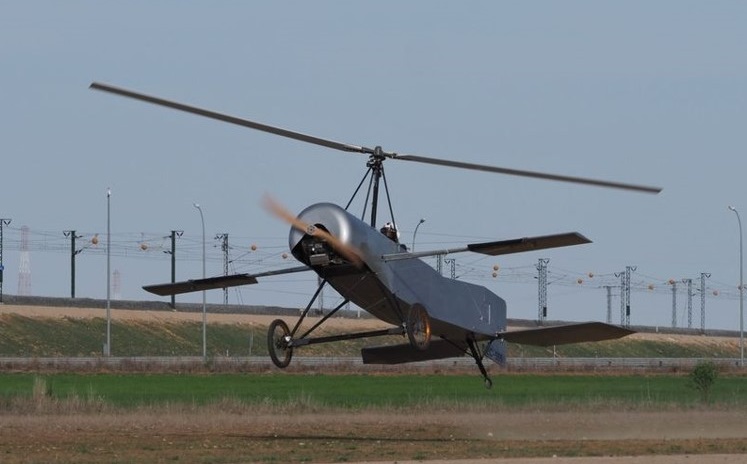
The project is the result of a decision by a group of friends at the Getafe Ultralight Club to commemorate the centenary of Juan de la Cierva’s historic first flight in his C.4 during January 1923. Following more than a thousand hours of design and fabrication work, the replica C.4 was ready for its official unveiling in January at Getafe Air Base, not far from the very spot where the original had first taken flight a hundred years earlier. The public unveiling took place at Camarenilla aerodrome March 2013, but the team chose to move the aircraft to Ocaña for its first flight. They disassembled the replica C.4 in the morning, driving it to the historic Ocaña Aerodrome by truck and then reassembling it.
Initial ground tests without the (unpowered) main rotor fitted, were carried out to check the engine operation and to test the aircraft in high-speed taxiing. After the crew fitted the rotor, a test run took place just a little after 6:00 p.m. local time. Pilot Fernando Roselló began the taxi run – but the autogiro lifted off briefly and then landed gently.
After this small jump, other takeoffs followed, until, finally, the Cierva took off and completed a couple of full circuits. Nerves, illusion and adrenaline were rewarded by seeing the autogyro take off from the ground without incident and land again successfully.
This particular early model does not having direct control through the inclination of the rotor hub, but rather still retains roll and elevator control with ailerons and rudder. While the replica C.4 stays true to much of the original design concept, the replica team chose to include some safety concessions, such as a modern engine and a well-proven, two-bladed rotor design (in place of the original four-bladed system which had only a marginal useful life of just a few hours flight time). One of the team engineers added that the rotor system, as it is without direct control, is based on Cierva’s patent, number 100595 of Dec 1926.
After alighting, Fernando Roselló stated that the aircraft behaved just as he had expected. It is a very stable aircraft, but since it lacks direct control (using aerodynamic control instead) it is slower to respond to control input. He flew as slowly as 50km/h and estimated a cruise of about 80km/h at about 4,500rpm, comparing it to 4,700rpm on his 80HP Rotax powered 912 gyroplane which flew at 80km/h with a positive variometer (rate of climb indicator).
Engineer Alfred Marcel Joachimczyk in 1910, at the Deutsche Flugmaschinenbau Gesellschaft at Berlin-Rummelsberg, designed the “Maikäfer” (“Beetle”), with the construction being completed in the spring of 1911. After several trials and errors, the craft finally flew for 19 minutes, but was seriously damaged in a later flight. The Beetle was a two-seat aircraft with wings in a tandem arrangement, constructed of wood, steel tubes, and canvas. The landing gear consisted of wide wheels, a tail wheel, skids, and at the front of the hull were additional runners. The engine drove two pusher, counter-rotating propellers.
Designed by Willi Schultze-Herfort and built in Rummelsberg, near Berlin, by Deutsche Flugmaschinenbau Gesellschaft (D.F.G) in 1910 the Argus-powered monoplane as flown by Alfred Behrend at the 1. Internationale Flugwoche, 10-16 May 1910 in Johannisthal.