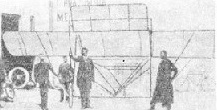
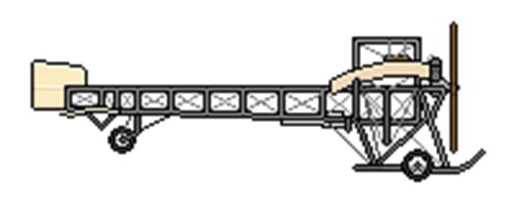
Gold 1910 airplane

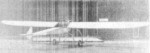
Gold’s plane before the Lviv workshop in 1910

An airplane designed by Willibald Gold in Lviv. It was built by the Lviv Mechanical Laboratory of Witold Tranda.

The unfinished construction was exhibited at the First Lviv Exposition in Lviv. In the end, the construction of the aircraft was not finished and as a result no attempts were made to take off.

The Gold plane was in the high-wing brace system. Truss hull with wire strainers. Single surface wing covered with canvas.

Wingspan: 6.75 m
Length: 8.0 m
Wing area: 10.5 sq m
Empty weight: 110 kg
Gross weight: 190 kg

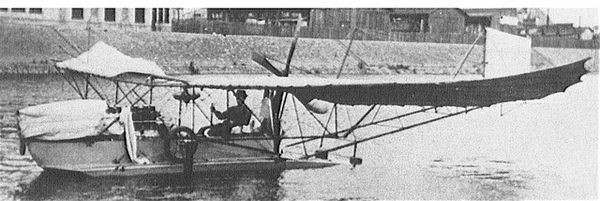
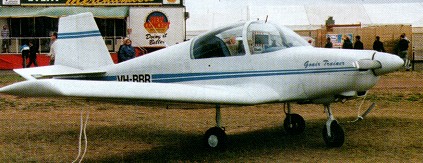
Goedecker Amphibium

The second Amphibium, or “Amphibium II”, constructed by the Jacob Goedecker Flugmaschinen-Werke in 1912. At the end of August 1912 Goedecker flyer Bernard de Waal took the newly developed “Amphibium” to the First German Seaplane Competition in Heiligendamm district. Due to technical problems the Goedecker flying boat achieved only 4th place in a field of 6 participants. A second flying boat with a more powerful engine was built and tested at the Mainzer Floßhafen, and stationed in a boathouse. In a strong storm on April 6, 1913, the “Amphibium II” was severely damaged and scrapped.

Gluhareff MEG-3X

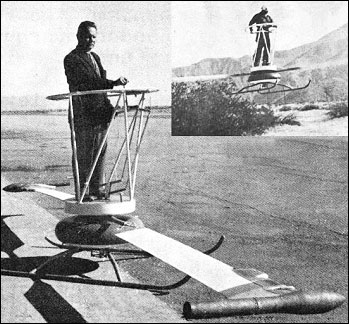
Mr. Gluhareff pioneered the use of liquid propane as a fuel for jet engines and a series of ultra-light portable one-man-helicopters, MEG-1X, MEG-2X and MEG-3X which were designed and built by his own company, Gluhareff Helicopters Corporation. All of which were powered by the G8-2 Pressure Jet Engine on the blade tip and test flown by Eugene M. Gluhareff.
Eugene Gluhareffs tip-mounted G8-2 engine MEG-3X was based on a dish-shaped platform on which the pilot would stand and a two-blade rotor revolving underneath the platform. No commercial development was undertaken.

Główny Instytut Lotnictwa GIL-4 / BŻ-4 Żuk

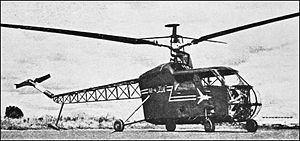
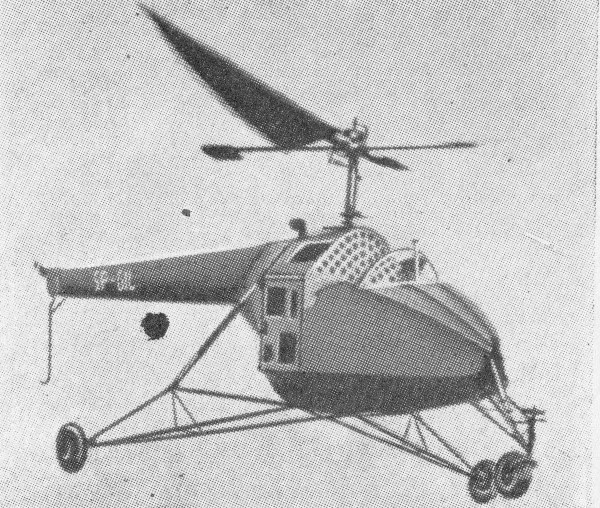
Work on the BŻ-4 Żuk began at the research institute Główny Instytut Lotnictwa – Main Aviation Institute in Warsaw in 1953, under the leadership of Dipl. Ing. Bronisław Żurakowski, who had earlier designed the experimental BŻ-1 GIL helicopter. Due to the delicate political situation in postwar Poland (Soviet influences and centrally planned economy), progress was slow. The main object was to produce a simple and inexpensive general use light helicopter. Its purpose was also to develop and test the novel rotor and transmission system, which eliminates vibration and improves control. Initially it was designated GIL-4.
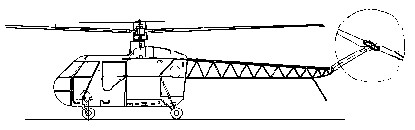
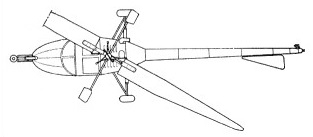
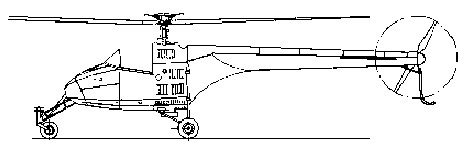
The BŻ-4 Żuk was based on a single main three-blade rotor powered by an indigenous one 320 hp Narkiewicz WN-4 piston engine in a fuselage made of a steel frame, behind a cabin section. It had an open frame rear boom structure and a fixed four-wheel undercarriage. Main rotor was atypical, for it had a smaller upper steering rotor and was fitted with an automatic stabilization system, of the Hiller principle. The cabin had four doors with two front seats and a rear bench. There were two fuel tanks, 220 litre in total.
Four main variants were planned: a passenger version accommodating a pilot and three passengers, an ambulance variant carrying pilot, one stretchers and an attendant, an agricultural variant carrying pilot and spraying or dusting equipment and a dual control trainer.
The first prototype of the BŻ-4 Żuk four-seat helicopter was manufactured and displayed publicly in the Polish Aviation Day Exhibition in August 1956. Due to a long program of ground testing and fixing faults, it flew first only on 10 February 1959 and completed 17 flights for a total of 3 hrs, 40 minutes. The Żuk was still in the development stage when further work was cancelled in favor of the licence production of the Mil Mi-1, that had already started in WSK PZL-Świdnik. The prototype was damaged during landing on 31 August 1959, and despite being repaired, it was not used again. Two additional prototypes were not completed.
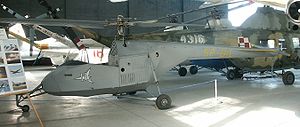
One damaged and incomplete prototype is preserved in the Polish Aviation Museum in Kraków.

Powerplant: 1× Narkiewicz WN-4 7-cylinder air cooled radial engine, 320 shp (237 kW)
Fuselage length: 10.55 m
Rotor diameter: 12 m (39 ft 4.5 in)
Height: 2.8 m
Empty weight: 1,050 kg (2,313 lb)
Loaded weight: 1,500 kg (3,307 lb)
Useful load: 450 kg
Maximum speed: 156 km/h (97 mph)
Range: 260 km (161 miles)
Service ceiling: 3000 m
Rate of climb: 4.6 m/s, 276 m/min
Crew: one, pilot
Capacity: three passengers

Główny Instytut Lotnictwa BŻ-1

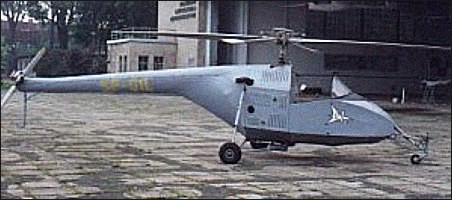
The BŻ-1 was designed at the research institute Główny Instytut Lotnictwa – Main Aviation Institute in Warsaw, from an initiative of Zbigniew Brzoska. The Polish aviation industry was destroyed after World War II, and in addition, the principal of the Institute was the only person who had seen a helicopter (Sikorsky R-4 in England).
Despite severe material shortages, work on the experimental design started in 1948, and the main designer became Bronisław Żurakowski (brother of test pilot Janusz Żurakowski), who designed the helicopter rotor and the control system. It used simpler Hiller rotor type, with two auxiliary blades. The structure of the fuselage, tail boom, auxiliary rotor and tricycle undercarriage were designed by Tadeusz Chyliński. The power unit and final drive were designed by Zbigniew Brzoska. The design utilized some components left by the Germans, like a piston engine Hirth HM 504 (configured for vertical use) and wheels from a glider’s landing gear.
Initially, the helicopter had no name. It only received the registration SP-GIL, from the Institute abbreviation, and soon it became known as GIL (gil also means bullfinch in Polish). Later it was also given the designation BŻ-1, from Żurakowski’s initials.
The helicopter was completed by the end of 1949. During the first flight trial on 15 January 1950, it was overturned by a wind gust and had to be repaired. The test pilot was Bronisław Żurakowski, who taught himself fly a helicopter. The helicopter first flew on 4 April 1950, restrained on tethers by two men for a measure of safety.
During 1950-1953, it underwent a test program and was often modified. At first it had elastic rotor blades. In 1950, it was fitted with rigid blades and an efficient simple custom designed resonant vibration eliminator. During tests, for different reasons, it crashed or was damaged without casualties, at least seven times and was repaired each time.

On 20 July 1952, the BŻ-1 GIL was first displayed to the public, during an air show at Okęcie airfield (it was one of first public helicopter presentations in the Eastern Bloc). On 16 November 1953 the helicopter was damaged when the main rotor was bent by the wind and cut off the rear pylon, thus ending the test program. By then, the prototype had completed 169 flights, 20 hours 21 minutes in total.

In 1956, the helicopter was repaired and used for training flights by helicopter pilots. On 28 June 1957, a tail rotor gear (originally from a World war II Zündapp motorcycle) broke and it could not be replaced, consequently, the helicopter never flew again, being written off in 1960. During 1956–1957 it had completed 185 flights, for a total of 12.5 hours.
Currently, the sole BŻ-1 GIL prototype is preserved in the Polish Aviation Museum in Kraków.

Powerplant: 1× Hirth HM 504, 105 hp
Length: 8.5 m
Rotor diameter: 8.8 m / 28 ft. 11 in
Rotors: 2-blade main; 2-blade tail
Height: 2.29 m
Disc area: 60.8 sq.m
Empty weight: 380 kg
Loaded weight: 610 kg / 1,276 lb
Maximum speed: 140 km/h / 87 m.p.h
Cruise speed: 120 kph
Service ceiling: 2000 m
Absolute ceiling: 3000m / 9,840 ft
Range: 275km / 112 miles at 73 m.p.h.
Rate of climb: 4.5 m/s
Seats: 2

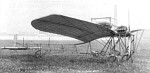
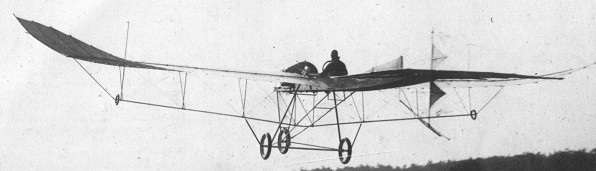
Głowiński 1911 monoplane

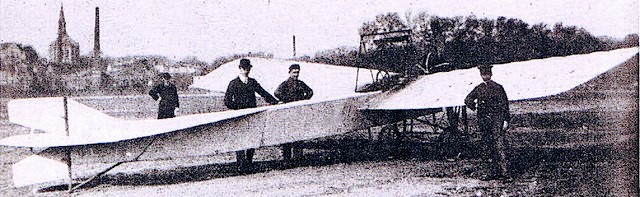
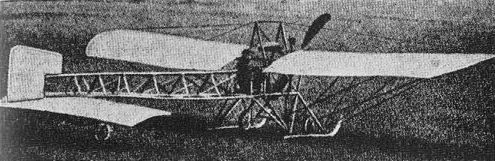
In May 1911, the Lwow press informed its readers about a successful flying demonstration of Glowinski’s monoplane. The machine, designed by Bronislaw Glowinski in 1910 and constructed and flown by him in Tarnopol, should therefore be regarded as the first Polish aeroplane to achieve a controlled and sustained flight in Poland.

Construction: Giowiriski’s aircraft was a single-seat braced monoplane of composite construction. The wing, a two-spar wooden structure of double-surfaced type covered with fabric, was built in two sections. Each wing panel, carried immediately above the main fuselage frame on an inverted twin-V cabane, was attached to the base of the cabane and braced to its top by wires, and to a low cabane under the second fuselage frame and the landing-gear framework. To maintain lateral stability wing warping was employed. The fuselage, an open brass-welded metal-tube structure trussed by wires, was of rectangular section forward and triangular section aft, terminating in a vertical knife-edge at the tail. The landing-gear frame and all supporting cabanes were built of metal tubes integral with the fuselage. The pilot’s seat was situated at the rear of the rectangular fuselage section. The control system consisted of a conventional control stick and rudder bar, the controls being by cable, except for the elevator system which was by push-rod to the back of the rectangular fuselage section and thence by cable. The tail unit, a wooden structure covered with fabric, consisted of a rudder, a tailplane and Bleriot-type full-chord elevators, the tailplane being wire-braced to the fuselage top longerons and supported by a cabane under the rear end of the fuselage. The landing gear, of neat design, comprised two outwardly-splayed side Ns, supported by a pair of struts and coupled by two transverse tubes. A pair of long wooden skids was attached to this framework. A cross-axle, carrying two wheels, was attached by rubber shock-absorber cords to the skids. The tailwheel fork was provided with a spring shock-absorber. Power was supplied by the 25 hp Anzani three-cylinder air-cooled semi-radial engine directly driving a two-blade tractor airscrew. The fuel tank was attached to the wing-carrying cabane. The monoplane had a span of 10.2 m (33 ft 6 in).

The plane was built in 1910-11 in Tarnopol. Kostruktor Bronisław Głowiński modelled himself during the construction on the construction of the Bleriot XI “La Manche” aircraft.

The assembly of the aircraft was carried out in the constructor’s brother’s workshop, in a shed serving as a carpentry workshop and as a room for the final assembly of the aircraft.

Modelled to a certain extent on the lines of Bleriot Type No. XI, but embodying several original and imaginative features, the machine made a number of short flights over an improvised airfield near Tarnopol in the late spring and summer of 1911. Unfortunately, the designer was unable to obtain the required materials and was forced to use heavier substitutes. This increased the weight of the airframe beyond the anticipated figure, and a weary Anzani engine, overhauled and modified by Glowinski, did not provide the desired power and reliability. As a result the monoplane was rather underpowered and this, combined with frequent breakdowns on the part of the capricious powerplant, severely limited its capabilities and performance and prevented Glowinski from attempting any flights beyond the area of the improvised landing field. His ambition to undertake prize flights in Lwow was never realized.

The condition of the engine deteriorated quickly and some of the parts soon became worn beyond repair. The designer could not afford another engine, and, as the expected help from ZASPL never materialized, he dismantled his machine towards the end of 1911 and had to abandon flying altogether. Later, for a time, he attended the Lwow Technical University, and the forward section of his aircraft was displayed at the Second Aviation Exhibition in Lwow, which opened on 16 February, 1913. Unable to overcome financial difficulties and disenchanted with the unfulfilled promises of support from aviation organizations, he eventually left Poland before the 1914-18 War to work on the construction of railway lines in Asia, but came back after the end of hostilities. Parts of his monoplane, stored in various places, survived until the 1939-45 War.

Powerplant: 1 × Anzani 3-cylinder fan, 19 kW (25 hp)
Wingspan: 10.20 m (33 ft 6 in)
Wing area: 18.5 m2 (200 sq ft)
Length: 8.00 m (26 ft 3 in)
Height: 2.5 m (8 ft 2 in)
Empty weight: 320 kg (700 lb)
Gross weight: 400 kg (880 lb)
Maximum speed: 60 km/h (40 mph, 35 kn)
Range: 25 km (15 mi, 13 nmi)
Crew: One pilot