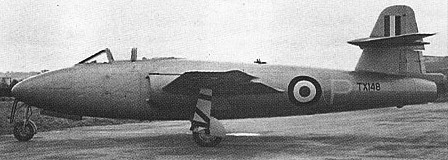
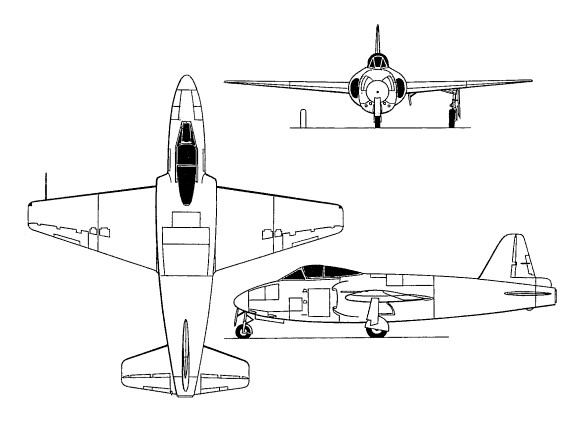
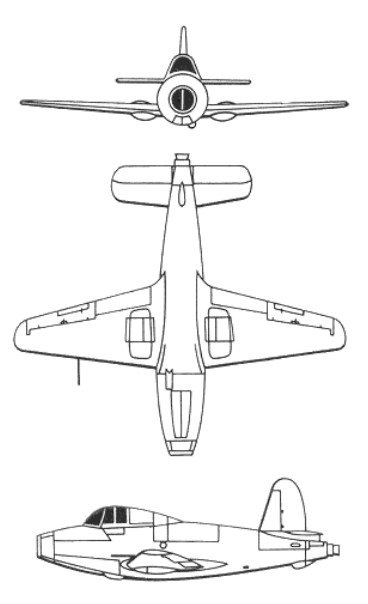
Late in 1944, Gloster began construction of an all-metal single-seat fighter designed around the RB.41 centrifugal-flow turbojet being developed by Rolls-Royce and to emerge as the Nene. To the requirements of Specification E.1/44, the first prototype was completed in July 1947, but suffered irreparable damage when the vehicle transporting it to the A&AEE was involved in an accident. A second prototype was completed and flown on 9 March 1948, this being powered by a 2268kg Nene 2 turbojet and having provision for four 20mm Hispano cannon. After initial flight testing the tail assembly was redesigned to improve handling. A third prototype was flown in 1949, and a fourth was nearing completion when it was decided that the single-engined fighter lacked the development potential of the twin-engined Meteor, further work being discontinued.
Max take-off weight: 5203 kg / 11471 lb Empty weight: 3747 kg / 8261 lb Wingspan: 10.97 m / 35 ft 12 in Length: 11.58 m / 37 ft 12 in Height: 3.55 m / 11 ft 8 in Wing area: 23.60 sq.m / 254.03 sq ft Max. speed: 998 km/h / 620 mph
In January 1930, Frank Whittle filed his first patent for the gas turbine engine. On April 12, 1937, the first Whittle engine, the Power Jets U.(1), ran on the test bench. In March 1938 the Air Ministry issued a contract for a single engine and on 3 February 1940 awarded Gloster a contract to produce the necessary airframe and further develop the aircraft under the specification E.28/39. Although the contract was seen as representing the operational requirements of a high-altitude interceptor, this aspect was not stressed, the main concern being to give special attention to the many new features associated with the installation of the turbojet engine.
The aircraft was designed by George Carter, Gloster’s chief designer, and building of the aircraft began in great secrecy at Hucclecote but was soon moved to Regent Motors in Cheltenham as it was considered more secure. While the aircraft was being built its first engine the W1X was also under construction for use in the first taxi trials.
On the 7th April, 1941 W4041 the first E28/39 was moved to Hucclecote for taxi trials complete with a fake wooden propellor on the nose to disguise its uniqueness. The trials were successful with several hops being achieved of 100 – 200 yards even though the grass surface was not an ideal. Following these tests the aircraft was moved to RAF Cranwell for the fitting of the W1 flight engine, much lighter and constructed of higher quality materials to withstand prolonged operation.
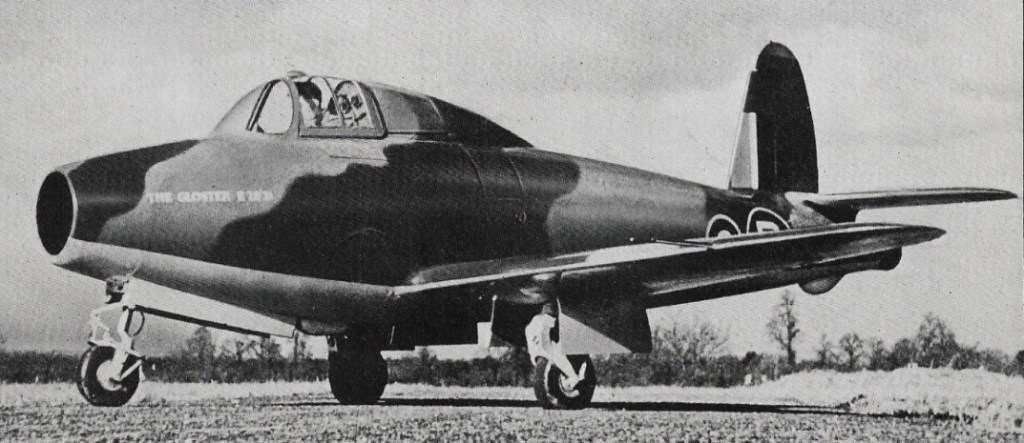
The E.29/39 was a cantilever low-wing monoplane of all-metal construction with the single engine located in the fuselage aft of the pilot’s cockpit. Air that passed through the nose orifice was channelled to pass each side of the cockpit to the engine.
The tricycle undercarriage built specially by Dowty was chosen by Carter to overcome potential problems raising the tail had the aircraft been fitted with a conventional undercarriage layout. They also decided to mount the engine in the middle of the aircraft behind the pilot with the jet pipe protruding from the back of the fuselage and fed from a bifurcated duct in the nose of the aircraft.
The first official flight took place with a 390-kg (860-lb) thrust W.1 engine from Cranwell on the evening of the 15th May 1941 as the weather earlier in the day was unsuitable. The pilot P.E.G Sayer took off after a ground run of about 600 yards after running the engine up to its maxium of 16,500 rpm. After he landed 17 minutes later he reported that he had found the aircraft to be incredibly quiet, vibration free and easy to control. Sayer flew the aircraft for a further 10 hours in the next 13 days at speeds of up to 370mph without any need to remove the engine covers including one flight of almost an hour with its maximum fuel load of 81 gallons and on another flight reached 25,000 feet. Subsequent development saw modifications made to the engine and airframe.
On 4 February 1942 the aircraft was flown with a 526-kg (1,160lb) thrust W.1A; on 30 July 1942, while flying with a 692-kg (1,526-1b) thrust Rover W.2B engine, the aircraft entered an inverted spin with jammed ailerons, forcing the RAE pilot to bale out.
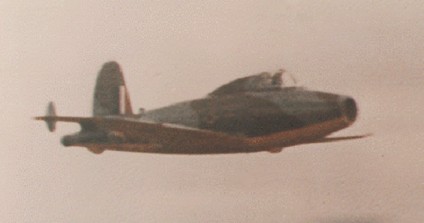
In May 1943 W4041 was joined by W4046 fitted with the 771-kg (1,700-lb) thrust Power Jets W.2/500 turbojet, later boosted to 798kg (1,760-lb) thrust. This second aircraft though had a short life as it had to be abandoned in flight by Sqn Ldr Douglas Davie when the ailerons jammed at high altitude which gave him the distinction of being the first pilot to bail out of a jet aircraft in Britain, it crashed near Bramley in Surrey. W4041 remained at Farnborough and was involved in numerous tests culminating in the fitting of the Powerjets W500 engine which required stablizing fins to improve directional control. When W4041 was finally retired it was sent to the Science Museum in Kensington where it is displayed to this day.
Engine: Power Jets W-1 turbojet, 860 lb (390 kg) thrust. Span: 29ft (8.84m) Length: 25ft 3.75in (7.72m) Height: 2.7 m / 8 ft 10 in Maximum speed: 338 mph (544 km/h) Max take-off weight: 2170 kg / 4784 lb Empty weight: 1700 kg / 3748 lb Max. speed: 370 km/h / 230 mph Ceiling: 10030 m / 32900 ft Range w/max.fuel: 660 km / 410 miles Crew: 1
Engine: Power Jets W-1A turbojet. Max speed: 466 mph @ 42,000 ft.
Engine: one 798-kg (1,760-1b) thrust Power Jets W.2/500 turbojet Max speed: 750 km/h (466 mph) at 3050 m (10.000 ft) Service ceiling: 9753 m (32,000 ft) Empty weight: 1309 kg (2,886 lb) Maximum take-off weight: 1700 kg (3,748 lb) Wingspan: 8.84 m (29 ft 0 in) Length: 7.72 m (25 ft 3.75 in) Height: 2.82 m (9 ft 3 in) Wing area: 13.61 sq.m (146.5 sq ft) Armament: none Seats: 1
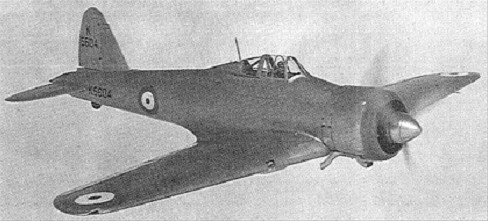
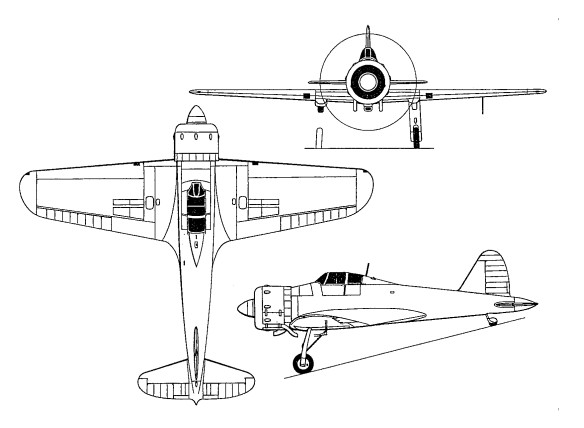
In 1935, to meet Air Ministry Specification F5/34, calling for a single seat monoplane interceptor armed with six or eight machine guns, a retractable undercarriage was required and an enclosed cockpit; a speed of at least 275mph (442kph) at 15,000ft (4,572m) was stipulated. This requirement was taken up by a number of firms. Bristol produced the Type 146 (835hp/622kW Bristol Perseus). Vickers brought their Jockey Mk II into approximate line with the requirements as the Venom (625hp/466kW Bristol Aquila). Henry Folland produced his last design for Gloster, the G.38 (840hp/626kW Bristol Mercury IX). None of the aircraft built to this specification achieved production status but ultimately produced the Hurricane and the Spitfire. The single-seat all-metal cantilever monoplane was powered by an 840hp Mercury IX nine-cylinder radial engine and carried an armament of eight 7.7mm Browning guns. This aircraft suffered a protracted development owing to the company’s preoccupation with the Gladiator. The first of two prototypes did not commence flight trials until December 1937, with the second following in March 1938. By the time that the Gloster fighter made its debut, the Hurricane had entered service and the Spitfire had reached production, and further development of the Mercury-engined monoplane was not pursued.
Engine: Bristol Mercury IX, 840hp/626kW Max take-off weight: 2449 kg / 5399 lb Empty weight: 1900 kg / 4189 lb Wingspan: 11.63 m / 38 ft 2 in Length: 9.76 m / 32 ft 0 in Height: 3.09 m / 10 ft 2 in Wing area: 21.36 sq.m / 229.92 sq ft Max. speed: 508 km/h / 316 mph
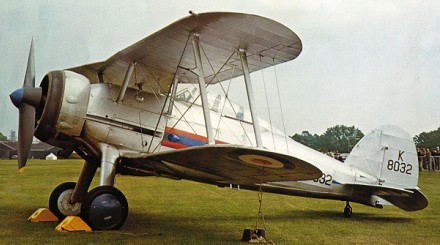
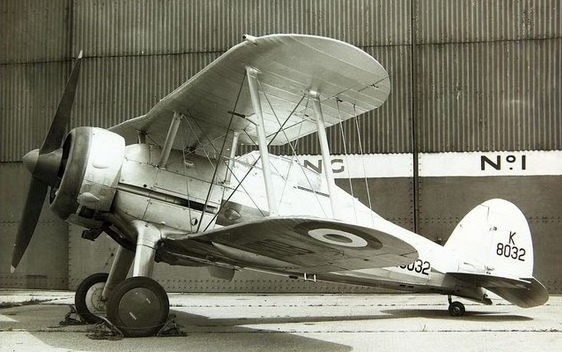
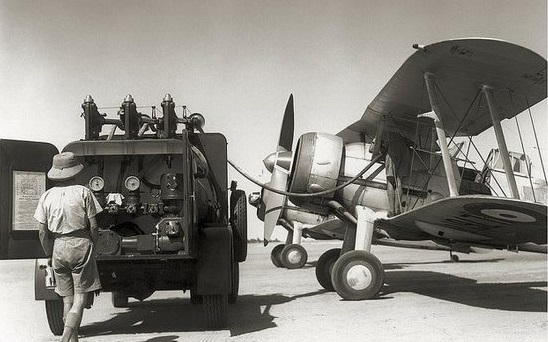
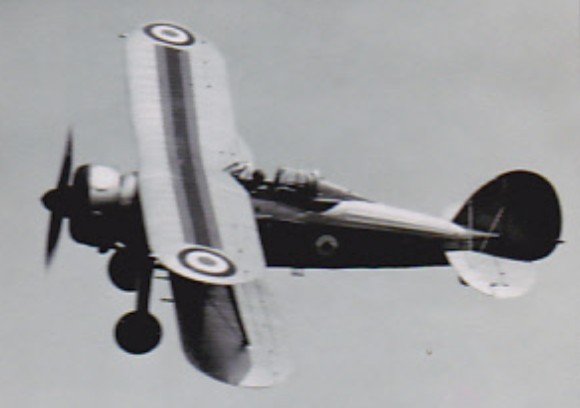
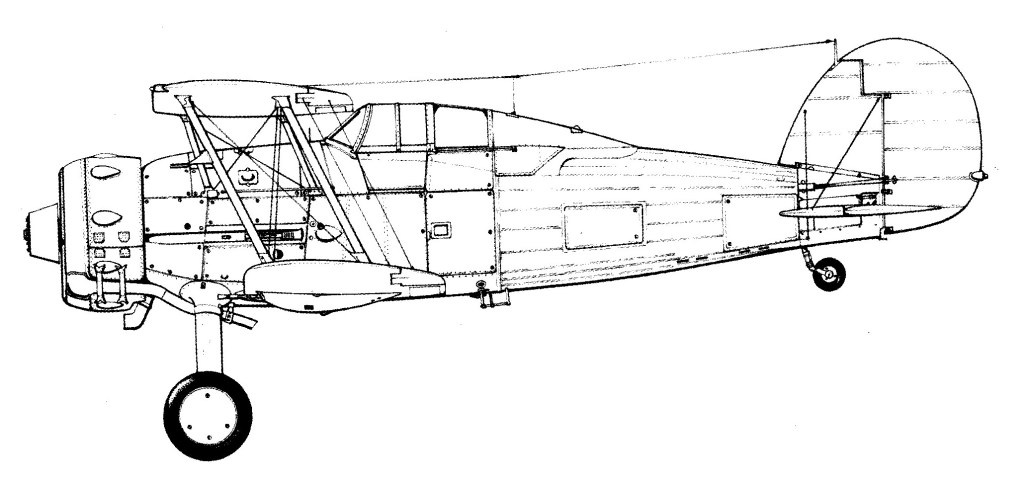
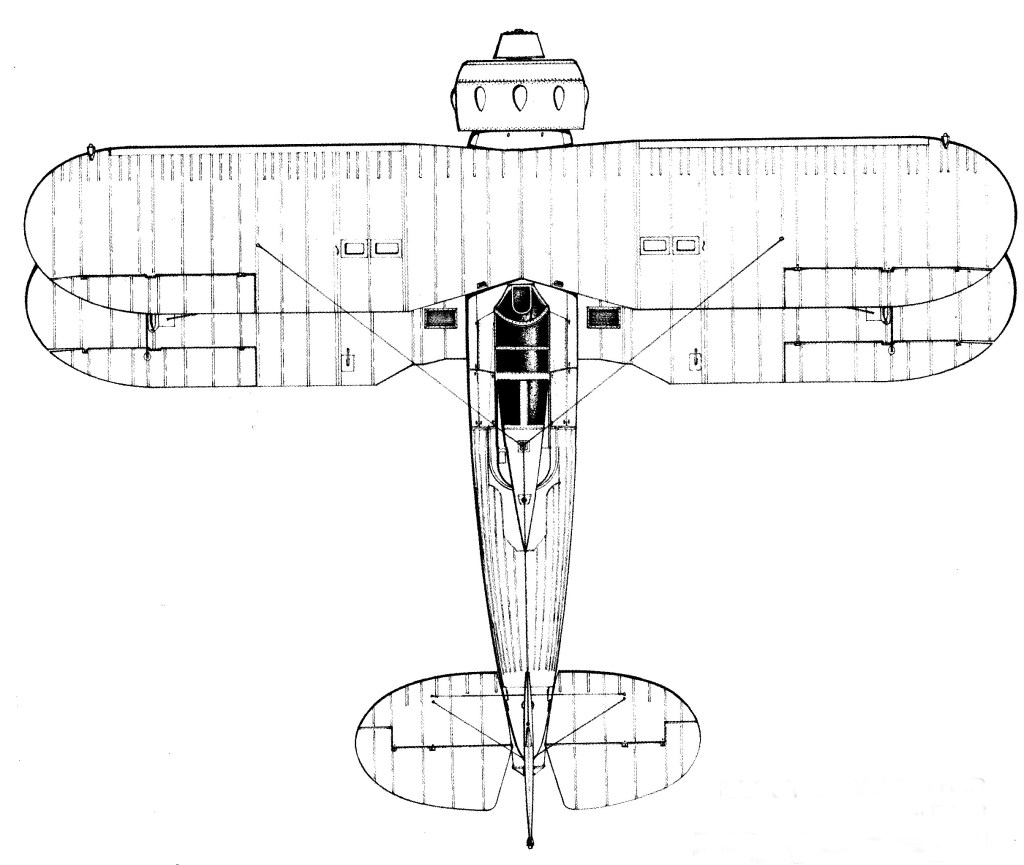
An improved version of the high-performance Gauntlet, in the Gloster SS.37Gladiator H. P. Folland endeavoured to satisfy the requirement of the Air Ministry’s F.7/30 specification which the Gauntlet had failed to meet. However the Gauntlet’s maximum speed was some 32km/h below the F.7/30 requirement, which also called for an offensive armament of four machine-guns. The Gauntlet represented a close approach to the requirement and Folland decided that aerodynamic improvements of the basic Gauntlet fuselage (together with installation of a more powerful engine) should prove adequate for the Gloster design to be ordered into production. It had been intimated by the Air Ministry that submissions for the F.7/30 requirement which were powered by the new Rolls-Royce Goshawk evaporative-cooled engine would receive favourable consideration. This meant that of the seven other contenders for this contract, five were designed to utilise the Goshawk. When this engine failed, it eliminated most of Gloster’s competitors. Folland pinned his hopes on the Bristol Mercury ME.30 radial which was then promising a power output of some 521.6kW. But it was not available when the prototype SS.37 was nearing completion and the first flight, on 12 September 1934, was made with an 840 hp / 395kW Mercury IV. The prototype Gladiator had an open cockpit, no gyro instruments and only 645 hp; the production airplane had a greenhouse that you closed by winding it forward by means of a bicycle chain and sprocket arrangement.
Features included each of the four planes having small hydraulically depressed drag flaps and cantilever landing gear with Dowty internally sprung wheels. Most early production had the Watts wooden propeller, though performance was better with the three-blade metal Fairey-Reed type.
On 1 July 1935 the Air Ministry ordered 23 aircraft in July 1935, as Gladiators, one going to Greece. These were powered by the 618.5kW Bristol Mercury IX. Other improvements included an enclosed cockpit with a sliding canopy and a redesigned tail unit.
It introduced refinements such as wing flaps and cantilever undercarriage which enabled it to combine a top speed of 253 mph but the maximum speed, between 174 and 217 knots, was slower than those of the newest bombers. The armament was four .303 Browning machine guns (two, engine synchro¬nized, in cutaways in the fuselage sides, and two in blisters under the lower wings) was inadequate. Metal structure, fab¬ric covered, no armor plate, no self-¬seal around the fuel tanks and no proper fire wall behind the engine.
It first entered service with Nos. 3 and 72 Squadrons in January 1937 as a replacement for the Bulldog. The early Gladiator I were followed by an improved Gladiator II in 1938 powered by the Bristol Mercury VIIIA engine. Other improvements comprised the addition of a battery and electric starter and the inclusion of a full blind-flying instrument panel.
Production also included 60 Sea Gladiators for the FAA. Generally similar to the Gladiator II, they differed by being equipped for catapult launch and deck landing – although not intended for operational use from carriers – and carried an inflatable dinghy in a fairing beneath the lower wing centre-section.
When World War II began, in 1939, the RAF still had 13 Gladiator squad¬rons; one home squadron was still fly¬ing them when the Battle of Britain started in 1940. Production of the type finished that year, but two squadrons went to France with the Advanced Air Striking Force in 1939.
In just ten days of hard fighting, following the opening of the German assault on 10 May 1940, all the aircraft had been lost. In a desperate attempt to provide fighter cover for the ‘little ships’ involved in the Dunkirk evacuation a detachment of home based aircraft, known as ‘G’ Flight, was formed at RAF Manston in late May. One squadron (No. 247) served during the Battle of Britain. In Norway during April, May and June the Gladiator, flown by Pilots of No. 263 Squadron from a frozen lake, offered opposition to the Luftwaffe forces supporting the German invasion of that country, fighting on until all its aircraft had been destroyed in the air or on the ground. Only two home based units used the Gladiator operationally during the Battle of Britain; No.247 Squadron at RAF Exeter and RAF Roborough and No.804 Squadron, Fleet Air Arm at stations in Scotland. A flight of four Sea Gladiators, flown by RAF pilots, defended Malta with such success that the Maltese named three of them Faith, Hope and Charity and, after the war, preserved one as a reminder.
The last biplane fighter to serve with the RAF and Royal Navy, of the total 747 Gladiators which were built, almost 30% were exported, serving with the armed forces of Belgium, China, Finland, Greece, Iraq, Irish Republic, Latvia, Lithuania, Portugal, Norway and Sweden. In addition some aircraft transferred from the RAF operated with Egyptian and South African forces.
After the Russian invasion of Finland in 1940, slowly reinforcements began to arrive for the Finnish air force. The first to come were 5 Gloster Gladiators, 12 Hurricanes, 17 Lysanders and 24 Blenheims, all from Britain. After that, 76 Morane-Saulnier and Koolhoven F.K. fighters arrived from France. Italy sent 17 Fiat fighters, Sweden 12 Gloster Gladiators, and the USA 44 Brewster Buffalo, of which however only 5 reached Finland in time. Even the Union of South Africa sent 25 Gloster Gladiators. Pilots and ground personnel from a number of countries also volunteered to assist them.
At the peak of its deployment the Gladiator was flown by 29 home and 11 overseas squadrons and many remained in RAF service until early 1945.
Total production amounted to at least 767, including 480 for the RAF, 60 Sea Gladiators and 216 exported to 12 countries. The last delivered in May 1940.
Latvia model
Users were Belgium, China, Egypt, Finland, Greece, Iraq, Ireland, Latvia, Lithuania, Norway, Portugal, South Africa, Sweden, and the RAF and RN.
Gladiator I Engine: Bristol Mercury IX or IXS Wingspan: 32 ft 3 in / 9.85 m Length: 27 ft 5 in / 8.38 m Height: 10 ft 4 in / 3.17 m Empty weight: 3450 lb / 1565 kg Loaded weight: 4750 lb / 2155 kg Max speed: 253 mph / 407 kph ROC: 2300 fpm / 700 m/min Service ceiling: 33,999 ft / 10,060 ft Range: 440 mi / 708 km Armament: first 71 aircraft 2 x 0.303in Vickers in fuselage, 2 x 0.303in Lewis lower wings, subsequent 4 x 0.303in Browning in same locations. 600 rounds each in fuselage, 400 in wings
Sea Gladiator Empty weight: 3475 lb Loaded weight: 5420 lb Max speed: 245 mph Range: 425 mi
Gloster SS 37 Gladiator Mk. II Engine: Bristol Mercury IX, 840 hp / 620kW Prop: 10ft 9in dia Watts two blade fixed pitch wooden MAUW: 4,750 lb. Empty weight: 3,450 lb. (1,565 kg). Wingspan: 9.8 m / 32 ft 2 in Length: 8.4 m / 27 ft 7 in Height: 3.2 m / 10 ft 6 in Wing area: 30.0 sq.m / 322.92 sq ft Max speed: 213 kts/253 mph at 15,000 ft. Ceiling: 7500 m / 24600 ft ROC: 2,450 fpm. Endurance: 2hr at 210 mph. Fuel cap: 100 (U.S.) gallons. Range: 400 miles. Crew: 1 Armament: 4x .303 MG (7,7mm)
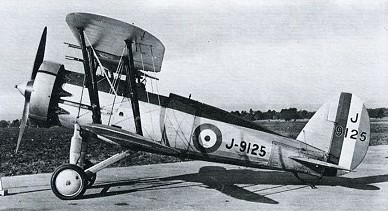
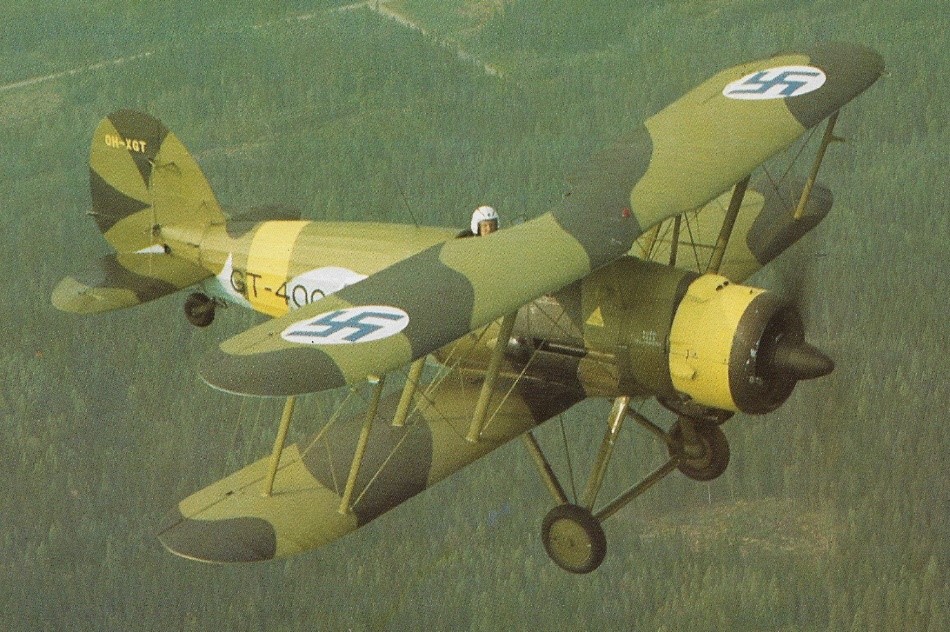
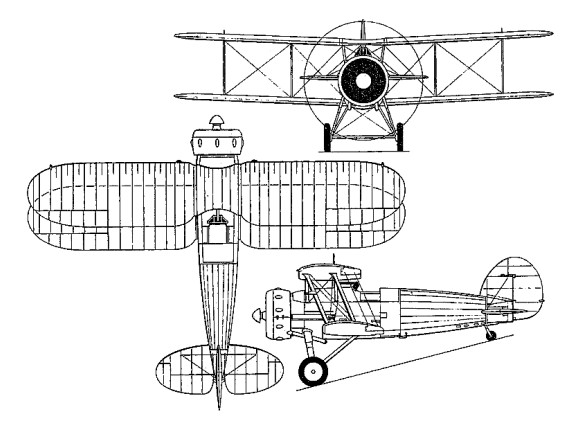
Specifications F.9/26 and F.20/27 remained unfulfilled; and F.7/30 calling for a 402km/h four-gun fighter seemed initially even more unlikely to be attained. Gloster’s first submission had been an improved version of the all-metal Goldfinch, and with the progression of time this design had been subjected to several permutations of airframe innovations and differing engines. When, in 1933, Gloster’s SS.19B demonstrated a maximum speed of 346km/h during tests at Martlesham Heath, it was ordered into production under the name Gauntlet I. During the period 1935 to 1937 Gauntlets were the fastest fighters in RAF service, partially replaced by Gladiators and Hurricanes in 1938 and finally ousted by Spitfires in 1939. Aircraft produced from 1935, after Hawker Aircraft had taken over the Gloster company, were constructed according to Hawker production methods, bringing changes to wing spar and fuselage structure. These differing aircraft were designated Gauntlet II.
Gloster Gauntlet Mk.II GT-400
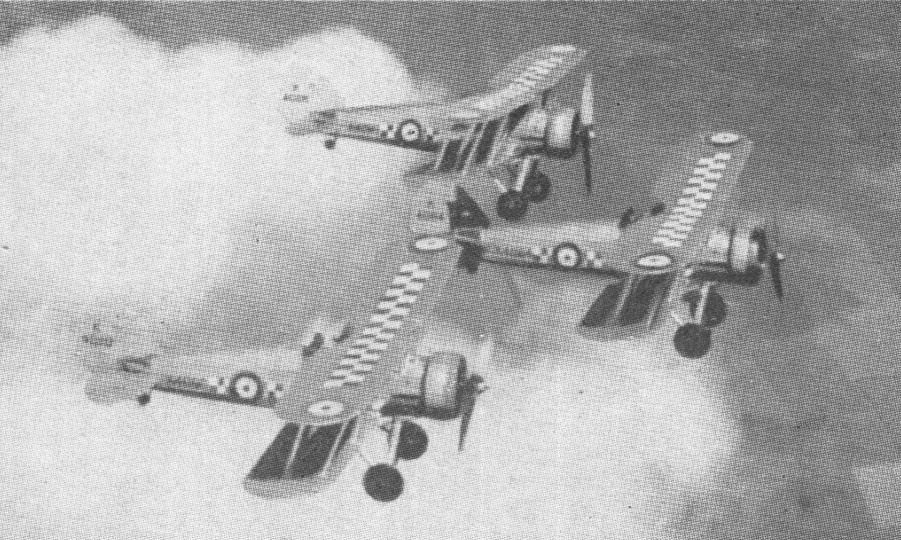
Last open-cockpit biplane in RAF service, the Gauntlet equipped 14 squadrons at its peak period of usage. It was during this same period that a very different performance was given under most secret conditions when (in November 1936) three of No 32 Squadron’s Gauntlets intercepted a civil airliner under the guidance of an experimental ground-radar installation at Bawdsey Manor, Suffolk. Thus the Gauntlet has the distinction of carrying out the world’s first radar-controlled interception.
Gloster SS 19 B Gauntlet Engine: Bristol Mercury VI S.2, 631 hp Length: 26.411 ft / 8.05 m Height: 10.236 ft / 3.12 m Wingspan: 32.776 ft / 9.99 m Wing area: 314.955 sq.ft / 29.26 sq.m Max take off weight: 3971.2 lb / 1801.0 kg Weight empty: 2769.5 lb / 1256.0 kg Max. speed: 200 kts / 370 km/h Service ceiling: 33497 ft / 10210 m Wing load: 12.71 lb/sq.ft / 62.0 kg/sq.m Range: 400 nm / 740 km Crew: 1 Armament: 2x cal.303 MG Vickers (7,7mm)
Gauntlet Mk II Engine: 1 x Bristol Mercury VIS2, 477kW Max take-off weight: 1801 kg / 3971 lb Empty weight: 1256 kg / 2769 lb Wingspan: 9.99 m / 32 ft 9 in Length: 8.05 m / 26 ft 5 in Height: 3.12 m / 10 ft 3 in Wing area: 29.26 sq.m / 314.95 sq ft Max. speed: 370 km/h / 230 mph Ceiling: 10210 m / 33500 ft Range: 740 km / 460 miles Armament: 2 x 7.7mm machine-guns
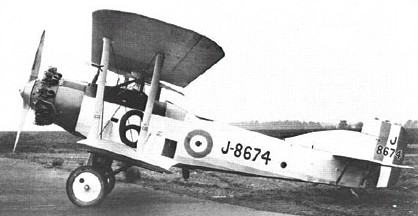
The Gloster Goring was a private venture to replace the Hawker Horsley, then (1927) in service as a light bomber with the RAF. The Air Ministry intimated that the engine they would like to see installed was the Bristol Orion fitted with an exhaust-driven supercharger. One airframe was so equipped, but due to the failure of the Orion and its supercharger, this variant was not proceeded with.
Another Goring, powered with a Bristol Jupiter 8-geared engine, met with much more success.
As a bomber, the Goring carried 700 lb of bombs and in addition the observer had a Vickers machine gun on a rotating mount in the rear cockpit. Provision was made for a second gun firing through the bottom of the fuselage. In this condition the Goring had an endurance of 6 hr 30 min at 15,000 ft.
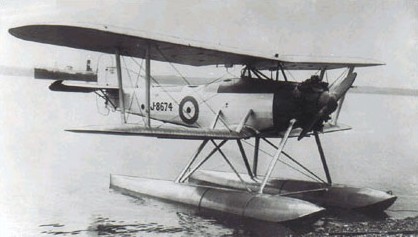
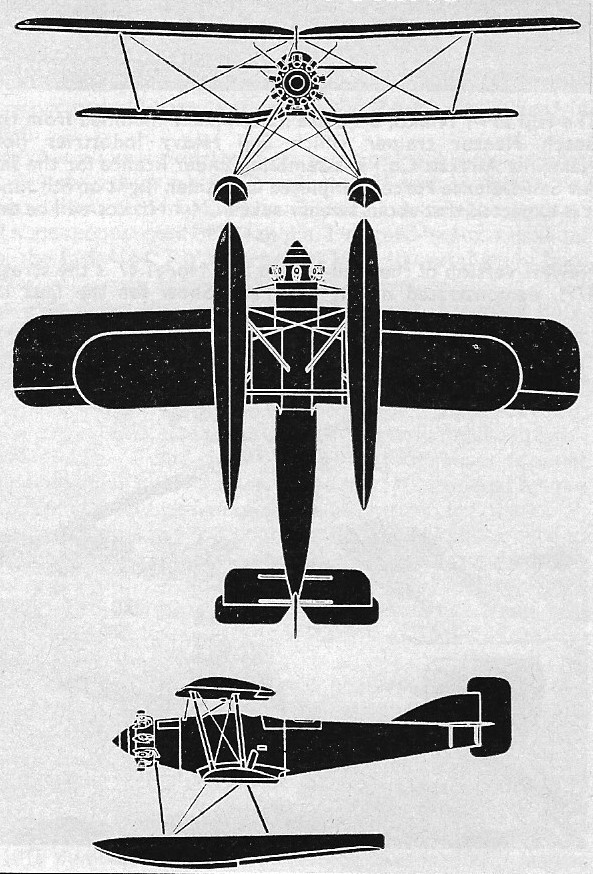
At a later stage the Goring was converted to a twin-float seaplane, still powered by a Jupiter 8. This decreased the maximum speed by only 4 mph and made similarly small alterations to performance figures of the landplane. The floats were of Gloster design and were made entirely of anodised duralumin.
Although the second aircraft was taken over by the Ministry for research work in connection with engines, the type was not ordered into production.
Goring (landplane) Engine: 1 x 425hp Bristol Jupiter VI Max take-off weight: 2440 kg / 5379 lb Empty weight: 1323 kg / 2917 lb Wingspan: 12.80 m / 41 ft 12 in Length: 9.14 m / 29 ft 12 in Height: 3.51 m / 11 ft 6 in Wing area: 41.81 sq.m / 450.04 sq ft Max. speed: 219 km/h / 136 mph Ceiling: 5029 m / 16500 ft Armament: 2 x 7.7mm machine-guns Crew: 2
Engine: 1 x 420hp Bristol Jupiter V or 425hp Jupiter VIA Max take-off weight: 2272 kg / 5009 lb Empty weight: 1336 kg / 2945 lb Wingspan: 14.20 m / 46 ft 7 in Length: 9.60 m / 31 ft 6 in Height: 3.45 m / 11 ft 4 in Wing area: 45.89 sq.m / 493.96 sq ft Max. speed: 208 km/h / 129 mph Range: 1208 km / 751 miles Crew: 2 Armament: 2 x 7.7mm machine-guns, 2 x 10⁵kg bombs
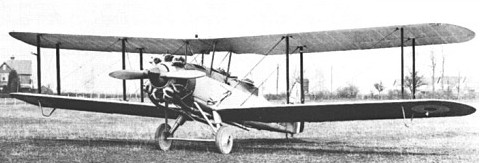
In 1923 Gloster built a two-seat private-venture research aircraft which became known as the Grouse, to carry out flight evaluation of new and special biplane wings. Simultaneously a single-seat version was built. When demonstrated to Air Ministry officials, its performance was considered to be so impressive that three prototypes were ordered. The first of these became the Grebe prototype which, following evaluation, was ordered into production under the designation Grebe II. This differed from the two-seat version by having a more powerful Jaguar IV engine (instead of a Jaguar III) and several other modifications.
The Grebe entered service in October 1923 with the RAF’s No 111 Squadron, and total production numbered 113 aircraft, including a small number of two-seat dual-control trainers. The Grebe was found to have wing flutter problems, resulting in the addition of outward-sloping Vee struts to brace the overhang of the upper wing. Two Grebes were modified during 1926 with special release attachments on the top surface of the upper wing. This allowed them to be carried into the air beneath the keel of the British rigid airship R-33, and used for launching experiments.
Grebes remained in service until their replacement by Armstrong Whitworth Siskins in mid-1928.
Grebe Mk II Engine: 1 x Armstrong Siddeley Jaguar IV, 385-425 hp Max take-off weight: 1189 kg / 2621 lb Empty weight: 780 kg / 1720 lb Wingspan: 8.94 m / 29 ft 4 in Length: 6.17 m / 20 ft 3 in Height: 2.82 m / 9 ft 3 in Wing area: 23.60 sq.m / 254.03 sq ft Max. speed: 243 km/h / 151 mph @ SL Ceiling: 7010 m / 23000 ft Armament: 4 x 7.7mm forward-firing machine-guns Crew: 1
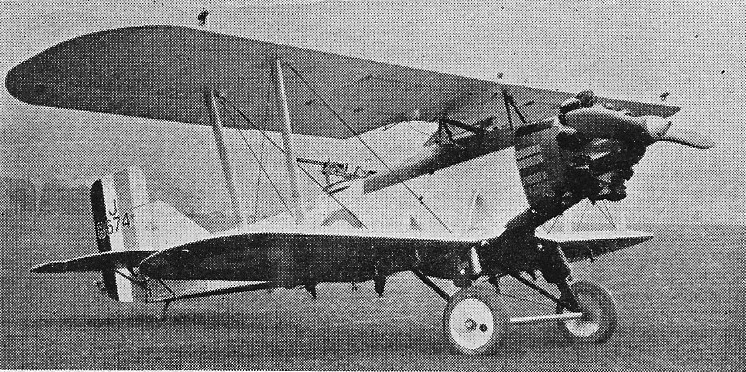
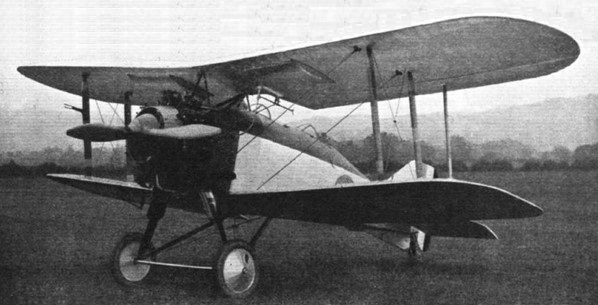
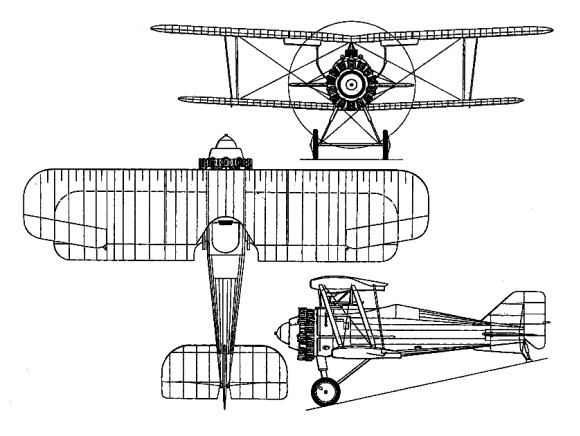
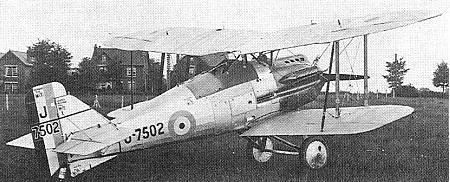
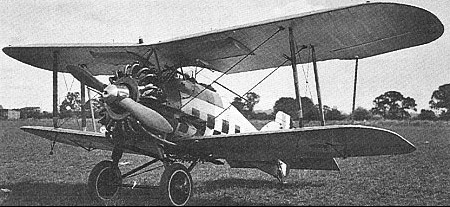
Gloucestershire Aircraft’s first military aircraft of all-metal construction was the third prototype Gorcock single-seat fighter resulting from a May 1924 Air Ministry contract for three prototypes powered by the Napier Lion 12-cylinder water-cooled engine. The first two combined a steel fuselage with wooden wings and the third had an all-steel structure. The first mixed-construction Gorcock was powered by a 450hp geared Lion IV and was flown mid-1925, the second Gorcock having a 525hp direct-drive Lion VIII. Engine difficulties prevented their delivery until 1927, together with the all-metal third Gorcock which had a Lion IV. All three aircraft carried the standard armament of twin synchronised 7.7mm Vickers guns and were used for research and development flying, no production being ordered. Although 72kg heavier than the mixed-construction prototypes, the all-metal prototype was 16km/h faster.
Prototype 3 Max take-off weight: 1514 kg / 3338 lb Empty weight: 1099 kg / 2423 lb Wingspan: 8.69 m / 28 ft 6 in Length: 7.94 m / 26 ft 1 in Height: 3.10 m / 10 ft 2 in Wing area: 23.22 sq.m / 249.94 sq ft Max. speed: 280 km/h / 174 mph
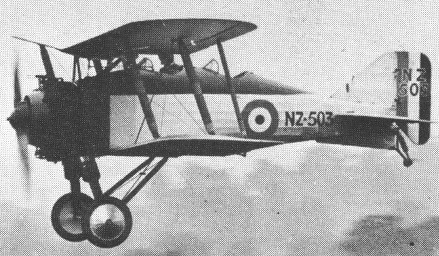
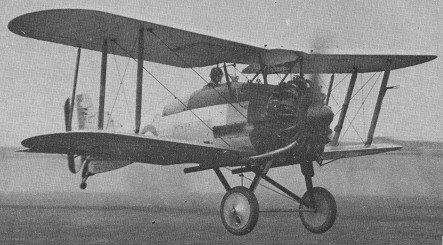
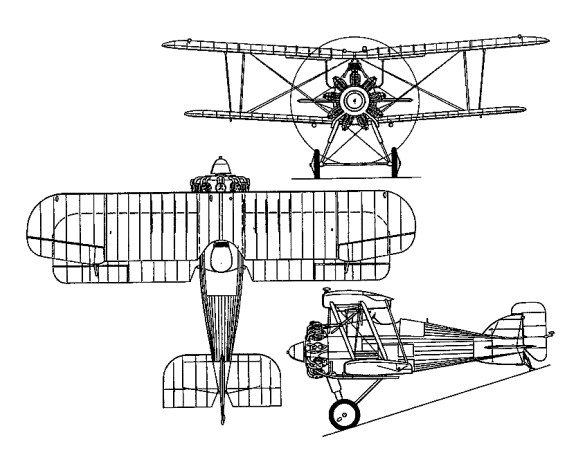
A development of the Gloster Grebe fighter, the Gamecock was initially to Specification 37/23, a re-engined variant of the Grebe using the new 398hp Bristol Jupiter IV radial engine. Of wooden construction with fabric skinning and retaining the then-standard armament of two synchronised 7.7mm Vickers guns. Ordered originally as the Grebe II in August 1924, the prototype Gamecock 1 (as it became titled) was delivered to Martlesham Heath for service tests on 20 February 1925. Trial reports were enthusiastic, resulting in an initial order for 30 production Gamecock Is machines in September 1925 powered by the 425hp Jupiter VI. First to take delivery of the production Gamecocks was 23 Squadron RAF, at Hen¬low, in May 1926; followed by 3, 17, 32 and 43 Squadrons. Although designed for day fighting, the Gamecocks issued to 3 and 17 Squadrons were specially modified for night interception duties. During the next five years, Gamecocks were prominent in the many public displays organized by the RAF, and demonstrated the type’s manoeuvrability in many superb aerobatic exhibitions. A further 60 Gamecock Is were built for the RAF (1925-27), one of these (unofficially known as the Gamecock III) at one time flying with a lengthened fuselage, new and enlarged fin-and-rudder assembly and narrow-chord ailerons.
Gamecock II
The Gamecock recorded a relatively high accident rate in service use; 22 having crashed within 19 months of its introduction to the RAF, and killing eight pilots. A variety of modifications were embodied progressively to eliminate the Gamecocks’ tendencies to spin abruptly and give wing flutter at high speed. Despite such characteristics, service Gamecocks quickly demonstrated their fast performance by tak¬ing the first three places in the 1927 Sassoon Cup Race for RAF fighter squadrons. A developed version, the Gamecock II, with a steel-tube upper wing centre section, narrow-chord ailerons and a larger rudder, appeared in 1928. This was adopted by Finland, two pattern aircraft and a manufacturing licence being acquired. Fifteen Gamecock IIs were built for the Finnish air arm 1929-30 by the State Aircraft Factory (Valtion Lentokonenetehdas), these having the lengthened fuselage tested earlier in the UK by the so-called Gamecock III and being powered initially by the 420hp Gnome-Rhone Jupiter (IV) 9Ab or 9Ak and later by the 480hp Jupiter (IV) 9Ag. By 1929 licensed production of the design (renamed Kukko) began at Helsinki. One unit, Fighter Squad¬ron 24, continued to fly this variant from 1929 until 1935; while one Finnish Gamecock (GA¬46) remained in service until late 1944.
Though development of the basic Gamecock was undertaken, resulting in the Gamecock II and III, the latter saw no service use. In 1928 the Finnish government, having been much impressed by various dis-plays of the Gamecock’s versatility, placed an order for the type.
Last of the all wood construction fighters in RAF use, the Gamecock achieved fame in perpetuity when the reformed 43 Squadron adopted a fighting cock as its chosen official badge motif; the unit being known ever since as ‘The Fighting Cocks’.
The last Gamecock Is were withdrawn from first-line RAF service mid-1931, Gamecock IIs remaining first-line Finnish equipment until 1935. In total 108 were built.
Gamecock Mk I Engine: 1 x Bristol Jupiter VI, 317kW Max take-off weight: 1299 kg / 2864 lb Empty weight: 875 kg / 1929 lb Span: (upper) 9.07 m (29 ft 9.5 in) Spun (lower) 7.89 m (25 ft 11 in) Length: 5.99 m / 19 ft 8 in Height: 3.06 m / 10 ft 0 in Wing area: 34.63 sq.m / 372.75 sq ft Max. speed: 249 km/h / 155 mph Ceiling: 6736 m / 22100 ft Armament: 2 x 0.303 in (7.7 mm) Vickers Mk 1, 1200 rounds. Endurance: 2.5 hr at 4572 m (15000 ft)