Goodyear Type F / ‘B’ Class

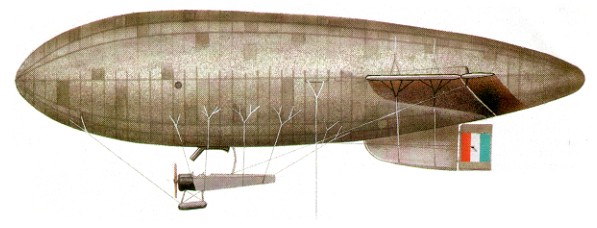
It was in 1915 that the US Navy took on charge its first non-rigid coastal patrol airship, a type that was based on the information coming out of Germany and built by the Connecticut Aircraft Company as the DN-1. The ‘B’ class which followed the failure of this first design was more closely based on that of British airships used for similar work, the first orders going to Goodyear on 14 March 1917 for 9 B Class airships of 77,000 cu ft (Goodyear Type F and FA). However in all fairness it should be said that the ‘B’ class was in no way conceived as a replacement for the earlier type, which had in fact not flown when de-sign work had begun on the Goodyear.
Although the ‘B’ class shared some of the British features, such as the use of an aeroplane fuselage as its car, there were differences such as the absence of an upper fin, though some ‘B’ class vessels did have this feature. There were several other differences be¬tween individual airships within the same class. The company’s first complete airship, BA, was delivered on July 19, 1917. This contract was followed by others for C and D Class ships.
Further variations took place after the first nine examples (B-1 to B-9) had been built by Goodyear, production then being undertaken by the B. F. Goodrich Co. The earlier airships had employed the finger-patch method of fastening the car lines to the envelope, which measured 9.60 m (31 ft 6 in) in diameter, and 48.77 m (160 ft 0 in) in length, but the ‘B’ class from B-10 to B-14 were longer and of greater girth.
It is interesting to note that the later variants (of which two only were built by Connecticut) were the shortest of all but with a greater-diameter envelope, and that the belly-bands which had replaced the finger-patches on the Goodrich were retained.
The B-10, in common with others of its class, proved a sound and reliable vessel; the two-man crew were fairly comfortably accommodated in the individual cockpits of the suspended fuselage, on which the landing gear had been replaced by rigidly-mounted air-filled flotation bags.
The B-10 was among the first batch of Goodyear/Goodrich vessels which were delivered between June 1917 and July of the following year, the former date marking something of a record since the first of the ‘B’ class had made its maiden flight at the end of May, only two weeks after the declaration of war on Germany by the United States. The total number of vessels of this type delivered was only 16, but three were later reconstructed and given new numbers B-17 to B-19. The final B-20 was sufficiently different, with increased gas capacity and an OXX-3 motor, to be considered a new design.
The Goodyear B-20 had an increased cubic capacity, and the rope lines of earlier models were replaced by cable. Three fins were fitted instead of the five of the early variants, although the car with its typical Avro 504-type lines was unchanged.

Goodrich B-10
Type: coastal patrol airship
Powerplant: one 74. 6-kW (100-hp) Curtiss OXX-2 eight-cylinder water-C cooled piston engine
Maximum speed 80 kph (50 mph)
Service ceiling 2134 m (7,000 ft)
Endurance about 16 hours.
Useful lift about 2268 kg 1 (5,000 lb)
Diameter 10.06 m (33 ft 0 in)
Length 50.90 m (167 ft 0 in)
Volume 2265.3 cu.m (80,000 cu ft)
Armament: one or two 7.62-mm (0.30-in) Lewis machine-guns.
Goodyear GA-400R Gizmo

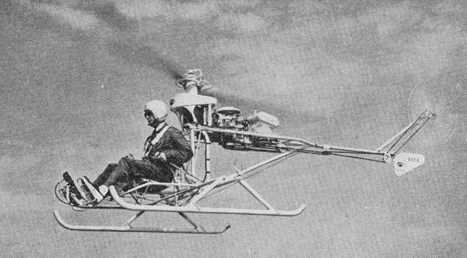
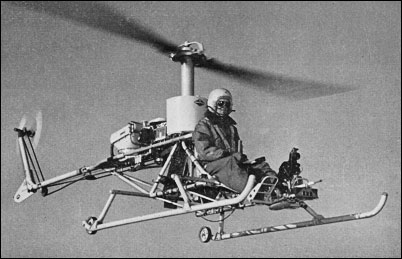
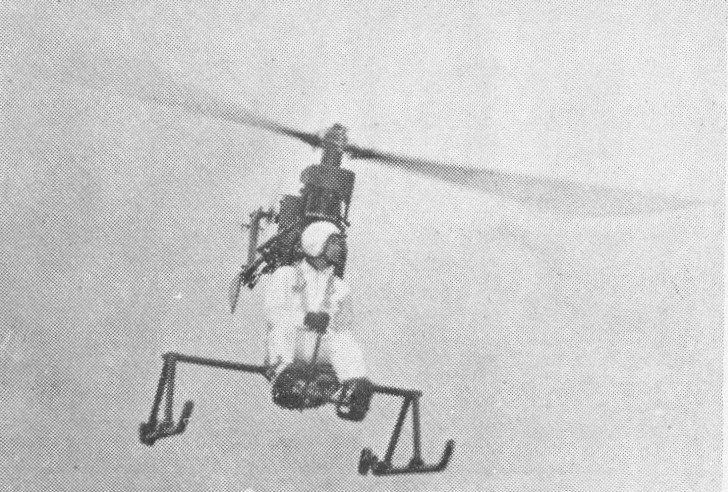
In 1954 Goodyear Aircraft Corporation produced a single-seater helicopter intended for the tactical requirements of transporting one man only. This single-seater open-frame ultra-light helicopter, designed by Paul Ziegler, is powered by a water-cooled, two-cycle engine driving the rotors through a belt and pulley arrangement. The main rotor consists of two laminated blades balanced about the feather axes and mounted in a steel hub underslung from a teetering hinge. The airframe is constructed from welded tubing, and the landing gear is formed of parallel aluminium skids.

The first flight took place on 9 May 1954 (N62N).

Designed by Paul Ziegler, this prototype was designated GA-400R Gizmo, with the pilot seat on the forward frame, a narrow tailboom with a tail rotor and the 32hp Mercury 55 engine mounted amidships and driving a two-blade main rotor. It was followed by the GA-400R-2 and GA-400R-3 (N69N and N53A) which were powered by a 38hp Johnson two-stroke engine. The GA-400R did not progress beyond prototype stage.

Gallery

Engine: 25 h.p. Johnson
Rotors: 2-blade main; 2-blade tail.
Loaded weight: 400 lb
Seats: 1.

GA-400R
Engine (outboard): Marine and MFG Big Twin, 31hp
Main rotor diameter: 5.49m
Length: 4.83m
Length with rotor: 6.77m
Height: 2.29m
Empty weight: 106kg
Take-off weight: 197kg
Max ceiling: 3660m
Cruising speed: 74km/h
Endurance: 45 min

Goodyear GA-22 Duck

In 1950, a revised four-seat variant of the Goodyear GA-2, the GA-22 Drake was flown, followed in 1953 by the GA-22A Drake (with a revised hull); only one of each was built.

The GA-22A Drake was powered by a 225 hp (167 kW) Continental E-225-8 and converted into a flying boat with a revised hull; first flight in 1953.

The last aircraft built, the GA-22A Drake registered N5516M, is stored by the EAA Air Venture Museum

Goodyear GA-2 Duck

Goodyear GA-2 Duck NC5500M

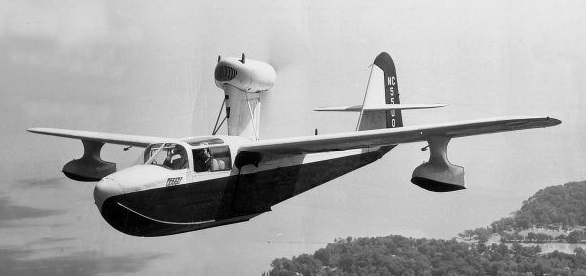
The Goodyear Aircraft Corporation began to design a small light amphibian before the end of the Second World War. The prototype designated GA-1 first flew in September 1944. It was a cantilever high-wing monoplane with underwing stabilizing floats. The GA-1 had an all-metal fabric-covered wing, an all-metal single-step hull, and a cruciform tail unit. It had a retractable tail-wheel, accommodation for two, and a pylon-mounted piston engine with a pusher propeller.

Goodyear GA-2 Duck

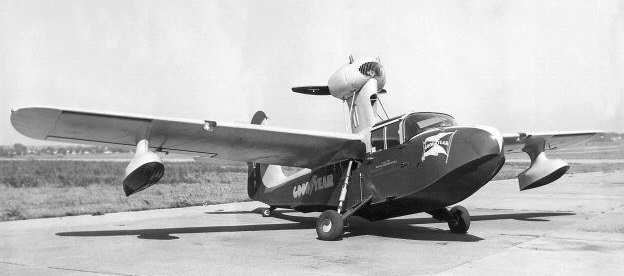
After successful testing of the prototype, 18 demonstration aircraft were built. These differed from the prototype in that they had room for the pilot and two passengers. Two versions were built, the GA-2 with a 145 hp (108 kW) Franklin 6A4-145-A3 piston engine, and the GA-2B with a 165 hp (123 kW) Franklin 6A4-165-B3 flat-six piston engine.

Sixteen GA-2 Duck were built, some later modified as GA-2Bs. Six GA-2B Duck were modified from GA-2s in 1949. The GA-2B had improvements over the GA-2, not the least insignificant of which was the fitting of the patented Goodyear Cross-Wind Landing Gear.

Goodyear GA-2B Duck NC5504M

GA-2B
Engine: 1 × Franklin 6A4-163-B3, 165 hp (123 kW)
Length: 26 ft 0 in (7.92 m)
Wingspan: 36 ft 0 in (10.97 m)
Height: 9 ft 6 (on wheels) in (2.90 (on wheels) m)
Wing area: 178.20 ft2 (16.55 m2)
Empty weight: 1600 lb (726 kg)
Gross weight: 2300 lb (1043 kg)
Maximum speed: 125 mph (201 km/h)
Range: 300 miles (483 km)
Service ceiling: 15,000 ft (4570 m)
Crew: One
Capacity: Two passengers

Goodyear GA-1

The Goodyear Aircraft Corporation began to design a small light amphibian before the end of the Second World War. The prototype designated GA-1 first flew in September 1944. It was a cantilever high-wing monoplane with underwing stabilizing floats. The GA-1 had an all-metal fabric-covered wing, an all-metal single-step hull, and a cruciform tail unit. It had a retractable tail-wheel, accommodation for two, and a pylon-mounted piston engine with a pusher propeller. Originally powered by a 107 hp (80 kW) Franklin 4ACG-100-H3 piston engine, later fitted with a 125 hp (93 kW) Franklin 6A engine.

After successful testing of the prototype, 18 demonstration aircraft were built. These differed from the prototype in that they had room for the pilot and two passengers. Two versions were built, the GA-2 with a 145 hp (108 kW) Franklin 6A4-145-A3 piston engine, and the GA-2B with a 165 hp (123 kW) Franklin 6A4-165-B3 flat-six piston engine.

Goodwin Tri-Moto

The Goodwin Tri-Moto is an American powered parachute that was designed and produced by FL Goodwin of Phoenix, Arizona and introduced in 1997. The Tri-Moto had, as a design goal, creating a powered parachute carriage that can be folded up and transported on top of a recreational vehicle, in a small pick-up truck or even carried in a small boat. Folding it takes one person 20 minutes.

The aircraft was designed to comply with the US FAR 103 Ultralight Vehicles rules as a single seater or two-place trainer, including the category’s maximum empty weight of 254 lb (115 kg). The aircraft has a standard empty weight of 205 lb (93 kg). It features a 485 sq ft (45.1 sq.m) parachute-style high-wing, two-seats-in-tandem, tricycle landing gear and a single 45 hp (34 kW) 2si 430-F engine in pusher configuration.

The Tri-Moto is built from anodized aluminium tubing. In flight steering is accomplished via foot pedals that actuate the canopy brakes, creating roll and yaw. On the ground the aircraft has lever-controlled nosewheel steering. The main landing gear incorporates spring rod suspension. The aircraft was factory supplied complete and ready-to-fly.

The Tri-Moto is out of production.

Tri-Moto
Engine: 1 × 2si 430-F
Reduction: 3:1 gearbox
Propeller: 2-bladed wooden, 5 ft 6 in / 1.68 m diameter
Wing area: 485 sq ft (45.1 sq.m)
Wing loading: 1.87 lb/sq ft / 9.1 kg/m²
Empty weight: 205 lb / 93 kg
Gross weight: 905 lb / 411 kg
Cruise speed: 26 mph / 23 kph / 42 km/h
Rate of climb: 500 ft/min / 2.5 m/s
Fuel capacity: 6 U.S. gallons / 23 lt / 5.0 imp gal
Crew: one
Capacity: one passenger
Unit cost: US$8,000 (2001)

Gonzales Gil-Pazo GP II

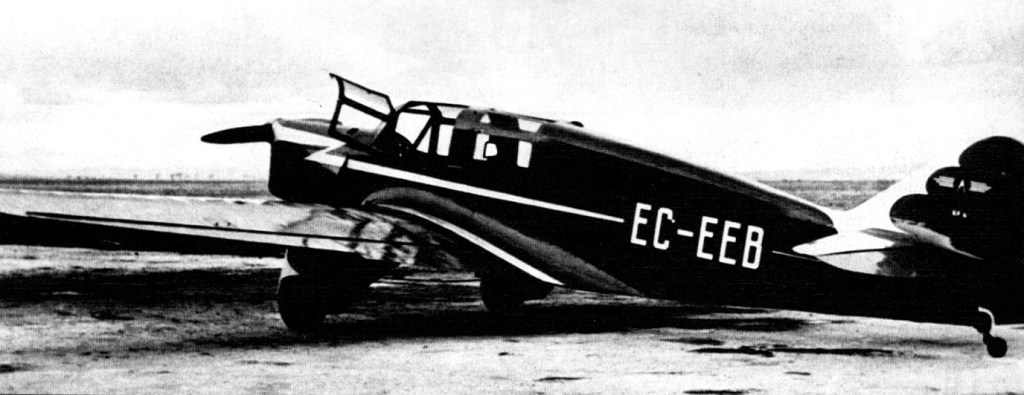
Gonzales Gil-Pazo GP II was built in Spain by Arturo Gil y Santibanez and Jose Pazo Montes. This special version was fitted with a single 130 hp engine. It took part in a record attempt from Barcelona to Senegal, piloted by Ramon Torres and Carlos Coll of the Aero Club Aero Popular de Barcelone, but landed in Morocco after cross winds affected its flight. It is photographed here at Madrid airport during test flights, where it proved it could average a speed of 250 kph with a range of 2000 km.

It was destroyed in an accident at Los Alcazares in January 1937.

Gonnel Uniplan

2nd version

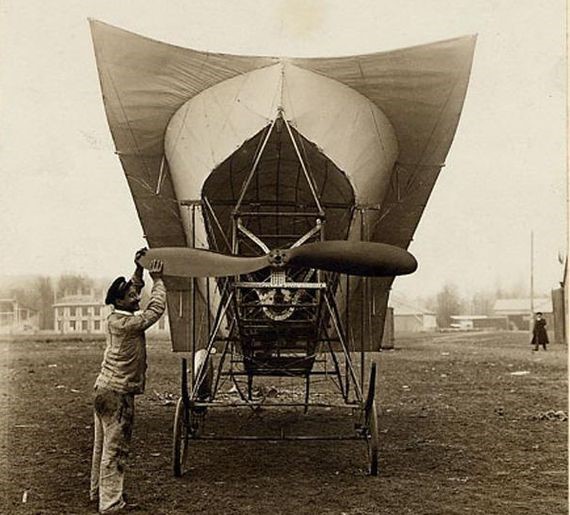
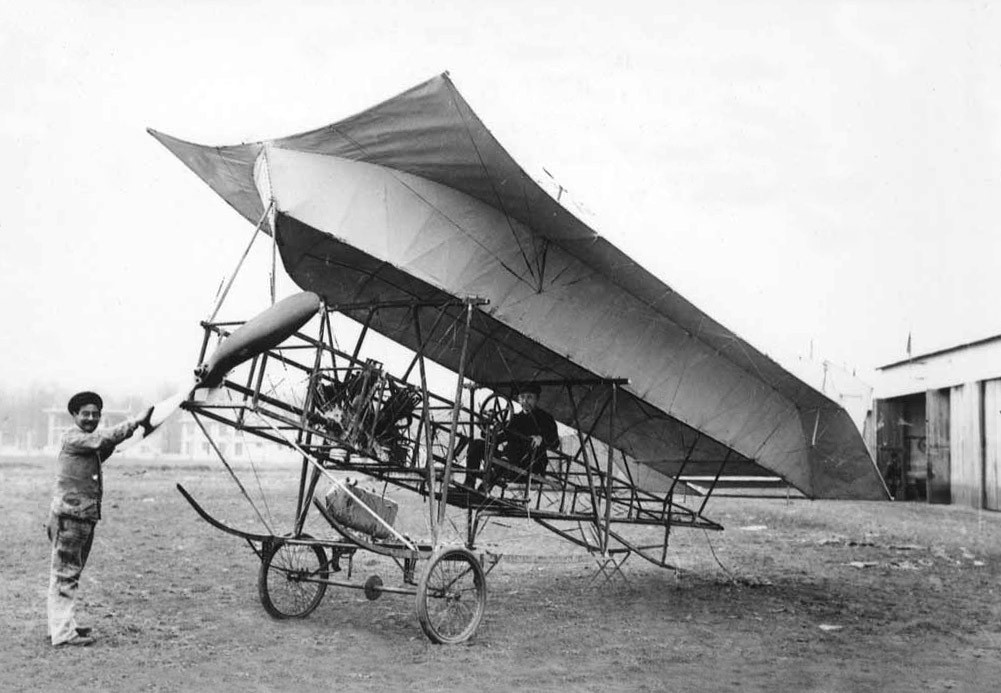
The second patented Uniplan of the Gonnel brothers – Raoul-Georges and Arthur-Édouard – built at Juvisy, France during March 1911.

This rebuilt, 2nd version of the machine, which is actually a complete rebuilt of the fuselage and undercarriage, was also fitted with a more powerful engine, a 45-50 hp 4-cylinder Velox-Suère.