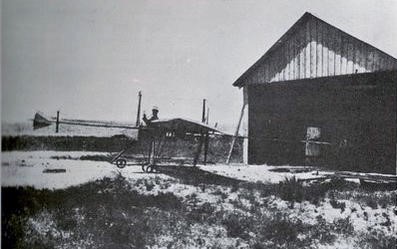
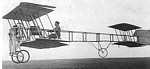
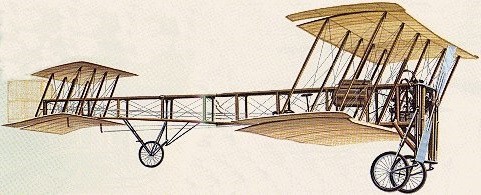
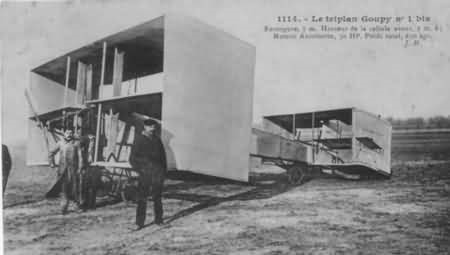
On December 11, 1909, Portuguese inventor João Gouveia, known for his model aeroplanes and who had already designed and constructed kites since 1907, presented a plan to the Academy of Sciences for the “Gouveia”, a 9 metre span monoplane powered by a 26 hp Anzani engine. He built a hangar in Seixal in 1911, constructed the machine and conducted experiments, but eventually abandoned the project due to breakdowns and a lack of funds.
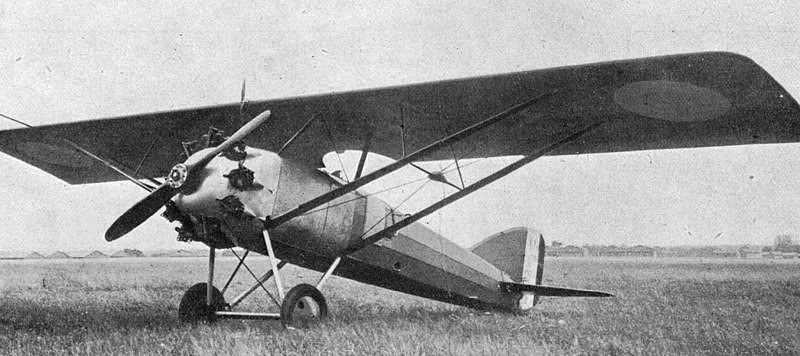
The GL-30 was a parasol-wing monoplane with retractable undercarriage and a Bristol Jupiter engine. Like most of Gordou-Lesserre’s earlier aircraft, it was a parasol wing design but its planform was trapezoidal rather than rectangular. In 1923 it flew the Coupe Beaumont course at an impressive 360 km/h (220 mph; 190 kn).
The GL.30 was the basis of a new fighter, the GL.31, which had a greater span, almost double the wing area, a fixed undercarriage, and a Gnome-Rhône 9A engine. It was armed with four machine guns, two in the forward fuselage and two in the wings. The GL. 31 was not flown until 1926 and then abandoned, overtaken by the GL.32, the company’s entry in a 1923 Aéronautique Militaire competition to select a new fighter. It returned to a rectangular plan wing.
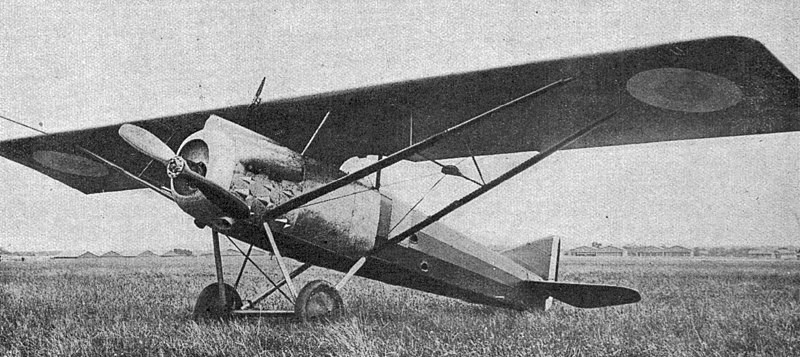
By the time this prototype flew, the Gourdou-Leseurre had been acquired by Loire, and therefore the new aircraft was entered as the LGL.32. Placed second in the trials, the type’s performance was impressive enough to still result in an order in January 1927 for a small batch of aircraft – five evaluation aircraft and 20 preproduction machines. Eventually, 475 of this basic version, dubbed LGL.32C.1 in service, would be ordered by the Aéronautique Militaire and 15 more by the Aéronautique Maritime. Romania ordered a further 50 aircraft of the same design as the examples in French service, Turkey ordered 12 (these designated LGL.32-T) and another one may have been purchased by Japan.
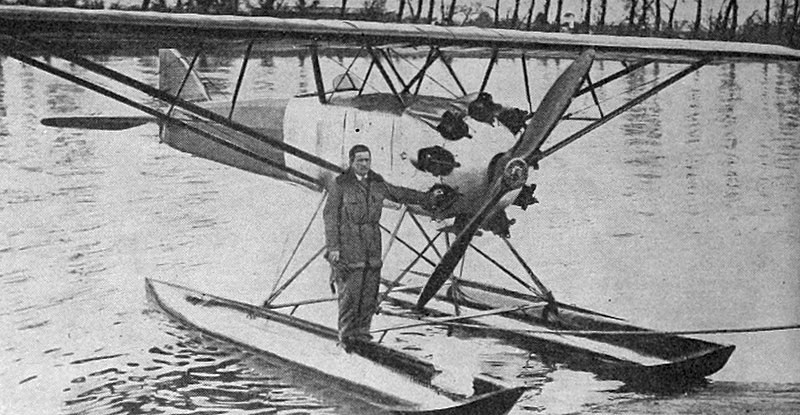
LGL.32 Hy May 1927
The LGL.32 Hy was a twin-pontoon floatplane version converted from the LGL.32 prototype. It set a world seaplane altitude record on 28 March 1927.
In French service, development turned from fighters to adapting the aircraft as a carrier-borne dive bomber. These featured general strengthening of the airframe, divided main undercarriage units, and a “fork” under the fuselage able to release a 50 kg (110 lb) bomb from under the fuselage while avoiding hitting the propeller.
While prolific, the GL.32 was not long-lasting, and attrition took a heavy toll on them. By 1934, all remaining examples were relegated to training and as instructional airframes; at the start of 1936, only 135 remained of the original 380 purchased. A number of these were sold to the government of the Second Spanish Republic and to the autonomous Basque Government. Another aircraft was supplied to the Basques in 1937, modified as a dive bomber along the lines of the previous French experiments. Designated the GL.633, this aircraft was used by Miguel Zambudio to attack the Nationalist battleship España, scoring decisive hits that contributed substantially to her subsequent sinking.
GL.30 Racer with retractable undercarriage and Engine: Bristol Jupiter one built
GL.31 / GL.31C.1 / CL-I-3 Four-gun fighter prototype with fixed undercarriage longer-span wings engine: Gnome-Rhône 9A one built
LGL.32 / GL.32C.1 Definitive two-gun fighter version Powerplant: 1 × Gnome et Rhône 9A Jupiter VIII, 450 kW (600 hp) Propeller: 2-bladed wooden fixed pitch Wingspan: 12.2 m (40 ft 0 in) Wing area: 24.9 m2 (268 sq ft) Length: 7.55 m (24 ft 9 in) Height: 2.95 m (9 ft 8 in) Empty weight: 963 kg (2,123 lb) Gross weight: 1,376 kg (3,034 lb) Fuel capacity: 285 kg (628 lb) – (ca. 200 L (53 US gal; 44 imp gal)) Maximum speed: 270 km/h (170 mph, 150 kn) at sea level Maximum speed: 260 km/h (160 mph; 140 kn) at 3,000 m (9,800 ft) Maximum speed: 251 km/h (156 mph; 136 kn) at 5,000 m (16,000 ft) Maximum speed: 215 km/h (134 mph; 116 kn) at 8,000 m (26,000 ft) Landing speed: 90 km/h (56 mph; 49 kn) Range: 500 km (310 mi, 270 nmi) Service ceiling: 9,700 m (31,800 ft) Time to 2,000 m (6,600 ft): 3 minutes 5 seconds Time to 5,000 m (16,000 ft): 11 minutes Time to 8,000 m (26,000 ft): 31 minutes Wing loading: 54.8 kg/m2 (11.2 lb/sq ft) Power/mass: 0.33 kW/kg (0.2 hp/lb) Armament: 2x 7.7 mm (0.303 in) Vickers or Darne machine-guns – fuselage / 2x 7.7 mm (0.303 in) Darne machine-guns in wings Crew: 1 ca. 490 built
LGL.32.01 The first prototype.
LGL.32T Export version for Turkey 12 built
LGL.32 Hy Twin-pontoon floatplane version converted from LGL.32 prototype. one converted
LGL.321 LGL.32 converted to use 450 kW (600 hp) version of the Gnome & Rhône 9Ac one converted
LGL.323 LGL.32 converted to use supercharged 373 kW (600 hp) Bristol Jupiter for unsuccessful altitude record attempts. one converted
LGL.324 LGL.323 further modified and used by Pierre Lemoigne to set world landplane altitude record 500 kg payload of 9,600 m (31,500 ft) on 23 May 1929 Albert Lécrivain set world landplane altitude record 11,000 m (39,090 ft) on 24 October one converted
LGL.33 / LGL.33C.1 Similar to LGL.32 revised wing struts, landing gear, and tail Engine: Lorraine 12Eb one built
LGL.34 / LGL.34C.1 Similar to LGL.32 Engine: Hispano-Suiza 12Gb one built
LGL.341 similar to LGL.32 Engine: Hispano-Suiza 12Hb two built, second with revised radiator arrangement
LGL.351 Engine: Renault 12J one built
LGL.390 night fighter prototype Engine: Hispano-Suiza 9Va one converted from LGL.32
GL.410 modernised fighter with divided main undercarriage one built
GL.430 strengthened carrier-borne dive-bomber prototype one built
GL.432 dive-bomber variant similar to GL.430 used for operational testing four built
GL.450 fighter version
GL-482 fighter version Engine: Hispano-Suiza 12Xbrs one built
GL.521 dive-bomber version taller tail fin Engine: Gnome-Rhône 9Kfr two built
The 1912 Goupy “hydroaéroplane” was just a land plane set on floats with wheels and all, no further alterations. Typical was the fuselage “hung” between the wings and the sesquiplane construction with the struts somewhat at an angle. The construction at the nose looks like radiators, but are unlikely that as this design was fitted with a 100 hp Gnome rotary. Maybe a streamlined construction to get the engine neatly into the ‘square’ fuselage.
The three-passenger Goupy biplane, type 1914-B, resembled in general construction other machines of this firm. The cell is composed of two staggered planes of unequal length: chord 1.6 m. top plane 19.75 m. long, lower one 10.35 m. long. The cell is rigid and lateral balance is obtained by powerful conjoined ailerons. The fuselage is of quadrangular section. The monoplane tail is slightly lifting and approximately rectangular, terminated by a flap 3.1 by .7 m. serving as an elevator. The quadrangular rudder, above the tail, is partly balanced and in front of it is a small vertical fin. The 100 hp Gnome supported between two bearings turns a 2.8 m. propeller, the axis being 1.8 m. above the ground. The chassis is of the usual type, skids and wheels: the wheels are far enough forward to prevent “capotage.” The skids, however, do not seem sufficient to protect the propeller in a bad landing on rough ground.