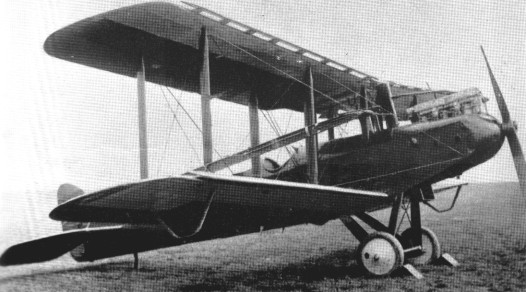
Wing leading-edge slots, per¬fected by Sir Frederick Handley Page and Dr. G. V. Lachmann in 1919, were first flown on the H.P.17, a modified D.H.9. By controlling airflow over the wing and so enabling aircraft to fly very slowly under perfect control, they ended the danger of the stall-and-spin type of crash.
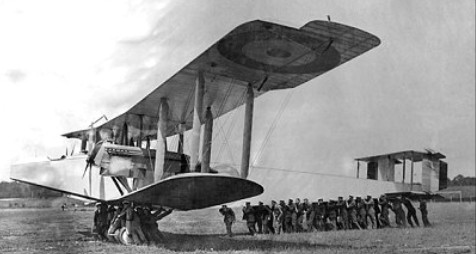
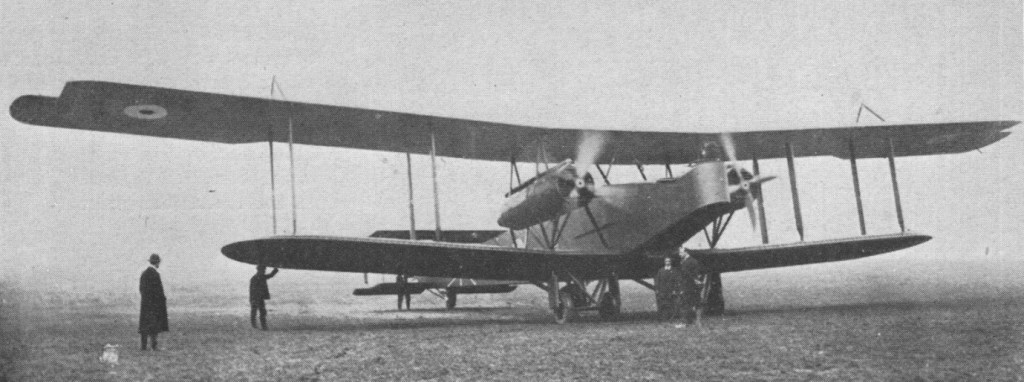
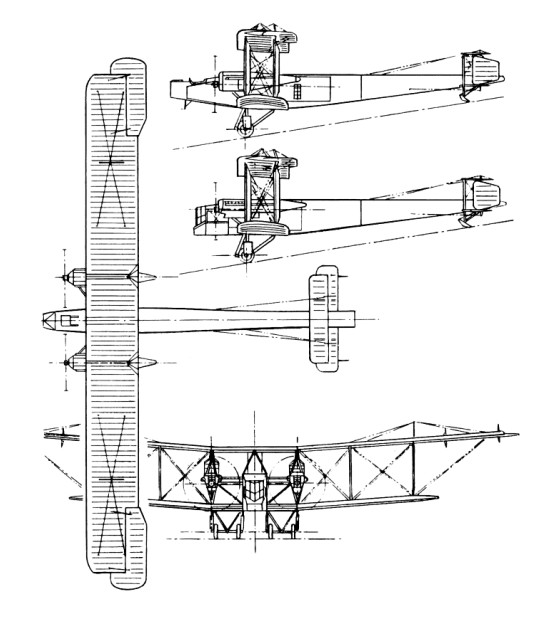
Frederick designed a large biplane to attempt a non-stop transatlantic crossing for the DailyMail’s £10,000 prize, but war intervened. He used his design experience, assisted by the Admiralty, to propose plans for a 100ft-span twin-engined bomber for the Royal Naval Air Service, the O/100 to an Admiralty specification of December 1914. The Royal Naval Air Service Admiralty was thinking in terms of a large twin engined aeroplane able to carry a crew of two and six 112 lb bombs on overwater patrols. Identified originally as the Handley Page Type O, it was later designated O/100, the figure 100 indicating its wing span in feet. When the prototype was completed, it was the largest aeroplane that had then been built in the UK.
The O/100 was of biplane configuration, with folding unequal-span constant-chord wings that had straight leading and trailing edges; these were mounted on a square-section cross-braced fuselage that terminated in a biplane tail unit. The tailskid landing gear had twin wheels on each main unit and the two 250hp Rolls-Royce Eagle II engines, in armoured nacelles, were mounted between the wings just outboard of the fuselage. Accommodation in the first prototype was in a glazed cockpit enclosure, the floor and sides of the cockpit being protected by armour plate.
Flown for the first time on 18 December 1915, the O/100 was found to be inadequate in performance. The first O/100 with 275 hp RR Eagle engines weighed 14,000 lb empty. Clifford Prodger did the testing. The second prototype had a revised open cockpit for a crew of two (with provision for a gunner’s position forward), the cockpit armour plating and most of that incorporated in the engine nacelles was deleted, and new radiators were introduced for the water-cooled engines. When the machine was first tested in April 1916 there was a marked improvement in performance, to an extent that in early May it was flown with 20 Handley Page employees aboard to a height of just over 2135m. Brackley and Vereker were the first Navy pilots.
Three prototypes were powered with either Sunbeam Cossack motors of 250 hp Rolls-Royces.
Formation of the first ‘Handley Page Squadron’ began in August 1916 and this unit became operational in France in late October or early November; its first recorded bombing attack was made on the night of 16-17 March 1917 against an enemy-held railway junction.
One of the first three sent to France was delivered intact to the Germans when its pilot landed by mistake behind the enemy lines.
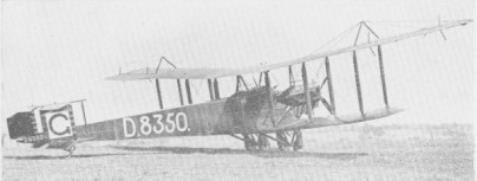
Altogether 46 were built and, after an initial period of daylight attacks against German shipping, they became the spearhead of British night bombing forces until succeeded in the last three months of the war by the improved O/400, with 250 hp Eagle IV or 360 hp Eagle VIII engines. Together the two types formed the heavy component of the Independent Force. In addition to their use as night bombers on the Western Front, O/100s also equipped the first bomber squadron of the RAF’s Independent Force following its establishment on 5 June 1918. Forty were delivered to the RNAS at Dunkirk in 1916-17.
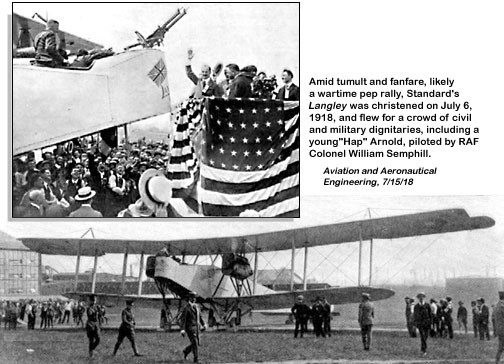
One early O/100 sample component (airframe B9449) was assembled by Standard Aircraft Corp in the US for publicity purposes and dubbed Langley, adorned with crossed British and American flags on the nose and its name on the sides, flew to 3500′ in a half-hour demonstration flight for a crowd of 5,000.
Engine: 2 x Rolls-Royce Eagle II, 250 hp. Max take-off weight: 6356 kg / 14013 lb Empty weight: 3632 kg / 8007 lb Wingspan: 30.48 m / 100 ft 0 in Length: 19.15 m / 62 ft 10 in Height: 6.71 m / 22 ft 0 in Wing area: 153.10 sq.m / 1647.95 sq ft Max. speed: 122 km/h / 76 mph Ceiling: 2652 m / 8700 ft Bombload: sixteen 112 lb. bombs
Engines: 2 x Rolls-Royce Eagle, 275 hp Wingspan upper: 100 ft Wingspan lower: 70 ft Wing area: 1630 sq.ft Wing loading: 8.5 lb/sq.ft Length: 63 ft Height: 22 ft Empty weight: 8480 lb Loaded weight: 14,022 lb Max speed loaded: 79.5 mph Time to 6500 ft: 30 min Service ceiling: 7000 ft Endurance: 8 hr Crew: 3 Armament: 3 or 5 mg Bombload: 1792 lb / 16 x 112 lb or 8 x 250 lb
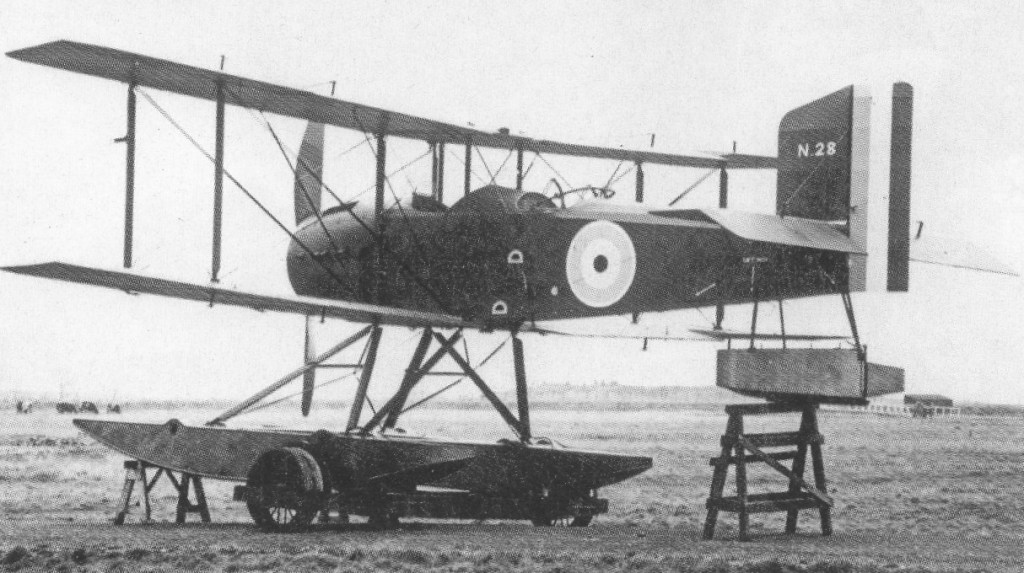
Designed to meet Admiralty requirement N.2a of 1917, the R/200 was a two seat reconnaissance fighter to operate as a seaplane or from the decks of the carriers HMS Furious and Argus. Two prototypes with 200 hp Hispano-Suizas were built. The wing trailing edges were entirely taken up by ailerons and camber changing flaps, all of the same size. To speed production and minimise spares, the left ailerons were interchangable with the right flaps and vice versa, and the fin and each half of the tailplane, and the rudder and each elevator, were identical. The R/200’s performance was undistinguished, and another four prototypes and twenty production aircraft were cancelled.
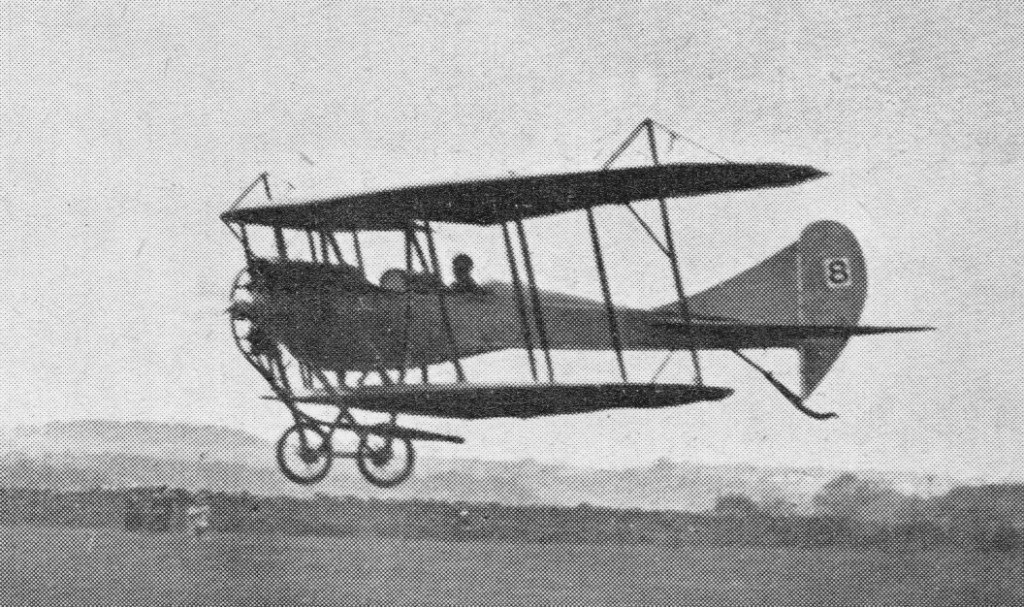
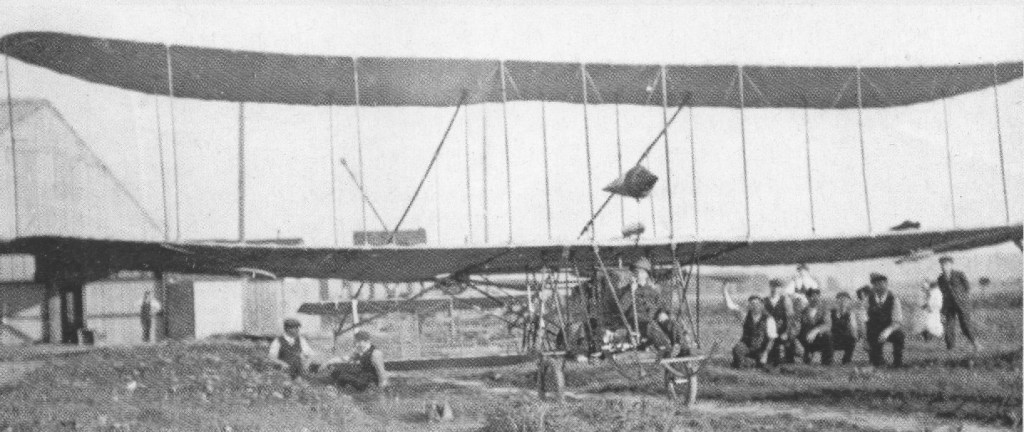
The Type G was the first biplane wholly designed by Handley Page. In 1924 the early Handley Page types were give a retrospective design number and the Type G became the H.P.7.
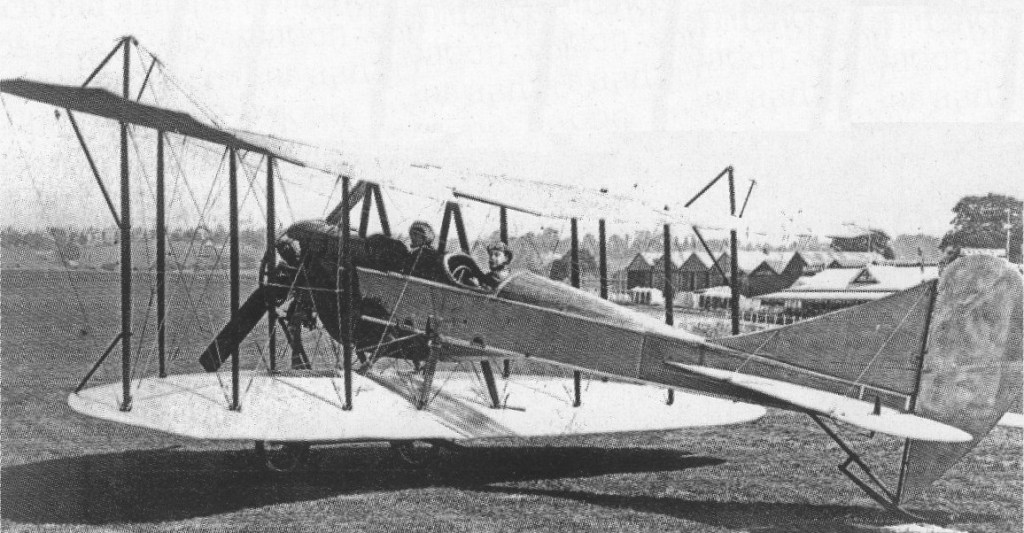
The Type G used wings of the same plan though of unequal span. It was a three bay biplane having slight wing stagger, with two pairs of separate but wire braced interplane struts per wing. Only the upper wings carried ailerons, which were operated via king posts that appeared as extra interplane struts near the wingtips, but extending above the upper wing and carrying the control wires. The details of this arrangement were modified at least once. The slender fuselage was positioned between the wings with struts above and below. It was flat sided, with a curved decking behind the pilot who sat in the rear seat. An early photo shows a single cockpit opening, but later there were two separate open cockpits for passenger and pilot. The pilot’s upward view was assisted by a small V-shaped trailing edge cutout. The horizontal stabiliser and fin were sharply swept at their leading edges. There were separate elevators and a rudder of half-heart shape, the point extending well below the fuselage to about the level of the lower wing.
In its early form the Type G had a two-wheeled single axle main undercarriage mounted by a pair of struts on each side, one forward to the engine bulkhead and one rearwards to the fuselage via the main spar. Initially the wheels were supplemented by a pair of skids to avoid nosing over, but these were later discarded. A long tail strut positioned a sprung tailskid just below the lower tip of the rudder. The aircraft was powered by a 100 hp (75 kW) Anzani 10 radial engine. The prominent pair of semicircular exhaust tubes characteristic of this engine fed a single exhaust pipe which curved away under the aircraft via a silencer, ending near the trailing edge.
The Type G flew successfully and usefully between 1913 and 1915. It was designed to have inherent stability and for a time, early in its life, demonstrated this by flying without its tailfin.
Before the First World war it was bought by a syndicate headed by Rowland Ding. Flown by Rowland Ding, who later became Blackburn’s main test pilot, he took it to various aviation meetings and also made a cross-channel flight with Princess Lowenstein Wertheim as a passenger. He also made many flights between meetings with his wife and six-year-old daughter in the front seat, qualifying the Type G as a three-seater.
At the outbreak of war in 1914 the Type G was bought by the Royal Naval Air Service and was based at Hendon, being used for training and defence. During its service life it carried a Union Jack and the number 892 on the rudder. On one occasion, mistaken by London ground forces for a German Taube because of the wing shape, it was caught in a “friendly fire” incident but survived. It was finally written off in a ground accident at RNAS Chingford in August 1915.
The 1913 Handley Page Type G biplane was priced at £1500.
Powerplant: 1 × Anzani 10, 100 hp (75 kW) Wingspan: 40 ft 0 in (12.2 m) Wing area: 384 sq ft (35.67 m2) Length: 25 ft 1 in (7.64 m) (without skids) Empty weight: 1,150 lb (522 kg) Gross weight: 1,775 lb (805 kg) Maximum speed: 73 mph (117 km/h, 63 kn) Endurance: 4 hours Rate of climb: 286 ft/min (1.45 m/s) to 3,000 ft (914 m) Crew: one Capacity: one or two passengers
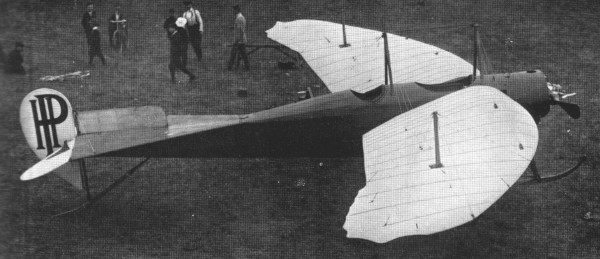
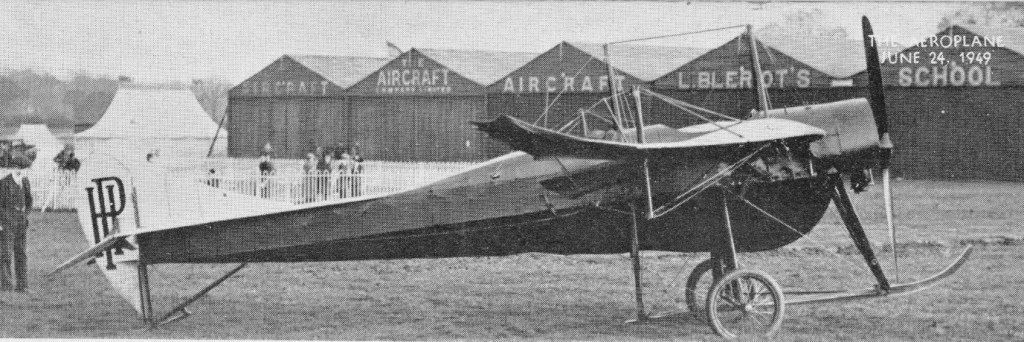
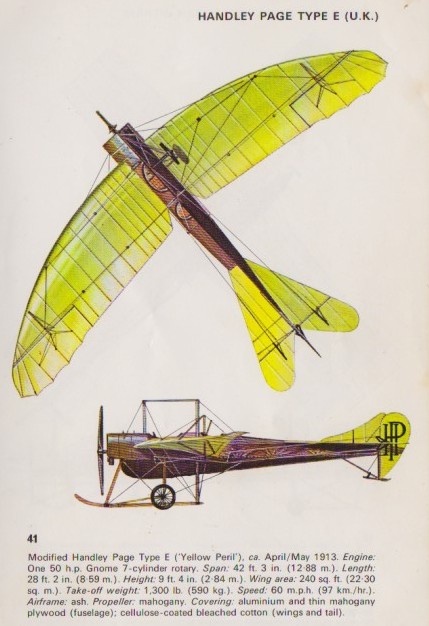
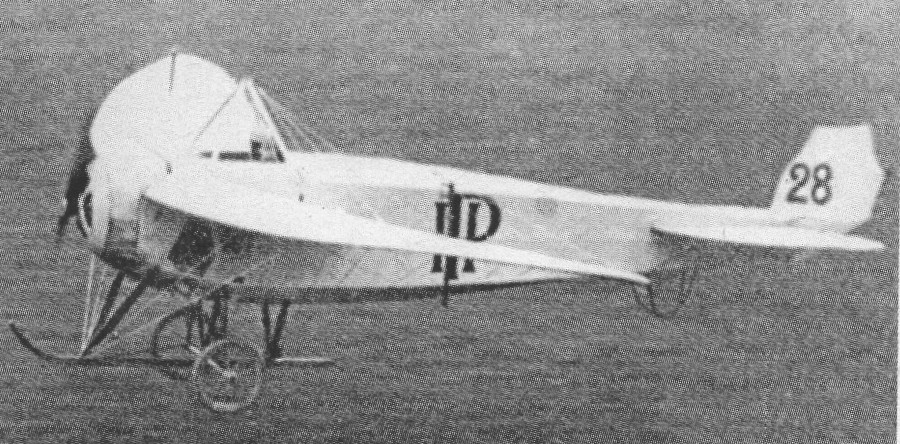
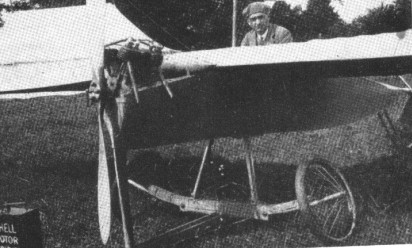
The first really successful Handley Page monoplane of 1912/13. The pilots were the Painter and Lt. Wilfred Parks RN, both who treated it as a joke, as they did everything else.
It made a flight over London from Barking to Brooklands, piloted by Edward Petre.
The 1912 Type F flew well in Military Aeroplane Competitions that summer, flown by Lt. Wilfred Parks RN.
One day Parks and Hardwick started for Farnborough to have it approved, and over Wembley the engine cut out. Park turned down wind to land on the golf course, stalled over some trees and dived into the ground. The machine was not badly broken but they were killed on impact.
The Type F monoplane crashed and brought the first fatalities to Handley Page (H.P.), and it was said that the deaths, from a stall accident, resolved FHP to seek a cure to what was then a very common occurrence.
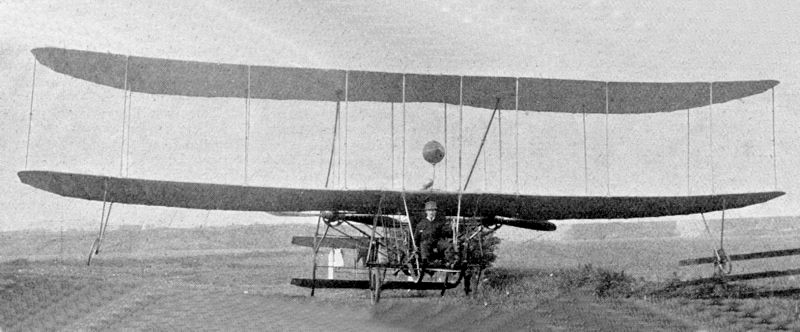
In 1909 Handley Page took a commission to build a prototype biplane aircraft, the concept of W.P.Thompson of Freshfield, Lancashire. Thompson had registered ideas of aircraft control by variable wing area and centre of gravity movement and was keen to build an aircraft with “pendulum stability”, with most of its mass mounted flexibly below the wings. The concept involved having pendulum stability by having the pilot, powerplant, and undercarriage suspended beneath the wing structure.
This was done with input from both Handley Page and Thompson’s assistant Robert Fenwick. The wide gap biplane wings were of two-bay form though in the absence of a fuselage between the wings there were further interplane struts. Two tail booms, each based on a cross-braced pair of members joined to the upper and lower wings, supported a biplane tail. It had no fuselage, the 60 hp Green engine was flexibly mounted below the lower wing and drove a pair of pusher propellers, mounted at lower wing level, via a pair of chains.
Designated the Handley Page Type B, the undercarriage collapsed on the first attempt at flight in late 1909. It was then wrecked when part of the works shed collapsed in a gale. Handley Page decided to have no more to do with what he considered a failure and nicknamed it “The Scrapheap”.
Repaired, it was delivered to Freshfield where Thompson, who had formed Planes Ltd, resumed trials.
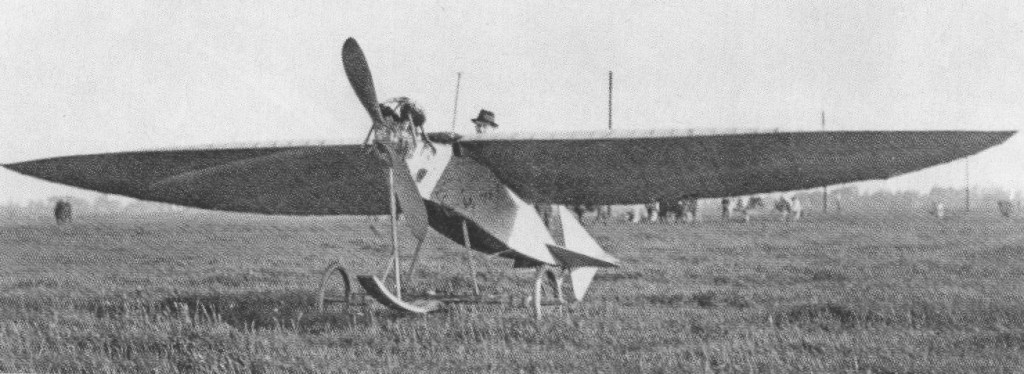
In June 1909 Frederick Handley Page (later Sir) established this company, building a series of monoplanes with crescent-shaped wings inspired by the Austrian designer Jose Weiss.
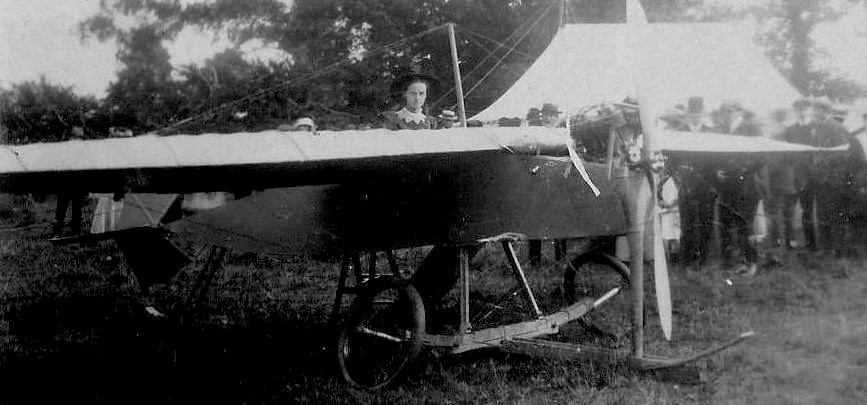
The first powered aeroplane was the type A, or Bluebird, with a 20 hp Advance V-4 engine. It was of wood construction with a tailskid landing gear, using a wing with a shape patented by José Weiss, which was claimed to provide automatic lateral stability, so there were no ailerons or wing warping mechanisms. The wings, fuselage and tail surfaces were covered with a blue-grey rubberised fabric, hence the nickname Bluebird. Priced at £376 at the March 1910 Olympia Aero Exhibition, it found no buyers.
Even after adding a triangular tailplane to the all moving cruciform tail surfaces only a few straight hops were achieved.
When FHP took off on May 26, 1910, the craft side slipped into the ground due to lack of lateral control at the first attempt to make a turn.
Adding wing warping and installing a 26 hp Alvaston engine did not help the redeignated Type C craft to fly. Although a 50 hp Isaacaon was then fitted, it was abandoned unflown.