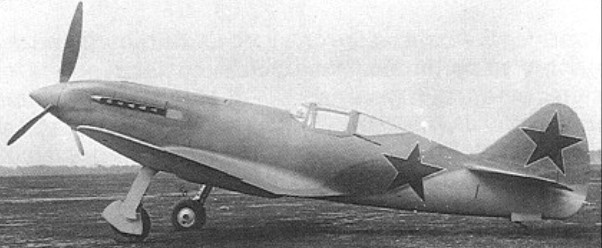
Mikoyan-Gurevich I-270(ZH)

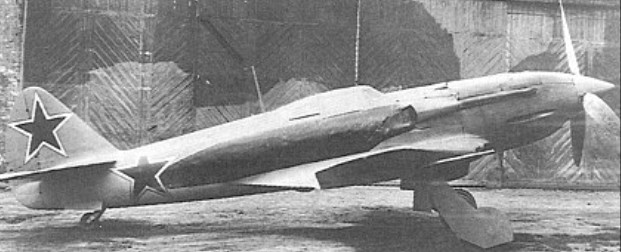
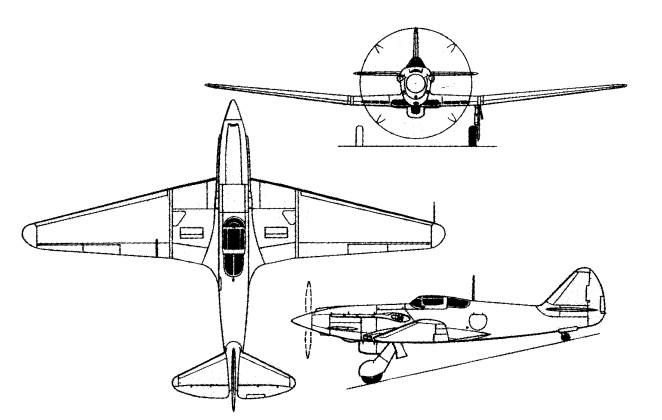
Created to meet a 1945 requirement for a rocket-propelled target defence fighter, the I-270(Zh) was based broadly on the Junkers Ju 248, but was of more conventional configuration. The I-270 featured a straight, near-laminar flow wing, a conventional horizontal tail, and an ejection seat (the first in a Soviet fighter).

The first of two prototypes was initially flown in December 1946 without the rocket motor installed, being towed into the air by a Tu-2.

Only the second prototype was to be fitted with the rocket motor. This, the RD-2M-3V modified version of the 4430 lb / 2010 kgp Walter HWK 509C, developed by L Dushkin and V Glushko, was a bi-propellant dual-chamber unit with a total thrust of 3,196 lb / 1450kg of which the cruise chamber contributed 400kg. The cabin was pressurised and proposed armament comprised two 23mm cannon and eight RS-82 rockets. Calculated endurance was 4 min at maximum thrust and 85 min on the power of the cruise chamber alone.

The first powered flight was carried out with the second prototype early in 1947, and speeds of the order of 620 mph (1000 km/h) were allegedly attained in level flight. The second prototype was written off as a result of a landing crash while being flown by an NII VVS pilot.

Shortly afterwards, the first prototype was damaged in a belly landing and was not repaired, further development was discontinued.

Max take-off weight: 4120 kg / 9083 lb
Empty weight: 1546 kg / 3408 lb
Wingspan: 7.75 m / 25 ft 5 in
Length: 8.91 m / 29 ft 3 in
Height: 3.08 m / 10 ft 1 in
Wing area: 12.00 sq.m / 129.17 sq ft
Max. speed: 1000 km/h / 621 mph
Time to 32,810 ft (10 000 m): 2.37 min
Time to to 49,210 ft (15 000 m): 3.03 min

Mikoyan-Gurevich I-231

A third I-230 airframe was completed early in 1943 with an 1800hp Mikulin AM-39 12-cylinder Vee-type engine and the Izdeliye designation 2D. Apart from the tailplane which was set 20cm lower, this aircraft was basically similar to the first I-230 and retained the same armament of twin synchronised cannon. Assigned the official designation of I-231, the prototype was written off in a landing accident shortly after the completion of factory testing and further development was discontinued.

Engine: 1800hp Mikulin AM-39
Max take-off weight: 3287 kg / 7247 lb
Empty weight: 2583 kg / 5695 lb
Max. speed: 707 km/h / 439 mph
Range: 1350 km / 839 miles

Mikoyan-Gurevich I-225

By early 1944, the VP programme was of little more than academic interest, yet work continued on two further “A” series prototypes, the I-224 and I-225, which had been assigned the Izdeliye designations 4A and 5A respectively.

The I-225 was to enter flight test three months before the I-224, the first of two prototypes flying on 21 July 1944. This was powered by a Mikulin AM-42B 12-cylinder liquid-cooled Vee engine equipped with a TK-300B turbo-supercharger on its starboard side giving 2000hp for take-off and 1750hp at 7500m.

The I-225 featured an improved Shchyerbakov pressure cabin, a 64mm armour-glass windscreen, 8mm seat armour and an armament of four synchronised 20mm ShVAK cannon. The I-225 was of all-metal construction and was flown for the first time on 21 July 1944.

On 2 August, the I-225 reached 707km/h at 8500m, but two days later during its fifteenth flight, the engine of the I-225 seized at an altitude of 15m and the aircraft crashed and proved irreparable.

The second prototype was not flown until 14 March 1945 as the OKB was devoting priority to the I-250. During subsequent testing, the I-225-02, which was powered by an AM-42FB engine with similar ratings to the AM-42B, attained 726km/h which, at the time, was believed to be the highest speed attained by a Soviet piston-engined fighter. This distinction had been gained, however, by the M-108-powered Yak-3M.

I-225-01
Engine: Mikulin AM-42B 12-cylinder liquid-cooled Vee, 2000hp
Max take-off weight: 3900 kg / 8598 lb
Empty weight: 3010 kg / 6636 lb
Wingspan: 11.00 m / 36 ft 1 in
Length: 9.60 m / 31 ft 6 in
Height: 3.70 m / 12 ft 2 in
Wing area: 20.38 sq.m / 219.37 sq ft
Max. speed: 707 km/h
Ceiling: 12600 m / 41350 ft
Range: 1300 km / 808 miles

I-225-02
Engine: Mikulin AM-42FB 12-cylinder liquid-cooled Vee, 2000hp
Wingspan: 11.00 m / 36 ft 1 in
Length: 9.60 m / 31 ft 6 in
Height: 3.70 m / 12 ft 2 in
Wing area: 20.38 sq.m / 219.37 sq ft

Mikoyan-Gurevich I-224

The last of the “A” series high-altitude fighter prototypes to enter flight test, the I-224 was flown for the first time on 20 October 1944. Powered by a Mikulin AM-39B engine rated at 1750hp for take-off, driving an 3.50m diameter propeller with 40cm chord “paddle” blades, and equipped with a single TK-300B turbo-supercharger on the starboard side, the I-224 carried an armament of two synchronised 20mm ShVAK cannon.

A feature of the I-224 was its exhaust system which included four fixed rear facing ejection “chimneys”. The I-224 achieved an altitude of 14,100m during its brief flight test programme which reportedly terminated when a malfunctioning supercharger resulted in an uncontrollable engine fire.

Engine: Mikulin AM-39B, 1750hp
Max take-off weight: 3921 kg / 8644 lb
Empty weight: 3105 kg / 6845 lb
Wingspan: 13.00 m / 42 ft 8 in
Length: 9.51 m / 31 ft 2 in
Height: 3.60 m / 11 ft 10 in
Wing area: 22.44 sq.m / 241.54 sq ft
Max. speed: 693 km/h / 431 mph
Ceiling: 14100 m / 46250 ft
Range: 1000 km / 621 miles

Mikoyan-Gurevich I-222

The first of the “A” high-altitude fighter series to mate turbo-supercharger and cabin pressurisation, the I-222, or 3A, was powered by a Mikulin AM-39B-1 engine of 1750hp for take-off and had a TK-300B turbo-supercharger on its port side.

Armament consisted of two synchronised 20mm ShVAK cannon.

Reverting to the wooden monocoque rear fuselage of the I-220, the I-222 employed a Shchyerbakov-designed pressure cabin of welded dural sheet with inflatable rubber seals and pressurized by air tapped from the compressor. The cockpit was air conditioned for the first time in a Soviet fighter.

The flight test programme began on 7 May 1944, but although plans had been formulated to produce the “A” series altitude fighters in quantity, the course of the war had meanwhile virtually eliminated the threat of high-altitude Luftwaffe attack. Priorities were therefore changed and although the development programme was continued all proposals for series production were discarded.

Engine: Mikulin AM-39B-1, 1750hp
Max take-off weight: 3790 kg / 8356 lb
Empty weight: 3167 kg / 6982 lb
Wingspan: 13.00 m / 42 ft 8 in
Length: 9.60 m / 31 ft 6 in
Wing area: 22.44 sq.m / 241.54 sq ft
Max. speed: 691 km/h / 429 mph
Ceiling: 14500 m / 47550 ft
Range: 1000 km / 621 miles

Mikoyan-Gurevich I-221

Late in 1942, work was well advanced at the MiG bureau on several aircraft in parallel and referred to as Series “A” prototypes, with which the OKB hoped to fulfil a VP (vysotny perekhvatchik, or high-altitude interceptor) requirement raised earlier in the year.

The second Series “A” high-altitude fighter and referred to as the 2A, the I-221 was the first of the OKB’s fighter prototypes to be fitted with turbo-superchargers. The I-221 was fitted with an AM-39A engine rated at 1700hp for take-off and equipped with a centrifugal compressor and paired TsIAM-developed TK-2B turbo-superchargers which, it was anticipated, would permit maximum power to be maintained to an altitude of 13000m. Although adhering closely in most other respects to the preceding I-220, the I-221 had a rear fuselage of dural construction rather than a wooden monocoque, and the outer wing panels were extended, increasing span by a total of 2.00m. Armament consisted of two synchronised 20mm cannon. The initial flight test took place on 2 December 1943, but the programme came to an abrupt end when, during one of the prototype’s early trials, a piston rod fractured, the engine seized and the aircraft crashed.

Mikoyan-Gurevich I-220

Late in 1942, work was well advanced at the MiG bureau on several aircraft in parallel and referred to as Series “A” prototypes, with which the OKB hoped to fulfil a VP (vysotny perekhvatchik, or high-altitude interceptor) requirement raised earlier in the year. The first of these, the I-220, owed little or nothing to earlier MiG fighters and was of mixed construction, the fuselage being of metal forward of the cockpit and a wooden monocoque aft, and the wings making use of steel main and auxiliary spars with spruce outer panel ribs.

The first prototype, which was rolled out of the factory in June 1943 and was first flown during the following month, was initially powered with a low-altitude Mikulin AM-38F engine of 1700hp. Armed with two synchronised 20mm ShVAK cannon, the AM-38F-powered I-220 achieved speeds of 572km/h at sea level and 630km/h at 7000m, practical ceiling being 9500m. The prototype was then re-engined with a medium-altitude AM-39 affording 1800hp for take-off and flown in January 1944, flight testing continuing until the following August. A second prototype also powered by the AM-39 flew in September 1944, but differed in armament, being the first Soviet fighter to carry four 20mm ShVAK cannon.

The second Series “A” high-altitude fighter and referred to as the 2A, or the I-221.

The programme came to an abrupt end when, during one of the prototype’s early trials, a piston rod fractured, the engine seized and the aircraft crashed.

Prototype 2
Engine: Mikulin AM-38
Max take-off weight: 3647 kg / 8040 lb
Empty weight: 3101 kg / 6837 lb
Wingspan: 11.00 m / 36 ft 1 in
Length: 9.60 m / 31 ft 6 in
Height: 3.16 m / 10 ft 4 in
Wing area: 20.38 sq.m / 219.37 sq ft
Max. speed: 697 km/h / 433 mph
Ceiling: 11000 m / 36100 ft
Range: 630 km / 391 miles

Mikoyan-Gurevich I-211 / Ye

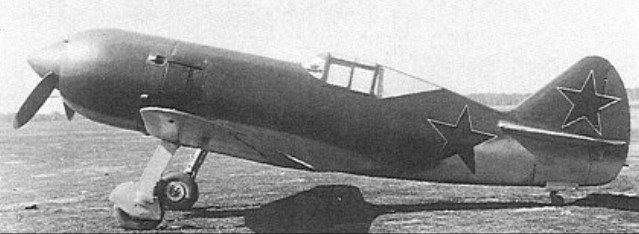
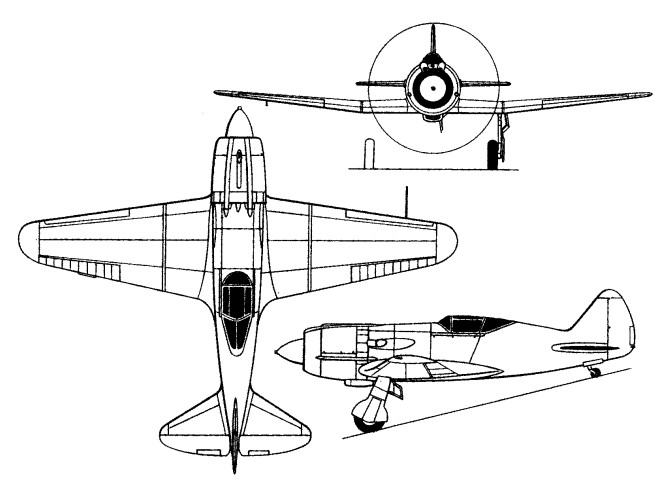
After completion by the TsAGI of full-scale wind tunnel testing of the I-210 / IKh, the OKB redesigned the junction between the engine cowling and the fuselage. It moved the pilot’s cockpit aft, enlarged the vertical tail surfaces, redesigned the engine cowling and repositioned the oil cooler intakes in the wing roots. The undercarriage was redesigned, power was provided by a Shvetsov M-82F radial engine of 1700hp and armament was restricted to a pair of wing-mounted 20mm ShVAK cannon. Only the outer wing panels of the MiG-3 remained and slots were applied to these.

This thorough-going redesign of the I-210 was referred to as the I-211, or Ye, a pre-series batch of 10 aircraft being laid down of which the first flew in August 1942. Factory testing was completed within one month, the results being highly successful, but no manufacturing capacity was available for production, and all aerodynamic data and information on the slots were passed to the Lavochkin OKB as a result of a ministerial request.

Engine: Shvetsov M-82F radial, 1700hp
Max take-off weight: 3100 kg / 6834 lb
Empty weight: 2528 kg / 5573 lb
Wingspan: 10.20 m / 33 ft 6 in
Length: 7.95 m / 26 ft 1 in
Height: 3.63 m / 11 ft 11 in
Wing area: 17.44 sq.m / 187.72 sq ft
Max. speed: 670 km/h / 416 mph
Range: 1140 km / 708 miles
Armament: 2 x 20mm ShVAK cannon

Mikoyan-Gurevich I-210

Late in 1941, series production of the MiG-3 was being phased out. The AM-35A engine manufacture was being discontinued as priority having been assigned to the AM-38 for the IL-2 Shturmovik. An attempt was made to adapt the basic airframe to take the 1700hp Shvetsov M-82A 14-cylinder air-cooled radial.

Assigned the Izdeliye designation IKh by the OKB and the provisional official designation I-210, and also referred to unofficially as the MiG-3M-82, the first of five airframes adapted to take the new engine was flown in December 1941.

The M-82A weighed only 20kg more than the AM-35A that it supplanted, but was 38cm wider, a new forward fuselage being necessary to cater for the cross section translation from the circular cowling to the oval centre fuselage. The armament consisted of three 12.7mm guns.

Plans were prepared to initiate IKh production as the MiG-9, but flight test revealed a serious drag problem, severe tail vibration and poor control characteristics. Despite the disappointing results of factory testing, the first aircraft was fitted with yet two more 7.62mm guns and sent to the Kalinin Front. The TsAGI, meanwhile, conducted full-scale wind tunnel testing with one of the IKh aircraft, resulting in development of the I-211.

Engine: 1700hp Shvetsov M-82A 14-cylinder air-cooled radial
Take-off weight: 3382 kg / 7456 lb
Empty weight: 2720 kg / 5997 lb
Wingspan: 10.20 m / 33 ft 6 in
Length: 8.08 m / 26 ft 6 in
Wing area: 17.44 sq.m / 187.72 sq ft
Max. speed: 565 km/h / 351 mph
Range: 1070 km / 665 miles

Mikoyan-Gurevich MiG-3U / I-230

With the primary objective of improving the aerodynamics of the basic MiG-3 design, the OKB began work late in 1941 on an enhanced version of the fighter to which it gave the Izdeliye designation of D. Known officially as the I-230, and later as the MiG-3U – the suffix letter signifying uluchshenyi (improved) – the new fighter was first flown in August 1942.

Whereas the fuselage of the MiG-3 was primarily of steel tube with duralumin skinning, that of the I-230 was almost entirely of wood owing to the contemporary metal shortages. By comparison with the MiG-3, the fuselage was lengthened by 37cm, but the Mikulin AM-35A engine was retained and the wing of the first prototype was unchanged, armament consisting of two 20mm SP-20 (ShVAK) cannon mounted above the engine.

The second prototype differed in having a larger wing of 18.00sq.m area and spanning 11.00m. Performance proved good during factory and state trials, but it was not possible to reinstate production of the AM-35A and production of the I-230 was therefore restricted to a pre-series of five aircraft which were assigned to a Guards Regiment (1 GvIAP) on the Kalinin front for service evaluation.

Prototype 1
Engine: Mikulin AM-35A, 1200 hp
Wingspan: 10.20 m / 33 ft 6 in
Length: 8.62 m / 28 ft 3 in
Wing area: 17.44 sq.m / 187.72 sq ft
Max take-off weight: 3285 kg / 7242 lb
Empty weight: 2612 kg / 5759 lb
Max. speed: 660 km/h / 410 mph
Range: 1350 km / 839 miles