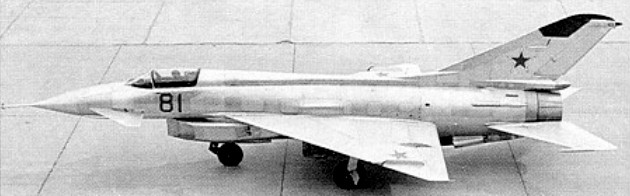
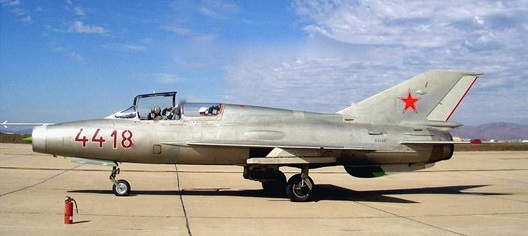
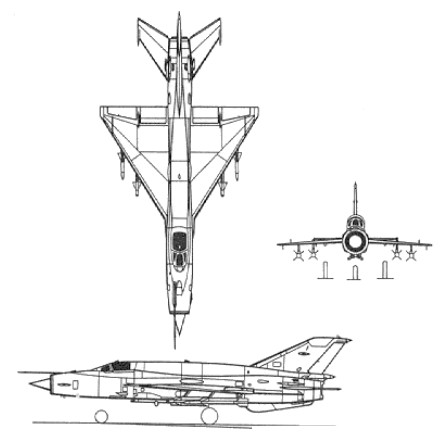
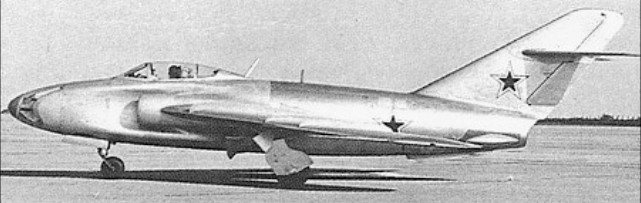
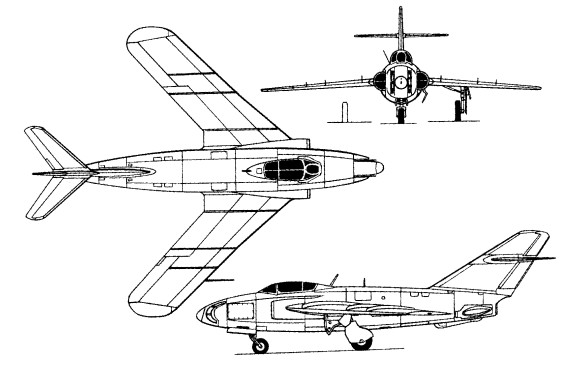
During 1961, the MiG OKB initiated work on an upgraded fighter based on the basic MiG-21PF airframe and referred to contemporaneously as the MiG-23. Assigned the OKB designation Ye-8, it featured a bifurcated ventral air intake for the R-21F engine, which, developed by N Metskhvarishvili, was rated at 4500kg and 7000kg with afterburning. A variable-incidence canard spanning 2.60m was fitted – this having been earlier tested by a Ye-6T – and it was proposed to install Sapfir 21 radar to accompany an armament of two K-13 AAMs. The first of two prototypes, the Ye-8/1, was flown on 17 April 1962, followed on 29 June by the Ye-8/2. On 11 September, the R-21F engine of the Ye-8/1 exploded at Mach=1.7 at 10000m. It was subsequently ascertained that the sixth compressor stage fan had penetrated the engine casing and had then continued on to destroy the starboard aileron. At this time, the Ye-8/2 had effected 13 flights, but the programme was abandoned.
Max take-off weight: 8200 kg / 18078 lb Wingspan: 7.15 m / 23 ft 5 in Length: 14.90 m / 48 ft 11 in Wing area: 23.13 sq.m / 248.97 sq ft Max. speed: 2230 km/h / 1386 mph Ceiling: 20000 m / 65600 ft
Designed in the 18 months following the Korean War, the Mikoyan-Gurevich bureau concentrated on a small day interceptor of the highest possible performance. Prototypes were built with both swept and delta wings, both having powered slab tailplanes, and the delta was chosen for production. At least 30 preproduction aircraft had flown by the time service delivery started.
The definitive prototypes with R-11 engines were the Ye-2A with swept wings and the Ye-5 with delta wings, these flew in May and June 1956 respectively, and were soon involved in comparative trials that showed the tailed delta configuration to have slight performance and operational advantages. The Ye-5 therefore became the basis for the Ye-6 prototype that was used to eradicate the various propulsion and flight-control problems besetting the programme, and in 1958 production was authorized of the MiG-21 fighter. The initial production version (NATO Fishbed-A) was built in only limited numbers from 1958. Power was provided by a Tumansky R-11 turbo-jet engine rated at 50kN (with after-burning). The initial MiG-21 included Fowler flaps, fully powered controls, upward ejection seat fixed to the rear of the front-hinged canopy (which incorporated the whole front of the cockpit enclosure except the bullet-proof windshield) to act as a pilot blast-shield, and internal fuel capacity of only 410 gal. Armament was two 30 mm NR-30 in long fairings under the fuselage, the left gun usually being replaced by avionics.
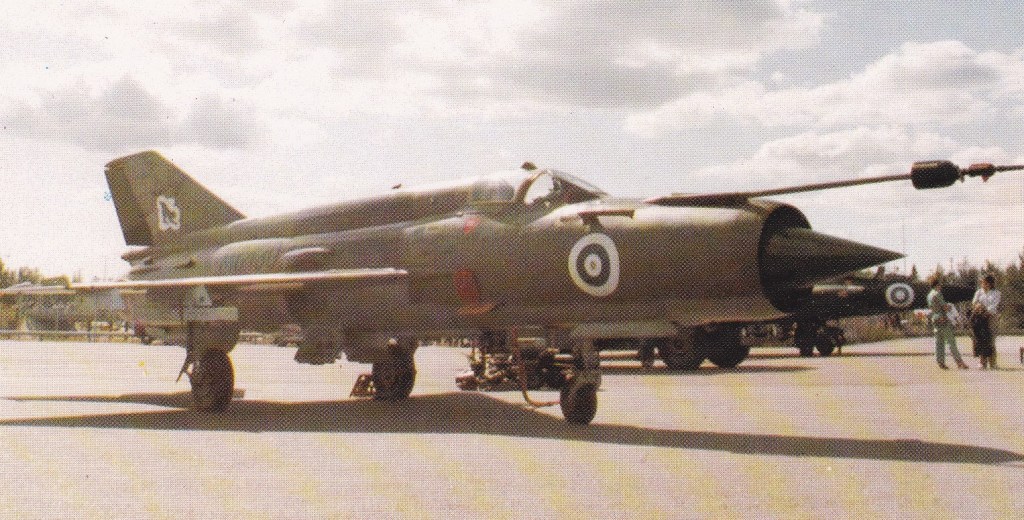
The Soviet Union had developed the K-13 (NATO Atoll) infra-red homing air-to-air missile and two pylons for two K-13 were fitted to the more powerful MiG-21F of 1959. The F became known to NATO as Fishbed-C and was a short-range clear-weather fighter (one 30mm cannon only) powered by a 56.4kN / 12,676lb st (with afterburning) Tumansky R-11. This had radar ranging, 515 gal fuel, broader fin, upward-hinged pitot boom attached under the and two dorsal blade aerials. In most 21 Fs the port cannon is removed, to save weight and provide space for the electronic pack serving two K 13A air to air missiles (AAMs), simple copies of Sidewinder called Atoll by NATO, carried on underwing rails. As the 21F matured, the fin was increased in chord and the braking parachute moved to a cylindrical box at the base of the rudder, while various aerials betrayed the presence of such standardized electronics as the UHF/VHF in the fin cap, rear warning radar (Sirena 3) and SRO series SIF/IFF (called Odd Rods by NATO). Exports began in April 1963 with the F-12 for Finland and F 13 for India (which called it Type 74) and Iraq. Czech-built aircraft (still called 21F) did not have the rear-view windows in the front of the dorsal spine. The F was also the type supplied to China in 1959 and used as the pattern for the Chinese-built F-8. As the oldest active variant it was also the first exported or seen in the West.
MiG-21F
In 1964 it was reported the unit cost to India was $500,000. India lost two of its first six in a mid-air collision in December 1963 and a second batch of six was scheduled for June 1964 delivery.
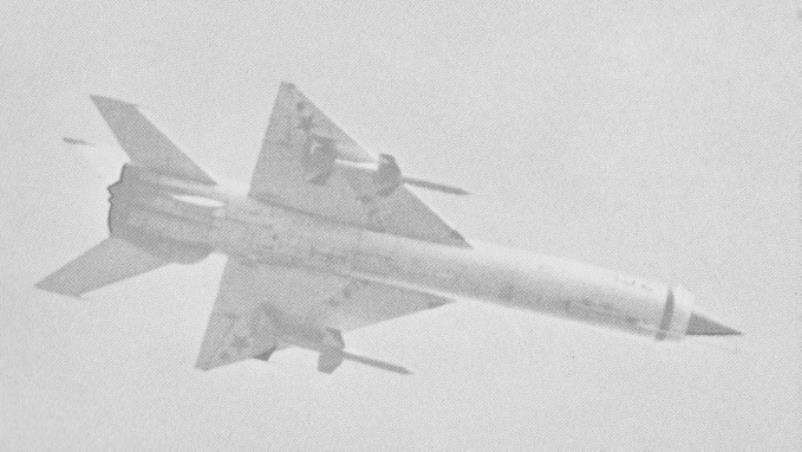
The MiG-21 programme spawned its own series of developments through various prototypes, and there were also a number of experimental and record-breaking prototypes such as the Ye-33 version of the MiG-21U operational conversion trainer used for climb and altitude records for women pilots; the Ye-66 version of the MiG-21F used for a speed record; the Ye-66A with a U-2 rocket in a belly pack for an altitude record, the Ye-66B with twin rockets; the Ye-76 version of the MiG-21PF for a number of women’s records; the Ye-8 with a powered canard foreplane to validate such a feature for the proposed MiG-2lSht attack fighter; the MiG-21DPD with two direct-lift jets in an extra fuselage bay on the centre of gravity, and the A-144 with a scaled-down version of the wing proposed for the Tupolev Tu-144 supersonic airliner. Trials in the direct-lift approach started with the MiG-21DPD to validate the basic concept.
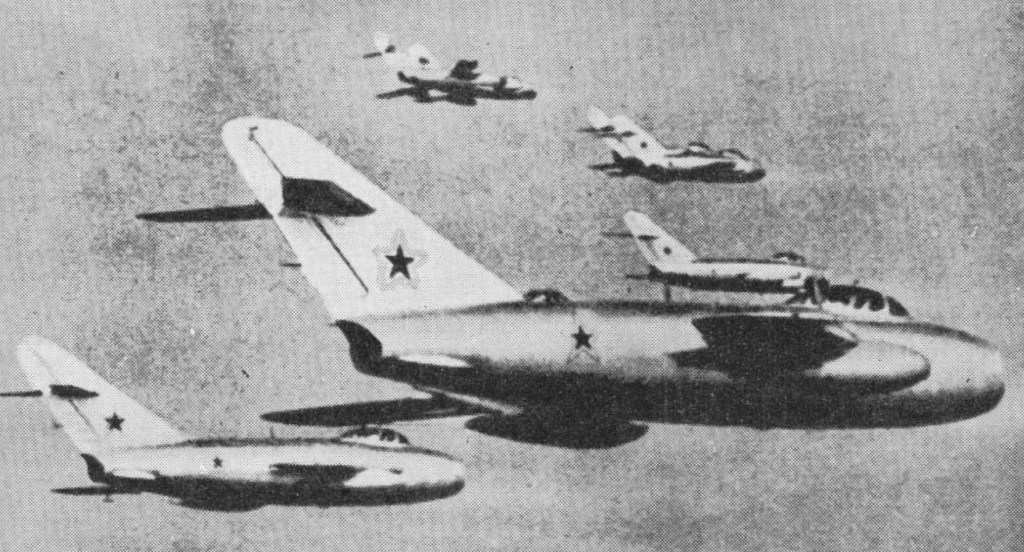
1961 Soviet Aviation Day fly-past
At Tushino in 1961 the prototype was displayed of what became the 21PF, with inlet diameter increased from 27 in to 36 in, completely changing the nose shape and providing room for a large movable centre-body housing the scanner of the R1L AI radar. Other changes included deletion of guns (allowing simpler forward airbrakes), bigger mainwheels (causing large fuselage bulges above the wing), pitot boom moved above the inlet, fatter dorsal spine (partly responsible for fuel capacity of 627 gal) and many electronic changes.
Fishbed E is the NATO name for the C or D version with extra broad fin, relocated brake chute and restored gun armament in the form of the GP 9 belly pack housing the GSh 23 twin barrel 23 mm (0.90 in) gun, with predictor sight and simple radar ranging. The MiG 21FL, from lokator (locator), has the R2L (Spin Scan B) radar. Extra broad fin and relocated chute are standard, as is the F2S¬300 engine, but not SPS or ATO rockets. India calls this the Type 77, and it was the first version made under licence by Hindu¬stan Aeronautics, some 100 being assembled from Soviet parts in 1966 70 and about another 96 with increasing Indian content in 1970 73. The 1964 MiG-21PF ‘Fishbed-D’ was the first of a new series with search/track radar to improve all-weather capability. It has an uprated engine with afterburner and rocket ¬assisted take-off.
The MiG-21F ‘Fishbed-C’ paved the way for the MiG-21PF ‘Fishbed-D’ of 1960 with the uprated R-11F engine and an enlarged inlet to allow the incorporation of R1L ‘Spin Scan-A’ radar in the centrebody, the MiG-21PFS ‘Fishbed-E’ with blown flaps and a ventral pod carrying a 23mm GSh-23L two-barrel cannon.
A further development, the MiG-2IPFM ‘Fishbed-F’ incorporating all the sequential improvements of earlier models, was soon superseded by the MiG-21PFMA ‘Fishbed¬ J’ which is a multi-role aircraft with four underwing pylons and a GSh 23-mm twin-barrel gun. It also carries four radar-homing ‘Atoll’ air-to-air missiles.
All PF had an uprated engine, late models had take-off rocket latches and final batches had completely, new blown flaps (SPS) which cut landing speed by 25 mph and reduced nose-up attitude for better pilot view. The FL was the export PF (L = lokator, denoting R2L radar) with even more powerful engine. Like the F models rebuilt in 1963-4, this can carry the GP-9 gunpack housing the GSh-23 23 mm twin-barrel gun, has a still further broadened vertical tail and drag-chute repositioned above the jetpipe. The PFS was the PFP with SPS blown flaps, while the PFM was a definitive improved version with another 19 in. added to the fin (final fillet eliminated), a conventional seat and side-hinged canopy, and large flush aerials in the fin. One-off versions were built to prove STOL with lift jets and to fly a scaled -analogue- of the wing of the Tu-144 SST.
From the MiG 21PFM stemmed a 1966 model, the PFMA, called Fishbed J. This was a supposed multi role version with four underwing pylons, provision for a belly tank or GP 9 gunpack, either ‘Jay Bird’ radar or infrared versions of K 13A and with three tank fitted pylons to offset the reduced internal fuel capacity of 2600 litres (572 Imp gal), despite the new deep dorsal spine giving an almost straight line from canopy to fin. Other changes included a zero/zero seat (ejector seat usable at zero height and zero speed), improved weapon aiming subsystem with alpha (angle of attack) sensor in a fairing on the left side of the nose, and pitot boom offset to the right. The -J featured an internal GSh-23L cannon.
The PFMA, made in huge numbers, and since 1973 has been built in India as Type 88, produced by Hindustan Aeronautics in 1973 78. The R-13 turbojet was introduced about 1970 in the multirole MiG-21M Fishbed J. After 1971 production switched to the re-engineered third-generation MiG-2lbis Fishbed L, with more internal fuel and updated avionics. The MiG 21MF is the all weather fighter/bomber variant of the MiG 21 family. It is derived from the MiG 21 F, but is much heavier, more powerful and equipped with a large avionics suite. The original reconnaissance model was the MiG-21R Fishbed H (based on the MiG21PFMA which introduced the large dorsal spine, a common feature of the ‘Fishbed’), produced in several sub-types with equipment ranging from basic internally-mounted optical cameras (occupying the area previously used to accommodate the integral twin-barrelled GSh-23 23-mm cannon armament) to an external pod system known to house forward and oblique cameras plus infra-red linescan apparatus. Powered by a single Tumansky R-11 turbojet, all variants of the MiG-21R can also operate with wingtip-mounted electronic countermeasures pods. More recently, the principal ‘Fishbed H’ reconnaissance derivative was the MiG-21RF which is essentially similar to the MiG-21MF in relying on the Tumansky R-13-300 engine offering greater power and featuring increased airflow despite being no larger. Sensor packages and equipment are probably the same as those incorporated in the earlier MiG-21R variant.
(23+99) Mikoyan-Gurevich MiG-21 US 01685134 – marked 215
Other versions include the MiG-21U, MiG-21UM, and MiG-21US NATO code name Mongol two-seat operational trainer and the ‘Fishbed-K’ which had modifications to the airframe of the basic ‘MF’ type. The Mongol A was a conversion of the Fishbed C, while the Mongol B had broad chord fin of the later single seat variants.
The first of the third-generation types was the MiG-21bis ‘Fishbed-L’ with a stronger yet lighter airframe and updated avionics.
The 1987 final MiG-21bis ‘Fishbed-N’ has the 73.6kN-thrust Tumansky R-25 turbojet and provision for more modern weapons. Indian licence manufacture was scheduled to end early in 1987. Also licence built in China as the Shenyang J-7 types (F-7 for export).
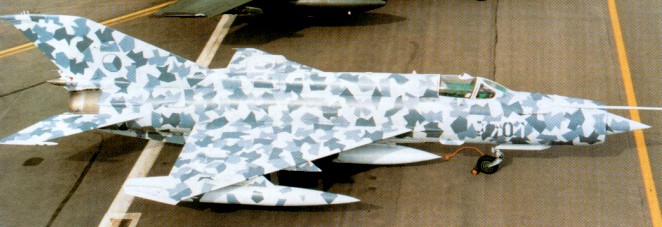
Code-named Mongol and called Type 66 in India, the U is the tandem trainer, the US has SPS flaps and UM the R-13 engine and four pylons. Many other versions have been used to set world records. About 10,000 MiG-21s have been built, and among users are Afghanistan, Algeria, Bangladesh, Bulgaria, China, Cuba, Czechoslovakia, Egypt, Finland, East Germany, Hungary, India, Indonesia, Iraq, North Korea, Poland, Romania, Syria, Vietnam and Yugoslavia.
In 1963 pilots assigned to test India’s MiG-21’s claimed to have reached mach 2. Previously rated at mach 1.7, this implied the USSR was supplying R37F engines estimated at 13,00 lb thrust with afterburner as used in the E-66 world speed record holder. The Indian government had asked USSR for other “modifications” and had received seven so far. Indian production was planned to begin by the end o 1965.
Over 15 variants were developed and more than 8000 aircraft were produced. Pakistan is still taking delivery of improved versions of the F-7, produced by China, to replace its Chinese F-6 aircraft (basically an improved version of the MiG-19). The MiG-21-93 is one of the upgrades for the Fishbed, especially Indian MiG-21s are or will be upgraded to this version. Also IAI introduced an upgrade package, called the MiG-21-2000, Elbit refurbished and updated Romanian MiG-21s to the MiG-21 Lancer standard.
Produced from 1959 to 1985, not including the Chengdu J-7 variant, 10,645 were produced in the USSR, 657 in India, and 194 in Czechoslovakia.
MiG-21F (Fishbed-C) Engine: Tumanski R37F (4500/6000kp) Length: 44.16 ft / 13.46 m Height: 14.764 ft / 4.5 m Wingspan: 23.458 ft / 7.15 m Wing area: 247.572 sqft / 23.0 sq.m Max take off weight: 17088.8 lb / 7750.0 kg Weight empty: 12017.3 lb / 5450.0 kg Max speed: 1145 kts / 2120 km/h Service ceiling: 57415 ft / 17500 m Wing load: 69.09 lb/sq.ft / 337.0 kg/sq.m Maximum range: 999 nm / 1850 km Range (max. weight): 648 nm / 1200 km Crew: 1 Armament: 1 MG 30mm, 2x Atoll A/AM
MiG-21FA Engine: 1 x Tumansky single-shaft turbojet with afterburner Wing span 23 ft 5½ in (7.15 m).
MiG-21FL Engine: 1 x Tumansky R-11-G2S-300 single-shaft turbojet with afterburner, 13,668 lb (6200 kg) Wing span 23 ft 5½ in (7.15 m)
MiG-21PF (Fishbed-D) Radar inlet centrebody Powerplant: one 60.00 kN (22,110 lb st) Tumanskii R-11 F2-300 turbojet with afterburning Fuselage length 12.285m (40 ft 3½ in) Height 4.806m (15 ft 9 in ) Wing span 7.154m (23ft 5½ in) Take-off weight (clean) 7,750 kg (17,085 lb) Max Take-Off Weight estimated 8,800 kg (19,400 lb) Max level speed at 13,000m (42,650 ft) Mach 2.05 or 2,175 km/h (1,353 mph) Max level speed at sea level Mach 1.2 or 1,300 km/h (809 mph) Service ceiling 19,000m (62,320 ft) Armament: 2 R-13R (AA-2 Atoll) IR air-to-air missiles or two rocket pods, with each up to 16 57mm unguided rockets, carried on two underwing pylons and one 490 liter (129 gal) drop tank carried on the centre line
MiG-21PFS (Fishbed-E) Engine: 1 x Tumansky R-11-G2S-300 single-shaft turbojet with afterburner, 13,668 lb (6200 kg) Wing span 23 ft 5½ in (7.15 m).
MiG-21PFM (Fishbed-F) Blown flaps Engine: 1 x Tumansky R-11-G2S-300 single-shaft turbojet with afterburner, 13,668 lb (6200 kg) Wing span 23 ft 5½ in (7.15 m).
MiG-21PFMA (Fishbed-J) Type: single-seat fighter Engine: 1 x Tumansky R-11-G2S-300 single-shaft turbojet with afterburner, 13,668 lb (6200 kg) Wing span 23 ft 5½ in (7.15 m).
MiG-21 Fishbed K Engine: 1 x Tumanski R-13-300, 14,550 lb / 6600 kg thrust Empty weight: 12,302 lb / 5580 kg Wingspan: 23 ft 5.5 in / 7.15 m Length: 51 ft 8.5 in / 15.76 m Height: 13 ft 5.5 in / 4.10 m Wing area: 247.6 sq.ft / 23.0 sq.m MTOW: 20,723 lb / 9400 kg Speed: 1385 mph / 2230 kph Ceiling: 50,000 ft / 15,250 m Range: 460 mi / 740 km Bombload: 3307 lb / 1500 kg Armament: 1 x 23mm GSh-23L cannon Seats: 1
MiG-21PFMA Engine: Tumanski R-11F2S-300, 13,668 lb. Wingspan: 23 ft 5.5 in / 7.15 m Length: 51 ft 8.5 in / 15.75m MTOW: 20,725 lb / 9400 kg Max speed: 1335 mph / 2150 kph Ferry range: 1118 sm / 1800 km Armament: 1 x 23 mm cannon (200 rds), up to 2000 kg external load.
MiG-21M Engine: 1 x Tumansky single-shaft turbojet with afterburner Wing span 23 ft 5½ in (7.15 m)
MiG-21MF Fishbed-J Engine: 1 x Tumansky R-13-300 single-shaft turbojet with afterburner, 14,550 lb (6600 kg) Wing span 23 ft 5½ in (7.15 m) Length (excluding probe): 48 ft ½ in (14.6 m) Height: 14 ft 9 in (4.5 m) Empty wt: 12,346 lb (5600 kg) MTOW: 21,605 lb (9800 kg) Maximum speed: 1,285 mph (2070 km/h, Mach 2.1) Initial ROC (clean): 36,090 ft (11,000 m)/min Service ceiling: 59,050 ft (18,000 m) Range (high, internal fuel): 683 miles (1100 km) Maximum range (high, three tanks) 1,118 miles (1800 km)
Mikoyan Gurevich OKB MiG 21 MF Engine: Tumanski R-11, 637650 N / 65000 kp Length: 45.932 ft / 14.0 m Height: 14.764 ft / 4.5 m Wingspan: 23.458 ft / 7.15 m Wing area: 247.572 sqft / 23.0 sq.m Max take off weight: 20727.0 lb / 9400.0 kg Max speed: 1204 kts / 2230 km/h Wing load: 83.85 lb/sq.ft / 409.0 kg/sq.m Range: 972 nm / 1800 km Crew: 1 Armament: 2x MG 23mm/100rds, 2-4 Atoll o. 1000kg / 4 St.
MiG-21SMT/SMB (Fishbed-K)
MiG-21bis-A (Fishbed-L) Engine: Tumansky R37F (4500/6000kp) Wing span: 23 ft 5.5in (7.15 m) Length: 45.932 ft / 14.0 m Height: 14.764 ft / 4.5 m Wing area: 247.572 sqft / 23.0 sq.m Max take off weight: 19514.3 lb / 8850.0 kg Weight empty: 12017.3 lb / 5450.0 kg Wing loading: 78.93 lb/sq.ft / 385.0 kg/sq.m Max speed: 1145 kts / 2120 km/h / M 2.11. Initial climb rate: 29527.56 ft/min / 150.00 m/s Service ceiling: 57415 ft / 17500 m Range: 999 nm / 1850 km Crew: 1 Armament: 2x ext. 500kg zB 2x Atoll A/A
MiG-21bis-B (Fishbed-N) Powerplant: one 69.61 kN (25,650 lb st) Tumanskii R-25-300 turbojet with afterburning Fuselage length 12.285m (40 ft 3½ in) Height 4.10m (13 ft 5½ in) Wing span 7.154m (23ft 5½ in) Take-off weight (clean) 8,725 kg (19,235 lb) Max Take-Off Weight 10,400 kg (22,925 lb) Max level speed at 13,000m (42,650 ft) Mach 2.05 or 2,175 km/h (1,353 mph) Max level speed at sea level Mach 1.4 or 1,450 km/h (902 mph) Service ceiling 17,800m (58,400 ft) Armament: one 23mm GSh-23L two-barrel cannon with 200 rounds; 1500 kg (3,307 lb) of disposable stores, Hardpoints: five (including centre line)
MiG-21bisF Fishbed N Single seat multi-role fighter Engine: Tumanskii R-25, 16,535 lb / 7500 kg Wingspan: 23 ft 5 in / 7.15m Height: 13 ft 5 in / 4.10 m Wing area: 247.58 sq.m / 23.00 sq.m Empty weight: 22,464 lb / 5200 kg Max TOW: 17,549 lb / 7960 kg Max speed: 1385 mph / 2229 kph / M2.1 at 36.090 ft / 11,000m Iniial rate of climb: 57,900 fpm / 17,675 m/min Service ceiling: 50,030 ft / 15,250m Eange: 721 miles / 1160 km Armament: 1 x 23mm twin barrel cannon Bombload: 4409 lb / 2000 kg
MiG-21R Type: single-seat reconnaissance Wing span 23 ft 5½ in (7.15 m).
MiG-21RF Type: single-seat tactical reconnaissance aircraft Powerplant: one Tumansky R- 3-300 turbojet, 6600-kg (14,550-1b) afterburning thrust Maximum speed at sea level 1300 km/h (810 mph) or Mach 1.06 Maximum speed at altitude 2230 km/h (1,385 mph) or Mach 2.1 Service ceiling 17500 m (57,400 ft) Range with maximum fuel 1670 km (1,038miles) Maximum take-off weight 9400 kg (20,723 lb) Wimgspan 7.15 m (23 ft 5 ½ in) Length 15.76 m (5 1 ft 8 ½ in) Height about 4.06 m (13 ft 4 in) Wing area 23.00 sq.m (247.6 sq ft).
In 1953 the Soviet authorities issued a requirement for a Mach 2 clear-weather interceptor with limited ground-attack capability. At this time the USSR’s Central Aerodynamics and Hydrodynamics Institute had arrived at two basic configurations for aircraft of the required performance level. Both were based on a cylindrical fuselage with a swept all-moving tailplane and a wing in the low mid-set position, but the difference came in the wing itself. One was a conventional type with a leading-edge sweep of between 580 and 620, and other a delta with 570 or 580 leading-edge sweep. The MiG bureau produced prototypes in both configurations. The Ye-50 and Ye-4.
An RD-9Ye turbojet was used in the Ye-4 with a delta wing, which first flew in December 1955. The Ye-4 was the true progenitor of the MiG-21, becoming the Ye-4/2 with airflow fences.
By early 1954, the MiG OKB was involved in a design programme with the objective of developing a comparatively lightweight interceptor fighter capable of attaining Mach=2.0 and altitudes of the order of 20,000m. At this time, the respective advantages of two favoured configurations – the thin, highly sweptback wing and the pure delta wing, both mated with slab-type horizontal tail surfaces – had still to be resolved. The OKB elected, to build aerodynamic test vehicles in parallel utilizing both configurations, the first to fly being that with the sweptback wing. Referred to as the Ye-1, this aircraft was originally to have been powered by an AM-5A turbojet. With the availability of the AM-9B engine of 2600kg and 3250kg with afterburning, the airframe was modified to take the more powerful unit, and, armed with two 30mm NR-30 cannon, was flown as the Ye-2 on 14 February 1955. As no clear advantage between the Ye-2 and the delta-winged Ye-4 was immediately obvious, an additional prototype of each configuration, the Ye-2A and Ye-5, was ordered, these having the Tumansky-developed AM-11 (R-11) engine of 3800kg and 5100kg with afterburning. The swept-back Ye-2A flew for the first time on 22 March 1956, and a pre-series of five more aircraft was built – these being provisionally assigned the designation MiG-23 – for evaluation purposes, but, in the event, the delta-winged Ye-5 was deemed to offer marginally superior characteristics and was chosen for large-scale production.
Max take-off weight: 6250 kg / 13779 lb Empty weight: 4340 kg / 9568 lb Wingspan: 8.11 m / 26 ft 7 in Length: 13.23 m / 43 ft 5 in Wing area: 21.00 sq.m / 226.04 sq ft Max. speed: 1900 km/h / 1181 mph Ceiling: 18000 m / 59050 ft
Despite termination of trials in 1951 with the SU derivative of the MiG-15 featuring paired 23mm cannon on articulated mountings, the basic concept of gun armament capable of elevation and depression for air-air use was persisted with by the MiG OKB. In 1953, flight testing of a more sophisticated development of the concept began as Izdeliye SN. A variation of the MiG-17, the SN featured lateral air intakes, the 2900kg VK-1A turbojet being fed by circular orifices against concave fuselage sides forward of the wing roots. This arrangement permitted installation of the SV-25 armament system of three 23mm TKB-495 cannon mounted asymmetrically (one to port and two to starboard) on an articulated mounting in the nose section. Operated electrically, the cannon could be elevated to 27° 26′ and depressed to 9° 48′, the complete SV-25 system weighing 469kg. Trials with the SN were discontinued owing to aiming complexities combined with advances in air-to-air missiles.
Engine: 1 x 2900kg VK-1A turbojet Take-off weight: 5620 kg / 12390 lb Empty weight: 4152 kg / 9154 lb Wingspan: 9.63 m / 31 ft 7 in Length: 12.33 m / 40 ft 5 in Height: 3.80 m / 12 ft 6 in Wing area: 22.60 sq.m / 243.26 sq ft Max. speed: 1058 km/h / 657 mph Ceiling: 14500 m / 47550 ft
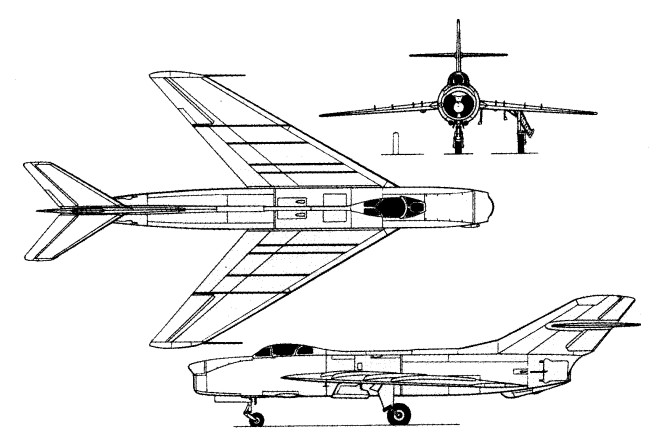
Early in 1949, in parallel with work on the SD (MiG-l5bis), the MiG OKB launched a more thoroughgoing redesign of the basic MiG-15 as the SI, alias 1-330. The SI was intended to afford improved transonic behaviour, achieved by mating the existing fuselage (forward of the rear frame of the engine plenum chamber) with a lengthened rear fuselage and an entirely new wing possessing better compressibility charac¬teristics, having leading-edge sweep of 45 deg inboard and 42 deg outboard. A mark of identification was the MiG-17’s three boundary layer fences on each wing.
The Klimov VK-l engine of the SD was retained, together with the armament of one 37-mm and two 23-mm cannon. The first prototype, officially flown on 13 January 1950, allegedly attained M 1.03, but crashed in March 1950. Following the loss of the first prototype, a second and further improved prototype took over, the test programme being completed on 20 June 1951 and series production being ordered as the MiG-17. Production began with a day fighter model (NATO `Fresco-A’), which retained the VK-1 engine.
The MiG 17 was preferred to the Yak 50 and entered service with the Soviet air force in its Fresco A form during 1952. Its power¬plant was a Klimov VK 1 turbojet producing 2700 kg (5950 lb) of thrust, the same as in the MiG 15 bis, and the armament was similar: one 37 mm (1.46 in) N 37 cannon and a pair of 23 mm (0.90 in) NR 23s, aimed with the aid of a simple gyro gunsight. Air to surface armament could also be carried in the form of four UV 8 57 pods each containing eight 5.5 cm (2.16 in) S 5 rockets, two 21 cm (8.26 in) rockets, two 250 kg (551 1b) bombs or 240 litre (53 Imp gal) drop tanks. The use of steel underwing beams allowed two rocket pods or bombs to be carried inboard, with drop tanks on the outboard pylons.
Fresco B was the MiG-17P, flown as a prototype in 1951, fitted with an S band ‘Izumrud’ (Emerald) radar, known as Scan Fix in the West, with the main dish mounted on the intake splitter and the rang¬ing element housed above in the lip discardingd the 37-mm cannon in favour of a third 23-mm weapon. The fuselage was lengthened by 127 mm (5 in) and the cockpit glazing was modified to cater for additional displays. In the event, production of the MiG-17P was to be limited pending availability of the afterburning VK-1F engine.
Experimental versions included the SN, a ground attack model of the VK-1-engined fighter, which, flown in November 1953, featured lateral air intakes and twin 23-mm nose-mounted cannon which could be hydraulically elevated or depressed (± 40 deg). Another, the SP-2 flown in 1951, was a limited all-weather version with a higher-powered Korshun (Kite) search radar and a twin 23-mm cannon armament. During the course of 1953, production of the MiG-17 gave place to the improved MiG-17F.
Availability of an afterburning version of the Klimov engine, the VK-1F offering 7,452 lb st (3 380 kgp) for three minutes, resulted in the SF, which, flown in 1951, was cleared for series production as the MiG-17F Fresco C (Forsirovannyi, or, literally, “boosted”) in April 1953. Apart from a cut-back rear fuselage exposing the variable nozzle, the MiG-17F featured shorter and deeper air brakes; those on the new variants were larger than their predecessors, mounted in a different position on the fuselage and operated by external jacks.
Large-scale production of the MiG-17F was paralleled by production of the similarly-powered MiG-17PF limited all-¬weather fighter with a trio of 23-mm cannon and (from the 26th aircraft) the improved RP-5 Izumrud radar in a bullet' radome at the centre of the nose air intake and in an extension on the upper lip of the intake. Subsequently, this S-band radar was superseded by an E/F-band version ofScan Fix’, which still gave neither a large antenna nor a wide angle of scan.
In 1953, gun armament was deleted from a MiG-I7PF and provision made for a quartet of K-S (ARS-212) beam-riding missiles mounted on underwing pylons, this version entering production in 1955 as the MiG-I7PFU (Usovershenstvovanny, or, literally, “improved”).
The MiG 17PF Fresco D entered service in 1955 and was fitted with progressively improved versions of Izurnrud/Scan Fix, operating in X band as well as the original S band, and in the MiG-17PFU Fresco E variant the gun armament was replaced by four beam riding AA 1 Alkali air to air mis¬siles carried on underwing pylons projecting forward of the leading edge. Some MiG-17s were fitted out for reconnaissance, with cameras in the forward fuselage and only two guns, and the type has increasingly been used for ground attack as it was replaced in the interception role.
The MiG-17PM (Nato Farmer D) being an all weather fighter carrying only air-to-air missles as armament.
Production of the MiG-17F and MiG-17PFU continued in the Soviet Union until 1958, and licence manufac¬ture of the MiG-17F was initiated in 1957 in Poland as the LIM-5P (licencyjny mysliwiec, or “licensed fighter”), remaining in production until 1960. The MiG-17F was in service with that country’s Soviet-dominated air force in the late 1950s. The lead company, WSK-PZL-Mielec, also carried out design work on various modified versions, some greatly altered. Production continued until 1961. Dedicated reconnaissance and ground attack variants evolved designated LIM-5R and LIM-6.
Polish production of the MiG-17PF (LIM-5M) being initiated in 1959 and continuing until 1961. Dedicated reconnaissance and ground attack variants evolved in Poland were designated LIM-5R and LIM-6. Licence production was also undertaken of the MiG-17F (as the Jian5) and MiG-17PF (Jian-5A) by Shenyang in China commencing late 1956, and a uniquely Chinese tandem two-seat advanced training version was developed as the JT-5.
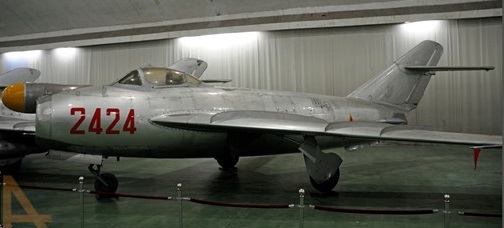
MiG-17 was license built China and known as Type-56, Dong Feng 101 and later is was dubbed J5 in Peoples Republic of China Air Force service. The first J5 prototype carried ‘Zhong-0101’.
J5 prototype
J5
Some Polish LIM 5P’s were modified to LIM 5M standard by fitting additional fuel tanks and a twin wheel main undercarriage with low pressure tyres which retracted into a larger wing centre section built of rein-forced plastics. A relatively small number were converted, but many others were upgraded to LIM 6 standard by introducing a braking parachute, rocket assisted takeoff units and additional stores pylons. The LIM-6, together with the LIM 6bis having modified ordnance racks and the reconnaissance LIM 6R, remained in Polish service until replaced by the Su 20 Fitter C.
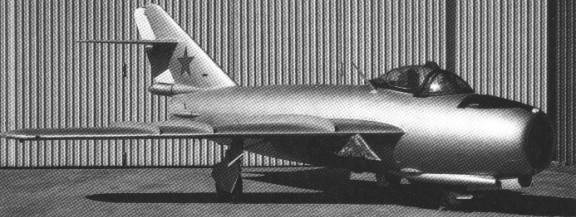
LIM-5
The earlier model had been constructed as the Czech S.104.
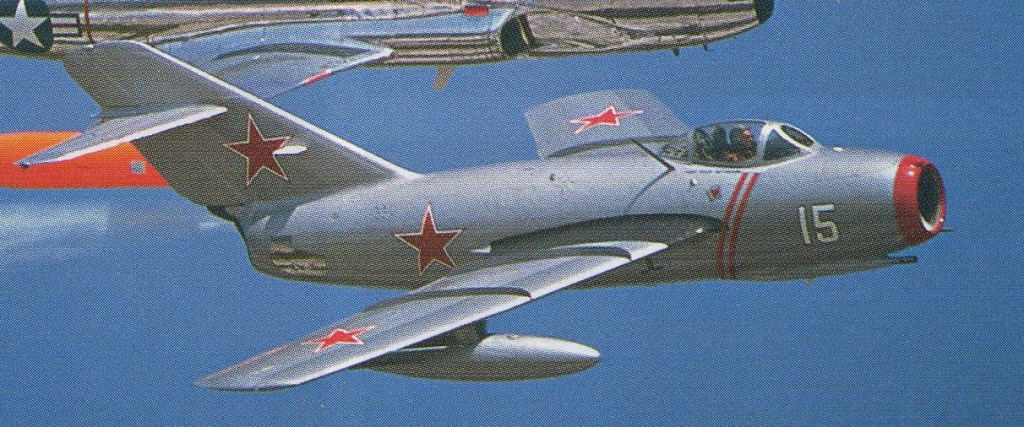
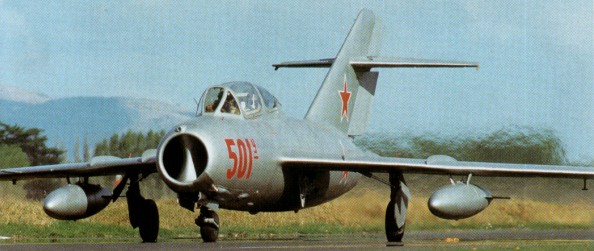
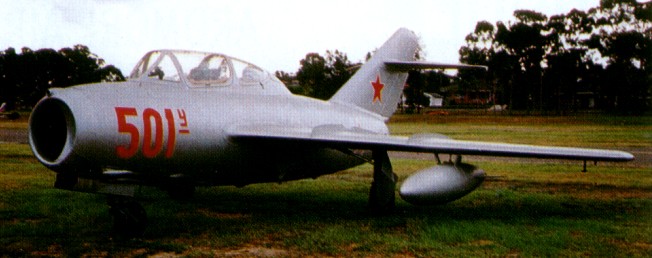
1721 Mikoyan-Gurevich Lim-5 R 1C-17-21
Licence production was undertaken of the MiG-17F (as the Jian-5) and MiG-17PF (Jian-5A) in China commencing late 1956, and a uniquely Chinese tandem two-seat advanced training version was developed as the JT-5.
A total of 11,015 was built (including licence production). The last one was built in 1958 but the type was exported more widely than any other Soviet military aircraft. The Fresco was withdrawn from Soviet air force service in the late 1960s but soldiers on in many parts of the world, typical ground-¬attack weapons comprising 250 kg (551 1b) bombs, UV 16 57 rocket pods and S 24 rockets.
Mikoyan-Gurevich MiG-17 Engine: 1 x Klimov VK-1 turbojet, 5,952 lbs thrust Wing Span: 31 ft 7 in Length: 36 ft 5 in Height: 12 ft 6 in Light weight: 8,646 lb Loaded weight: 11,803 lb Ceiling: 52,366 ft Speed: 696 mph Range: 1,290 miles (ferry) Crew: 1 Armament: 2 x 23mm cannon, 1 x 37 mm cannon, 4 x 57mm rocket pods
MiG-17 Engine: 1 x VK-1F(N) turbo-jet Wingspan: 9.6 m / 31 ft 6 in Length: 11.4 m / 37 ft 5 in Height: 3.8 m / 12 ft 6 in Wing area: 22.6 sq.m / 243.26 sq ft Max take-off weight: 5200 kg / 11464 lb Max. speed: 1114 km/h / 692 mph Ceiling: 15000 m / 49200 ft Range: 2000 km / 1243 miles Crew: 1 Armament: 1 x 37mm machine-guns, 2 x 23mm machine-guns, bombs or missiles
MiG-17 Engine: 1 x Klimov VK-1 turbojet, 5952 lb (later models) VK-1F, 4732 lb / afterburner-7452 lb) Max speed, 692 mph (1114 km/h) at 6,560 ft (2 000 m) Initial climb, 9,252 ft/min (47 m/sec) Range (with max external fuel), 1,336 mls (2150 km) Empty weight, 8,373 lb (3798 kg) Loaded weight (clean), 11,468 lb (5202 kg) Span, 31 ft 7 1/8 in (9,63m) Length, 36ft l1 1/3 in (1l,26m) Height, l2 ft5 5/8 in (3,80 m) Wing area, 243.26 sq ft (22,60 sq.m)
MIG-17F ‘Fresco-C’ Type: single-seat fighter Powerplant: one 3400-kg (7,495-lb) afterburning thrust Klimov VK-JF turbojet Maximum speed 1145 km/h (711 mph) at 3000m (9,845 ft) Initial climb rate 3900 m (12,795 ft) per minute Service ceiling 16600 m (54,460 ft) Range (with max external fuel): 1470 km (913 sm) Empty weight: 4100 kg (9,040 lb) Maximum take-off weight: 6700 kg (14,770 lb) Wingspan 9.63 m (31 ft 7 in) Length 11.09 m (36 ft 4½ in) Height 3.35 m (11 ft) Wing area 22.60 sq.m (243.3 sq ft) Armament: three 23-mm NR-23 cannon, plus four AA-1 ‘Alkali’ missiles or up to 500 kg (1, 102 lb) of external stores.
MiG-17P Engine: 1 x Klimov VK-1 turbojet, 5952 lb (later models) VK-1F, 4732 lb / afterburner-7452 lb) Wing span: 31 ft (9.45 m) Length: 36 ft 3 in (11.05 m) Height 11 ft (3.35 m) Empty wt: 9040 lb MAUW: 14,770 lb
MiG-17PF Wing span: 31 ft (9.45 m) Length: 36 ft 3 in (11.05 m) Height 11 ft (3.35 m) Empty wt: 9040 lb MAUW: 14,770 lb
MiG-17PM Wing span: 31 ft (9.45 m) Length: 36 ft 3 in (11.05 m) Height 11 ft (3.35 m) Empty wt: 9040 lb MAUW: 14,770 lb Armament: 4 x AA-1 missiles.
The I-310(S) was designed to meet a March 1946 requirement for a high-altitude day interceptor. The Mikoyan/Gurevich, Lavochkin and Yakovlev design bureau competed for the production contract, striving to meet the specification of a Mach 0.9 top speed, high rate of climb to 10000 m (32800 ft), good manoeuvrability at this height and above, a minimum of one hour’s duration and cannon armament, combined with simplicity of design and operation.
The need for a near sonic speed demanded the adoption of wing sweep, and the design team was able to draw on the expertise of Gurevich himself, in addition to other work carried out by Russian and German engineers. A swept forward wing layout was examined but discarded in favour of the swept back solution. The aircraft was designed around the RD-10A turbojet of 1000 kg (2205 lb) thrust, based on the German Jumo 004. A Russian designed powerplant with twice the thrust was in the pipeline and was expected to become available within a year, but the Anglo Soviet trade agreement of 1946 offered a more attractive possibility. The trade pact included the supply of 25 Rolls Royce Nene turbojets, most of which were allocated to the Klimov engine design bureau or to research establishments. One was supplied to the Mikoyan/Gurevich team and the MiG 15 was redesigned to accommodate the fatter Nene, which had a centrifugal compressor compared with the axial unit or the Russian engine under development, and which also produced greater thrust. The Rolls-Royce Nene immediately went into production at No 45 production factory in Moscow, designated RD-45 after the factory.
The layout involved air fed from a bifurcated nose intake via four ducts which passed either side of the cockpit and then over and under the unbroken wing centre section. The wing, of almost parallel chord, was swept back by 35 degrees at the leading edge and was built up from two main spars skinned with light alloy. The upper surfaces carried two full chord fences on each side and large Fowler flaps, set at 20 degrees for takeoff and 55 degrees for landing, were attached to the wing, just forward of the trailing edge. The ailerons were the only power operated aerodynamic controls.
The circular section fuselage was constructed in two halves which could be separated by means of quick release bolts at the attachment point for the rear wing spar, exposing the complete engine for maintenance. Air brakes were fitted on either side of the rear fuselage. The tailplane was swept back by 40 degrees and its incidence could be adjusted manually before takeoff. Two fuel tanks in the rear fuselage carried 90 litres (19.8 Imp gal) each, but the majority was contained in a 1225 litre (269 Imp gal) tank fitted between the wing spars. The undercarriage had a wide track 4 m (13 ft 1.5 in) to allow operation from rough fields; the levered suspension mainwheels retracted inwards to lie within the fork of the front main spar.
Navigation, communication and fire-control equipment was extremely simple but this solution proved to be the correct solution when the type was blooded in combat. A gyro gunsight (copied from the British GGS Mk 2) with a maximum range of 800 m (875 yards) was used to aim the two 23 mm (0.90¬in) NS 23 cannon mounted in a pack under the nose. This arrangement was later replaced by a single 37 mm (1.46 in) N 37 cannon with 40 rounds on the right hand side and a pair of NS 23s with 80 rounds each on the left. The wing hardpoints were stressed to carry up to 500 kg (1102 lb) of bombs, although two weapons of 100 kg (220 lb) each were more usual, and rockets were also fitted. Alternatively, auxiliary fuel tanks could be carried to increase endurance.
It seems likely that the first prototype of the MiG-15, designated I 310, made its maiden flight in July 1947, but crashed during low speed trials. Several design changes were introduced as a result, including the adoption of 2 degrees of wing anhedral in place of the dihedral layout, installation of wing fences and several changes to the back end. The rear fuselage was shortened and the jet pipe cut back to reduce the amount of engine power being lost, the tailplane was removed from the top of the fin and repositioned two thirds of the way up, and the fin itself was swept back by 56 degrees. The first of two replacement prototypes, the S-01, was flown on 30 December 1947. As the I 350 prototype, it flew for the first time in September 1953.
The revised design was far from perfect – it tended to enter a spin from a tight turn, necessitating the fitting of recovery rockets but it was apparent that the layout was basically sound. The Mikoyan/Gurevich team had six months’ headway over their competitors, and this proved decisive, although both the La 168 and Yak 30 proceeded to the flight-test stage and the former entered limited production.
Reverse engineering of the Nene by Vladimir Klimov’s bureau had paralleled design development of the I-310, and as the RD-45 of 4,850 lb st (2 200 kgp), this engine powered the initial series fighter, which, as the MiG-15, was cleared for production in March 1948 (NATO Fagot), the first pre-series aircraft being delivered to the NII for evaluation seven weeks later, on 10 May.
Early production MiG-15s powered by the RD 45, copied from the Nene, reached the squadrons before the end of 1948. The RD 45F (Forsirovanny, meaning boosted), uprated from 2200 kg (4850 lb) to 2270 kg (5000 lb) thrust for take¬off, soon replaced the earlier powerplant at an early production stage. Armament comprising one 37-mm N-37 and two 23-mm NS-23KM cannon.
Production under licence was begun in Poland as the LlM-1 and in Czechoslovakia as the S-102.
Variants of the RD-45F-powered fighter included the MiG-15PB escort fighter with two 132 Imp gal (600 lt) underwing slipper tanks, the MiG-15P with a pre-series Izumrud (Emerald) radar and the MiG-15SV with faster-firing NR-23 cannon, none of these being built in quantity.
A structural reappraisal of the basic MiG-15 resulting in a 198 lb (90 kg) weight reduction, minor aerodynamic changes, upgraded equipment and a Klimov-developed VK-1 turbojet (origi¬nally designated RD 45FA) rated at 5,952 lb st (2 700 kgp) for takeoff, or 3000 kg (6615 lb) with water injection produced the MiG-15SD flown in September 1949. With some further changes (which in¬cluded modifications to the ailerons and air brakes) this was placed in production in the following year as the MiG-15bis. The engine’s external dimensions remained the same, but the mass flow was increased and the larger diameter hot end resulted in dry weight rising from 870 kg (1918 lb) in the RD 45 to 875 kg (1930 lb) in the VK 1. Fuel capacity was increased by 160 litres (35 Imp gal) and improved equipment was fitted. Perforated flaps were therefore adopted to save airframe weight, offsetting increases in other areas. Late production models of the MiG-15bis, which was the variant built in the largest numbers, carried 23 mm (0.90 in) NR 23 revolver cannon in place of the slow firing NS 23s. Polish and Czech versions were designated LIM-2 and S-103.
Lim-2
The MiG 15bis was followed by the two seat MiG-15UTI, code¬named Midget, with the instructor sitting behind and slightly above his pupil. Some fuel capacity was sacrificed, and the top speed dropped slightly. The principal production version of the basic design, with several thousand being built until late 1951, plus others licence-built in Czechoslovakia and Poland (as the LIM-3).
LIM-3
The MiG-15bis standardised on an armament of two 23-mm NR-23 cannon and one 37-mm N-37 cannon.
Limited all-weather versions with Izumrud radar included the MiG-15SP-1 and SP-2. The two seater was also used for ejection seat experiments and formed the basis of the SP 5, the first all-weather fighter variant. An Izumrud (Emerald) fire control radar (NATO code name Scan Fix) was fitted, the antenna being mounted in a bullet fairing in the centre of the intake splitter. A complementary ranging radar was installed in the top lip of the intake. The definitive all weather fighter variant, the MiG-15P, was, however, a single seater derived from the MiG-15bis.
Other experimental models were the MiG-15SU for ground attack and featuring a pack containing cannon angled to fire downward, the MiG-15bisSB (ISh) intended for the shturmovik role and the MiG-15bisS escort fighter with 132 Imp gal (600 1t) slipper tanks, reduced armament and other changes.
A reconnaissance version, the MiG-15bisR with full armament and fitted with a single nose mounted vertical camera below the gun magazines was developed for high altitude sorties over Korea and was additionally employed in Europe.
A further variant was the MiG-15SB, which had twin beams extending from the wing leading edges to carry two 100 kg (220 1b) bombs, eight 55 mm (2.16 in) rockets or auxiliary fuel tanks. Rockets were fitted to reduce the takeoff run and a braking parachute similarly shortened the landing roll.
Production in the Soviet Union ended in 1953.
On 10 March 1953, five days after a Polish pilot had defected with his MiG-15 to the Danish island of Bornholm, two Czechoslovakian MiGs attacked two American F-84G Thunderjets over Regensburg in Bavaria. One of the Thunderjets was shot down by the 23mm and 37mm cannon of one of the MiGs. The pilot ejected safely over Czechoslovakian territory.
The last RB-29 was shot down by two MiG-15s above the east coast of Hokkaido, Japan, on 4 September 1954. The aircraft allegedly flew over Soviet territory on the Pacific coast, according to the Sovies. Ten or elevel of the crew survived.
One of the most widely used jet fighters of all time, the MiG-15bis was also manufactured in China (as the Shenyang F-2, and the MiG-15UTI as the Shenyang FT-2), Czechoslovakia (Mig-15bis as the Aero Vodochody S-103 and the Mig-15UTI as the CS-102) and Poland Czechoslovakia (Mig-15bis as the PZL-Mielec Lim-2 and the Mig-15UTI as the SBLim-1) in considerable numbers and it is known to have served with close to 30 air arms throughout the world as a front-line fighter and as an advanced trainer.
Large numbers (over 1,000) of early versions were supplied to China and North Korea, entering combat in 1951. No Allied fighter could stay with it and even the technically superior F-86 had inferior climb, ceiling and high-altitude turn radius. Many thousands (14,000+) of all versions were built, and the MiG-15 remained an invaluable aircraft for air forces with little jet experience, being supplied to at least 18.
The MiG 15 took part in the first ever all jet air combat when one was destroyed by a Lockheed F 80 Shooting Star of the US Air Force over Korea on November 7, 1950, some six days after the Russian type was deployed to that theatre. The Soviet aircraft was more manoeuvrable and had a higher ceiling than its US adversaries, and the slow ¬firing but hard hitting cannon carried a heavier punch than the machine guns of the opposing fighters. The USAF’s response was to introduce the North American F 86A Sabre, which scored its first MiG kill on December 17, 1950. The North Korean and Chinese pilots could not hope to match the experience of their adversaries, and on May 20, 1951, Capt James Jabara bagged his fifth and sixth MiG 15s to become the first jet ace. The USAF alone claimed 792 MiG 15s destroyed over Korea, while the US Navy also notched up a creditable score, bringing the claimed kill to loss ratio to about 12:1.
MiG-15 Engine: 1 x Klimov RD-45F, 5,005 lb st (2270 kgp) Max speed, 648 mph (1043 km/h) at 9,845 ft (3000 m) Max initial climb, 8,268 ft/min (42 m/sec) Range (clean), 882 mls (1 420 km) at 236 mph (380 km/h) at 39,370 ft (12 000 m) Empty weight, 7,456 lb (3 382 kg) Loaded weight (clean), 10,595 lb (4 806 kg) Span, 33 ft 1 in (10,08 m) Length, 32 ft 1¼ in (10,04 m) Height, 12 ft 1 2/3 in (3,70 m) Wing area, 221.75 sq ft (20,60 sq.m).
Engine: 1 x VK-1 turbo-jet, 26.5kN / 5950 lb Wingspan: 10.1 m / 33 ft 2 in Wing area: 20.6 sq.m / 221.74 sq ft Length: 10.1 m / 33 ft 2 in Height: 3.7 m / 11 ft 2 in Empty weight: 13,249 lb Max take-off weight: 4960 kg / 10935 lb Max. speed: 1076 km/h / 669 mph Max ROC: 19,400 fpm Ceiling: 16000 m / 52500 ft Range w/max.fuel: 2000 km / 1243 miles Range w/max.payload: 1400 km / 870 miles Armament: 1 x 37mm cannon, 2 x 23mm machine-guns, 400kg of bombs or missiles Crew: 1
MiG-15P Equipment: Izumrud (Emerald) radar.
MiG¬-15PB Type: escort fighter Fuel cap: two 132 Imp gal (600 1t) underwing slipper tanks
MiG-15SV Armament: faster-firing NR-23 cannon
MiG-l5bis Powerplant: one 2700-kg (5,952-lb) thrust Klimov VK-1 turbojet / later models one 6990-lb thrust Klimov VK-1A turbojet. Maximum speed 1100 km/h (684 mph) at 12000 m (39,370 ft) Initial climb rate 3500 m (11,800 ft) per minute Service ceiling 15550 m(51,015 ft) Ferry range 2000 km (1,242 miles) Empty weight 3400 kg (7,495 lb) Maximum take-off 5785 kg(12,756 lb) Wingspan 10.08 m (33 ft 0¾ in) Length 11.05 m (36 ft 3¼ in) Height 3.40 m(11 ft 1¾ in) Wing area 20.60 sq.m (221.7 sq.ft) Armament: one 37-mm NR-37 cannon and two 23-mm NR-23 cannon, plus up to 1000 kg (2,205 lb) of external stores.
MiG-15Bis (SD) Max speed, 692 mph (1114 km/h) at 7,220 ft (2 200 m) Time to 16,405 ft (5 000 m), 2.1 min. Range (clean), 826 mls (1330 km) Empty weight, 8,115 lb (3 681 kg) Loaded weight (clean), 11,175 lb (5069 kg) Span, 33 ft 1 in (10,08 m) Length, 35 ft 7½ in (10,86 m) Height, 12 ft 1 2/3 in (3,70 m) Wing area, 221.75 sq ft (20,60 sq.m) Armament: two 23-mm NR-23 cannon and one 37-mm N-37 cannon.
Engine one 7,452-lb Klimov VK- 1F turbojet Gross wt. 12,000 lb Empty wt. 8,115 lb Max speed 668 mph Range 450 nm Ceiling 50,855 ft Seats 1-2.
MiG-15UTI Engine: LIS-2, 5500 lb thrust. Fuel cap: Internal: 1000 lt, external 2 x 400 lt. ROC: 6000+ fpm. Service ceiling: 48,000 ft. Loading: Clean, +8g, With drop tanks full, +4g. Max speed: 570 kts (M 0.92), with drop tanks, 430 kts. Stall: 110-103 kts.
MiG-15UTI Type: Two seat fighter/trainer Engine: One Klimov RD-45 turbojet, 5,005 lbs thrust Empty weight: 7,900 lb Loaded weight: 10,935 lb Wing Span: 33 ft 1 in Length: 33 ft 2 in Height: 12 ft 2 in Ceiling: 50,580 ft Speed: 668 mph Range: 1,225 miles (ferry) Armament: 2 x 23mm cannon, 1 x 37 mm cannon, 2 x 100 kg bombs or rockets
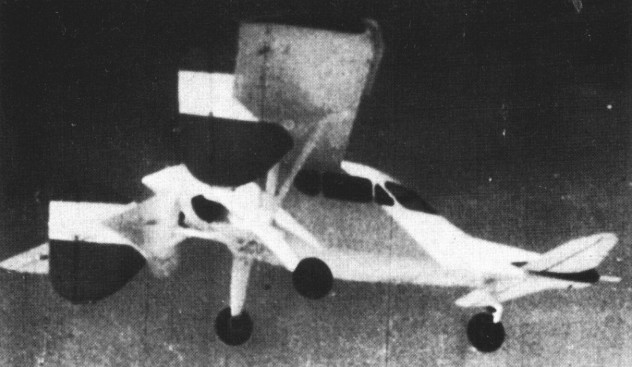
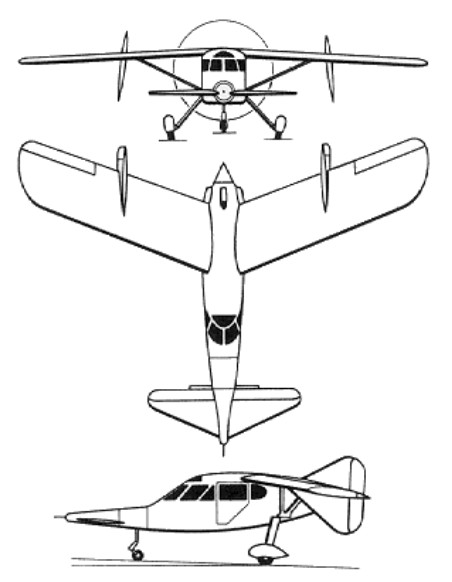
Although usually attributed to the Mikoya Gurevich design bureau and certainly assign the designation MiG-8, the Utka (Duck) three seat tail-first monoplane was apparently designed by students of the Zhukovskii Academy under the supervision of Prof G A Tokaev as a research project and built at the MiG bureau’s experimental factory.
A light high-wing canard monoplane with pusher propeller, built of wood with fabric cover, the Utka was completed and flown in 1945, intended primarily to study low-speed control problems associated with wing sweepback at low speed. The wings were swept 20 deg, carried splayed vertical surfaces at mid-span and featured leading-edge slats which occupied approximately one-third span outboard. Elevators were carried by the canard surface. The aircraft was flown in two variants, differed by location of the rudders.
Test pilots A.I.Zhukov and A.N.Grinchik flew it in the end of 1945. Apparently it performed well without any modifications.
Engine: five cylinder M-l1FM air-cooled radial, 150 hp / 81kW Wing span: 3l ft 2in (9,50 m) Length: 23 ft 3.5 in (7,10 m) Wing area: 170.07sq ft (15.8 sq.m). Max take-off weight: 1150 kg / 2535 lb Empty weight: 640 kg / 1411 lb Maximum speed: 127 mph (205 km/h) Maximum endurance: 5.0 hours Crew: 1 Passengers: 2
As the MiG OKB’s Izdeliye M contribution to a 1950 programme to develop a single-seat fighter powered by a single Lyulka TR-3A single-shaft turbojet which was to be committed to production as the AL-5, and capable of attaining and maintaining a speed in excess of M = l.0 in level flight, the 1-350 was flown on 16 May 1951.
Characterised by 60° wing sweepback, T-tail, and assigned the official designation I-350, one prototype was built, the M-1 with RP-1 Izumrud AI radar, a second, the M-2 with Korshun AI radar, being abandoned before completion. Armament comprised one 37mm N-37 and two 23mm NR-23 cannon.
The M-1 was flown for the first time on 16 June 1951, but the TR-3A turbojet, which was rated at 4600kg, failed shortly after take-off. The hydraulic system also failed, but the pilot nonetheless effected a successful landing.
The Lyulka¬ engined prototype was, in consequence, rebuilt with a paired Mikulin AM-5 engine installation similar to the I-360 (SM-2). The destruction of the latter under test led to a delay in the resumption of flight testing of the I-350 pending redesign of the tail assembly transferring the horizontal surfaces to the fuselage. With this change and AM-5 engines, the prototype commenced test on 18 September 1953 as the 1-350(M), but lack of afterburning prevented M = 1.0 being exceeded in level flight.
Four further flight tests were performed, but engine difficulties persisted, and, as it was obvious that the Lyulka turbojet demanded considerable further development, the I-350 programme was terminated in August 1951.
I-350 (estimated) Max take-off weight: 8710 kg / 19202 lb Empty weight: 6125 kg / 13503 lb Wingspan: 9.73 m / 31 ft 11 in Length: 16.65 m / 54 ft 8 in Wing area: 36.00 sq.m / 387.50 sq ft Max. speed: 1266 km/h / 787 mph Range: 1120 km / 696 miles