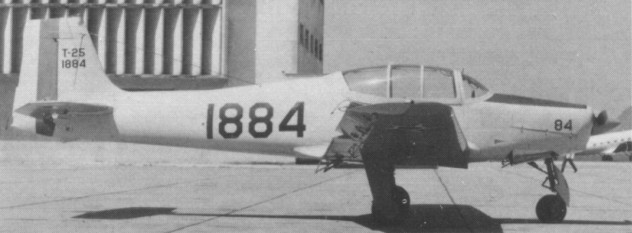
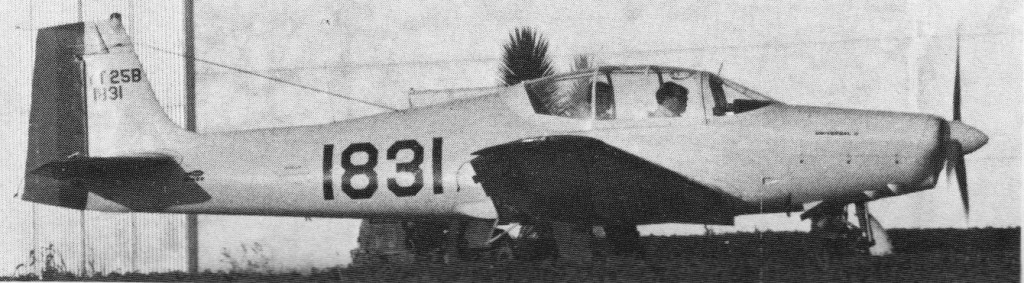
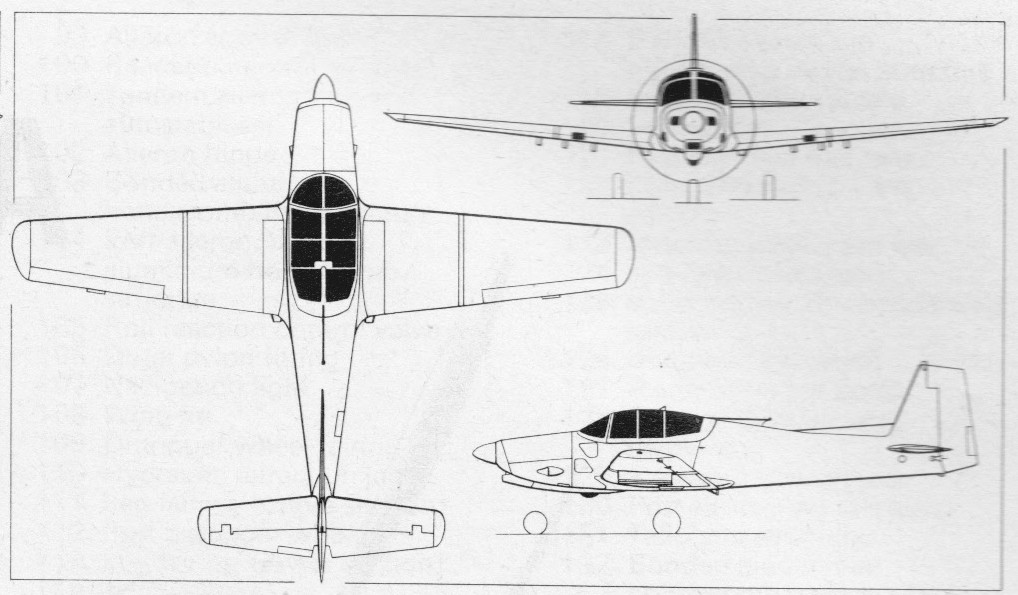
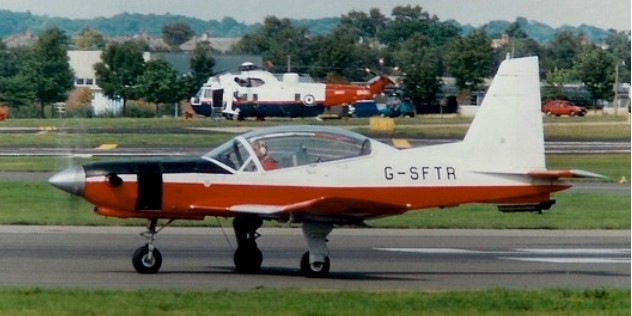
Designed to replace Fokker S-11 and Harvards with the Brazilian Air Force. The Universal is designated T-25 in Brazilian service and operates as a 2/3 seat basic trainer. About 140 were delivered plus 10 to the Chilian Air Force. An armed version with underwing pylons is designated AT-25.
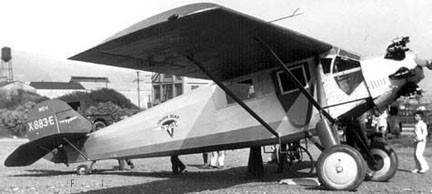
Designed by Richard Korman, the three-place cabin Neilsen Steel Aircraft Co NC-1 Golden Bear, or Coach, was a fabric-covered Ryan B-3 type. Subsequent models were planned to be metal-clad.
Priced at $7,500 in 1928, it was destroyed by an angry crowd at a “thrill show” at Oakland Speedway in Aug 1939 after its performance failed to meet their expectations.
A second one, with 300hp Wright J-6, was reportedly under construction at the time, but its history is unknown.
Engine: 130hp Comet Wingspan: 37’6″ Length: 29’0″ or 28’6″ Useful load: 800 lb Max speed: 130 mph Cruise speed: 110 mph Stall: 40 mph Range: 800 mi Seats: 3
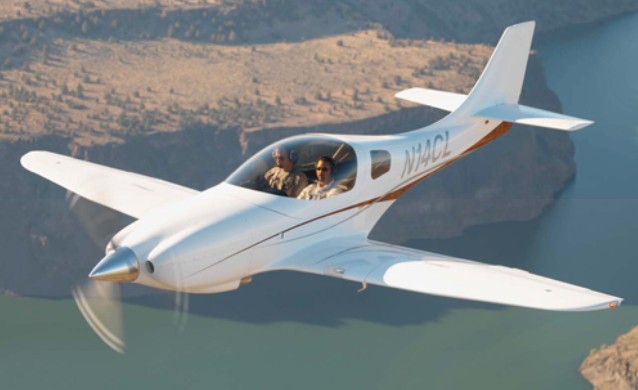
In 1982 Martin Hollmann held one of his aircraft design classes in Santa Monica, CA. Six people attended including Lance Neibuaer. He asked Martin if there was a future in bringing to market a new, two place sport aircraft. Martin of course said “yes.” Two years later, Lance sent Martin a request to perform a stress analysis on his two place design and a check for $200. Richard Trickel offered to build the moulds for Lance’s aircraft at no cost. Richard had formed a composite fabrication company called High Tech Composites in Oxnard, CA. Lance moved to Santa Paula, CA based on Martin’s recommendations and rented a shop space that had been occupied by Jim Kern of Task Research. The new aircraft was powered by a Continental O-200 and Lance called his aircraft the Lancair 200. It had a cruise speed of 200 mph. Although the prototype was made of urethane and hot wire cut styrofoam and covered with wet layed up fiberglass, the production Lancair 200 kit parts were made of temperature cured, prepreg fiberglass and graphite parts. They were lighter and stronger than the epoxy, wet layed up, fiberglass parts used on most kits at that time.
Lance Neibauer sold his family home to pursue his dream of producing the perfect kit. At the time, only the prototype had flown but its performance on an O 235 engine was good. The Lancair 200 is a sleek two-place retractable with maximum level flight speed of 213 mph and 625 pound useful load, and 193 mph cruise. Comprising 27 premoulded, oven cured components, it can be put together in around 600 hours.
Lancair 235 ZK-PDS
The structural integrity of the Lancair wing is said to be +9G and 4.5G ultimate at maximum all up weight (MAUW). This is achieved with an airframe in excess of 25 per cent lighter than similar aircraft built using different construction methods.
At Oshkosh 87 Lancair unveiled its new 320 model, powered by a 150 hp Lycoming O-320. This increased the cruise to 230 mph from the 235 models 210 mph. Kit prices in 1987 were $16,900 for the 235, and $18,500 for the 320.
When the NEICO “fast build kit” became available early 1990, popularity resulted in a one year waiting list. Two years in the development, the kit provides all major sub assemblies including the fuselage ex factory with a resultant saving of up to 700 hours by the builder.
In twelve years 400 kits had been sold using 108-180 hp.
Lancair 360
Two models were available in 1990; the 118hp version with a fixed pitch propeller returns a 180 knot cruise on 75 per cent power while the Lancair 320, sporting a 160 hp Lycoming and constant speed unit, has a 210 knot cruise. The kit price was $18,950 (1987), and $23,200-28,900 in 1998. A kit was also available in carbon for $34,400 in 1998. The 320 is approved for aerobatics. The 320 replaced the 235.
The Lancair 360 has optional wingtip extensions that take the wing from its usual 7.2 m out to 8.3 m. The empty aircraft weighs in at 543 kg and is powered by a Lycoming IO-360-B1F engine behind an MTV-12-B/175-59d three-bladed propeller.
The Australasian market is provided for by licence built 235 and 320 kits manu¬factured by Avtex at Ballina on the NSW coast. The Australian company takes prospective builders step by step through the construction manual. Deposits for twenty eight Lancairs were held by the NSW company in 1990 which has the capacity to turn out one kit every ten days. Standard kits can be constructed in around 800 900 hours while the “fast build” comes together in as little as 200 300 hours.
Aviation Composite Technology / ACT in the Philippines was formed in 1990 to develop the Apache I military trainer from the Lancair 320. 1988 saw the first flight of a Lancair 320 assembled in the Philippines by Aviation Composite Technology (ACT) in a venture with Aerotech S.A. of Switzerland.
In 1991 in the Philippines, Pacific Aeronautical, the new name of ACT relocated to Cebu City started producing airframes for Lancair 320 and Lancair IV, the new higher-powered, four-seat version.
Apparently brought in as the 1929 Engle T-1 and renamed in 1930, the F-2 N11028 c/n 27 was sold (as forfeiture of mortgage) to Richard D Savage of Brighton MA for $4,000 on 15 November 1930, then to Nina L Armitage of Manville RI on 4 April 1934, who reported to CAA on 16 March 1936, “Aircraft now being dismantled.” The sole example of the F-2 open cockpit biplanes registration was cancelled by CAA 15 April 1936.
The F2-WG of 1929, NX117M c/n 26, was powered by an 85hp Wright-Gypsy. The registration of the one built was cancelled on 26 January 1931.
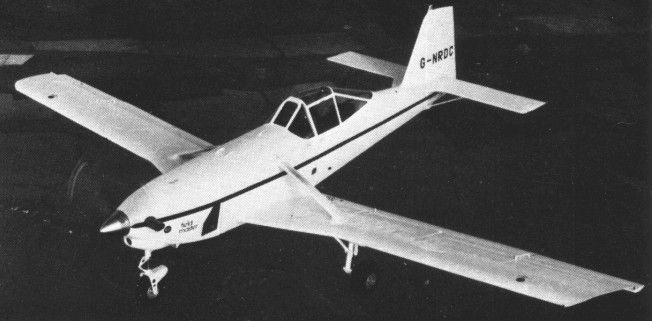
First flown in 1981, the turboprop Fieldmaster agricultural aircraft features a built in ferry tank and a titanium hopper that forms an integral part of the fuselage structure.
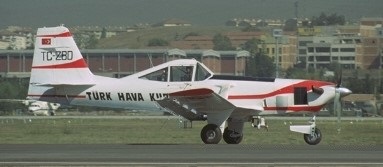
THK bought up all rights to the NAC-6 Fieldmaster/Firemaster agricultural and firefighting aircraft, and tried to sell the aircraft on the market under the new name TAYSU (Tarimsal Havacilik ve Yangin Söndürme Uçagi). After producing only two airworthy and two completely assembled, but engineless aircraft during 1997-1999, the production was stopped because of the general economic crisis and particularly because of internal association difficulties. Since these difficulties were apparently insurmountable, and new agricultural and firefighting aircraft were urgently needed, at the end of 2001 five Polish Pezetel M-18B Dromader were bought.
THK – TAYSU c/n 6002 / TC-ZBD at the Ankara IDEF 1999
NAC 6 Fieldmaster Engine : PT 6 A 34AG, 552 shp Length: 36.089 ft / 11.0 m Height: 13.451 ft / 4.1 m Wingspan: 53.15 ft / 16.2 m Wing area: 357.365 sq.ft / 33.2 sq.m Max take off weight: 8500.3 lb / 3855.0 kg Weight empty: 4996.5 lb / 2266.0 kg Max. weight carried: 3503.7 lb / 1589.0 kg Hopper cap: 2642 lt Max. speed: 143 kts / 265 km/h Landing speed: 60 kts / 111 km/h Ldg dist: 300 ft Cruising speed: 126 kts / 233 km/h Manoeuvring speed: 135 kt Initial climb rate: 964.57 ft/min / 4.9 m/s Service ceiling: 18209 ft / 5550 m Wing load: 23.78 lb/sq.ft / 116.0 kg/sq.m Range: 999 nm / 1850 km Seats: 2 Crew: 1
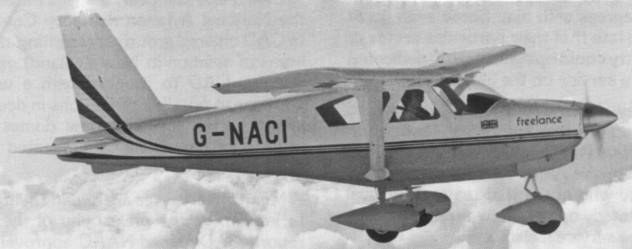
A conventional four seat light single, the Freelance can fold its wings to slip into a space four metres by nine metres. The swing wing capability has enabled a lengthy 39 foot span wing, providing an aspect ratio of over nine. The higher the aspect ratio the less the induced drag; enabling the manufacturer to claim that the Freelance, weight for weight, burns less fuel generating its lift than all other aircraft in its class.
First flown in September 1984.
Powered by a 180hpLycoming, the Freelance offers a cruise on 75 percent power of 117.3 knots (135 mph), an 800 fpm rate of climb, a take-off run (to 50feet) of 1380feet (421 metres) and a landing run (from 50 feet) of 1120 feet (341 metres). Total useful load is 1050 lb. Equipped with large section tyres, the Freelance can operate from grass strips. A 100 United States gallon capacity detachable belly tank is available for the spray role.
Engine: Lycoming, 180 hp Wing span: 39 ft Cruise 75%: 117.3 kt (135 mph) ROC: 800 fpm Take-off run (to 50 ft): 1380feet (421 metres) Landing run (from 50 ft): 1120 feet (341 metres) Useful load: 1050 lb
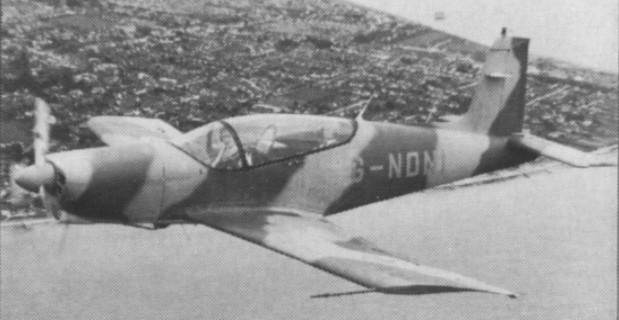
Designed by N.D. Norman, formerly of the Britten Norman Company, the prototype of the NDN 1 Fire-cracker (G NDNI) two seat civil and military training and sports aircraft made its maiden flight on 26 May 1977.
Desmond Norman designed, built and flew the prototype of a high performance piston single, the NDN1 Firecracker. Its origin can be traced to the day a friend of his thought he’d buy a Siai-Marchetti SF.260; Norman decided to build you a better airplane. Norman aimed to neither build nor market the Firecracker himself but to sell the whole manufacturing project to a smaller country that perhaps had never even built aircraft before. Intended as a primary military trainer, the Firecracker is designed to + 9 and -6 Gs, and the prototype has full inverted fuel and oil, controllable three blade Hoffrnan prop, pushrod ailerons and elevators and a rate of roll that should exceed 200 degrees a second. Range is 1,390 nautical miles to dry tanks, 75 percent cruise 175 knots on a 260 horsepower Lycoming. Gross is 2,650 pounds, or 2,150 pounds for advanced aerobatics. It can operate to 50 feet inside 1,200 feet of run. The tall gear is designed to allow under wing weapon pods, and there is an under fuselage air brake to steady the machine on a diving at-tack run, and to keep it below Vne.
The cabin is wide and deep, to allow occupants to wear full military flying gear, and its layout is very military. The rear seat is substantially raised above the front one, to give the observer/instructor a remarkable view of what is happening. That straight, low aspect ratio wing looks odd on such a high performance design, but it is easier to build than a tapered wing.
From this aircraft has been developed the turboprop powered NDN-1T Turbo Firecracker, the first flown on 1 September 1983.
Norman NDN-1T Turbo Firecracker
NDN-1T Turbo-Firecracker Engine: 1 x P&WAC PT6A turboprop, 410 kW Span: 7.9 m Length: 8.3 m Wing area: 11.9 sq.m Empty wt: 1210 kg MTOW: 1830 kg Max speed: 375 kph Initial ROC: 628 m / min Ceiling: 8260 m T/O run (to 15m): 530 m Ldg run (from 15m): 760 m Fuel internal: 405 lt Range: 1120 miles
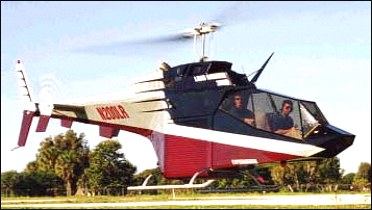
Designed and built by Tom Navickas, the Load Ranger is primarily targeted at the aerial spraying market, but applications for medium freight hauling, law enforcement and special missions also being considered.
Development started July 1996; first flight in April 1997 and certificated in the Experimental category; 30 flight hours logged by February 1998. Restricted use certification was aimed for third quarter of 1998, but no further information.
The structure was a chrome-alloy tubing skeleton with semi-monocoque skin and a slab-sided fuselage with large centre cargo compartment accessed via a roller shutter. The landing gear was tubular welded steel skids. Power was from one Allison 250-C18 turboshaft, rated at 236kW for take-off, and a max continuous rating of 201kW driving a two-blade metal main rotor with blade folding. Fuel capacity in standard tank was 190 litres, and with auxiliary or ferry tank, 758 litres.
A pilot and operator were in tandem seats. A freight compartment had a typical load capacity of 907kg. Alternatively, six passengers can be seated side saddle in the cargo compartment with roller doors stowed. It was priced at US$500,000 (with Army surplus Allison T63 engine and drive train) or US$1.5 million (with civil Allison 250-C18 engine and Bell 206 drive train) in 1999.
Tom Navickas was killed in the Load Ranger in Jersey fathers day 2005 and killed his nephew with him. Apparently they ran out of fuel.
Load Ranger 2000 Main rotor diameter: 10.15m Tail rotor diameter: 1.58m Fuselage length: 10.44m Overall length, rotors turning: 11.79m Overall width: 0.70m Height to top of rotor head: 3.35m Height over tail fin: 3.20m Weight empty: 438kg Max gross weight: 1520kg Useful internal load: 1081kg External slung load: 1045kg Never-exceed speed: 278km/h Hover ceiling, IGE: 2745m Hover ceiling, OGE: 1065m Service ceiling: 4725m Range, with max fuel: 547km
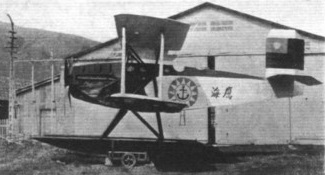
The Ding was a dual-purpose torpedo bomber and passenger seaplane. In a military configuration, the fairly standard tractor biplane had a crew of three – a pilot just under the wing, a gunner behind him, and a bombardier in a compartment in the fuselage between the pilot and engine. Two main floats were placed on either side of the fuselage, providing clearance for a single torpedo or load of conventional bombs. It was powered by the same 360hp 12-cylinder liquid cooled Rolls-Royce engine of the Beeng fighter-bomber. As a passenger aircraft, the bombardier’s cabin provided sufficient room for four people to sit comfortably. The aircraft had a loaded weight of 5,300lb, wingspan of 46ft, and length of 36ft.