In 1984 Robert Nelson built the single-place, mid-wing canard monoplane Star Lance 1 registered N32286.
Power was a 35hp Cuyuna or optional 72hp Kawasaki.
Wingspan: 23’0″
Useful load: 280 lb
Cruise speed: 124 mph
Range: 620 mi
Seats: 1
In 1984 Robert Nelson built the single-place, mid-wing canard monoplane Star Lance 1 registered N32286.
Power was a 35hp Cuyuna or optional 72hp Kawasaki.
Wingspan: 23’0″
Useful load: 280 lb
Cruise speed: 124 mph
Range: 620 mi
Seats: 1
Bob Nelson of Pendleton OR. USA, built the Nelson Sport, built-up from Piper J-3 parts. With a single-place cabin, and mid-wing monoplane, it was possibly registered N2478x.
Engine: Continental A-65, 65hp
Seats: 1
Circa 1960, Bob Nelson of Pendleton OR. USA, built the 1-B Special from assorted parts, such as Taylorcraft empennage and Ercoupe wings. A single-place cabin, low wing monoplane, the single example built, N1325N, was modified circa 1967 by a new owner in Troutdale OR and re-designated Half-Nelson.
Engine: Lycoming O-145, 65hp
Seats: 1
Built by Raymond Nelson, the two place cabin, mid-wing monoplane N-4 was a modification of the Nelson N-1.
Engine: Continental C-85, 85hp
Wingspan: 24’9″
Max speed: 120 mph
Cruise speed: 105 mph
Seats: 2
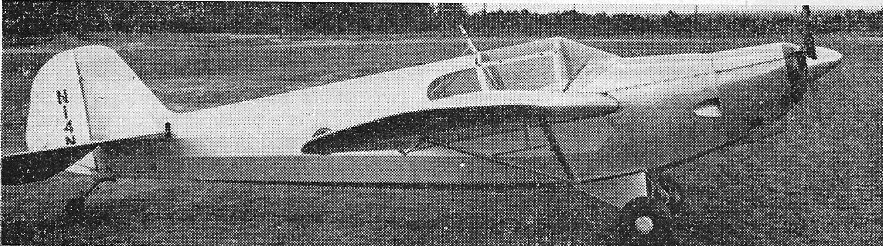
Built by Raymond Nelson circa 1957, the N-1 Special was a single place cabin, mid-wing monoplane, built from some parts of a Piper J-3. One was built, N14N c/n 1, powered by an 85hp Continental C-85.
Engine: Continental C85, 85 hp
Max speed: 105 mph
Cost: $800
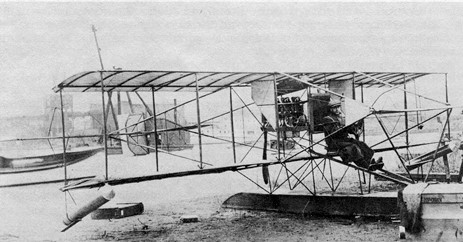
The Nels Nelson No. 4 was built in the winter of 1911-12 as a Kirkham engined landplane and fitted with the float in the summer of 1912 – first flight as a floatplane in August. It was flown in both forms but later in 1912 Nelson made further changes and converted it to a permanent wheeled configuration. It was in this form that it was sold to Prof. Charles Swartz, Mgr. of the Aeroplane Exhibition Co. Humboldt, Tenn., who promptly wrecked it.
Nels J. Nelson, a 22-year-old Swedish immigrant working as an automobile mechanic in his shop on Elm Street in New Britain, began building and flying his own aircraft. On May 1, 1911, young Nelson made his first flight from the new field in Plainville, now known as Robertson Airport and the oldest in Connecticut.
That summer he flew some 40 miles to the ball field that also served as an airfield in Saybrook. Located at the end of Dudley and Coulter Streets, the area remained open fields until housing was built there in the 1940s. After arriving, he tested his biplane but it did not rise more than a few feet from the ground.
That evening a crowd of about 2,000 people gathered to see his flying machine and to watch the Saybrook and Deep River baseball game. When the time came, he took his machine to one end of the field, got good speed on the ground and, it was reported, “glided upward like a bird.”
He skillfully circled around while ascending to the magnificent height of two or three hundred feet. While circling, the engine’s radiator cap flew back and broke the wooden propeller. With the loss of thrust the aircraft came down rapidly and struck a fence as it landed. He was in the air for about five minutes.
Nelson continued to fly and build airplanes but, unable to get government contracts, ultimately lost out to other manufacturers. He died at his home in Yonkers, New York, in 1964.
The 1929 Fleet Wing, N2827 c/n 25, was a three place open cockpit biplane, powered by a 90hp Curtiss OX-5, and with a 32’0″ wingspan and 28’0″ length.
The registration was issued on 26 April 1929, reissued on 17 March 1930, reported in storage Feb 1933, and cancelled 3/15/36.
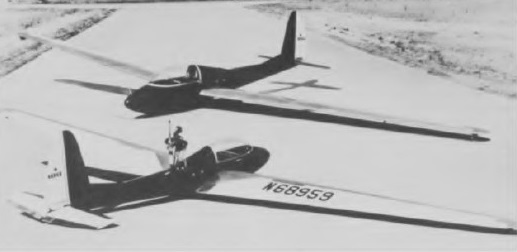
Designed by Harry Perl & Ted Nelson, Nelson developed the Hummingbird in 1953 after discontinuing the Dragonfly. It is a two-place tandem self-launching sailplane. The fixed gear is two wheels in tandem, the front one steerable with rudder pedals. It features an all-moving horizontal tail with anti-balance tab, spoilers and dive brakes, and styrofoam-filled leading edges. The original version, of which two were built, was almost all wood; later models were metal.
Built by the Nelson Aircraft Corporation of Irwin, Pennsylvania, which firm also makes the 45hp Nelson H-63CP four-cylinder horizontally-opposed two-stroke engine that powers it. This is mounted aft of the cockpit and drives a two-blade fixed-pitch pusher propeller; it retracts forward into the fuselage behind the one-piece tear drop cockpit canopy when not in use.
Three or four were built, including N68581, N68959. Two belong to the National Soaring Museum, and one belongs to the Smithsonian Air & Space Museum, Washington.
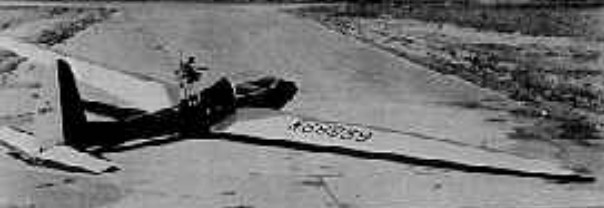
PG-185B
Engine: 40 kW/ 40 bhp. Nelson H-59
Span: 54 ft 0 in / 16.46m
Length: 22 ft 0 in
Wing area: 185.0 sqft / 17.18sq.m
Aspect ratio: 15.76
Airfoil: Go 549 (root), Go 676 (tip)
Empty Weight: 363kg / 800lb
Gross Weight: 544kg / 1200 lb
Max speed: 120 mph
Cruising speed: 90mph
Stall: 39 mph
MinSink: 25 at 89 kph / 48 kt / 55 mph
L/DMax: 0.91 m/s / 3.0 fps / 1.78kt
Seats: 2
William Nelsch of St Louis MO., USA, built an experiment in roadable airplanes. A single place cabin, high-wing monoplane, featuring folding wings, and caged motor for ground operation.

