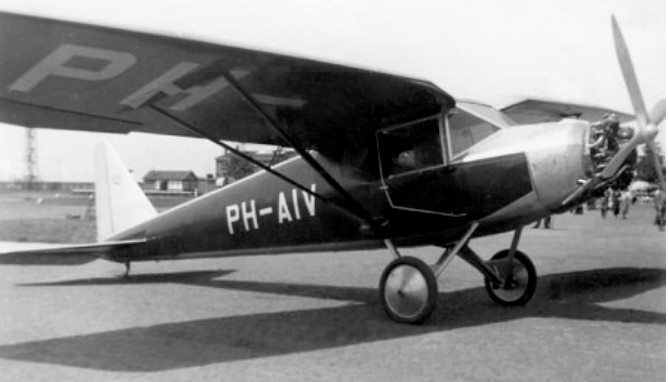
Pander Multipro

Designed by Theo Slot, who was responsible for all of Pander & Sons original designs, the Multipro is variously described as a side-by-side two seat or three seat light aircraft. It had high and almost constant chord wings, braced on each side by a V-form pair of struts fixed to the lower fuselage longerons. The fuselage was a rounded, plywood skinned structure, contemporaries remarking, as they had with other Panders, at the quality of the finish.

It was powered by a Pobjoy R 7-cylinder radial engine; the two blade propeller was driven via spur gears that reduced its speed and placed the output shaft above the engine centre, an unusual arrangement for a radial. The cabin was under the wing with a deep starboard-side access door and multi-panel glazing. The fuselage tapered aft, with the tailplane set half way up it and its fin and rudder together were almost triangular apart from a rounded tip. The Multipro’s conventional undercarriage was fixed, with the mainwheeels on V-sruts attached to the lower longerons and stabilized laterally by an inverted V-strut jointed at the fuselage central underside.

The Multipro flew for the first time in September 1932.

In all three Multipros were built. The first (PH-AIU c/n 42) and third (PH-AIX c/n 44) were rapidly sold to private individuals; the second (PH-AIV c/n 43) remained registered to the Pander works until 1937, when it too was bought privately. All remained on the Dutch civil aircraft register until at least 1939. One, the second aircraft, is known to have been destroyed by German bombing during the invasion of the Netherlands on 10 May 1940.
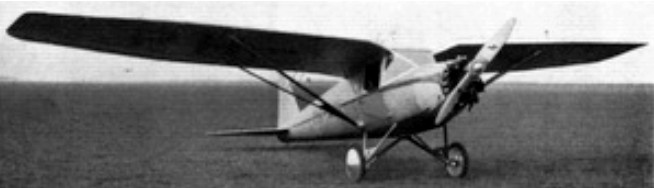
Engine: 1 × Pobjoy R 7-cylinder, 63 kW (85 hp)
Wingspan: 11.30 m (37 ft 1 in)
Length: 7.80 m (25 ft 7 in)
Gross weight: 720 kg (1,587 lb)
Maximum speed: 175 km/h (109 mph; 94 kn)
Capacity: 2 or 3
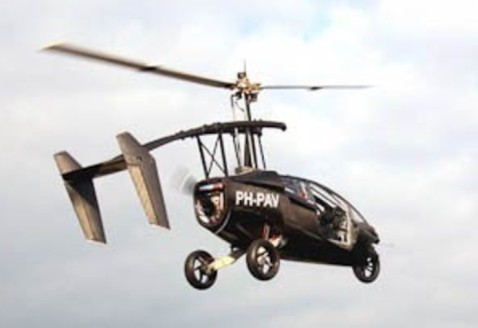
PAL-V One

The PAL-V (Personal Air and Land Vehicle) in flight is an autogyro or gyrocopter designed by C. Klok (exterior design), with a pusher propeller at the rear of the fuselage providing forward thrust and a free-spinning rotor providing lift. Directional stability is provided by twin boom-mounted tailfins. It has a tricycle undercarriage with relatively large wheels.

On the ground, the propeller and rotor are stopped and power is diverted to the wheels, allowing it to travel as a three-wheeled car. Unusually, it leans into turns like a motorcycle, a solution pioneered by the Carver vehicle, also produced by a Dutch company. However, the PAL-V does not tilt as a Carver but like the BMW “Simple Concept” from 2009. The PAL-V ONE transforms into a gyrocopter within minutes as its rotor unfolds and its tail extends. Converting the PAL-V ONE from airplane to automobile takes about 10 minutes. The propeller folds itself automatically into the driving position. Pushing a button then lowers the rotor mast into the horizontal position. The same motion lowers the tail. The outer blades are folded over the inner blades via hinge mechanisms. And then driver/pilot has to push the tail into its driving position and secure the rotor blades.

The PAL-V One has two seats and a 160 kW flight certified gasoline engine, giving it a top speed of 180 km/h (112 mph) on land and in air, and a Maximum Takeoff Weight of 910 kg.

A prototype model was first test flown in March 2012 and the company was seeking funds to develop the type for production. Estimated unit price is around $300,000 in 2014.

Engine: 160 kW
Dimensions Road (LxWxH): 4.0 x 1.6 x 1.6 m
Empty weight: 1,499 lb (680 kg)
Gross weight: 2,006 lb (910 kg)
Maximum speed: 97 kn (112 mph; 180 km/h)
Minimum control speed: 27 kn (31 mph; 50 km/h)
Range inflight: 220-315 mile
Range on land: 750 mile
Takeoff dist: 165m (540 ft)
Landing roll: 30 m (100 ft)
Capacity: 2

Palomino Aircraft / San Antonio Aviation Palomino

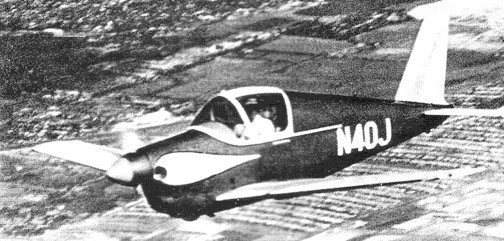
The original 1962 Palomino was a single plane low wing cabin monoplane powred by a 125 hp Lycoming O-209 (registered N40J). Circa 1965, the aircraft was rebuilt as a two place with a 150 hp Lycoming O-320. Marketing of this all-metal tandem-seater was moderately successful.

1962
Engine: Lycoming O-290, 125hp
Seats: 1

1965
Engine: Lycoming O-320, 150hp
Wingspan: 28’2″
Length: 20’7″
Useful load: 710 lb
Cruise speed: 167 mph
Stall: 70 mph
Range: 575 mi
Seats: 2

Palmer Sunshine Clipper

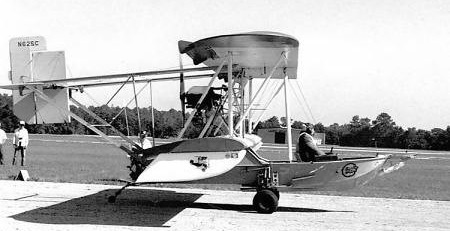
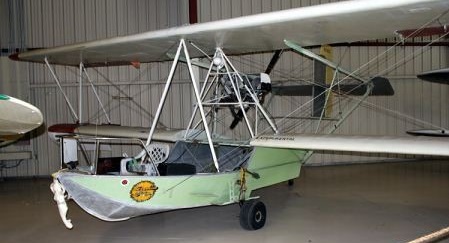
The Sunshine Clipper was a small two-seat amphibious homebuilt aircraft designed and constructed by Henry C. Palmer of St. Petersburg, Florida, USA. The aircraft uses a 14 ft (4.27 m) Orlando Clipper aluminum boat of 1948 vintage as basis for the fuselage, which was then combined with the wings of a Piper J-3 Cub, and parts and components of Piper J-3 Cub, PA-22 Tri-Pacer and PA-25 Pawnee aircraft.

The aircraft (N62SC c/n 1) first flew in November 1987, powered by a 65 hp Continental A65 engine. The aircraft remained a one-of-a-kind design and was registered to the SUN ‘n FUN Aviation Foundation on August 21, 1999 and is on display at the Florida Air Museum.

Engine: Continental A65, 65 hp
Span: 33 ft 0 in (7.20 m)
Weight empty: 1,100 lb (360 kg)
Loaded weight: 1,500 lb (572 kg)
Max speed: 65 mph (145 kmh)
Cruise speed: 55 mph (120 kmh)
Climb: 100 ft (1,000 m)/min

Palmer Skyhook

The second Palmer trike, the Skyhook (FAA registered N4411) in spite of its early date of origin, had most of the attributes of a modern ultralight trike, except it used a single cylinder snowmobile engine, as the two-stroke twin cylinders were not available yet. It was powered by a 17 hp (13 kW) at 5000 rpm single cylinder JLO L297 two stroke engine, driving a composite propeller designed and built by Palmer himself and driven by a 2.1/1 reduction gearbox. The engine had electric start and the craft had fiberglass composite spring landing gear.

The airframe consisted of bolted 6061-T6 aluminum tube, with 6061 T-6 extruded angle. The craft took off, flew, and landed at about 30 mph (48 km/h). Palmer’s trikes were not developed further and remained in obscurity. Palmer moved on to design a successful line of personal hovercraft.

Palermo-Corben P-10

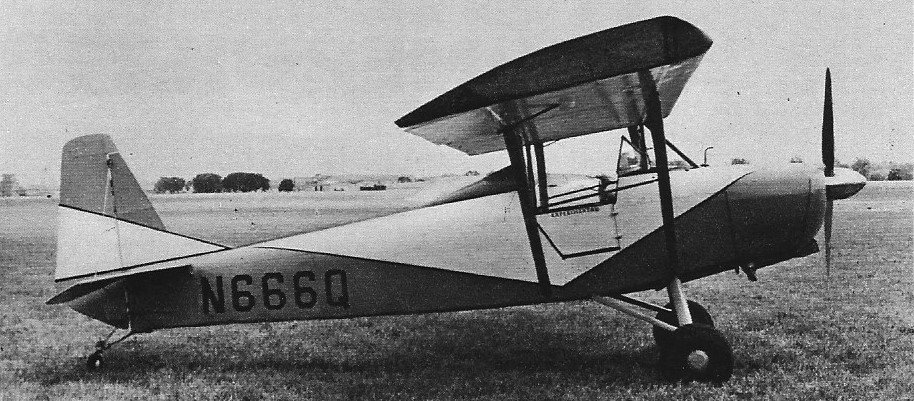
An executive pilot for Eastman Kodak’s Gulfstream, Joseph Palermo built his single-seat P-10 registered N666Q from plans published in Mechanics Illustrated magazine, but changed the tail configuration and skinned the steel tube fuselage with .025 magnesium alloy. The $600 craft took six years to build.

The wing has fabric covered wood structure and is fitted with Palermo’s own designed tips.

Engine: Continental A-65-A8, 65 hp
Wingspan: 26 ft / 7.92 m
Empty weight: 540 lb / 245 kg
MAUW: 740 lb / 335.7 kg
Cruise: 87 mph / 140 kph
Landing speed: 35 mph / 56 kph
ROC: 900 fpm / 4.57 m/sec
Range: 270 mi / 435 km