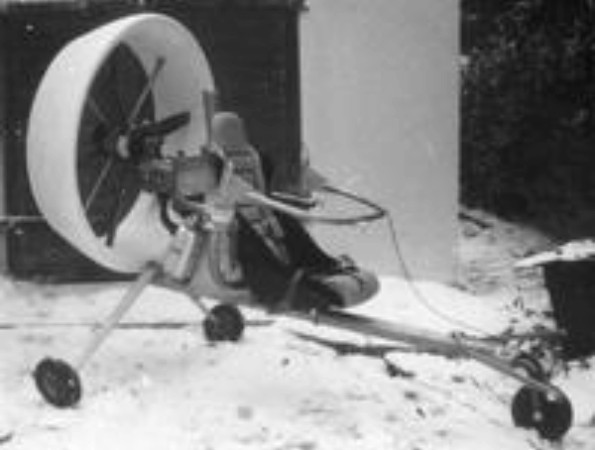
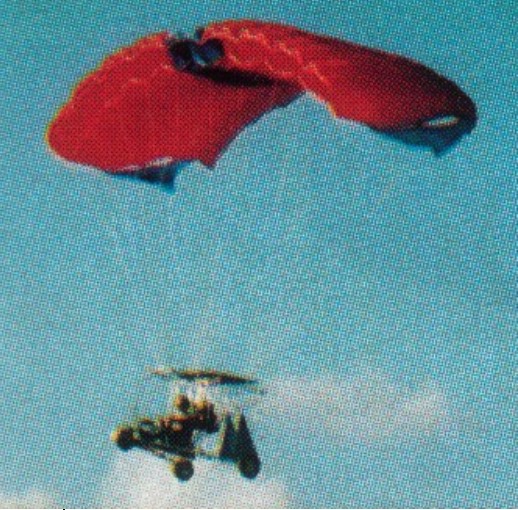
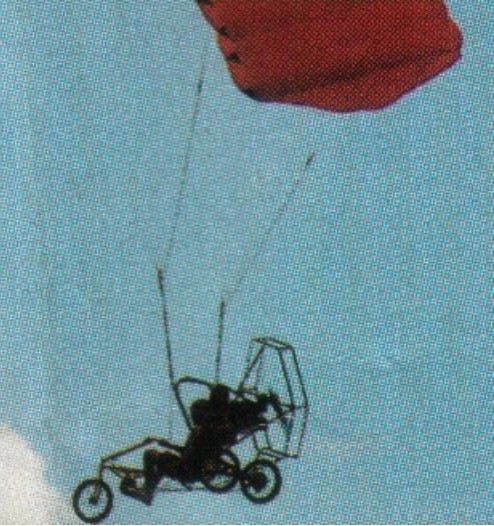
One of the first engine powered parachute wing vehicle was designed in Poland in mid-eighties, by aeronautical engineers: Marek Debski Ph.D. and Andrzej Komor Ph.D. The power unit consisted of the KFM piston engine and two counter-rotating over-ducted propellers. The idea of counter-rotating was to eliminate possible gyro effects. The power unit was mounted on a vehicle’s carriage. All the structure are easily demounted and packed into a car luggage compartment for transport purposes.
Parafan Engine: KFM Cruise: 24 kt / 28 mph / 45 kmh Empty Weight: 100 kg / 220 lbs MTOW Weight: 200 kg / 441 lbs Climb Ratio: 400 ft/min / 2 m/s Glide Ratio: 4 Take-off distance (50ft obstacle): 130 ft / 40 m Landing distance (50ft obstacle): 100 ft / 30 m
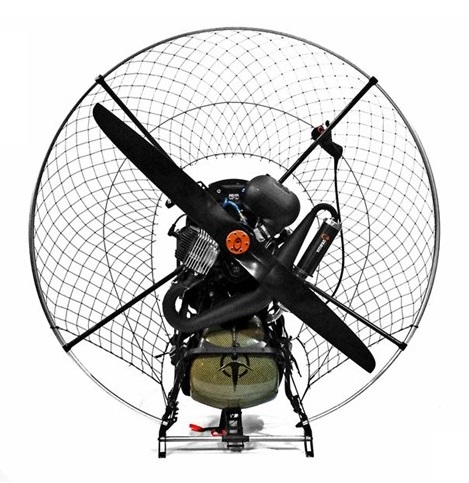
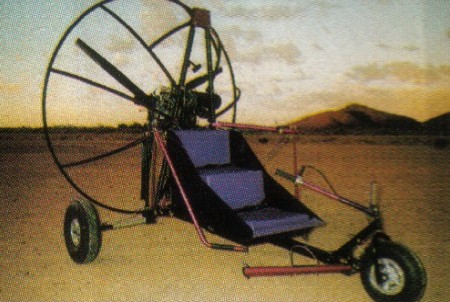
The Blackbird was designed to improve the function, performance and ergonomics of paramotors. Many hundreds of hours of design and analysis, numerous prototypes and over 50hrs of test flying were dedicated to refining the final product.
The Blackbird seat-back allow the pilot to fly comfortably reclined without compromising take off performance and also allows the incorporation of an optional rigid foot rest. Aerodynamics are improved by moving the fuel tank away from the prop and into a more streamlined position during cruise. Ground handling versatility is also improved allowing better ground stability and compact storage.
The Blackbird features a Carbon/Kevlar back support, Apco SLT harness, Powder coated aluminium lazer cut frame, Carbon fibre spokes, Vittorazi V-throttle and an 11.5 lt carbon/kevlar reinforced composite fuel tank (2.5- 3 hrs endurance).
The cage diameter is 1450mm, and total frame & engine/prop weight is 25kg.
The motor is a Moster 185cc SILENT or PLUS with two piece carbon prop. The thrust with a standard 1.3m carbon prop (Vittorazi) is 75kgs.
The Blackbird sold for $8,450.00 in 2017 from Christchurch, NZ.
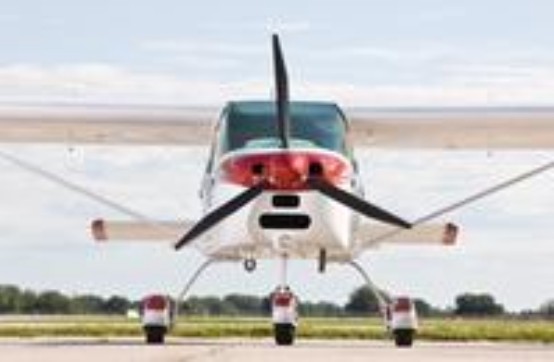
The Paradise P-1 complies with all aspects of the Light Sport Aircraft (LSA) ASTM standards, that specify the design and performance requirements of the two types of LSA aircraft. Special Light Sport Aircraft (SLSA) and Experimental Light Sport Aircraft (ELSA). Easy to service and maintain and if registered as an E-LSA can have even the annual inspection made by the owner. 2009 Price: US$108300
The P-1 is constructed using 4130 steel tube frame welded and is covered with aviation grade aluminum. Powered by a 100 HP Rotax 912 ULS, it offers short field take off and landing performance, with excellent climbing rate and cruise speed. The cowling can be removed by one person making it easy to access every component for inspection and maintenance
It is a high wing, two seat, side by side aircraft similar to a Cessna 150, but that is where the similarity ends. The combination of its wing design and large moving horizontal tail (stabilator) produces a very gentle yet stable aircraft with a good stall characteristic. This, coupled with the ruggedness of its landing gear, dual control system, and a wide range of optional, makes it an excellent trainer. Taxiing is easy with the pedal steered nose gear and large hydraulic brake system.
The large cabin width (43.3 inches), panel mounted yoke, unhindered floor space providing lots of leg room, with, the standard leather upholstery can accommodate two large occupants in plush comfort.
The behind the seat baggage space (largest of its category), with 75 lbs of load capacity and over 18 cubic ft of available space can carry a lot of luggage, including 2 golf bags plus a cooler or perhaps your fishing and camping gear. No hotel, remove the seat, place a sleeping bag for a 6 ft + person to sleep in comfort. The inherent “nose down” level flight characteristic, offers a superb ahead and all around visibility.
2009 Paradise P-1 Engine: Rotax 912 ULS, 100 hp Propeller: 3-blade Warp Drive Gross weight: 599 kg / 1320 lb Empty weight, std: 370 kg / 815 lb Useful load, std: 505 lb Usable fuel, std: 26 USG Vne: 125 kt Best rate of climb, SL, two passengers: 800 fpm / 4 m/s Best rate of climb, SL, one passenger: 1000 fpm Max cruise speed: 105 kt Stall: 35 kt / 40 mph / 64 kmh Range: 630 nm Takeoff ground roll, one passenger: 260 ft Landing over 50 ft. obstacle: 760 ft Glide Ratio: 13/1
The Goodwin Buckshot is an American powered parachute that was designed and produced by FL Goodwin of Phoenix, Arizona and introduced in 1998.
Designed as a US FAR 103 Ultralight Vehicles two seat trainer, it features a parachute-style high-wing, two seats in side-by-side configuration, tricycle landing gear and a single engine in pusher configuration. The standard engines supplied were the 45 hp (34 kW) 2si 460F-45 and the 45 hp (34 kW) Zenoah G-50 engine, although any light, two-cylinder, two-stroke engine can be used.
The aircraft is built from bolted anodized aluminium tubing to save weight. In flight steering is accomplished via foot pedals that actuate the canopy brakes, creating roll and yaw. On the ground the aircraft has tiller-controlled nosewheel steering. The main landing gear does not incorporate suspension and the aircraft relies on large tundra tires to provide this. The aircraft was distributed by Paraborne Aviation of Kissimmee, Florida. The Buckshot is out of production. The rectangular canopy is made from double ripstop, mylar and kevlar. The trike design utilises shroud lines and risers.
Engine: Rotax 503, 46 hp hp range: 40-65 Height: 7 ft Length: 9 ft Wing span: 50 ft Wing area: 502 sq.ft Empty weight: 230 lb Gross weight: 730 lb Fuel capacity: 13.5 USG Cruise: 26 mph Rate of climb: 700 fpm Takeoff dist: 50 ft Landing dist: 30 ft Service ceiling: 10,000 ft Seats: 2
Buckshot Engine: 1 × 2si 460F-45, 45 hp (34 kW) Empty weight: 230 lb / 104 kg Fuel capacity: 13.5 U.S. gallons / 51 lt / 11.2 imp gal Cruise speed: 25 mph / 22 kph / 40 km/h Crew: one Capacity: one passenger Unit cost: US$9000 (2001)
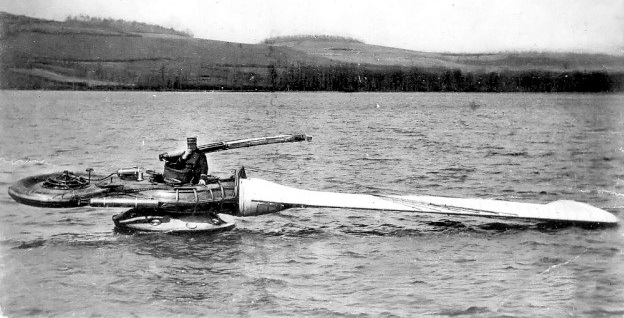
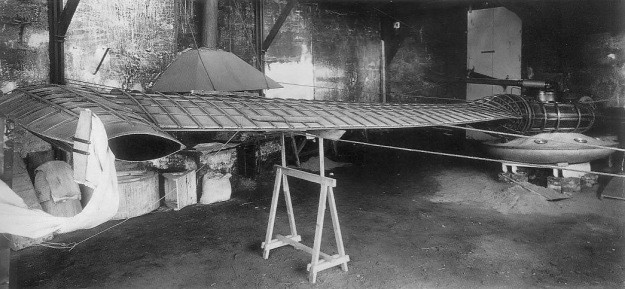
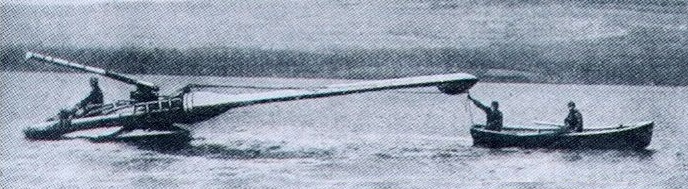
The completed Gyroptere awaiting tests on Lake Cercey on 31 March 1915
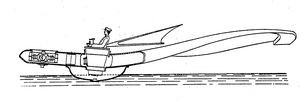
The Gyroptere was designed in France from 1911-1914 by Alphonse Papin and Didier Rouilly. Their monocopter was based on the sycamore seed; a single blade extends from the seed to spin the seed and slow its descent as it falls. Though unsuccessful, the machine was the first air-jet helicopter. Papin and Rouilly obtained French patents 440,593 and 440,594 for their invention and later obtained U.S. patent 1,133,660 in 1915 (filed in 1912).
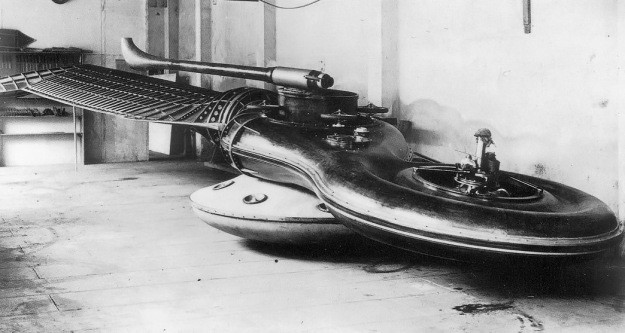
Construction of Papin and Rouilly’s Gyroptere began in February 1914 and was completed in June of the same year. The prototype was named Chrysalis (Chrysalide). Constructed of molded wood, the Gyroptere was well built with compound curves and a smooth sweep of its single, long, airfoil-shaped blade. The fabric-covered blade was hollow and approximately 19.5 ft (5.9 m) long and 4.4 ft (1.33 m) wide, giving it an area of 130 sq ft (12 sq m). The blade was counterbalanced by an 80 hp (60 kW), nine-cylinder Le Rhone rotary engine. The pilot occupied a nacelle between the blade and engine. The bottom of the nacelle included a structure to support the machine while it was on the ground or act as a float when on water.
This image offers a good view of the Gyroptere. The blade does not have its covering, the float and directional control tube can clearly be seen in the center nacelle, and the Le Rhone engine in its fan housing is on the right.
The Le Rhone engine was started with a pulley system. The engine, turning at 1,200 rpm, drove a fan that produced an output of just over 250 cu ft (7 cu m) of air per second. The air, along with the engine’s hot exhaust for thermal expansion, was directed through the length of the blade and exited the blade’s tip through a nozzle on the trailing edge at 330 ft/s (100 m/s). This jet of air would turn the blade, and the gyroscopic force of the motor would lift the blade into a positive angle of attack. The nacelle that carried the pilot was centered on the axis of rotation. The nacelle was mounted on ball-bearings and was centered against four horizontal rollers. The entire machine weighed 1,100 lb (500 kg), which was 220 lb (100 kg) more than originally planned.
The pilot controlled the Gyroptere through the use of two foot pedals: one pedal opened a valve to admit air to the blade; and the second pedal allowed air into an L-shaped tube above the craft that served as a rudder for directional control. The L-shaped tube was directed by the pilot; its discharge provided forward thrust, steering, and stabilized the center drum to prevent it from spinning with the blade. A switch in the nacelle allowed the pilot to engage or disengage the engine.
The outbreak of World War I delayed testing until 31 March 1915. During tests on Lake Cercey (Reservoir de Cercey), near Pouilly-en-Auxois, France, the craft achieved a rotor speed of only 47 rpm, well below the 60 rpm calculated as necessary for liftoff. Even so, the machine was wildly out of balance, and the blade repeatedly contacted the water, damaging itself and shaking up the pilot. In addition, the Le Rhone engine used was not powerful enough; the Gyroptere had been designed to use a 100 hp (75 kW) engine which could not be obtained.
A military commission observing the test determined that such a machine could not aid the war effort and halted further evaluation. The Gyroptere remained at Lake Cercey until it was sold for scrap in 1919.
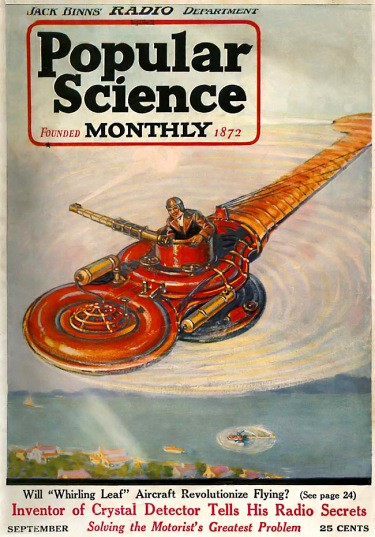
The Papin-Rouilly Gyroptere as depicted on the cover of the September 1922 edition of Popular Science
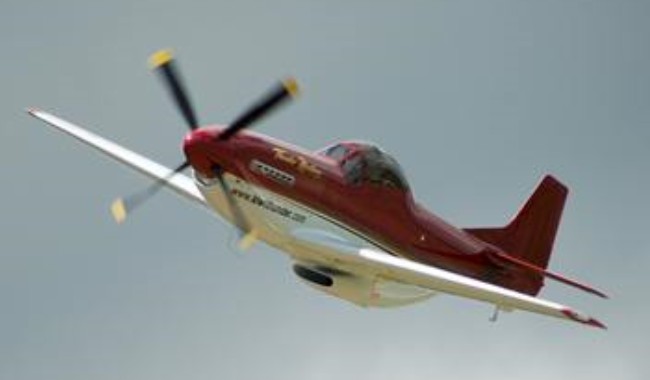
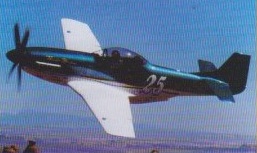
The Thunder Mustang was originally designed by Martin Hollmann for Dan Denny in 1988. Martin later finished the design and performed the flutter analysis for high performance aircraft.
Papa 51 Inc has produced kits to build Thunder Mustang two-seat 75 percent-scale representation of P-51 fighter, first flown 1996. Papa51 Co. Ltd., the original manufacturer of the Thunder Mustang is no longer in business.
The Thunder Mustang was not in production. The Thunder Builders Group L.L.C. acquired the assets required to manufacture the Thunder Mustang through foreclosure on a loan. These assets were posted as for sale.
First flown in 1996, the two seat Thunder Mustang offers its owner a unique blend of speed, maneuverability and mystique. Given the power to weight ratio, it outperforms the original North American P-51D fighter at a fraction of the cost.
Thunder Mustang kits are complete, containing everything from the spinner, prop and engine to the tail wheel, less your choice of instruments, avionics, paint and upholstery. Extensive prefabrication helps reduce construction time and eliminate hassles. The complete use of carbon fiber in the structure produces incredible strength and light weight.
The 8 foot diameter, constant-speed 4-blade prop is manufactured by MT Propellers. The gear box ratio of 2.8:1 turns the prop at 1607 RPM for the optimum ratio for the best prop efficiency and high speed with the V-12 turning 4500 RPM. The 100 lb. propeller is of composite construction utilizing a wood core, which is self-dampening and non-fatiguing. This saves weight compared to metal propellers and reduces the gyroscopic effect of the prop on takeoff.
Walter-powered Thunder Mustang
Thunder Mustang Powerplant: Falconer V-12, 640hp Displacement: 601 cubic inches Propeller: MT 94″ 4-blade constant speed Length: 24.2 ft Frontal Area: 8.1 sq. ft Wing Span: 23.8 ft Wing Area: 104 sq. ft Height: 9.4 ft Maximum Level Speed @ Sea Level: 326 kts (375 mph, 603 kph) Cruise Speed: @ 75% Power: 300 kts (340 mph, 547 kph) Vne (never exceed): 439 kts Vsl (stall, clean): 77 kts Vso (stall, in landing config.): 68 kts Range: 1300 nautical miles Rate of Climb @ gross: 5200 ft/min Takeoff distance: 1000 ft Landing distance: 2500 ft Service Ceiling: 25,000 ft. Gross Weight: 3200 lb Empty Weight: 2200 lb Useful Load: 1000 lb Payload w/full Fuel: 400 lb Basic Fuel Capacity: 102 gallons (in wings) Baggage Capacity: 50 lb Wing Loading: 28.84 lbs/sq.ft Power Loading: 4.69 lbs/hp Design Limit Load Factor: +9g / -6g @ 2600 lb / +7.3 / -4.9 g @ 3200 lb Vx (best angle of climb): 87 kts Vy (best rate of climb): 156 kts Va (design maneuvering): 222 kts Vfe (max flaps extended): 165 kts Vle (max landing gear extended): 148 kts Best Glide: 153 kts Seats: 2
Engine: Falconer V-12, 640 hp Wing span: 7.25 m Wing area: 9.57 sq.m MAUW: 1361 kg Empty weight: 907 kg Fuel capacity: 401 lt Max speed: 603 kph Cruise speed: 555 kph Minimum speed: 109 kph Climb rate: 26 m/s Seats: 2 Kit price (1998): $195,000
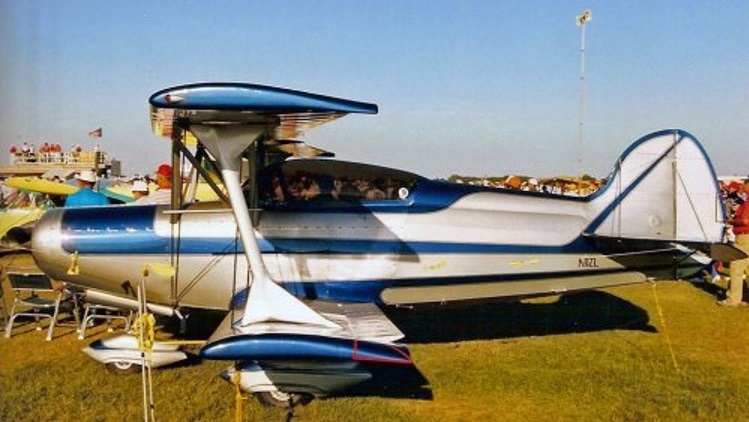
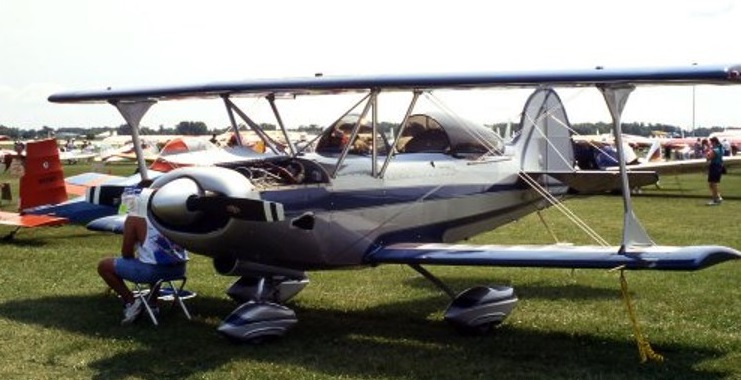
Despite its superficial resemblance to a Pitts S-2, the Panzl Pan 1 N11ZL is an original 1987 homebuilt experimental biplane. It was a two-place cabin biplane, powered by a Franklin 6V-335.
The one built, N11ZL c/n ZL-1, won the EAA Champion Custom-Plans Built award at Oshkosh in 1990.
It was substantially damaged on March 18, 2003 during impact with terrain following a forced landing attempt near Vernal, Utah. The commercial pilot, who was the sole occupant on board, received minor injuries.