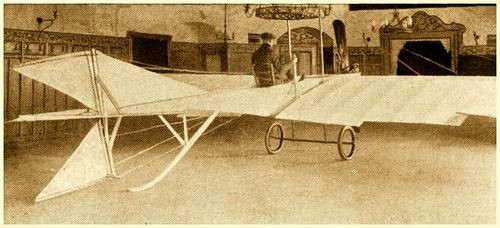
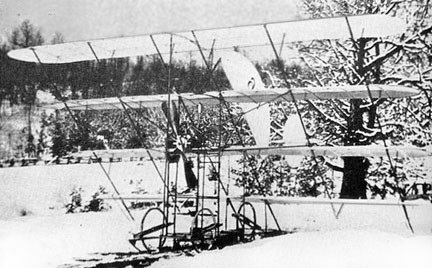
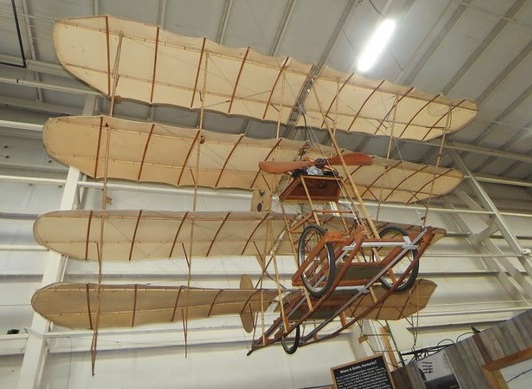
In 1909 Blaine Selvage built a single-place, open cockpit, mid-wing monoplane powered by a 40hp Selvage engine. Hardly more than an open framework with a wire-braced wing attached, reportedly built by a local mechanic, Alfred Peterson, but a 19 November 1909 newspaper photo shows it in flight. Friends who had gathered in the field watched as the 24 year-old man took his seat in front of the controls and revved his home-built engine to a roar. Then, according to a local newspaper, “the machine dragged itself over the rough ground for a distance and then evenly ascended.” It was the first airplane flight north of the Golden Gate, and one of the first anywhere on the West Coast.
The first flight took place November 16, 1909, outside of Eureka. Selvage flew three-quarters of a mile in a minute and a half, an average speed of 30MPH. He might have gone farther, had he more than a gallon of gasoline in his tank.
The most significant aspect of his flight was that he demonstrated control of the aircraft by flying in a circle almost back to his starting point; most first-time pilots barely managed to keep the thing wobbling along in a straight line.
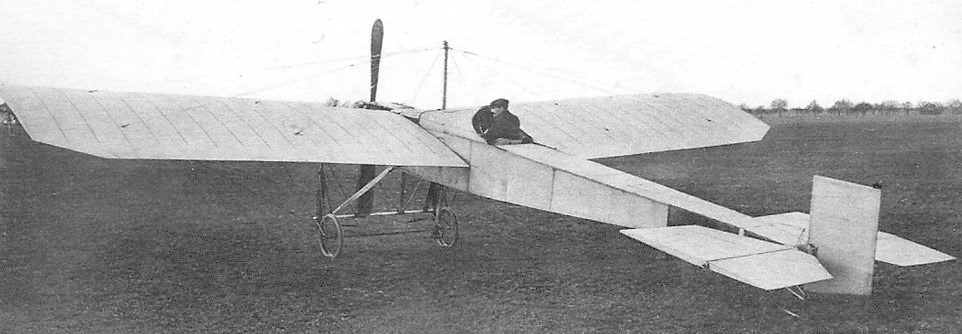
While Martin and most other Americans were trying to copy the Wright Brother’s biplane, Selvage had built the sort of single wing plane that they were making in France. An aviation-enthusiast magazine of the time described it as a “combination of a Bleriot and Antoinette,” which probably meant that it looked much like the actual 1909 Bleriot shown in modern-day flight in the video here, except that his plane had a longer wingspan.
A few days after his premiere flight, the Press Democrat reprinted in full an account from the Eureka Herald. The PD had previously claimed that Selvage would be making his first flights from Santa Rosa, and the reprinted article included a preface that Selvage was “formerly a well known Santa Rosa boy.” Selvage and several brothers were rooming together here in recent years and working as laborers.
Selvage told a local paper that he had a lucrative offer in Southern California for exhibition flights, and might enter a $10,000 Los Angeles competition. Whether he did either is unknown, but about six months later, on June 5, 1910, he was back in Eureka to make arrangements for exhibition flights on the Fourth of July. He said he had been in Oakland, where he made “a number of flights” and was “studying aeronautics and experimenting in aviation.”
“The most successful flights which have taken place in Alameda County, Ca., have been made by Blaine Selvage in a monoplane, which he built himself,” an item in Aircraft magazine noted that September. “Three times on the same day he flew several miles and returned to the starting place without the slightest hitch.” The magazine also reported, “Selvage’s ambition is to be the first aviator to fly across San Francisco Bay.”
Perhaps Selvage felt humbled by honed skills and expensive, high-powered machines, but his career as a pioneer aviator was apparently over. The complete absence of any mention in the press after 1910 suggests that he called it quits. Or maybe his plane was repossessed; in August, 1910 he had accepted $500 from a backer that was apparently secured by the plane.
WILL MAKE AEROPLANE FLIGHT FROM SANTA ROSA
Blaine Selvage, a well known young mechanic of Eureka, has practically perfected a model of a new aeroplane of his own invention, with which he has already made several successful trial flights in private. Mr. Selvage is planning to bring his machine to Santa Rosa, where he will make his first public exhibition and trial flights.
The machine which Mr. Selvage has built consists of two plane surfaces, both 40 feet in length and six feet wide. These surfaces are connected with light but strong supports and rods of different materials, the machine built along practical lines.
A feature of the machine is an appliance whereby the man controlling the machine can make the aeroplane swing and rock from side to side and turn on an unsteady course, much as a bird in flight. This feature of the machine is now before the patent office at Washington and within a short time Mr. Selvage expects to receive his patents. The course of the aeroplane is determined by a horizontal rudder.
The motor which is now being built for the model machine is being built under the direction of Mr. Selvage. The engine is a four-cylinder motor and is capable of developing 30 horsepower. The feature of the motor is its small size and light weight which will make it adaptable for use by the aeroplane.
- Press Democrat, August 12, 1909
SELVAGE TAKES HIS FIRST FLIGHT IN OWN AEROPLANE
A few days ago the Press Democrat mentioned the achievements of Blaine Selvage, formerly a well known Santa Rosa boy, with his self constructed aeroplane at Eureka. The Eureka Herald gives the following detailed, interesting account of his first flight, which will be read with interest by his many friends here:
In the air for a minute and a half, during which time almost a complete circle was traversed, was the feat performed at the Woods resort on the Arcata road yesterday afternoon at 5:30 o’clock. Mr. Selvage made a genuine test and his machine took to the air as nicely as a Wright machine ever tried to do . Mr. Selvage was in town this morning. Despite his modesty as to his achievement the young man was appreciably proud of his machine and exceedingly gratified at the success he enjoyed late yesterday afternoon.
Had the aeronaut had more gasoline in his machine he would have remained in the air longer. One cylinder of his four-cylindered motor began to miss. The aeronaut concluded that it would be well for him to land before any of the other cylinders refused to work. After landing and an examination of the motor made, it was found that the supply of gasoline had been practically exhausted. But one gallon of gasoline had been put in the tank and a part of this had been used in turning over the motor before a flight was attempted. More gasoline had been ordered sent out bit it did not arrive. Hence Mr. Selvage made his initial flight with a shortage of fuel.
The flight was made in a field to the south of the Woods hotel on the Arcata road. The field is no larger than is required for aeroplane maneuvers. Upon starting, the vertical rudder was put hard over. The machine dragged itself over the rough ground for a distance and then evenly ascended. When a height of 20 feet had been attained Mr. Selvage adjusted his planes [sic] to go no higher. He did not care to seek a high altitude upon the initial flight. The machine answered the levers nicely and gave evidence of having sufficient strength to withstand the strain that it must undergo. The motor behaved nicely until the gasoline was exhausted. With the vertical rudder kept hard over the machine circled about the field and would have returned to the place of beginning had there been plenty of gasoline and a landing not been made.
The Selvage machine is a monoplane. It is 40 feet from end to end of the plane, which extends on either side of the light frame work supporting the motor and affording a seat for the aeronaut. The machine was built in this city at the Pacific garage by Mr. Selvage, he making the motor himself.
Mr. Selvage says that he will not attempt to make another flight for afew days, probably not until the latter part of this week or the first of next week. He wishes to place stronger wheels beneath his machine. He is having wide hubbed wheels made especially for the machine. In landing a considerable strain is put upon the wheels. The landing of last evening came very near putting one of the wheels out of commission. Until this matter is attended to the young man will not attempt to make another flight.
The flight of yesterday afternoon was witnessed by a few invited friends of Mr. Selvage He wished to try out the aeroplane in the presence of a few before permitting the general pubic to know of the time of any intended flight.
- Press Democrat, November 21, 1909
TO FLY AFTER STORM
Blaine Selvage, the young Eurekan who in an aeroplane of his own construction succeeded in flying three-quarters of a mile in a minute and a half last Tuesday night, stated last evening that immediately after the present storm is over he will make another flight out on the Arcata road near Woods’ resort.
Selvage is putting more substantial wheels under his flying machine and the next time he ascends heavenward it will be with the firm resolve to make a record breaking flight.
The inventor states he is confident he could fly over the top of Eureka, and but one thing discourages such an attempt, the possibility of his engine breaking while in mid air which would necessitate a descent to terra firma. House tops to not offer a descent to terra firma. House tops do not offer all that might be required for a place of alightment.
After several more flights in this county, Selvage will be ready to sally forth in search of new fields to conquer, it being his intention to go to Lon Angeles and try for the Harris Gray Otis prize, the millionaire newspaperman in the City of Angels is offering.
Selvage is confident he has infringed on none of the patents awarded to the Wright Brothers or any other aviator, and he has several applications for patent on his machine pending.
His 40 horse power engine of four cylinders made entirely by himself, Selvage declares to be the greatest factor in his success. A new system of lubrication has been used to advantage in the Selvage engine and even when it is geared to 1000 revolutions per hour the machinery does not become heated.
Other aviators have had considerable trouble with their engines, their machines becoming so heated while working at full speed in the air that long flights are impossible. Selvage thinks he has successfully bridged this gap.
Then again, the Selvage aeroplane is equipped with steering and balancing devices far superior to any yet used. Generally the amateur aviator has trouble on his first flight in keeping the machine right side up, but Selvage did not experience the slightest difficulty from that source in his first dash into the clouds.
The Selvage machine is of the monoplane type used considerably by French aviators, the Wrights are using a biplane.
- The Humboldt Times, November 19, 1909 as reprinted in “Redwood Country” Eureka Times-Standard, November 21, 1969
IS ASKED TO FLY AGAIN
Blaine Selvage, the young machinist of this city who recently made a flight of three-quarters of a mile in a minute and a half in an aeroplane, monoplane type, of his own construction has already received tempting offers for exhibitions in other parts of the state.
There is soon to be a big jubilation in Ventura and Selvage has been offered $500 and all expenses to make flights in that county during the carnival. Selvage has about decided to accept the offer and he is planning to leave Humboldt county soon to keep the engagement.
After Ventura, he told The Times, he would then fly on to Los Angeles to accept the challenge for a $10,000 purse being offered by the publisher of The Los Angeles Times.
[..]
It has been suggested that Mr. Selvage be asked to make a number of flights in this city next Fourth of July or next fair week and something of that nature may be arranged. This winter he wants to go to Southern California where there are flying contests.
Selvage has demonstrated that he has mastered the air in a measure and he will no doubt have more engagements to make exhibition flights that he can attend to hereafter.
- The Humboldt Times, November 23, 1909 as reprinted in “Redwood Country” Eureka Times-Standard, November 21, 1969