Seibel S-3

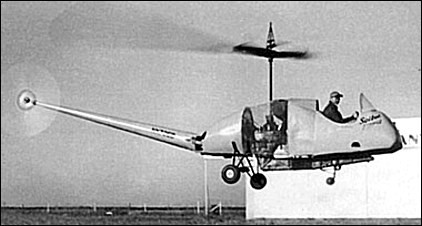
With two collaborators Seibel built in 1947 the S-3 light helicopter with lateral and longitudinal control effected by changing the center of gravity. Each blade attaches to the rotor hub with the help of a piece of bent sheet metal. This formed an angle that could be “twisted” to control changes in pitch. The advantage of this design is how mechanically simple it is. There is no need for bearings, hinges or dampers.

A moveable cabin section shifted in response to “cyclic” stick inputs, thereby shifting the c/g and causing the machine to act accordingly. This was soon abandoned (insufficient control and the potential for roll-over on a hard landing) and replaced by a more conventional cyclic control system for testing and promotional flying.

S-3 NX735B c/n 1 was built in a cellar from miscellaneous spare parts, including a truck differential and an automotive clutch.

The S-3, NX735B, first took flight on 4 September 1947 and flew mainly to demonstrate Charles Seibel’s simplified two-bladed rotor system and transmission.

Most design and features evolved into the Cessna CH Skyhook.

Engine 65hp Franklin
Rotor diameter: 7.62m
Loaded weight: 365kg
Empty weight: 245kg
Cruising speed: 112km/h
Inclined climb: 275m/min
Absolute ceiling: 3660m
Seats: 1

Seguin Siren Wasabi

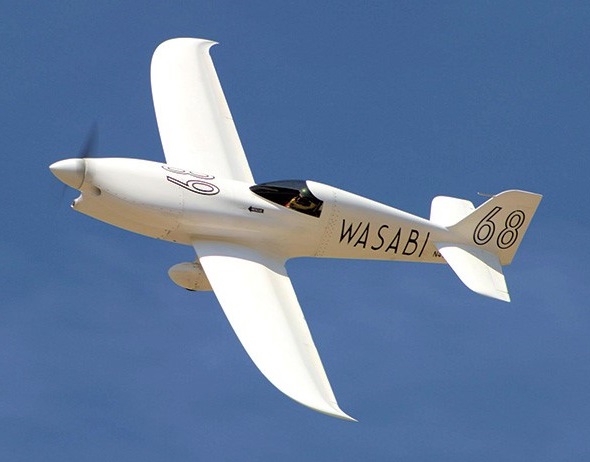
Looking to move into the gold, Elliot Seguin’s Siren Wasabi reflects the move toward high-aspect-ratio elliptical wings for more speed.

The Wasabi Special is a single place, low-wing, conventional landing gear-equipped racing aircraft.

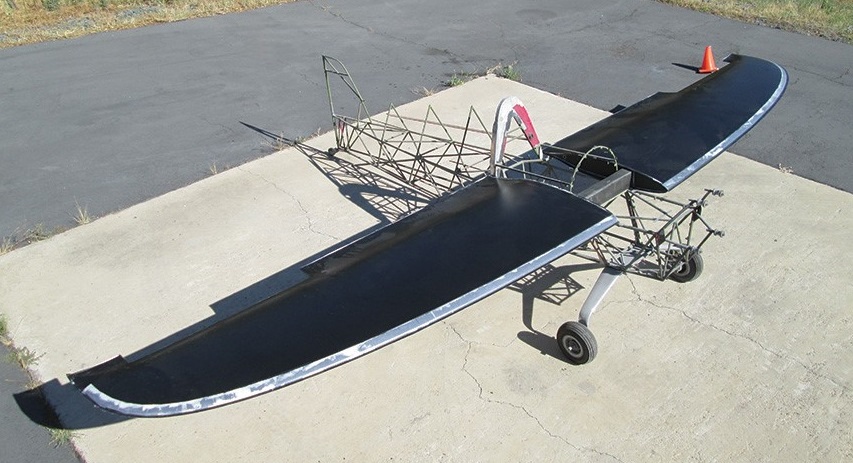
Formula 1 Cassutt custom wing

The airplane was designed and built at the Mojave Air and Spaceport by Elliot Seguin for racing and record setting.

At the Reno Air Races in 2013 the Wasabi Special achieved 229 mph.

At EAA Airventure Set C1, set a record for MHV to OSH flying non-stop with 5 other experimental aircraft from Mojave.

At Reno Air Races 2014 achieved 235 mph.

Powerplant: 1 × Continental O-200
Propeller: 2-bladed
Crew: 1

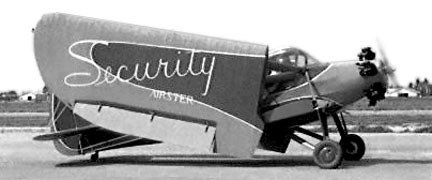
Security S-1 Airster / Security-National S-1 Airster / Security-American S-1 Airster

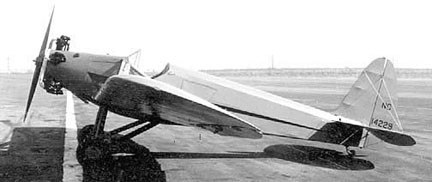
Security-National S-1-A

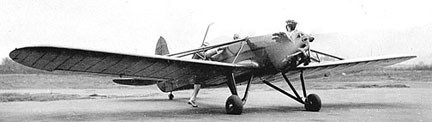
The S-1 Airster designed by Bert Kinner was a folding wing, side-by-side evolution of the Kinner Sportster. First flying on 1 May 1933 (piloted by Lee Brusse) they received ATC 521 and were priced at $1,985.

Two were built as S-1, NX217Y and NC13702, and 12 as S-1-A, NC13743, NC13746, NC13792 to 13794, NC14227 to 14232, and NC14293.

Security-National S-1-A NC14229

ATC 2-451 was received for gross weight change on prototype NX/NC217Y and NC13702.

About five 1937 S-1-B Airster were built with ATC 705, including NC15536 and NC18135, priced at $2,995. The prototype, NX/NC18967, was built as a class project at the Warren School of Aviation in Los Angeles

Security-American S-1-B NX28967

S-1 / S-1-A Airster
Engine: 100hp Kinner K-5
Wingspan: 40’0″
Length: 23’11”
Useful load: 555 lb
Max speed: 100 mph
Cruise: 88 mph
Stall: 35 mph
Range: 300 mi
Ceiling: 14,000′
Seats: 2

S-1-B Airster
Engine: 125hp Security-Kinner S-125
Wingspan: 40’0″
Length: 23’10”
Useful load: 625 lb
Max speed: 90 m[h
Cruise: 80 mph
Stall: 38 mph
Range: 305 mi
Ceiling: 15,000′
Seats: 2

SECAT S.4 Mouette / SECAT S.5

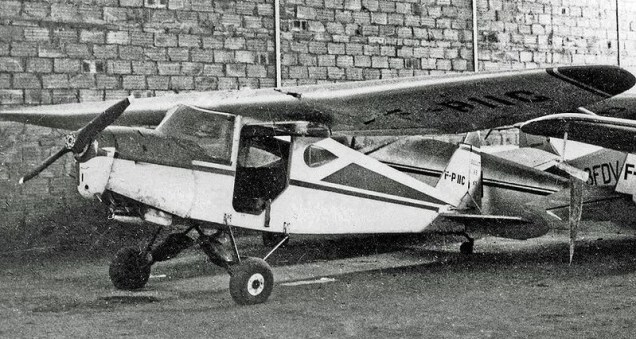
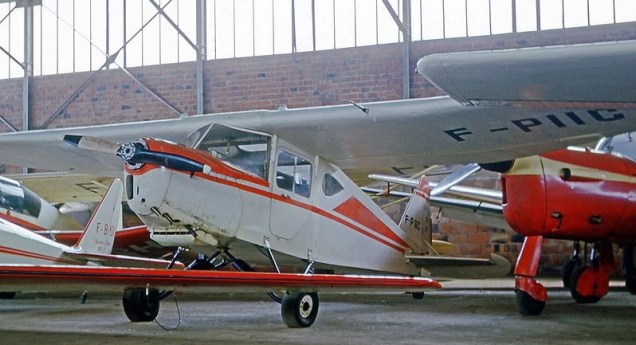
SECAT S.5 F-PIIC Toussous

Société d’Etudes et de Construction d’Avions de Tourisme (SECAT) had been established in the late 1930s, and in 1938 had built the two-seat, high-wing S-4 Mouette, designed by Rémy Goucher, the development of which was interrupted by the hostilities of the Second World War.

Design work on light aircraft was resumed by SECAT in 1946, resulting in the SECAT S-5, the prototype of which was first flown in that year.

The S-5 was based on the design of the S-4, and was of all-wooden construction and had side-by-side seating for two persons. The cantilever, elliptical high-set wing comprised a wooden box-spar, chordwise ribs and a stressed plywood skin. The trailing edge carried ailerons and flaps. The fuselage was a wooden semi-monocoque and dual controls were fitted. The windscreen was split. A large access door was provided on each side of the fuselage, and all fuel was carried in a 250 l (55 imp gal; 66 US gal) tank installed in the wing.

The SECAT S-5 was a light, high-wing, two-seat touring monoplane aircraft, and only one example of the type was ever built, and it flew for a variety of private owners for several decades.

SECAT S-5 F-PIIC Toussus

After the prototype, no further examples of the type were completed. The sole example of the SECAT S-5, registered F-PIIC, was initially operated from Toussus-le-Noble Airport, near Paris. By 1964, it was owned by M. Rene Dupuis, and it was hangared at Arras Roclincourt Airport. The aircraft was still extant in 1967; however, it was struck off the French civil aircraft register during the 1970s.

Engine: 1 × Regnier 4D.2, 56 kW (75 hp)
Wingspan: 8.99 m (29 ft 6 in)
Length: 6.15 m (20 ft 2 in)
Height: 2.11 m (6 ft 11 in)
Empty weight: 350 kg (772 lb)
Gross weight: 570 kg (1,257 lb)
Fuel capacity: 250 l (55 imp gal; 66 US gal)
Maximum speed: 196 km/h (122 mph, 106 kn)
Cruise speed: 150 km/h (93 mph, 81 kn)
Range: 800 km (497 mi, 432 nmi)
Service ceiling: 3,600 m (11,810 ft)
Rate of climb: 3.0 m/s (590 ft/min)
Crew: 1
Capacity: 1 passenger or student pilot

Sebring Wee Wing

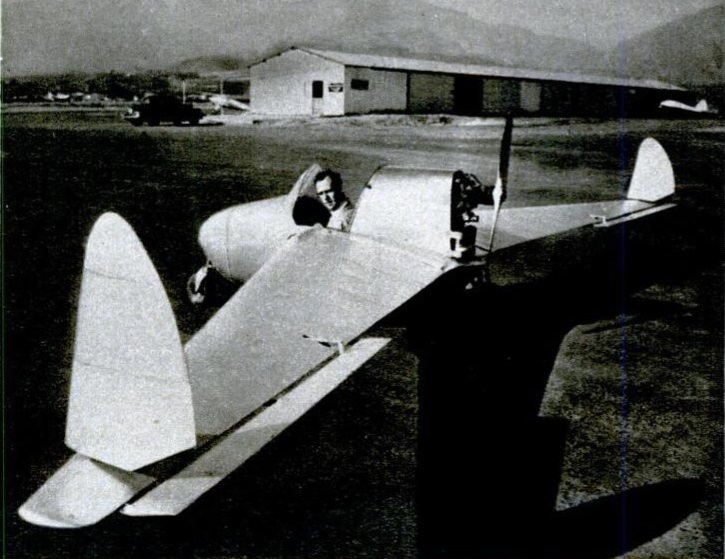
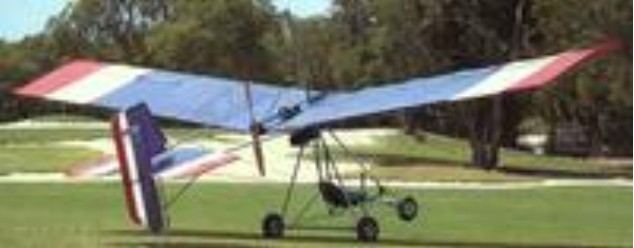
Designed and built by Robert M Sebring over a three-year period, the 1949 Wee Wing was a single-place pusher, the airframe was reportedly built for less than $100. The wing was of bonded plastic plywood. The wood construction aircraft was completed in 1949 and in its structure several composite material parts and components were used. The aircraft had so called wingtip tails and was fitted with one 12hp Richter two-stroke (drone) engine, the Richter company later being acquired by the Nelson Engine company.

Only limited testing of the aircraft took place and further development was soon halted.

Only a single example of the flying wing was built.

Engine: one 12hp Richter (Nelson) two-stroke
Wingspan: 22 ft
Height: 2.5 ft
Empty weight: 150 lb
Cruise: 65 mph
Seats: 1

Seawind International / SNA Seawind

Seawind 300

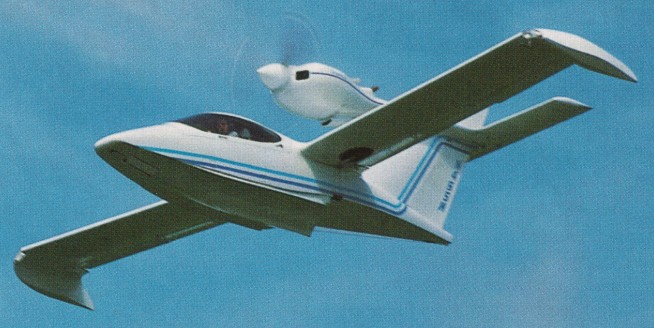
The Seawind 2000 am¬phibian offered by Seawind International of Ontario, Canada, was designed by Rodger Creelman and first flown in 1993.

The pylon mounted engine sits well forward of the fin leading edge, giving an impression that it might part company if subjected to gyroscopic or turbulence loadings. However the mount has been subjected to and survived a 20G test loading, twice the required FAA rertifica¬tion requirements. The Seawind has a wingspan of 35 feet, a MAUW of 3100 lbs and provides a cruise of 145 knots on its fin mounted single Lycoming IO 360 consuming 10 US gal¬lons each hour.

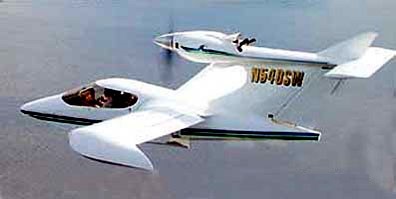
The four seat Seawind 2500 amphibian design is of composite manufacture, and first flown in 1994. The amphib¬ian’s power source is a 200 hp tail-mounted Lycoming IO 360; cruise is noted at 145 knot.

The certified Seawind 300C is manufactured Exclusively by Sea Air Composites, inc, a single engine 4/5 place amphibian.

Initially with tail-mounted 300hp Lycoming IO-540 (prototype with 200hp IO-360), later powered by 400hp Allison 250-B17B turboprop.

Of fiberglass and cellfoam construction the Seawind received the EAA award for craftsmanship in 2000. The standard kit with molded components, less engine sold for $58,980.

Seawind N548SW

Seawind 2000

Seawind 2500
Engine: Lycoming IO-540-T, 300 hp
HP range: 250-300
Height: 10.2 ft
Length: 27.2 ft
Wing span: 35 ft
Wing area: 160 sq.ft
Weight empty: 2230 lb
Gross: 3400 lb
Fuel cap: 110 USG
Speed max: 187 mph
Cruise: 178 mph
Range: 1600 sm
Stall: 59 mph
ROC: 850 fpm
Take-off dist: 1010 ft, (1600 ft water)
Landing dist: 770 ft (620 ft water)
Service ceiling: 14,800 ft
Seats: 4
Landing gear: retractable nose wheel

Seawind 3000
Engine: Lycoming IO-540, 300 hp
Height: 10.2 ft
Length: 27.2 ft
Wing span: 35 ft
Wing area: 160 sq.ft
Weight empty: 2300 lb
Gross: 3400 lb
Fuel cap: 110 USG
Speed max: 200 mph
Cruise: 191 mph
Range: 1460 sm
Stall: 57 mph
ROC: 1250 fpm
Take-off dist: 820 ft, (1100 ft water)
Landing dist: 770 ft (620 ft water)
Service ceiling: 20,000 ft
Seats: 4
Landing gear: retractable nose wheel

Seawind 300C
Engine: Engine Continental IO-550-N. 310 hp
Propeller: McCauley 3-blade 76” Constant Speed
Wing Area: 163 sq. ft.
Wing Span: 35 ft
Height: 10 ft 2 in
Overall Length: 27 ft 2 in
Ground Clearance: 8.5 in
Wing Loading: 20.81 lbs/sq ft
Power Loading: 10.97 lbs/hp
Max Gross Weight: 3400 lbs
Std Empty Weight: 2300 lbs
Equipped Empty Weight: 2350 – 2400 lbs
Useful Standard: 1150 lbs
Useful Equipped: 1000 – 1150 lbs
Fuel Capacity Mains: 80 US gals
Long Range – Aux Tanks: 30 US gals
Sea Level Speed 100% Pwr: 200mph / 174 kt.
Cruise 75% Pwr (8,000 ft): 190mph / 165kt.
Cruise 65% Power (8,000 ft): 180mph / 156kt.
Cruise 55% Power (8,000 ft): 169mph / 147kt.
Fuel Burn at 55% Power: 12.8 gph
Max. Range (no reserve main) 1040sm / 905nm.
Extended Fuel Range: 1460sm / 1270nm.
Rate of Climb: 1250 fpm
B/Rate of Climb Speed: 99mph / 86kt.
B/Angle of Climb Speed: 74mph / 65kt.
Stall Speed: Clean 72mph / 63kt, Flaps & Wheels: 60mph / 54kt.
Service Ceiling: 18,000 ft.
Take off Distance 3200 lbs: Land 870 ft / Water 1100 ft
Take off Distance 3400 lbs: Land 1175 ft / Water 1400 ft.
Over 50’ Obstacle: Land 1175 ft / Water 1400 ft
Landing Distance: Land 770 ft / Water 620 ft.
Over 50’ Obstacle: Land 1300 ft / Water 1150 ft.
Cabin Length: 105”
Cabin Width: Front 52″ / Rear 54″
Cabin Baggage: 16 x 48″ wide, 24” high, 10 cu ft
Aft Baggage: Opening 19” x 40”, Length 71″, Volume 30 cu ft
Nose Deck Forward Storage: 3 cu ft

Seahawk Industries Condor

The Condor is a single-engine, high-wing monoplane has a cruciform tail and kingpost and cable braced single-surface wing. The Condor is controlled solely by weight shift. The engine is a twin-cylinder Kawasaki with 2.0 reduction is mounted in the center below the wing. Drive shaft to pusher prop is above the wing. The taildragger gear has torsion bar suspension. Fourteen-inch wheels have pneumatic tires.

The Condor II has three-axis aerodynamic controls include stick controls for elevator and spoilerons plus rudder pedals. The engine is a Kawasaki twin-cylinder 440 engine has 2.0 reduction and is mounted below the wing in the center. It drives a pusher prop of 54×32-inch wood. Some of the two seaters were equipped with Kawasaki liquid cooled engines of 80 hp. The taildragger gear has 14-inch main wheels with pneumatics and torsion bar suspension. The plane is has a single surface wing, and is wire braced. The kit came as a simple bolt together assembly taking approximately 75 hours to assemble.

The Condor single place and two place were produced up until about 1984.

Condor
Wingspan, 32 ft
Wing area 160 sq.ft
Empty weight, 164 lb
Wing loading, 2.06 lbs/sq.ft
Fuel capacity, 3.1 USG
Engine displacement, 440cc
Rated HP, 40 hp

Condor II
Wingspan, 32 ft
Wing area, 160 sq.ft
Empty weight, 196 lbs
Wing loading, 2.26 lbs/sq.ft
Fuel capacity, 3.1 USG
Engine displacement, 440cc
Rated HP, 40 hp

Condor
Stall: 22 kt / 25 mph / 40 kmh
Cruise: 30 kt / 35 mph / 56 kmh
VNE: 56 kt / 65 mph / 105 kmh
Empty Weight: 106 kg / 234 lbs
MTOW Weight: 215 kg / 475 lbs

Seagull Aerosports Escape Pod / Pod Racer

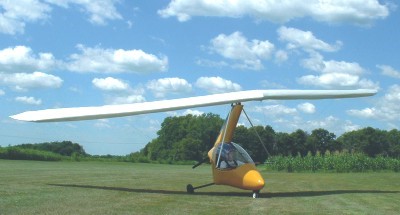
Manufactured by Seagull Aerosports, the Escape Pod is the first fully enclosed trike with retractable landing gear. According to Michael Riggs is President and Founder of Seagull Aerosports the Seagull was designed “starting from a clean piece paper, trying to change the trike genre.”

Developed by Michael Riggs, Riggs’ company Seagull Aerosports, will fully build the Escape Pod and its unpowered sibling, the Pod Racer, buth weight-shift control with a fully enclosed cockpit. Since empty weight is well under Part 103’s 254-pound limit, ready-to-fly construction is completely proper.

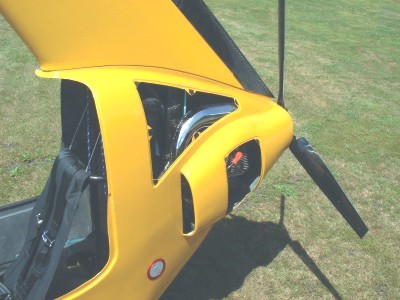
The fuselage, or “pod,” is made from composite foam sandwich construction of PVC and graphite prepreg materials. The shape is vacuum-bag molded and oven cured for minimum weight and maximum strength. The complete lower shell and main structural bulkhead weigh only 16 pounds out of the mold, and the entire trike chassis weighs less than 80 pounds with engine and parachute. The bottom of the fuselage is flat so that if an outlanding is necessary and terrain does not encourage use of the gear, a belly landing can be made. In addition, the shape of the nose will prevent shoveling and possible flipover. A foam crush zone forward of and under the pilot adds another layer of protection as does a four-point seat restraint system.

The tricycle gear is fully retractable, which were allowed under Part 103 though not for LSA. Maingear legs are made of a filament wound graphite, and the gear is retracted using racing catamaran hardware.

Abandoning the forward tube, the Escape Pod uses a streamlined, tapered composite mast that has enough vertical area to provide yaw stability for high performance hang glider wings.

The Pod has been designed for full enclosure in a molded acrylic canopy with graphite frames. To facilitate control movements, the triangular control bar passes through a Neoprene-covered slot running fore to aft in the canopy following the control bar’s arc, thus accommodating a full range of motion.For summer use or if customers prefer, a shorter summer windscreen was also to be available. The fuel tanks are mounted internally and the engine is fully enclosed.

A rocket-deployed parachute is mounted on the rear of the main structural bulkhead and fires through a hatch on the side. The handle is on the floor between the pilot’s legs (and emergency responder labels.

The Escape Pod is powered by a 25-hp Cors-Air M-21Y and Powerfin three-blade propeller. An unpowered variation, called the Pod Racer, is also available and is launched via a winch or aerotow.

The powered Escape Pod and unpowered Pod Racer can be used with any hang glider wing that will accommodate the weight of chassis, pilot, engine, fuel and parachute system.

Like most trikes, the Escape Pod can be broken down small enough for storage in your garage or in the corner of your hangar. Its light weight will allow loading to trailer or pickup.

Riggs was anticipating that the Escape Pod would fly by the fall of 2004

Seaflight (NZ) Shearwater

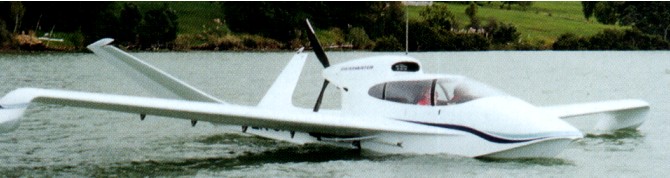
The desire to have a four-seat amphibian led to the development of the Seaflight Shearwater ZK-SFA. Designed by Bill Townson over a three-year period via a series of 1/5th scale models

Construction began in 1997 and incorporated a PZL-built development of the 210 hp Franklin pusher engine mounted lower than normal. This required a lower, cut down rear fuselage. The aircraft is equipped with a V-tail.

Registered ZK-SFA, the Shearwater first flew in November 2001, piloted by Andrew Buttle.