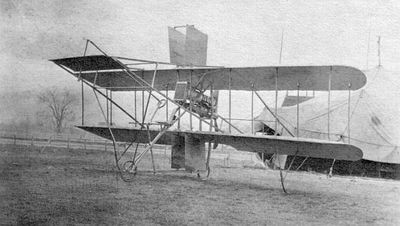
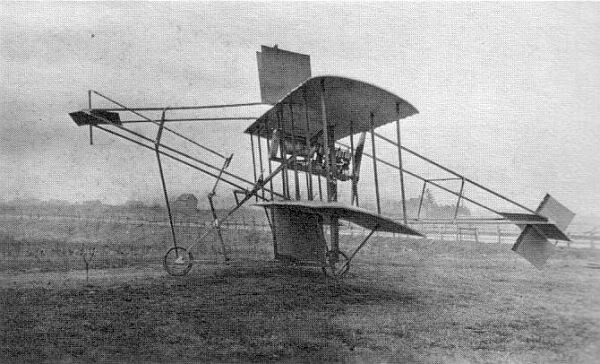
Arthur L Smith believed he could build a plane that would fly better than the Wright airplane, and as he worked on his design, he was careful to avoid infringing on their patents. This was the end result of two prototypes that crashed, mainly because Smith was teaching himself to fly as he went along.
It took him and a friend six months to build the single-place, open cockpit, biplane, which they moved through the streets of Fort Wayne at night to a field in what is now Memorial Park.
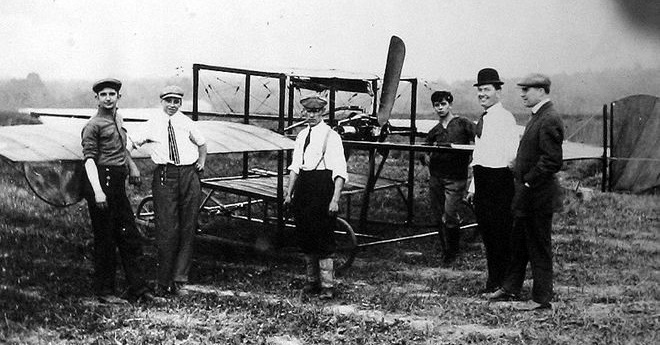
Built by Arthur L. Smith, a Curtiss-type biplane flown and crashed at Fort Wayne, Indiana, on January 18, 1910. The aeroplane reached almost fifty miles per hour before leaving the ground when suddenly it rose alarmingly, dipped, rose again, and crashed into the field in what is now Memorial Park. Art was thrown onto the frozen ground and badly injured. The machine was ruined except for the 40 hp Elbridge engine and never rebuilt.
A replica of this ship, built by Billy Parker and Bob McComb, is now hung on display at Ft Wayne Intl Airport terminal.
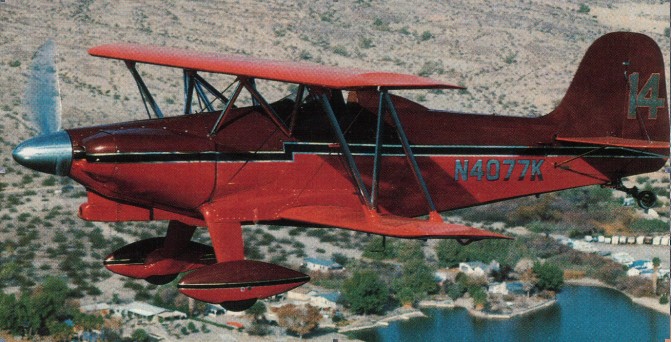
The primary appeal of the Smith Miniplane is its small-size construction simplicity and open-cockpit. The fuselage framework is a conventional truss structure of welded steel tubing, faired to shape with wood stringers. As on most similar designs, the vertical stabilizer is welded up as part of the rear fuselage structure. The wings are made from spruce spars and ribs. Several engines can provide the power, the Continental from 65 to 85 hp or the Lycoming from 100 to 125 hp.
The 1956 DSA-1 Miniplane model designation was for “Damn Small Aeroplane”. The prototype first flew on 29 October 1956.
Smith Miniplane N90P
There have been hundreds of the original Smith Miniplane Biplanes built and flying today. In 1996 plans cost US$140.
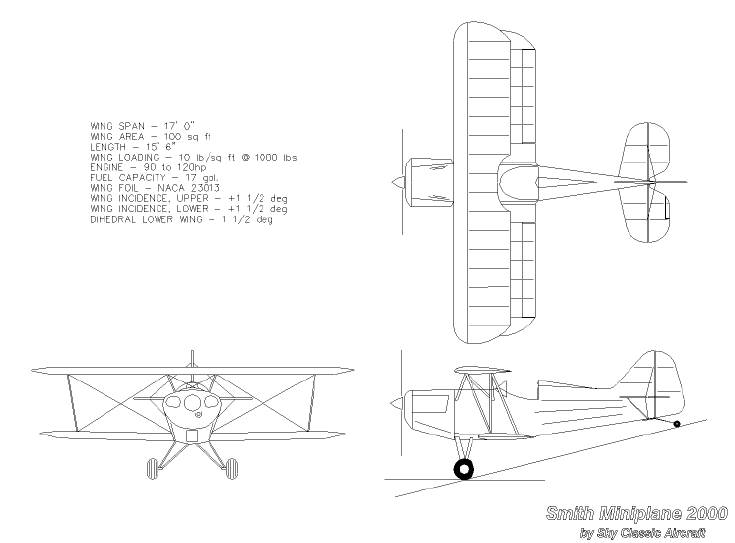
Sky Classic Aircraft introduced the 2000 version of the Smith Miniplane Biplane. Many of the parts and pieces on the aircraft were simplified to make it easier to build.
Changes include: 1) New wing fittings to simplify building. 2) Stretched the length of the fuselage by 5 inches to accommodate a larger person. 3) Stretched the width of the fuselage by 2 inches to accommodate a larger person. 4) Added a trim tab to the elevator. 5) Reshaped the rudder assembly to look more racy. 6) Added struts to the horizontal stabilizer to stop any cracking like the Pitts did. 7) Changed the wing foil to a NASA 23013. Good for aerobatics yet very stable with less drag. 8) Changed the wing angles of attack to fix an old problem on the old aircraft. 9) Reduced the rudder control speed to make it just a little easier to fly. 10) Aircraft plans on computer CAD so that they are easy to read. 11) Adding springs to the original type landing gear.
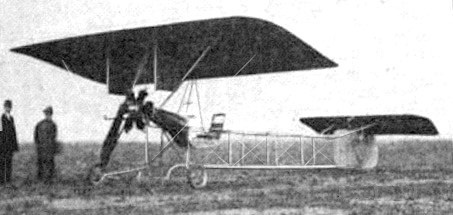
Based on the Lazor-Rautenstrach Belle of Bethany and built by Robert R Smidley in 1959, the Smidley Rapid Robert was a single-place cabin, low wing monoplane.
Smidley began construction of his monoplane in 1909. It was described in the August 1909 NY Times as having large wings on either side of the central rectangular box. A smaller plane was above and in front, and a fixed semicircular plane was at the tail. Control was a semicircular device at the front with the halves of the semicircle moving together as elevator or separately. It was mounted on four small wheels that ran on rails. This was the 223 pound bamboo version with 18 hp engine. At some point the machine was changed to larger wheels for take-off from the ground and probably rebuilt in other ways. Smidley is credited with three aircraft and a completely rebuilt version of his first machine was reported to be ready for testing in a March 1910 Aeronautics. There is a small picture in November 1910 Aeronautics that shows a machine with the larger wheels, powered by an 18 hp 2-cylinder Stevens Duryea air-cooled engine, and the structure doesn’t look like bamboo. These machines were not powered by an electric motor, but a machine identified as Smidley’s third machine was displayed at a Harrisburg auto show in early 1910, where an electric motor was used to run the propeller in the exhibition. The picture is either the second version incomplete or the third, with the Duryea.
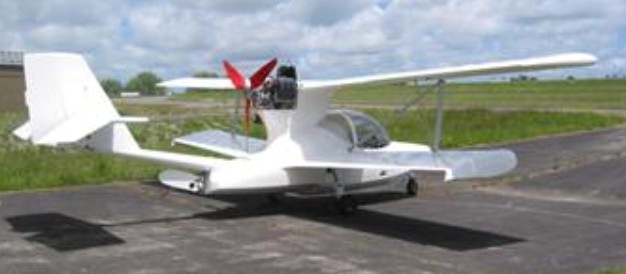
A side by side two seat amphibious pusher biplane. A full detachable canopy that can be converted into an open cockpit with its own separate windshield.
The wings, boom and tail section detach for reduced storage and easy transportation.
Production of the Petrel was taken over by SMAN, who returned it to the market circa 1998.
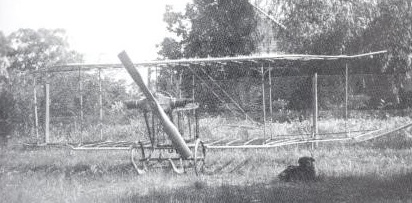
Australian tractor biplane designed and constructed by Douglas Sloane. The engine was also of his own design and one of the things that held him up in his attempt to fly. Despite the stage of progress seen in this photo, the plane was eventually covered. It was towed behind a car to give it extra power but the engine just didn’t have the muscle. However the plane did manage a short hop at “Dick’s Plain” swamp in late April 1912.
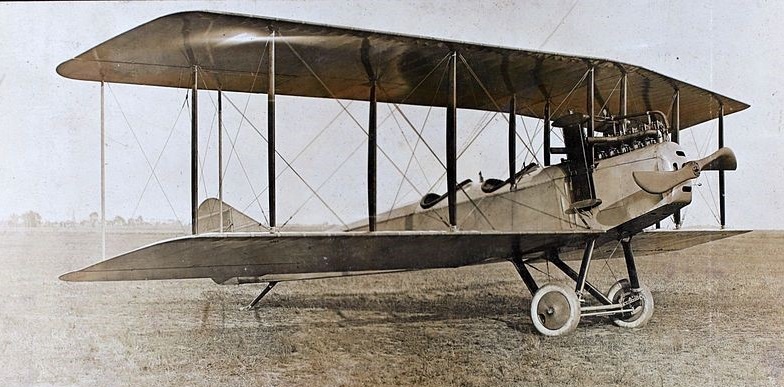
Designed by Charles H Day and originally known as the Sloane H-2, the Standard H-2 was built by the Standard Aircraft Corporation. Modified from Sloan H-2, three were built by Standard Aircraft Corp, AS82 to 84.
An early American Army reconnaissance aircraft, ordered in 1916, it was an open-cockpit three-place tractor biplane, powered by a 125 hp (90 kW) Hall-Scott A-5 engine. It had swept-back wings and originally had mid-wing ailerons. Only eight were built; AS82 to AS89.
An improved version, the H-3, with the same engine, swept-back, and equal-span wings, earned an order for eight aircraft, AS85 to 93, while the Navy ordered four with floats as the H-4H, 137 to 140.
These, like J-1 and Curtiss JN-4, were the basis of countless modifications as surplus civil aircraft after the war.
H-4H seaplane
Two Standard H-3s were sold by the US Army to Japan, where a further three were built by the Provisional Military Balloon Research Association (PMBRA) in 1917, powered by 150 hp (110 kW) Hall-Scott L-4 engines. They were used as trainers between May 1917 and March 1918, although they were considered dangerous.
H-3 Engine: 1 × Hall-Scott A-5, 135 hp (101 kW) Wingspan: 40 ft 1 in (12.22 m) Wing area: 532 sq ft (49.4 m2) Length: 27 ft 0 in (8.23 m) Empty weight: 2,500 lb (1,134 kg) Gross weight: 3,300 lb (1,497 kg) Fuel capacity: 68 US gal (57 imp gal; 260 L) Maximum speed: 84 mph (135 km/h, 73 kn) Stall speed: 46 mph (74 km/h, 40 kn) Endurance: 6 hr Time to altitude: 10 minutes to 3,400 ft (1,000 m) Crew: 2
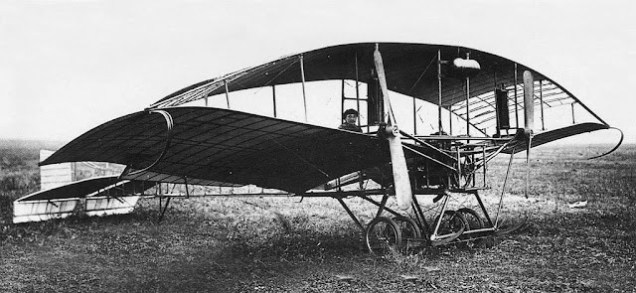
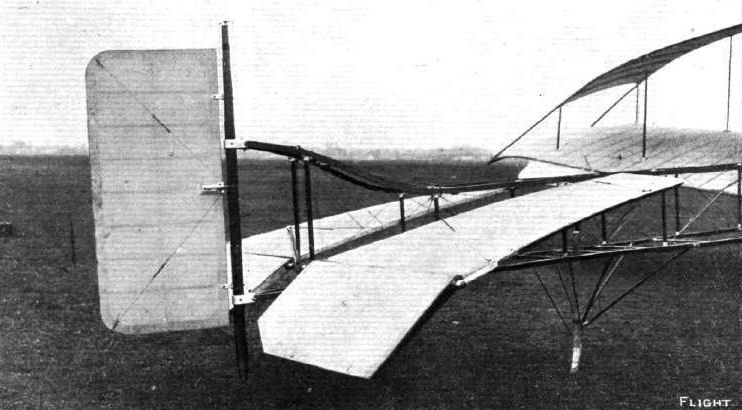
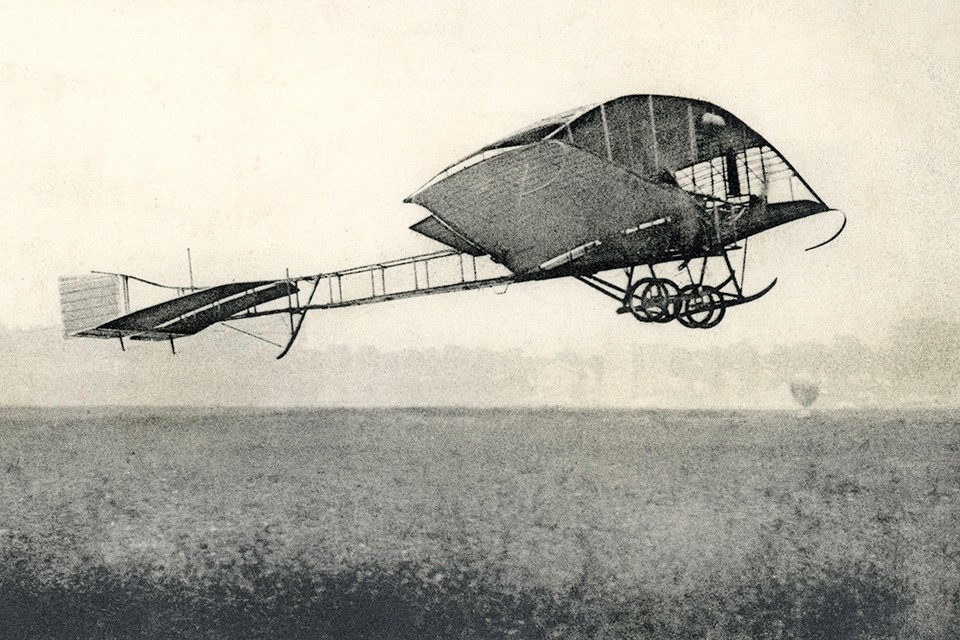
Between 1910 and 1912, American expatriate Jacques-Jules Sloan built a series of biplanes he called Bicurves in his small workshop in the Paris suburb of Charenton-le-Pont. The Bicurve’s fuselage, tail and landing gear were similar to those found on French Blériot monoplanes of that period. As initially constructed, the fuselage terminated in a movable rudder, without a fixed fin, and fixed horizontal stabilizers of flat section without any airfoil. The elevators were originally mounted ahead of the fuselage on struts, in canard fashion. Those struts were subsequently removed and the elevators relocated to a more conventional position at the tail, hinged at the trailing edge of the horizontal stabilizers.
It was in its wing cellule that the Bicurve differed markedly from any of its contemporaries, or from any subsequent biplane designs. The Bicurve’s lower wing attached to the upper fuselage longerons. The lower wing, which was reminiscent of that found on contemporary Antoinette monoplanes, was designed with marked dihedral, transforming to anhedral near the tips, and was fitted with conventional trailing-edge ailerons. The upper wing, on the other hand, was deeply arched, both in section and in span, so much so that the tips curved sharply downward and were attached by struts to the lower wingtips.
The initial version of his Bicurve was fitted with two propellers driven by a single engine via chains and gears. An examination of photographs of the airplane provides a clue as to why he added the additional weight and complexity of such a drive system. The two propellers were clearly arranged to turn in opposite directions, suggesting that Sloan was trying to further improve the airplane’s handling characteristics by canceling out the torque effect imparted by a single propeller.
Lateral control was achieved not by wing-warping but by means of fins installed on the trailing edge of the lower wings, just before the wingtips drooped. Due to the airplane’s inherent natural stability, their surface area was quite small. Vertical control could be achieved any of two ways, depending on the pilot’s preference. One method involved using two elevators, one at the front coupled with another at the rear, acting simultaneously by opposite bearings. This control system was very effective, but some pilots preferred to use only the rear elevator.
The main undercarriage consisted of two forward-facing skids carrying two pairs of wheels, which were equipped with dampers and mounted on a universal joint that could absorb shocks from rough field landings. The undercarriage was secured, as with the fuselage itself, by means of special aluminum fittings. The main gear was complemented by either a rear skid or wheel.
The original Bicurve had a wingspan of 35 feet 11 inches, a length of 37 feet 1 inch and wing area of 161 square feet. Maximum speed was recorded as 46 mph.
Sloan seems to have built and flown at least three different versions of the Bicurve between 1910 and 1912, and it is also reported to have been powered at various times by at least two different engines: a 35-hp Labor-Aviation and, later, a 50-hp Gnome. As was the case with numerous early airplanes, however, there is little documentation as to whether the various Sloan Bicurves were new builds or simply improved versions of the same airframe. For example, while the original airplane had twin propellers driven by a single engine and elevators mounted in front, other versions featured a single propeller and conventional tail-mounted elevators.
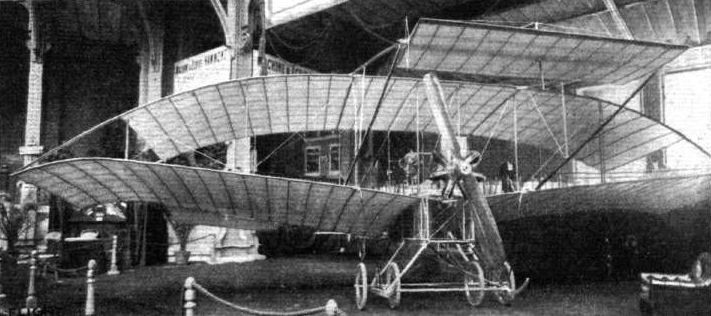
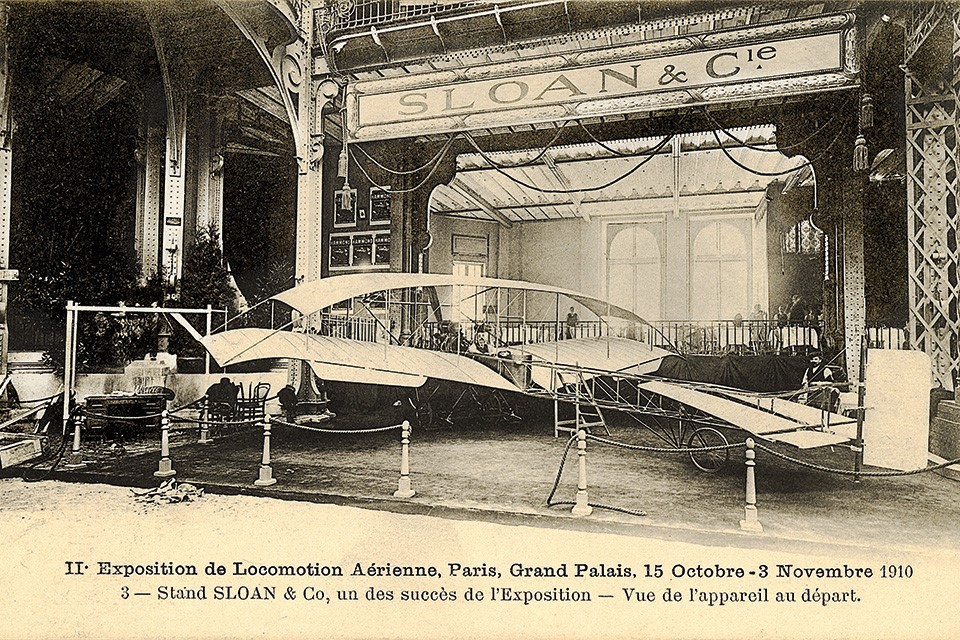
A photograph exists of the Bicurve exhibited by Sloan & Company at the Exposition de Locomotion Aérienne in Paris between October 15 and November 3, 1910. In spite of that publicity, the airplane was not a financial success and the design proved to be a dead end. Nevertheless, unlike many strange-looking early airplanes, the Sloan Bicurve actually flew, and apparently flew well. Motion picture footage still exists showing the machine taking off and landing, and it appears to do so quite smoothly.