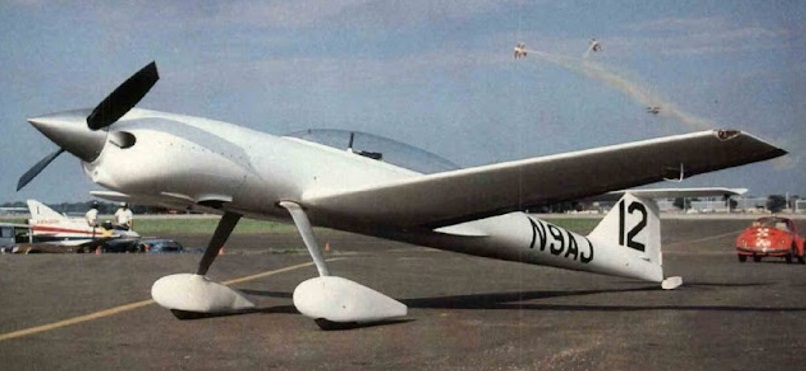
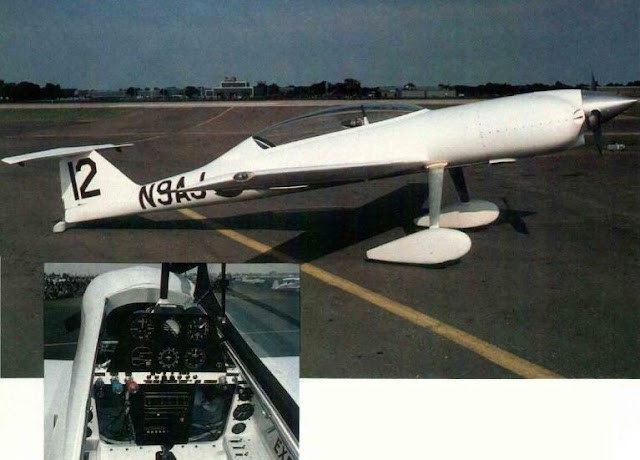
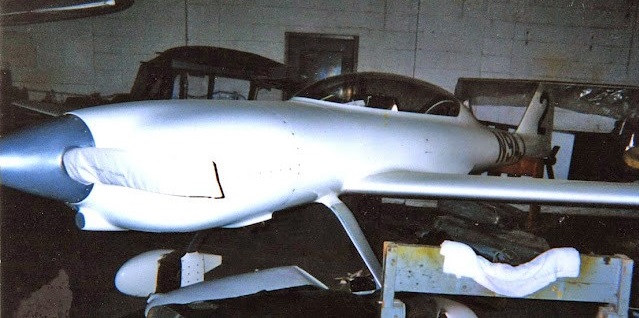
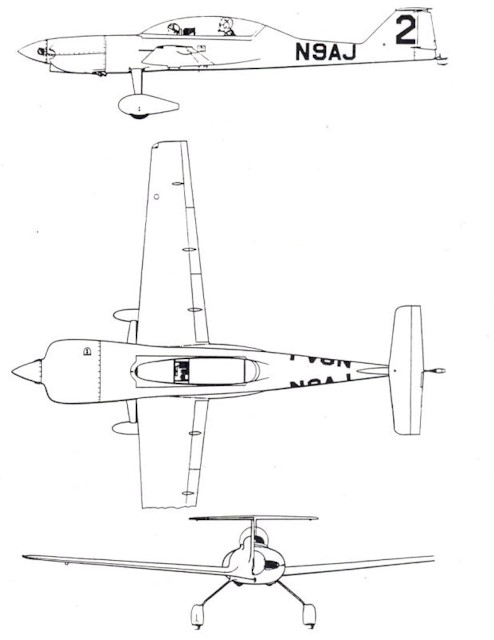
The AJ-2 was designed as a cross-country touring aircraft. It had two seats. The passenger seat was intended to serve as a baggage area when only the pilot was aboard. The engine is a Lycoming IO-360. It makes about 215 hp and has a custom, “one-off” McCauley constant-speed prop. Long-range cruise (55% power) reportedly resulted in 200 mph and 40 mpg. Normal cruise (75% power) was said to be 250-255 mph and about 23-24 mpg.
For the airframe, A.J. utilized techniques developed by the Germans in WWII. It consists of bulkheads spanned by balsa and foam. The wing is one piece, designed to be easily replaced with an updated version that contained retractable gear. The updated version was, to my knowledge, never manufactured or mounted. The wing pictured uses a NACA 64212 airfoil, 12% thick, with a constant section and a .5 taper ratio with no twist. The lack of twist produced undesirable stall characteristics, so A.J. added stall strips and rigged the ailerons up a quarter of an inch, providing an effective twist.
The airplane has a T-tail that also uses NACA sections – 9% for the horizontal, and 12% for the vertical. The tailwheel is a Henry Haigh locking version mounted on a Wittman-type tapered rod spring.
Andrew’s experience with gliders clearly translated into the exquisitely efficient design of the AJ-2. Indeed, according to Mike, Andrew once claimed that the total drag of the airplane was approximately equivalent to a 12″x12″ square piece of plywood being pushed through the air.
This paid off in cross-country competition. First flown on 15 July 1981 registered N9AJ, Andrew and the AJ-2 won a cross-country race that emphasized efficiency known as the Oshkosh 500. The airplane, AJ-2, was designed to compete in a new EAA sponsored efficiency race, the Oshkosh 500. AJ competed successfully, winning seven years in a row. He won the race with an average speed of just under 218mph while burning only 19.2 gallons to cover the 500 mile long course. On August 6, 1982 he flew the AJ-2 to a 500 km closed course speed record – 253.3 mph (407.7 km).
Andrew apparently was interested in donating the AJ-2 to a museum, but ultimately ended up selling it before passing away in 2004. It was then stored in a hangar at a nearby airport in rural Wisconsin.
In addition to the aircraft itself, there was a vast quantity of plans, diagrams, and three-ring binders of handwritten calculations and data that AJ used to design it.
After purchasing the AJ-2 back in the early 2000s, the new owner still has yet to fly it. But he thought it will likely happen later when he completes the removal of a wing modification. This project should return the AJ-2 to its standard/original configuration.
Gallery
Engine: 215hp Avco Lycoming IO-360-A1B6
Wingspan: 24’0″
Length: 22’0″
Useful load: 600 lb
Max speed: 298 mph
Cruise: 255 mph
Stall: 68 mph
Seats: 2