The Staib DM was a home-built, single-seat, aerobatic aircraft, registered N9V.
An open-cockpit biplane, powered with a 65hp Continental engine, the speed was 140 mph.
The Staib DM was a home-built, single-seat, aerobatic aircraft, registered N9V.
An open-cockpit biplane, powered with a 65hp Continental engine, the speed was 140 mph.
The 1930 Justacrate Black Buzzard was a single-place, parasol-wing, home-built monoplane, registered N362V. Power was a 40hp Ford Model A.
The A-2 N11564 was built by T G Stafford in 1933. It was a single-place, open cockpit monoplane, powered by a 45hp Ford engine.
The TG Sport N11540 was built by T G Stafford in 1932. It was a single-place, open cockpit biplane, powered by a 38hp Ford A engine.
The Stadlman Exhibition Biplane was designed by Chance Vought and built circa 1913. A single-place, open cockpit biplane, it was destroyed in a crash in Lake Michigan in 1914.
Engine: 90hp Curtiss OX
Max speed: 80 mph
Stall: 35 mpg
Seats: 1
Little is known of a 1910 Triplane built in the USA by Stadtler. Three wings were forward, three wings aft, the span for all being 25’0″. The length was 40’0″. Twin chain-driven pusher props had “variable pitch.”
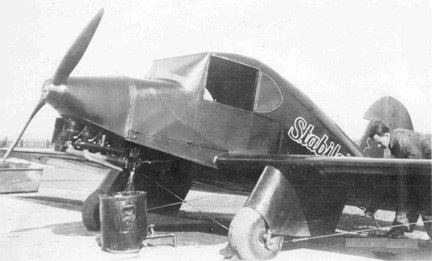
The 1930 Stabilaire Inc A prototype NC853Y c/n A-1-30 was a two-place, powered by a Szekely SR-3, later replaced by a 55hp Rover. The registration was cancelled on 15 June 1931.
Biplane, struts and cable bracing, cruciform tail. Taildragger, steerable tailwheel. The Stinger is derived from the Hornet, being of similar configuration and construction, and differs principally by having a smaller wing span and area.
The power pack is a Kawasaki TA440, as on the Hornet, and the price was $6450 ready to fly in 1983.
Engine: Kawasaki TA440, 35 hp at 6000 rpm
Propeller diameter 50 inch, 1.27 m
V belt reduction, ratio 2.0/1
Max static thrust 235 lb, 107 kg
Power per unit area 0.19 hp/sq.ft, 2.0 hp/sq.m
Fuel capacity 5.0 US gal, 4.2 Imp gal, 18.9 litre
Length overall 18.0 ft, 5.49 m
Height overall 6.3 ft, 1.91 m
Wing span 26.3 ft, 8.02 m
Total wing area 185 sq.ft, 17.2 sq.m
Empty weight 245 lb, 111kg
Max take off weight 600 lb, 272kg
Payload 355 lb, 161kg
Max wing loading 3.24 lb/sq.ft, 15.8 kg/sq.m
Max power loading 17.1 lb/hp, 7.8 kg/hp
Load factors; +12.0, 12.0 ultimate
Max level speed 62mph, 100kph
Never exceed speed 100mph, 161kph
Cruising speed 55mph, 88 kph
Stalling speed 24 mph, 39 kph
Max climb rate at sea level 700 ft/min, 3.6 m/s
Best glide ratio with power off 8/1
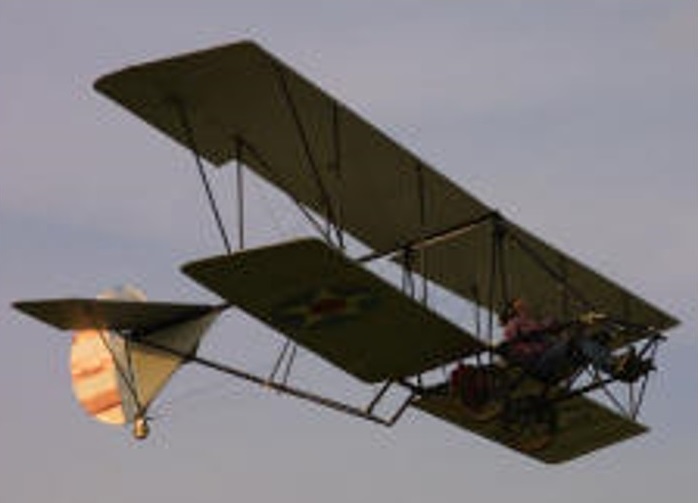
The Hornet was originally powered by a Mac 101 go cart engine, was foot launched, and had three axis controls using elevator and ailerons through a side stick arrangement. With it’s large wing area and light weight it made an excellent glider. Later models had landing gear added to them and engine power increased to the Rotax 503.
SR-1 Enterprises Hornet Article
Single seat single engined biplane with conventional three axis control. Wing has unswept leading and trailing edges, and constant chord; cruciform tail. Pitch control by elevator on tail; yaw control by fully flying rudder; roll control by half span ailerons on upper wing; control inputs through stick for pitch/ roll and pedals for yaw. Wings braced by struts and transverse X cables; wing profile; double surface. Undercarriage has three wheels in tail dragger formation; suspension on tailwheel and bungee suspension on main wheels. No ground steering. No brakes. Aluminium tube/steel tube framework, without pod. Engine mounted between wings driving pusher propeller.
Introduced in 1982, the Hornet is a biplane which is built very much according to the customer’s wishes and it is thus rather difficult to describe a ‘standard’ machine. However, all Hornets use a combination of steel and aluminium tubing for their construction, with a ladder frame for the wings and drag and anti drag diagonal cables inside the double surface wing. Two steel tubes in the shape of an inverted V run between the trailing edges of the upper and lower wings and provide a mounting for the engine, usually a 30 hp Cuyuna 430R.
Engine: Cuyuna 430R, 30 hp at 5500 rpm
Propeller diameter and pitch 45 x 33 inch, 1.14 x 0.84 m
V belt reduction, ratio 2.0/1
Power per unit area 0.13 hp/sq.ft, 1.5hp/sq.m
Fuel capacity 3.0 US gal, 2.5 Imp gal, 11.4 litre
Length overall 18.3 ft, 5.56 m
Height overall 6.7ft, 2.03m
Wing span 34.0ft, 10.36m
Sweepback 0 deg
Total wing area 218 sq.ft, 20.3 sq.m
Main wheels diameter overall 20 inch, 50 cm
Empty weight 200 lb, 91 kg
Max take off weight 575 lb, 261 kg
Payload 375 lb, 170 kg
Max wing loading 2.64 lb/sq.ft, 12.9 kg/sq.m
Max power loading 19.2 lb/hp, 8.6 kg/hp
Load factors; +5.5, 4.5 ultimate
Max level speed 60 mph, 97 kph
Never exceed speed 65 mph, 105kph
Economic cruising speed 48mph, 77kph
Stalling speed 21mph, 34kph
Max climb rate at sea level 800 ft/min, 4.1 m/s
Min sink rate 250ft/min at 33mph, 1.3m/s at 53 kph
Best glide ratio with power off 9.3/1 at 33 mph, 53 kph
Take off distance 75 ft, 23 m
Landing distance 160 ft, 49 m
Engines: 150-200 hp
Under carriage: retractable

