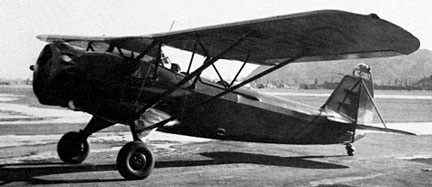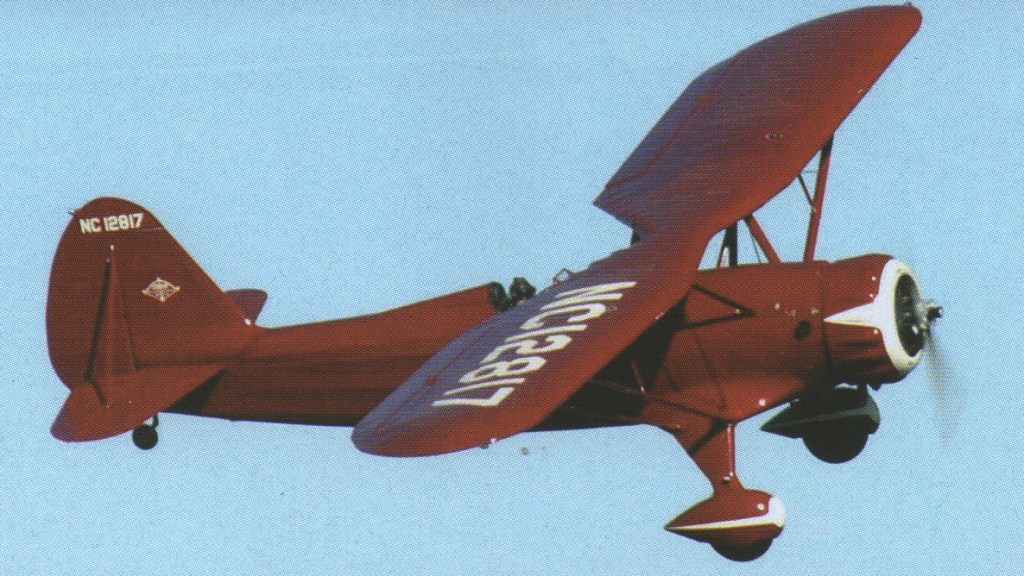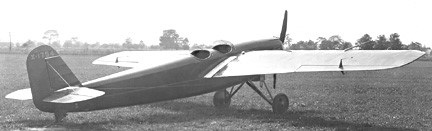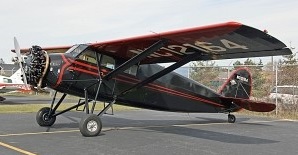
Stinson Aircraft had introduced their large high-winged six-seat SM-1 Detroiter in 1927. The SM-1 was sold successfully to airlines and other commercial operators, but it was too large to appeal to private owners.
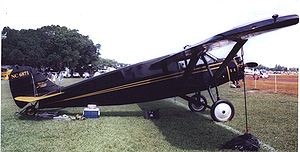
Stinson therefore redesigned the aircraft with shorter span wings, shorter fuselage and a choice of less powerful engines as the SM-2 Junior. The aircraft was a strut-braced high-wing monoplane with a sturdy outrigger undercarriage which was braced against the wing support struts and the initial 110 h.p. Warner Scarab engine was normally left uncowled. The first SM-2 flew in mid-1928 and deliveries commenced that year. Later versions of the SM-2 had higher-powered engines of between 165 h.p. and 225 h.p.
Stinson introduced its revolutionary Detroiter in February 1926. The first ever enclosed passenger aircraft used by an airline (Northwest on 5 July 1927), and designed by Eddie Stinson. The Detroiter was named after the group of Detroit motor moguls who financed their building.
The Jr-S has solid spruce plank wing spars, routed to I section, and a total of 36 wooden ribs. The wing also contains mild carbon steel drag tubes and steel drag wires. The ailerons span 9ft 8in and have a chord of 15.75in. They have steel frames, a 4130 tubular spar and nine metal ribs. The wing is braced by gin chord lift struts. The struts have a streamlined shape formed with a 4130 steel tube and 11 mild steel stamped ribs in the forward struts, and 14 in the rear struts.
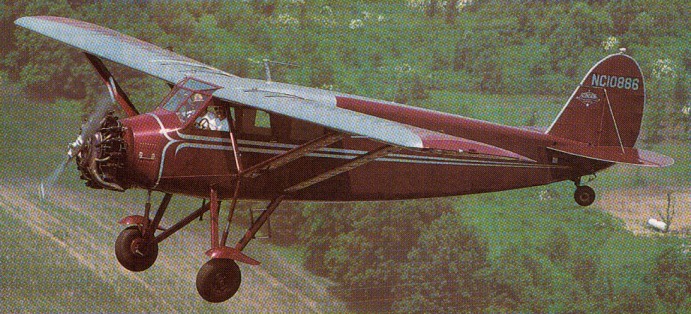
The fuselage is a conventional welded chromoly structure and has a nicely upholstered cabin which is 8ft 3in long from the instrument panel to the rear bulkhead, and 40in wide across the front and rear seats. The height at the forward seats is 48in, and 46in at the rear. A 69 lb capacity baggage area is located aft of the rear seats. Dual con¬trol wheels are fitted, and the instrument panel layout is close to the original, although it now contains mostly modern instru¬ments.
The tail surfaces have 4130 tubular steel frames with tubu¬lar ribs, and the tailplane spans 13ft. The 31.5in high fin, which has a maximum chord of 34in, has two ribs. The rudder is 67in high, and has a 28in maximum chord and seven ribs. The tailplane’s maximum chord is 31in, the elevator’s 23.25in, and each has ten ribs. Ailerons and rudder are cable controlled, and push pull tubes are used in the elevator. The tailplane can be adjusted by a centrally posi¬tioned lever in the cabin which activates push pull tubes connected to a crank in the aft end of the fuselage.
The strut braced main land¬ing gear is made from chromoly tubes and employs a Stinson ¬designed oleo and spring hydraulic strut with 7in travel. The main tubular vees are streamlined with pine fairings and covered with Ceconite. Original Autofan wheels, with mechanical brakes, carry McCreary 8.50 x 10in tyres. Track is 9ft 6in. The tailwheel is again an Autofan, with a 5.00 x 4in tyre, and its wheel is installed on a fully castoring oleo strut. A small brake is attached to the outer cylinder to prevent shimmy.
The Jr S has a span of 41ft l in and a chord of 6ft 3in. Its over¬ all length is 26ft 1lin, and height 8ft 9in. It weighs 2,300 lb empty and 3,265 lb fully loaded. Its original fuel capacity was 60 US gal. The Jr S’s performance was similar to that of many other four seaters of the early 1930s, but the type saw heavy service with small airlines, charter operators, and private owners.
The take off run is 570 to 600ft at 50 mph with two aboard, or 1,000ft with four passengers. It climbs at 600ft/min at 65 mph with two, and cruises at 90 mph at 1,850 rpm (engine redline is 2,200 rpm). At cruising speed its fuel consumption is 13 14 US gal/hr, permit¬ting a 5hr range with reserves.
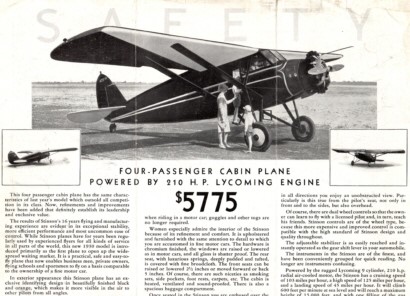
In 1931 a Stinson Jr S was factory priced at $5,775.
The first of the Stinson “Junior” line, the SM-2, rolled off the Northville, Michigan factory floor in 1928. The airplane fuselage was welded chrome-moly steel tubing construction attached to a wooden wing structure with an overall fabric cover. Although designed to be used extensively for private use, with successive power increases, the aircraft became too big and heavy for the light plane class. They were put into service as air taxis and flight demonstrators. One of the early SM-2 models participated in the 1928 National Air Tour. Piloted by Randolph Page, the plane placed third in the tour. Later models of the Junior series would see many engine and dimensional changes.
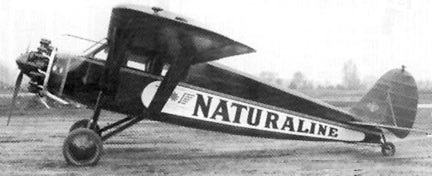
The 1928 SM-2 Junior (ATC 48) was designed by William Naylor and sold for $6,950 About 27 were built.

Only one SM-2A was built, in 1929, registered N9699 c/n M-1047.
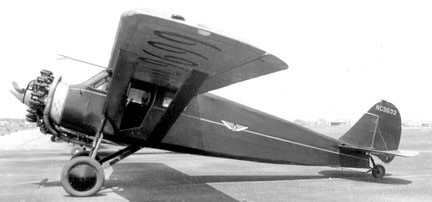
Twenty-two of the 1929 SM-2AA (ATC 145) were built, priced at $8,500, the ATC 2-173 was for weight adjustment.
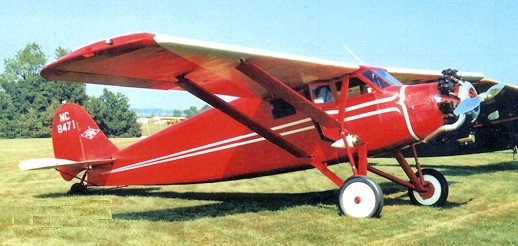
Thirty-two 1929 SM-2AB (ATC 161) were built priced at $10,500. ATC 2-267 was for the 220hp Wright J-5 and EDO floats in 1930.
ATC 194 covered the SM-2AC of 1929, priced at $11,000. ATC 2-143 was for the SM-2ACS floatplane version for $13,500, possibly NC8475.
The 1929 SM-2K (ATC 2-136) was powered by 100hp Kinner K-5 engines. Three conversions (2-414) for 125hp Kinner B-5 were made in 1932 as SM-2K Special.
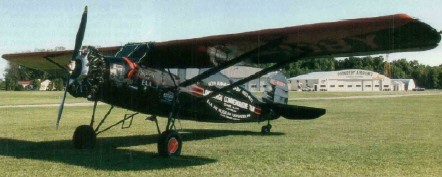
The design was further developed to produce the more powerful and heavier SM-7 and SM-8 models which were full four-seaters and these were also used by commercial firms. The Junior R of 1932 had a deeper fuselage and a low-set stub wing to mount the undercarriage and wing struts.
The 1930 SM-7A, ATC 298, was priced at $8,995 and a float version as SM-7AS, ATC 2-313. Eight were built.
The SM-7B (ATC 329) was priced at $10,695 and eight were built.
The SM-8A, A.T. C. #295 and 2-301, equipped with a Lycoming R-680 9-cyclinder radial engine was introduced in April of 1930. Designed by Kenneth Ronan, the price was $5775. The low price tag paid off and by the end of 1930 there were more SM-8As sold, about 300, then all other cabin airplanes put together. The airplane could cruise comfortably at 105 mph with a ceiling of 14,000 feet and a range of about 500 miles.
ATC 2-461 was for a 220hp Wright J-5 powered SM-8A Special in 1933, NS13 c/n 4091, destroyed in a fire in August 1934.
Five SM-8B (ATC 294) were built in 1930, powered by a 225hp Wright J-6, for $8,495. Three were converted to SM-8B Special (NS25, NS27=NC18627, NS28=NC18628).
Two SM-8D (ATC 312) were built in 1930, NC200W and NC227W, powered by a 225hp Packard DR-980 diesel. They were priced at $8,995.
A total of 321 Stinson Juniors were built between 1928 and 1933, of which 27 survived in 2001 and several of these were airworthy in private hands.
Variants:
SM-2 Junior
Engine: Warner Scarab 110 h.p.
Wingspan: 41’5″
Length: 26’3″
Useful load: 984 lb
Max speed: 106 mph
Cruise: 90 mph
Stall: 42 mph
Range: 425 mi
Ceiling: 13,500′
Seats: 3-4
SM-2A
SM-2AA
Engine: Wright J6-5 165 h.p.
Wingspan: 41’6″
Length: 26’4″
Useful load: 1180 lb
Max speed: 115 mph
Cruise: 97 mph
Stall: 47
Range: 580 mi
SM-2AB
Engine: Wright J-6 165 h.p.
Useful load: 1060 lb
Max speed: 130 mph
Cruise: 112 mph
Stall: 49 mph
Range: 600 mi
Ceiling: 15,000′
SM-2AB
Engine: Wright J-5, 220 hp
U/C: floats
SM-2AC
Engine: Wright J6-7 225 h.p.
Length: 29 ft 0 in
Wingspan: 41 ft 8 in
Height: 8 ft 3 in
Wing area: 236 ft2
Empty weight: 2,169 lb
Gross weight: 3,229 lb
Maximum speed: 135 mph
Cruise speed: 113 mph
Range: 450 miles
Service ceiling: 22,000 ft
Rate of climb: 1,200 ft/min
Crew: 1
Capacity: 3 passengers
SM-2ACS
Length: 29 ft 0 in
Wingspan: 41 ft 8 in
Wing area: 236 ft2
U/C: floats
SM-2ACS
floatplane version of the SM-2AC
Engine: Wright J6-7 225 h.p.
Length: 29 ft 0 in
Wingspan: 41 ft 8 in
Height: 8 ft 3 in
Wing area: 236 ft2
Crew: 1
Capacity: 3 passengers
SM-2K
Engine: 100hp Kinner K-5
Seats: 3
SM-2K Special
Engine: 125hp Kinner B-5
Seats: 3
SM-7A
Engine: Wright J6-9 300 h.p.
Wingspan: 41’8″
Length: 30’11”
Useful load: 1266 lb
Max speed: 142 mph
Cruise: 120 mph
Stall: 60 mph
Range: 550 mi
Undercarriage: tailwheel
Seats: 4
SM-7AS
Engine: Wright J6-9 300 h.p.
Wingspan: 41’8″
Length: 30’11”
Undercarriage: floats
Seats: 4
SM-7B
Engine: P&W Wasp Junior 300 h.p.
Wingspan: 41’8″
Length: 29’11”
Useful load: 1188 lb
Max speed: 142 mph
Cruise: 120 mph
Stall: 60 mph
Range: 550 mi
Seats: 4
SM-8A Junior
Engine: Lycoming R-680 215 hp
Wing Span: 41 ft. 6 in
Wing Area: 234 sq. ft
Airfoil: Clark Y
Length: 28 ft. 11 in
Height: 8 ft. 9 in
Empty Weight: 2061 lb
Gross Weight: 3195 lb
Useful Load: 1134 lb
Maximum Speed: 125 mph
Cruising Speed: 105 mph
Stall: 55 mph
Ceiling: 14,000 ft
Cruising Range: 500 mi
Price April 1930: $5775 at factory
SM-8 Special
Engine: Wright J-5, 220 hp
Wing Span: 41 ft. 6 in
Length: 28 ft. 11 in
Useful load: 1134 lb
Maximum Speed: 125 mph
Cruising Speed: 105 mph
Stall: 55 mph
Range: 500 mi
SM-8B
Engine: Wright J6-7 225 h.p.
SM-8B Special
SM-8D
Engine: Packard DR-980 diesel 225 hp
Wingspan: 41’8″
Length: 29’0″
Useful load: 1025 lb
Max speed: 128 mph
Cruise speed: 108 mph
Stall: 50 mph
Range: 495 mi
Junior R
deeper fuselage.
28 Units built
Engine: Lycoming R-680 215 h.p.
Junior R-2
Engine: Lycomong R-680-BA 240 h.p. 3 Built.
Junior R-3
as R-2 with retractable undercarriage 3 built.
Engine: Lycomong R-680-BA 240 h.p.
Junior R-3-S
Engine: Lycoming R-680-6 245 h.p.
Jr S Detroiter
Engine: Lycoming R 680 radial, 215 hp
Cruise: 85 mph
Seats: 4.