Sukhoi Su-7B

The S 1, created by the newly resuscitated design bureau of Sukhoi and to demonstrate M = 2.05 early in its test programme, was the first dedicated interdiction and close air support fighter developed in the Soviet Union since WW2. While a small pre series was being built for service evaluation by the V VS TacAir component, the Frontovaya Aviatsiya (FA), as the Su 7, a second prototype embodying some aerodynamic refinement, the S 2, joined flight test, and it was this, in productionised S 22 (or S 2 2) form, that was to be ordered into large scale production in 1958 as the Su 7B.

Sukhoi Su-7B Article

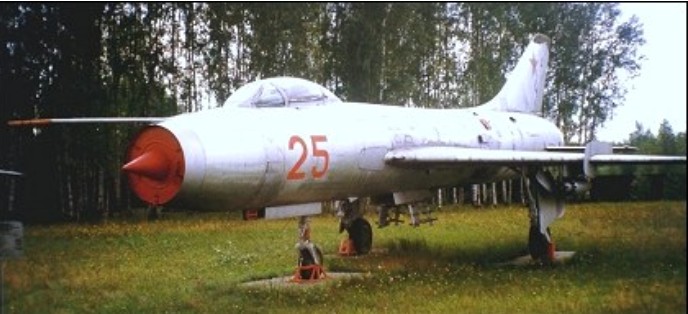
With the change in the VVS FA heavy fighter requirement from a primary air-to-air role to that of ground attack, the Sukhoi OKB undertook revision of the basic S-2 “frontal” fighter as the S-22. Embodying some structural changes to cater for the primarily low-level mission, together with equipment and armament changes, the S-22 retained the highly sweptback (60 degrees at quarter chord) wing, circular-section fuselage and Lyulka AL-7F turbojet of the S-2 (Su-7). The first prototype of the ground attack fighter flew in April 1959. Preparations for series production of the S-22 as the Su-7B (the suffix letter signifying Bombardirovshchik) at Novosibirsk had begun prior to the prototype testing, thus allowing this ground attack fighter to enter the VVS FA inventory early in 1960.
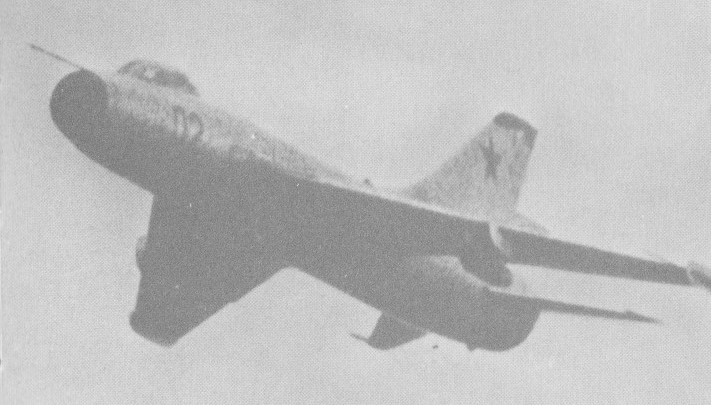
The Su-7B possessed a gun armament of twin 30mm cannon, and four external stores stations (two fuselage and two wing) had a theoretical maximum ordnance load of four tonnes. The Su-7B was succeeded in 1961 by the Su-7BM (Modifikatsirovanny) with an AL-7F-1 turbojet, this engine, standardised for all subsequent versions, being rated at 7000kg boosted to 10110kg with afterburning.

The Su-7BM (S-22M) also introduced a revised fuel system with prominent external piping ducts along the upper rear fuselage. To improve rough field capability in a version designated Su-7BKL (S-22KL) the flaps were redesigned, provision made for ATO rockets and twin braking chutes, and a unique wheel-skid (kolyosno-lyzhnyi) undercarriage introduced. The main undercarriage members embodied small, extensible steel skids for use on soft ground and were accommodated, when retracted, in bulged bays.
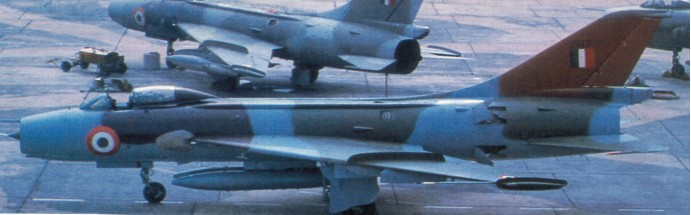
Su-7BM

The definitive series model introduced in the mid ‘sixties and remaining in production into the early ‘seventies was the Su-7BMK – the suffix letters signifying modifitsirovanny kolyosny – with new mainwheel members (from which the skids had been eliminated) retracting into flush wheel wells. This modification was accompanied by upgrading of the avionics fit, provision of zero-zero ejection seat and standardisation on a further pair of wing stores pylons as introduced by late Su-7BKLs.

Revealed at the 1956 Aviation Day at Tushino were large Sukhoi fighters; one with a swept wing (called Fitter by NATO) and the other a tailed delta (called Fishpot). Both were refined into operational types, losing some of their commonality in the process. The highly swept Su-7B became the standard Soviet bloc attack aircraft, some thousands being supplied to all Warsaw Pact nations and to Egypt, Cuba, India, Syria, Hungary, Iraq and North Vietnam. There are many sub-variants, the -7BM being a STOL roughfield version. Code names of tandem trainers are Su-7U Moujik and Su-9U Maiden.

Su-7B

Though criticized for its poor payload/range capabilities, the Sukhoi Su-7 possessed the saving graces of excellent handling qualities, good low-level gust response and manoeuvrability. Remaining in service with 15 air arms in 1984, although almost replaced within Soviet front-line units, it has seen action on several occasion during wars in the Middle East and Indian sub-continent. First flown in 1955, the aircraft entered service four years later in its Su-7B form, under the NATO reporting name ‘Fitter-A’, and rapidly established itself as the standard fighter-bomber of the Soviet air force and some Warsaw Pact allies. Three progressively improved models followed, but featured insufficient changes to warrant a change of Western designation. In the Su-7BM, underwing stores pylons were doubled to four; the muzzle velocity of the internal cannon was increased; and an uprated engine was fitted, take-off power being further boosted, if required, by two JATO bottles, The aircraft also introduced a radar warning receiver in the tail and two duct fairings running long the spine. Rough-field operation was provided in the Su-7BU, whose large, low-pressure nosewheel tyre is betrayed by a blistered floor to its bay. Further changes of detail were incorporated in the later Su-7BMK, but little could be done to moderate the demands of the thirsty AL-7F engine, which on full afterburner at sea level would consume the entire 2940 litres (647 Imp gal) of internal fuel in a little over eight minutes, Even so, fuel capacity is reduced in the operational trainer versions (Su-7UM and Su7UMK, known to NATO as ‘Moujik’) to make way for a second seat, despite a slight lengthening of the fuselage.

Egyptian air force Su-7BMKstrike aircraft have been refitted with a British nav/attack system.

The Sukhoi bureau opted to consider variable geometry for an evolutionary development of the classic Su-7 ground-attack fighter, whose poor payload/range performance could perhaps be transformed by a limited form of variable geometry. It was clear that provision of full variable-geometry wings would require a structural redesign of the fuselage as well as the wings, and was thus impractical. The bureau therefore selected a partial variable-geometry layout in which only the outer wings were pivoted, and this arrangement was used on the S-221 prototype, which was evaluated as the Su-7IG. The modification radically improved the type’s payload/range equation, and the type entered production as a type known variously as the Su-17, Su-20 and Su-22 according to model and engine.

Finally withdrawn from VVS-FA first-line service in 1986, the Su-7B was supplied to Afghanistan, Algeria, Czechoslovakia, Egypt, Hungary, India, Iraq, North Korea, Poland, Romania, Syria, Vietnam and South Yemen.

Gallery

Su-7B
Type: single-seat close-support and attack
Engine: 1 x Lyulka AL-7F single-shaft afterburning turbojet, 22,046 lb (10.000 kg) thrust
Wing span: 29 ft 3.5 in (8 93 m)
Length (including pitot boom): 57 ft (17.37 m)
Height: 15 ft 5 in (4.70 m)
Range with twin drop tanks: 900 miles (1450 km)
Armament: two 30 mm NR-30 cannon, 70 rounds in wing roots, four wing pylons, inners rated at 1,653 lb (750 kg) and outers at 1,102 lb (500 kg), but when two tanks are carried on fuselage pylons total external weapon load is reduced to 2.205 lb (1000 kg)

Su 7BKL

Su-7BM
Type: single-seat close-support and attack
Engine: 1 x Lyulka AL-7F single-shaft afterburning turbojet, 22,046 lb (10.000 kg) thrust
Wing span: 29 ft 3.5 in (8 93 m)
Length (including pitot boom): 57 ft (17.37 m)
Height: 15 ft 5 in (4.70 m)
Empty wt: 19,000 lb (8620 kg)
Max loaded wt: 29,750 lb (13,500 kg)
Max speed at alt. clean: 1055 mph (1700 km/h, Mach 1.6)
Initial climb: 29,900 ft (9120 m)/min
Service ceiling: 49,700 ft (15.150 m)
Range with twin drop tanks: 900 miles (1450 km)
Armament: two 30 mm NR-30 cannon, 70 rounds in wing roots, four wing pylons, inners rated at 1,653 lb (750 kg) and outers at 1,102 lb (500 kg), but when two tanks are carried on fuselage pylons total external weapon load is reduced to 2.205 lb (1000 kg).

Su-7BMK ‘Fitter-A’
Type: single-seat ground-attack fighter
Powerplant: one 10000-kg (22,046-1b) thrust Lyulka AL-7F7-1 afterburning turbojet
Wingspan 8,93 m (29 ft 3.5 in)
Length, including probe 17,37 m (57 ft 0 in)
Height 4.57 m (15 ft 0 in)
Wing area 27.60 sq.m (297 sq ft)
Empty weight: 8620 kg (19,004 lb)
Normal take-off weight: 12,000 kg (26,455 lb)
Maximum speed at sea level 850 km/h (528 mph) without afterburning, or 1350 kph (839 mph) with afterburning
Initial climb rate 9120 m (29,920 ft) per minute
Service ceiling 15150 m (49,705 ft)
Range: 430 mi / 690 km
Maximum take-off 13500 kg (29,762 lb)
Armament: two 30-mm NR-30 cannon (with 70 rpg) in wing roots; six weapon pylons: two under fuselage and two under the inner wings, each carrying up to 500 kg (1,102 lb) of stores, plus two under the outer wings each carrying up to 250 kg (551 lb); weapon load reduced to 1000 kg (2,205 lb) when two 600-litre (132-Imp gal) droptanks are carried on fuselage pylons
Seats: 1

Su 7IG

Su-7U
Type: dual control trainer
Engine: 1 x Lyulka AL-7F single-shaft afterburning turbojet, 22,046 lb (10.000 kg) thrust
Wing span: 29 ft 3.5 in (8 93 m)
Length (including pitot boom): 57 ft (17.37 m)
Height: 15 ft 5 in (4.70 m)
Range with twin drop tanks: 900 miles (1450 km)
Armament: two 30 mm NR-30 cannon, each with 70 rounds in wing roots, four wing pylons, inners rated at 1,653 lb (750 kg) and outers at 1,102 lb (500 kg), but when two tanks are carried on fuselage pylons total external weapon load is reduced to 2.205 lb (1000 kg)

Su 7UM

Su 7UMK

Sukhoi Su-7B

Sukhoi T-3 / Fishpod A

Unofficially dubbed Balalaika thanks to its resemblance in shape to the sound box of that musical instrument, the T-3 initiated the series of missile-armed single-seat tailed-delta interceptor fighters developed by Pavel Sukhoi’s OKB. Evolved in parallel with the S-1 “frontal” fighter and first flown on 26 May 1956 by Vladimir Makhalin, the T-3 possessed 57 degrees of wing leading-edge sweepback, was intended to be armed with two K-8 or K-9 missiles and was to have had an Almaz (Diamond) search-and-track radar. The elements of the Almaz were to have been housed within a broad elliptical radome above, and a circular housing on, the intake splitter plate. Powered initially by an unaugmented Lyulka AL-7 turbojet – which was to give place to an AL-7F rated at 6500kg boosted to 9060kg with afterburning – the T-3 was demonstrated over Tushino on 24 June 1956.

NATO code name ‘Fishpod-A’.

TsAGI wind tunnel testing of the efficiency of air intake/radar housing combinations being inconclusive, two further prototypes, the PT-7 and PT-8, were completed with different arrangements. The former, flown in September 1956, retained the chin intake position and superimposed elliptical radome, but with a variable-angle lower wedge to produce a two-dimensional intake. The PT-8, which joined the test programme two months later, featured a lengthened – by approximately 1.25m – nose with circular air intake and conical translating centrebody. The T-3 and its PT variations provided the basis for the further T-4 series from which the first production Sukhoi tailed-delta fighters were to be derived.

T-3
Engine: AL-7F
Wingspan: 8.43 m / 28 ft 8 in
Length: 16.75 m / 55 ft 11 in
Wing area: 24.20 sq.m / 260.49 sq ft
Max. speed: 2100 km/h / 1305 mph
Ceiling: 18000 m / 59050 ft
Range: 1840 km / 1143 miles

Sukhoi T-3

Sukhoi S-1 / S-2 / Su-7 (II)

During reorganisation of the Soviet aircraft industry in November 1949, Pavel O Sukhoi’s OKB was disbanded, being resurrected three-and-a-half years later, in May 1953, to pursue development of two fighter projects with either the 58 degree to 62 degree swept wing, or the 57 degree or 58 degree tailed delta configurations evolved by the Central Aerodynamics and Hydrodynamics Institute. These were referred to as the S-1 and T-3 respectively, the prefix letters signifying strelovidnyi (arrowhead) and treugolnyi (triangular) in reference to the wing configuration (ie, sweptback and delta). Both aircraft were designed around the large, new Lyulka AL-7 (TRD-31) turbojet, but enjoyed only limited design commonality.

The S-1 was conceived as a so-called “frontal” fighter – a tactical air superiority warplane intended to operate in the vicinity of the battlefront – and was the first Soviet aircraft to feature a slab-type tail and a translating nose cone. Flown on 8 September 1955, the S-1 was initially fitted with an unaugmented AL-7 rated at 14,330-lb / 6500kg aspirated via a circular nose inlet with a conical inlet centrebody that translated in and out to regulate the supersonic airflow through the inlet. This was replaced by an afterburning AL-7F of 9500kg with which the S-1 established a national speed record of 2170km/h, or Mach=2.04, in April 1956. Featuring 62 degrees of sweepback, the S-1 had an armament of three 30mm cannon and provision for a retractable ventral tray for 32 spin-stabilised 57mm rockets. Demonstrated over Tushino on 24 June 1956, this prototype crashed on 21 November that year.

A second prototype, the S-2, embodying some aerodynamic refinements, had joined the test programme in the meantime and – although this was not to complete State testing until the autumn of 1957 – manufacture of a pre-series went ahead simultaneously. Built in sufficient quantity to equip a regiment for evaluation purposes, these fighters, which possessed a primary air-to-air role and entered service in the Soviet Far East in early 1959, were assigned the designation Su-7. This repeated the appellation of the mixed-power experimental fighter tested in 1944. A requirement change led to the further development of the basic design as a dedicated ground attack fighter under the designation Su-7B (S-22).

While a small pre series was being built for service evaluation by the V VS TacAir component, the Frontovaya Aviatsiya (FA), as the Su 7, a second prototype embodying some aerodynamic refinement, the S 2, joined flight test, and it was this, in productionised S 22 (or S 2 2) form, that was to be ordered into large scale production in 1958 as the Su 7B.

Su-7 (pre-series)
Max take-off weight: 9423 kg / 20774 lb
Wingspan: 9.15 m / 30 ft 0 in
Length: 16.72 m / 55 ft 10 in
Max. speed: 1827 km/h / 1135 mph

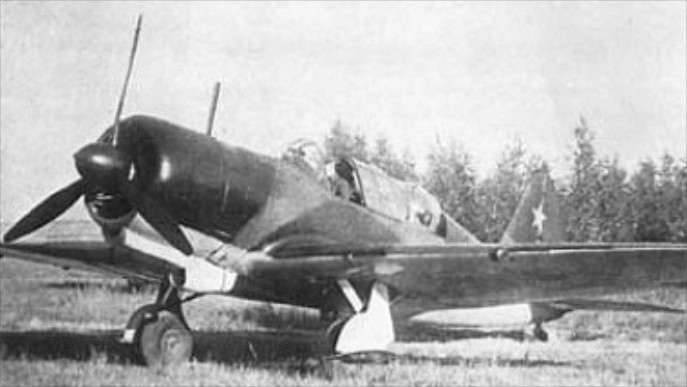
Sukhoi Su-6

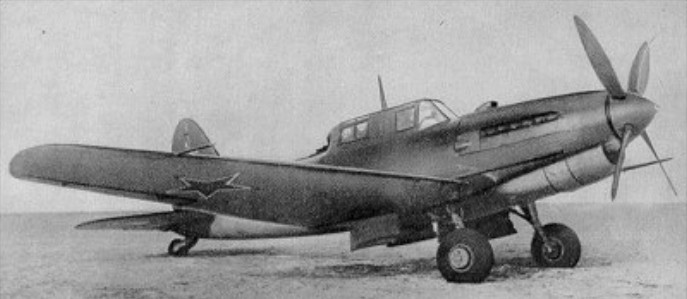
The Su 6 single seat assault aircraft was designed around the experimental M 71 engine and intended to compete with Ilyushin’s Il 2. The Su 6 offered a considerably higher performance than the Il 2, and carried a more effective armament, but by this time the Ilyushin design was already in production, and as manufacture of the M 71 engine had not begun.

Development started in 1939. Second Su-6-2 (improved) version was built in 1942, and the last one (Su-6-3), powered by liquid-cooled 2000hp AM-42 started flight testing early in 1944.

Engine: 1 x ASh-71F, 1620kW
Max take-off weight: 6500 kg / 14330 lb
Empty weight: 4000 kg / 8819 lb
Wingspan: 13.5 m / 44 ft 3 in
Length: 9.2 m / 30 ft 2 in
Wing area: 26.0 sq.m / 279.86 sq ft
Max. speed: 500 km/h / 311 mph
Ceiling: 8100 m / 26600 ft
Range w/max.fuel: 970 km / 603 miles
Armament: 2 x 37mm machine-guns, 3 machine-guns, 10 missiles, 400kg of bombs
Crew: 2

Sukhoi Su-6

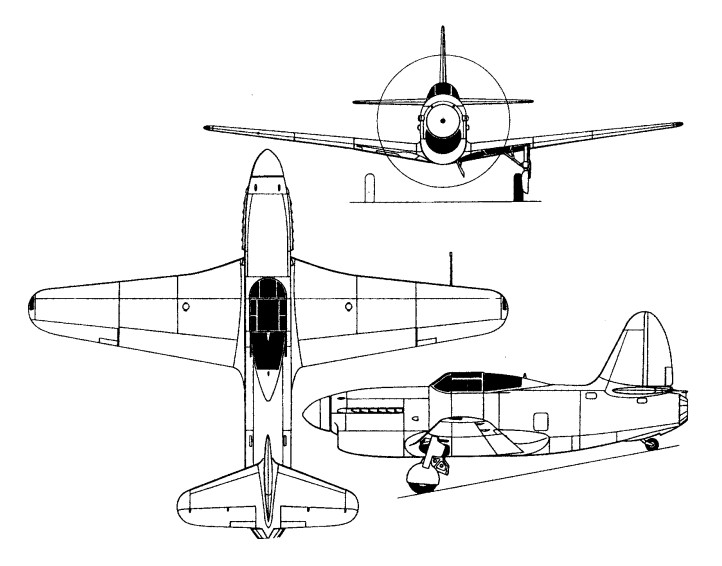
Sukhoi Su-5 / I-107

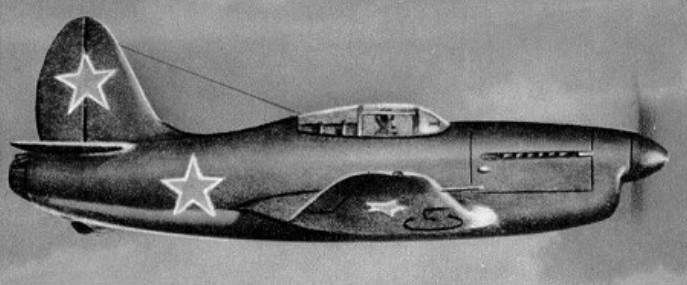
The development at the TsIAM (Central Aero Engine Institute) by K V Kholshchevnikov of the so-called “accelerator”, or VRDK (Vozdushno-reaktivny dvigatyel kompressorny, or Air-reaction engine compressor), prompted the development of mixed-power single-seat fighters as an interim means of meeting the potential threat of German turbojet-powered fighters. Both Mikoyan-Gurevich and Sukhoi bureaux were assigned the task of creating such fighters, the former developing the MiG-13 alias I-250(N) and the latter the Su-5 alias I-107. The VRDK provided 300kg thrust for up to 10 min at high altitude to boost the power available from the Klimov M-107A (VK-107A) 12-cylinder Vee-type liquid-cooled engine which delivered 1,650hp for take-off. An all-metal stressed-skin single-seat monoplane with a monocoque fuselage, the Su-5 had an armament of one 23mm engine-mounted cannon and two 12.7mm machine guns.

First flown in April 1945, the prototype was soon fitted with a new wing of laminar-flow type developed by the TsAGI, and during one subsequent flight test a speed of 793km/h was attained at 4350m, this being 25km/h faster than had been calculated for that altitude. The effect of the VRDK was a gain of 90km/h at low altitude rising to 110km/h at 7800m, at which it was anticipated that maximum speed would be 810km/h. Early in July 1945, before this speed could be attained, the M-107A engine suffered some damage in flight and when it was found to be irreparable, the Su-5 flight test programme was abandoned.

Engine: Klimov M-107A (VK-107A) V-12, 1,650hp & 1 x VRDK Air-reaction engine compressor
Max take-off weight: 3804 kg / 8386 lb
Empty weight: 2954 kg / 6512 lb
Wingspan: 10.56 m / 35 ft 8 in
Length: 8.51 m / 28 ft 11 in
Height: 3.53 m / 12 ft 7 in
Wing area: 17.00 sq.m / 182.99 sq ft
Max. speed: 810 km/h / 503 mph
Range: 600 km / 373 miles

Sukhoi Su-5 (I-107)

Sukhoi Su-3 / I-360

At the time of the evacuation of the Sukhoi OKB to Novosibirsk, the prototype of a developed version of the Su-1, the Su-3, was under construction. Initiated under the designation I-360, the Su-3 mated the Su-1 fuselage and tail surfaces with an entirely new wing of revised profile with shorter-span outer panels resulting in a 2.00sq.m reduction in wing area. The radiator bath was enlarged, but in all other major respects the Su-3 was similar to the Su-1. Retaining the M-105P engine and the same armament, the Su-3 was completed at Novosibirsk and entered flight test in the late summer of 1942. Although the TsIAM had meanwhile undertaken much development work on the TK-2 turbo-supercharger, the principal defects were found to remain, and, as a consequence, development of the Su-3 was discontinued towards the end of 1942.

Engine: Klimov M-105P V-12, 1,100hp
Max take-off weight: 2860 kg / 6305 lb
Empty weight: 2490 kg / 5490 lb
Wingspan: 10.10 m / 33 ft 2 in
Length: 8.42 m / 28 ft 7 in
Height: 2.71 m / 9 ft 11 in
Wing area: 17.00 sq.m / 182.99 sq ft
Max. speed: 638 km/h / 396 mph
Range: 700 km / 435 miles
Armament: one 20mm cannon and two 7.62mm machine guns

Sukhoi BB-1 / Su-2

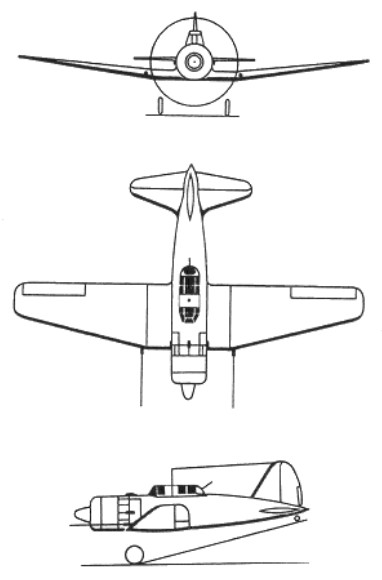
During 1939, Sukhoi established his own design bureau, and began the redesign of the ANT 51 with an M 88B engine, a low wing and an increased offensive load, this emerging as the BB 1, entering series production in 1940, and being redesignated Su 2 in 1941.

The Sukhoi Su-2 entered service with the V-VS early in 1941 but, as far as is known, was not encountered during the Winter War which ended the previous year. Derived from Sukhoi’s ANT-51 and designated BB-1 during its early trials, the aircraft was fairly efficient by current standards once the M-87 engine had been replaced by the M-88 and then the M-88B.

Despite being further improved by installation of the 746kW M-88B radial, the Su-2 was found to be desperately vulnerable and virtually unable to defend itself with its single small-calibre machine-gun in the unwieldy manually-operated dorsal turret. Estimates suggest that about 100 were in service with the Frontovaya Aviatsya at the time that the German army rolled into the Soviet Union in June 1941, but that dozens were shot down by flak and fighters in the first few disastrous weeks.

The Su 2 was built in fairly substantial numbers, both with the IM 88B engine and with the more powerful M 82. The state of the Soviet aircraft industry in 1941 prevented much being done to remedy the immediate lack of suitable ground support aircraft (until production of the two-seat Il-2m3 could be stepped up) and recourse was made to further attempts to improve the Su-2 by installation of the 1134kW M-82 radial and freguent deletion of the dorsal turret, but with little tactical benefit. Accepting that losses would remain high, the Soviets therefore simply loaded the aircraft with further bombs and rockets on the supposition that the more explosive delivered against the enemy the better the chances of some degree of success. This version, as well as the completely redesigned Su-6, were abandoned in favour of all-out dependence on the Il-2m3. The Su-2 probably did not survive in production beyond mid-1942.

Engine: 1 x M-88B, 735kW
Max take-off weight: 4400 kg / 9700 lb
Empty weight: 3000 kg / 6614 lb
Wingspan: 14.3 m / 47 ft 11 in
Length: 10.3 m / 34 ft 10 in
Wing area: 29.0 sq.m / 312.15 sq ft
Max. speed: 460 km/h / 286 mph
Ceiling: 3800 m / 12450 ft
Range w/max.fuel: 1200 km / 746 miles
Armament: 5 x 7.62mm machine-guns
Bombload: 600kg
Crew: 2

Sukhoi Su-2

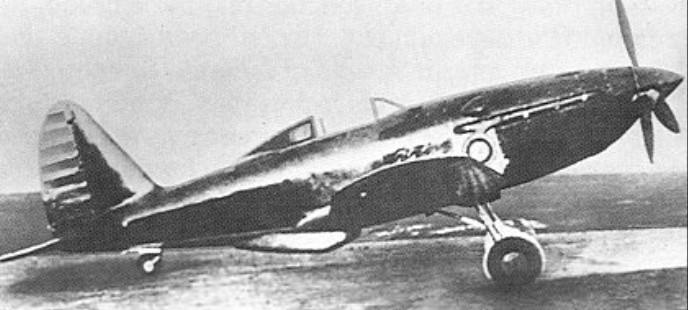
Sukhoi Su-1 / I-330

Pavel O Sukhoi established his own OKB, or Experimental Design Bureau, in December 1938, and, early in the following year, was assigned the task of designing an advanced single-seat high-altitude fighter. Initially designated I-330, the fighter was of mixed construction, with a single-spar all-metal wing of comparatively high aspect ratio with flush-riveted light alloy skinning, and a wooden semi-monocoque fuselage with shpon, or bakelite-ply, skinning. Power was provided by a Klimov M-105P 12-cylinder liquid-cooled Vee-type engine rated at 1,100hp for take-off and fitted with a pair of TsIAM-developed TK-2 exhaust-driven turbo-superchargers, the radiator being accommodated in the fuselage aft of the cockpit and exhausting over the rear decking. Armament consisted of one 20mm cannon and two 7.62mm machine guns. Factory testing commenced late 1940, by which time the designation Su-1 had been adopted, State testing being performed in the following summer. The turbo-superchargers proved capricious and the Su-1 was flown on several occasions with the TK-2s removed. Although the fighter met its specified performance with the turbo-superchargers functioning, their failure frequency was unacceptable and the TsIAM had failed to improve reliability by October 1941, when the OKB was evacuated from Moscow to Novosibirsk, the Su-1 being damaged in the process. This prototype was not rebuilt, development continuing with the Su-3.

Engine: Klimov M-105P V-12, 1,100hp
Max take-off weight: 2875 kg / 6338 lb
Empty weight: 2495 kg / 5501 lb
Wingspan: 11.50 m / 38 ft 9 in
Length: 8.42 m / 28 ft 7 in
Height: 2.71 m / 9 ft 11 in
Wing area: 19.00 sq.m / 204.51 sq ft
Max. speed: 641 km/h / 398 mph
Range: 720 km / 447 miles
Armament: one 20mm cannon and two 7.62mm machine guns

Sukhoi Su-1 (I-330)

Sud-Ouest SO.7050 / SO.7055 / SO.7060 Deauville

SO.7060 Deauville

Developed from the SO.7050 and SO.7055 two-seat cabin monoplanes, the SO.7060 Deauville differs primarily in having the 75 hp Mathis 4GO replaced by a 105 hp Walter Minor 4-III.

The first of two Deauville prototypes flew on 22 March 1948. Of all-metal construction, dual controls are provided and a third seat may be fitted aft of the side-by-side front seats.

SO.7050
Engine: 75 hp Mathis 4GO

SO.7055
Engine: 75 hp Mathis 4GO

SO.7060 Deauville
Engine: 105 hp Walter Minor 4-III
Wing span: 34 ft
Wing area: 161.4 sq.ft
Length: 21 ft 10 in
Height: 7 ft 11 in
Empty weight: 1140 lb
Loaded weight: 1760 lb
Max speed: 127 mph
Cruise: 105 mph at 3280 ft
Range: 500 mi