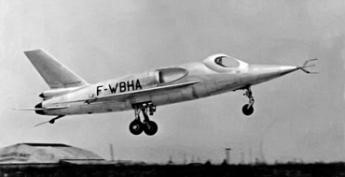
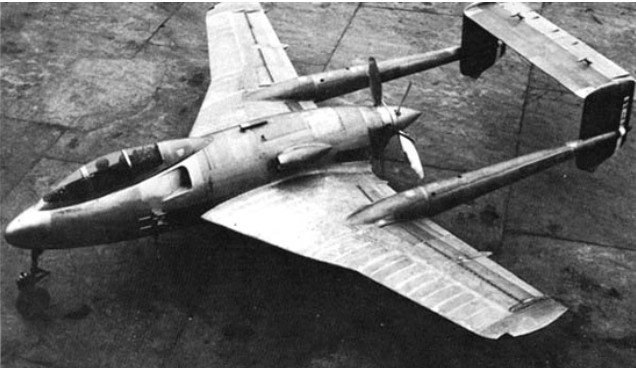
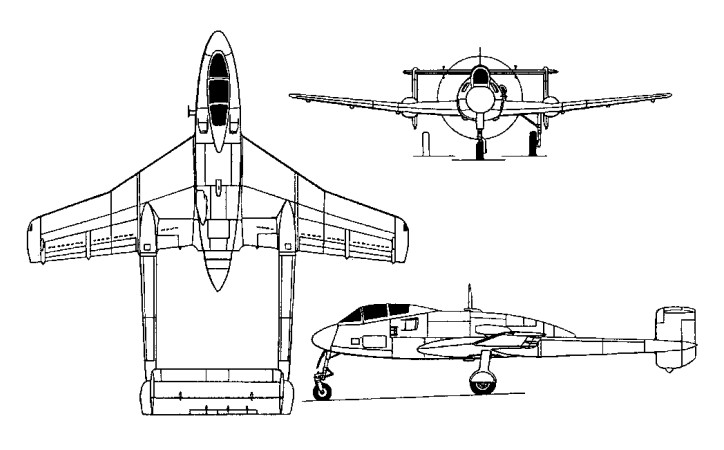
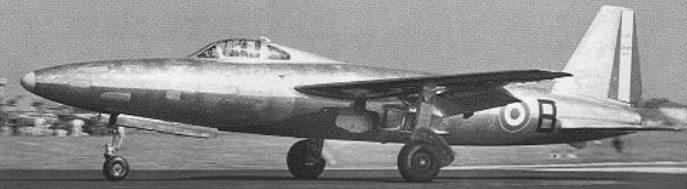
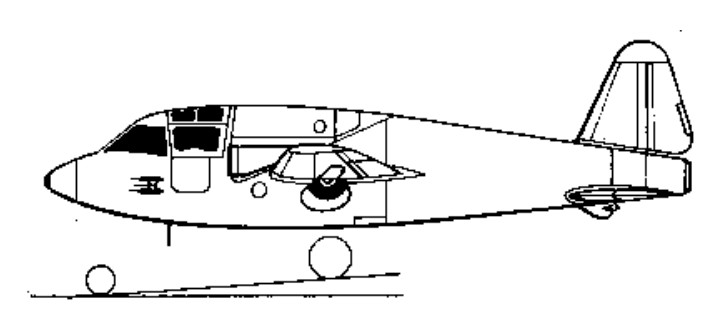
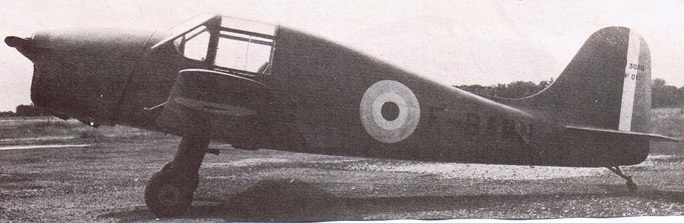
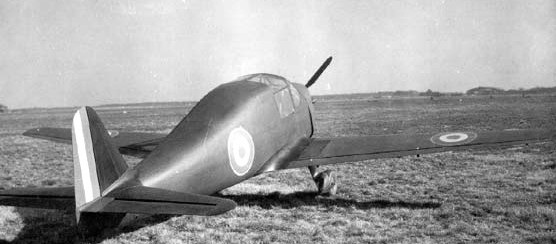
The Deltaviex is an experimental aircraft designed by ONERA for development of supersonic aircraft. designed in 1953 by ONERA, the prototype was built by SNCASO in Courbevoie, under the direction of engineer Aliette.
The aircraft was intended for multiple testing, including a roll stabilization device obtained by the profile of the trailing edge landing flaps. This device was developed lift while providing propulsion. Conventional ailerons were located at the ends of the wings. At 3.40 m they were partly intended to produce a very low inertia and damping in roll. The jet was formed by air bled from the engine in a small proportion (about 2%). The system has a switchable ramp equipped with many output holes. The steering was done with an extremely short period of around five hundredths of a second, producing a flap ange of + / – 2 °. The 70° wing thickness does not exceed 6%. It is adjustable in flight to 1 ° -4 °. The tricycle undercarriage is retractable.
The Deltaviex made its first flight in 1954 with Robert Fouquet at the controls, registered F-WBHA c/n. 001. It was mainly flown by Robert Fouquet, chosen due to his small size, essential in the cramped cockpit of the minuscule aircraft. Its small size allowed testing it in the wind tunnel at Modane (Savoy) at full scale in order to precisely measure its behaviour in various flying situations. The aircraft served for trials with blown ailerons, whereby bleed air from its Marboré II engine was blown over the wing trailing edge, a system later installed for example on the F-104 Starfighter. An innovative directional control system was installed, using pressurised air instead of a rudder and elevator to change direction.
Testing remained secret until November 8, 1956, when the Deltaviex was introduced to the press.
During testing (at Brétigny, Meudon, and Modane), the Deltaviex changed canopy type three times.
The single example of the Deltaviex finished its career at Modane (Savoie). It was recovered in 1984, from a garage owner in the region, by the Association of Ailes Anciennes Toulouse. It is held association at: Ailes Anciennes Toulouse Derrière le 5 chemin de Laporte Saint Martin du Touch 31300 Toulouse
Engine: Turbomeca Marbore II turbojet, 400 Kp Wingspan: 3.40 m Length: 7.10 m Height: 2.50 m Empty weight: 550 kg Max weight: 920 kg Wing area: 5 m² Max speed: 400 km h Range: 300 km
The subject of an order for two prototypes on 31 May 1946, the SO 8000 Narval (Narwhal) was conceived by a team under the leadership of Ing Dupuy at the Societe Nationale de Constructions Aeronautiques de Sud-Ouest (SNCASO) as a shipboard fighter and attack aircraft. Of twin-boom configuration with a sweptback wing – 24 degrees inboard and 13.5 degrees outboard on the leading edge – and a tricycle undercarriage, the Narval was powered by an Arsenal 12 H-02 (Junkers Jumo 213) engine rated at 2,250hp, installed as a pusher and driving contra-rotating propellers. Proposed armament comprised six 20mm cannon with provision for up to 1000kg of external ordnance.
Development was somewhat protracted, and the first flight (by the second prototype) did not take place until 1 April 1949, the second following on 30 December. Numerous problems arose during the test programme, dictating changes in the control surfaces, the air intakes and the propellers (Rotol propellers replacing the original Chauviere units); constant troubles were experienced with the engine, and, following the generally unfavourable results of evaluation at the Centre d’Essais en Vol in January 1950, development of the Narval was discontinued. The second prototype effected its 43rd and last flight on 8 January 1950, and the first prototype flew only once. Proposals to adapt the design for a Rolls-Royce Nene turbojet as the SO 8010 were not pursued. The quoted performance was not, in fact, achieved during flight test.
Loaded weight: 6606 kg / 14564 lb Empty weight: 4821 kg / 10629 lb Wingspan: 11.77 m / 39 ft 7 in Length: 11.83 m / 39 ft 10 in Height: 3.20 m / 11 ft 6 in Wing area: 26.30 sq.m / 283.09 sq ft Max. speed: 730 km/h / 454 mph Range w/max.fuel: 4500 km / 2796 miles
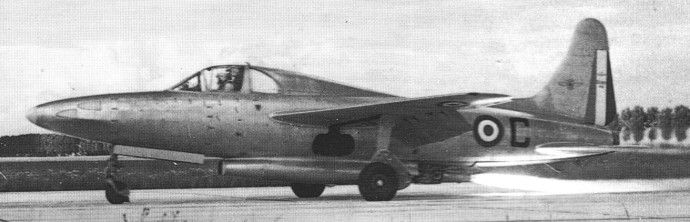
The first turbojet-powered single-seat fighter of French design to be built, the SO 6020 Espadon (Swordfish) interceptor was developed by the Societe Nationale de Constructions Aeronautiques de Sud-Ouest (SNCASO) under the design leadership of Lucien Servanty. Conceived to meet the requirements of a programme promulgated on 25 March 1946, and the subject of an order for three prototypes placed two months later, on 28 June, the SO 6020 was powered by a 2268kg Rolls-Royce Nene turbojet with, unusually, an aft-mounted ventral air intake. The SO.6020 featured flush inlets on the fuselage sides aft of the wing trailing edge. Proposed armament was initially to have comprised four 30mm cannon and four 12.7mm machine guns, this later being changed to six 20mm or 15mm weapons.
The first prototype flew on 12 November 1948 and the second on 16 September 1949, the latter being modified, after initial test, with NACA-type lateral intakes in place of the ventral intake. It was appreciated at an early stage that the SO 6020 was underpowered and would offer inadequate performance, a major redesign as the SO 6021 therefore paralleling initial flight testing of the SO 6020. The third prototype, intended for tactical reconnaissance, was completed as the SO 6025 with lateral intakes and a ventrally-mounted SEPR 25 auxiliary rocket motor of 1500kg thrust, this flying on 28 December 1949.
Sud-Ouest SO 6021 Espadon
The SO 6021 represented an attempt to reduce the weight and alleviate some of the aerodynamic problems that had beset the SO 6020 from the outset of flight test. Retaining the same Nene engine, but having a 1.30sq.m increase in wing area, an entirely redesigned vertical tail and a 604kg reduction in empty weight, the SO 6021 was equipped with servo controls and flew on 3 September 1950. Armament comprised six 20mm cannon. In June 1951, a ground attack version of the SO 6021 was offered to the Armee de l’Air with an afterburning Rolls-Royce Tay engine and an armament of two 30mm cannon. However, testing of the SO 6021 indicated that some of the difficulties experienced with the SO 6020, notably the shortcomings of the air intake arrangement, had not been overcome. A speed of Mach=0.96 was attained in a shallow dive, but serious buffet occurred at Mach=0.75, and further development was abandoned, the sole SO 6021 serving as a test bed for small wingtip-mounted turbojets associated with the SO 9000 programme, continuing in this role until 1956.
SO.6025 Espadon
The second prototype, with a similar rocket motor installed in the rear fuselage, became the SO 6026, flying in this form for the first time on 28 March 1953.
In 1953 the third prototype built had its wings replaced by bigger ones and fitted with rocket engine SEPR. This resulted in being the first European aircraft to break the sound barrier in level flight on 15 December 1953.
Considerably more development followed, but by 1953 the type was clearly obsolescent and further work was abandoned.
The third prototype was once being used a target at firing range before being recovered to the Ailes Anceinnes museum in Toulouse by August 2018.
Sud-Quest SO 6025 Espadon 03
SO-6020 Loaded weight: 7454 kg / 16433 lb Empty weight: 5354 kg / 11804 lb Wingspan: 10.60 m / 35 ft 9 in Length: 15.00 m / 49 ft 3 in Height: 4.55 m / 15 ft 11 in Wing area: 25.20 sq.m / 271.25 sq ft Max. speed: 967 km/h / 601 mph
SO 6021 Espadon Loaded weight: 6870 kg / 15146 lb Empty weight: 4750 kg / 10472 lb Wingspan: 10.60 m / 35 ft 9 in Length: 15.00 m / 49 ft 3 in Height: 4.72 m / 16 ft 6 in Wing area: 26.50 sq.m / 285.24 sq ft
The Sud Ouest SO 6000 Triton, first flying on 11 November 1946, was the first French jet powered aircraft to fly. Five were built. The first was powered by a 1980 lb thrust Junkers Jumo 004-B2 with a nose intake. Later versions had a 4850 lb thrust H-S Nene with both nose and fuselage scoops.
They were used as test beds and side-by-side trainers.
The third built, SO-6000-03, is at the French Musee de L’Air.
Engine: Rolls Royce Nene 101, 21582 N Length: 34.121 ft / 10.4 m Wingspan: 32.644 ft / 9.95 m Wing area: 162.536 sq.ft / 15.1 sq.m Max take off weight: 10363.5 lb / 4700.0 kg Weight empty: 7056.0 lb / 3200.0 kg Max. speed: 513 kt / 950 km/h Cruising speed: 462 kt / 855 km/h Initial climb rate: 9842.52 ft/min / 50.0 m/s Service ceiling: 39370 ft / 12000 m Wing load: 63.76 lb/sq.ft / 311.0 kg/sq.m Crew: 2
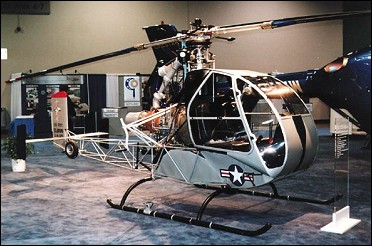
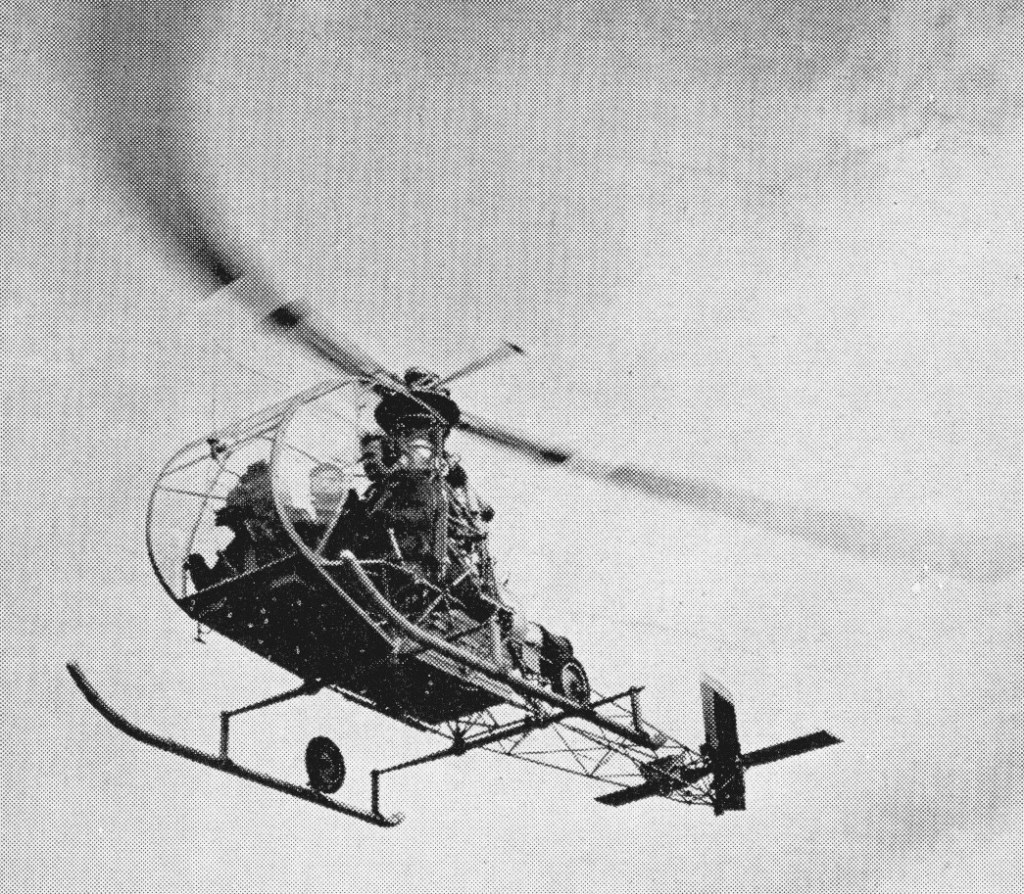
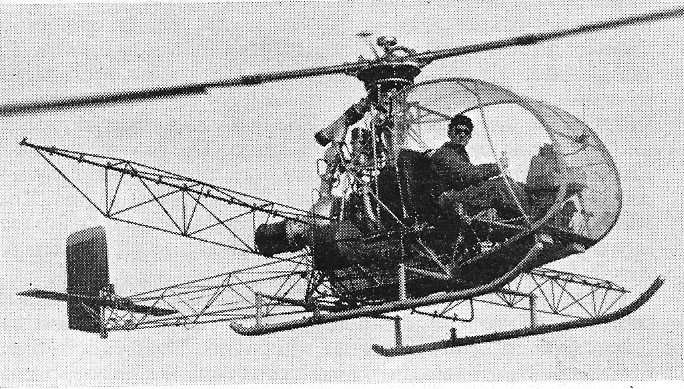
The experience acquired by Sud-Ouest in building its two prototypes of the Ariel led to the SO.1221 Djinn. The Djinn’s began with two single-seat SO.1220 prototypes, F-WGVO and F-WGZX, the first of which made its maiden flight on 2 January 1953. A simple uncovered structure of welded steel tube carrying a two-blade rotor above it, and with a single exposed seat for its pilot. Its powerplant was a Turbomeca Palouste turbo-compressor producing a large volume of compressed air which, using a similar distribution method to that of the Ariel, was discharged at the blade tips. These were both intended primarily to prove the rotor and propulsion systems.
F-WGVO was later fitted experimentally with agricultural spray booms.
On 16 December 1953 the first of five 2-seat SO.1221 prototypes was flown, having a fully enclosed cabin, two side-by-side seats, an open-framework tail boom, and an all-up weight of 600kg. On 29 December this aircraft established a new altitude record in its class of 4789m.
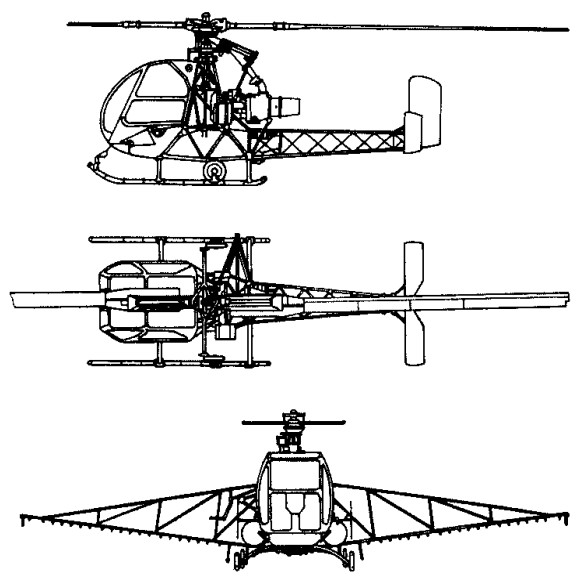
The Djinn was the world’s first production helicopter to make use of the ‘cold jet’ principle of propulsion. This system used a modified Turbomeca Palouste IV engine as a turbo-generator to feed compressed air through the rotor shaft to ejectors built into the tips of each rotor blade. The air itself is in fact warm enough to eliminate the need for other means of de-icing the blades. No tail rotor is fitted, the aircraft having two outrigged fins and a large central rudder that is situated in the line of the residual thrust exhaust from the engine to provide directional control. The craft’s small spartan two-seat cockpit was surrounded by a sectioned bubble-type enclosure and transparent side doors, which combined to provide excellent visibility forward and to both sides. Cockpit instrumentation was quite basic in the standard SO.1221, and The Djinn’s landing gear was of the skid type, with small retractable wheels to facilitate ground handling.
Twenty-two pre-series SO. 1221’s were then built, primarily for evaluation for the French Army, and the first of these was flown on 23 September 1954. Three machines from this batch were evaluated by the U.S. Army, under the designation YOH-1.
In late 1956 the US Army leased three examples for evaluation in the observation role. The Djinn, which had first flown in December 1953, was already in service with the French Army as an observation craft and its success in that role, coupled with its relatively low per-unit cost and fairly basic maintenance requirements, piqued the Army’s interest. The machines obtained by the Army (serials 57-6104 through -6106) were the first helicopters acquired under the new HO (helicopter, observation) classification, and were designated YHO-1. the three YOH-1s were consequently fitted with additional U.S. military-standard avionics and communications equipment for their Army evaluation.
The Army’s engineering and operational evaluation of the YOH-1 found the aircraft to be well built, relatively easy to maintain under field conditions, and an exceptional observation platform. The Djinn was not adopted for service use, however, primarily because the Army faced continuing budgetary constraints and some domestic political opposition to the procurement of French, rather than American (or Canadian) aircraft. In early 1958 all three YOH-1s were returned to Sud-Ouest for ultimate delivery to the French Army.
Chief customer for the Djinn has been France’s Aviation Legere de l’Armee de Terre, which received one hundred of the one hundred and fifty production Djinns completed up to 1961, and still had about half of these in service in mid-1967. The first production aircraft was flown on 5 January 1956, and French and US certification was gained in April 1958. Six were also delivered to the Federal German Heeresfliegerei. The military Djinns operate at a slightly higher gross weight – 800kg – than the civil models. One was used in France for the first experiments in launching Nord SS.10 anti-tank missiles from a helicopter, but the Djinn’s main military functions have been those of observation, liaison, training and (with one pilot and two external litters) casualty evacuation.
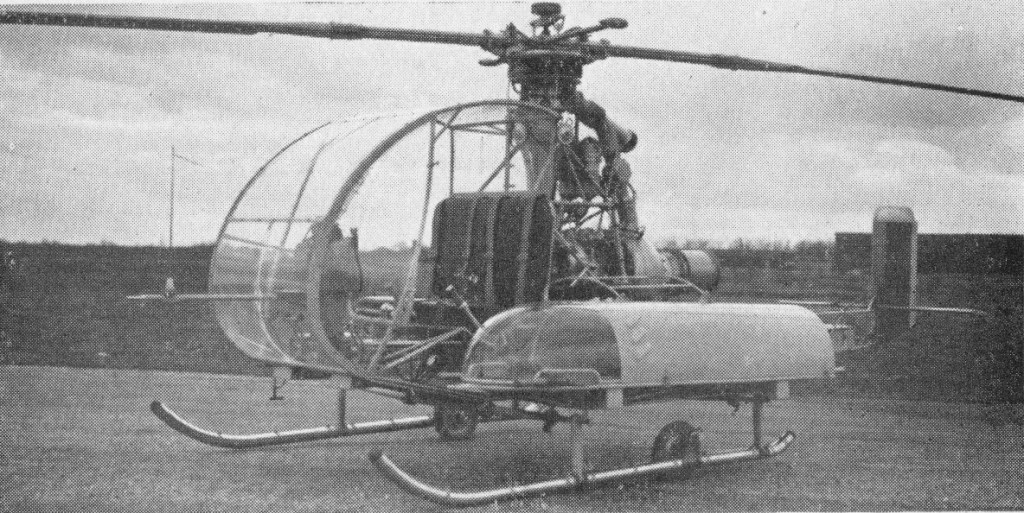
Between forty and fifty civil Djinns were active in ten countries, most of them in an agricultural role, for which Sud-Aviation offered renewed conversion facilities in 1965. The so-called ‘agricopter’ version of the Djinn can carry up to 200 litres of liquid chemical in twin tanks, and is fitted with lateral spray bars for the spraying, dusting or ‘fogging’ of crops with fertilisers or pesticides.
When production ended in the mid-1960s a total of 178 had been built, exported to about 10 countries. Many were used in an agricultural role, equipped with two tanks to contain liquid chemicals and spray bars for its distribution. By the time that production ended Sud-Ouest had twice changed its name, to Ouest-Aviation on 1 September 1956 and Sud-Aviation on 1 March 1957 when it merged with Sud-Est Aviation; this explains why the Djinn is sometimes recorded as the Ouest S.O.1221 or Sud-Aviation S.O.1221.
Sud-Ouest SO-1221 Djinn Engine: 1 x Turbomeca Palouste IV turbo-compressor, 179kW / 237 shp Main rotor diameter: 32 ft 10 in / 10.97 m Fuselage length: 17.388 ft / 5.3m Height: 8.530 ft / 2.6m Width of hull: 6.332 ft / 1.93 m Max take-off weight: 800kg / 1,550 lb Empty weight: 793.8 lb / 360kg Max speed: 70 kts / 130km/h / 75 mph Endurance: 2h 15min Initial climb rate: 1279.53 ft/min / 6.5 m/s Service ceiling: 13123 ft / 4000 m Range: 103 nm / 190 km Typical range: 100 miles at 44 mph Crew: 2
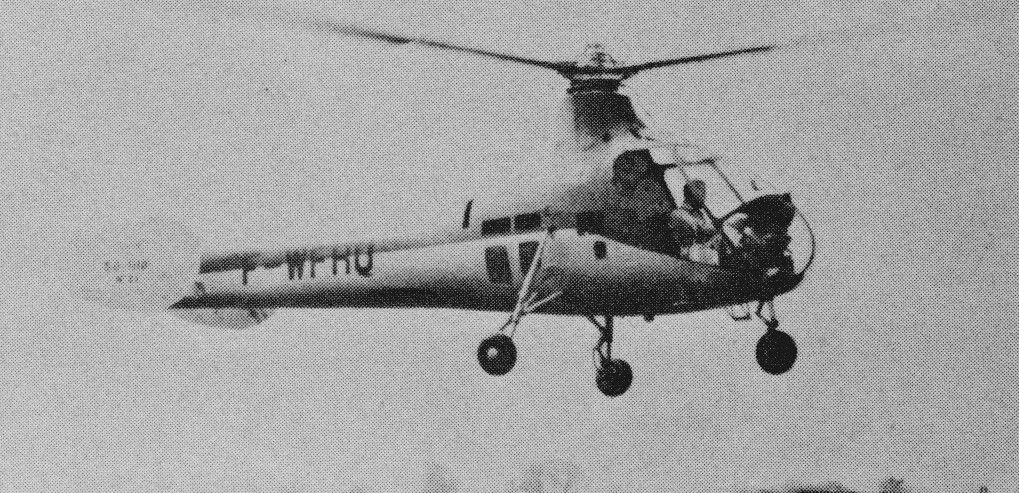
The 1948 experimental Ariel helicopters used tip jets at the blade tips.
The SO.1221 was powered by a cold-jet propulsion system developed by Sud-Ouest for its earlier two prototypes Ariel II and III helicopters. Residual thrust from the engine is ducted to the end of the fuselage and used for directional control.
Engine: 275 h.p. Turbomeca Arrius gas-turbine Rotor diameter: 35 ft 5 in Rotors: 3-blade tip-powered main rotor. Fuselage length: 27 ft 2 in Loaded weight: 2,750 lb Ceiling: 15,000 ft Typical range: 155 miles at 85 mph with 1,000 lb load Seats: 2-3
The 1949 Sud-Ouest SO-1119 Ariel II was the first French reaction jet helicopter to fly. Rotor tip jets were fed by an exhaust-driven compressor driven by a 190-hp Mathis C-40 located in the fuselage.
The SO-1119 Ariel II is at the French Musee de L’Air.
Engine: Mathis C-40, 190 hp Rotor diameter: 35,42 ft Fuselage length: 23.39 ft Max speed: 102 mph ROC: 1082 fpm
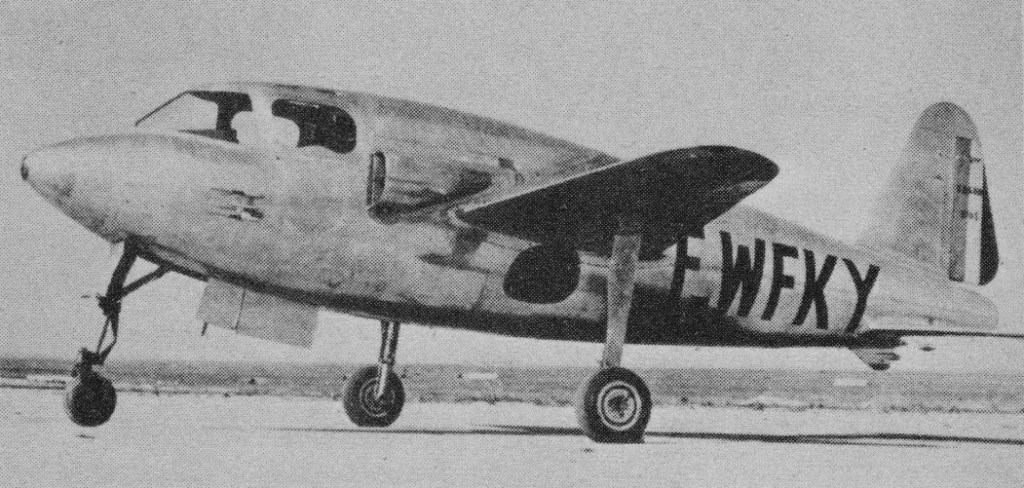
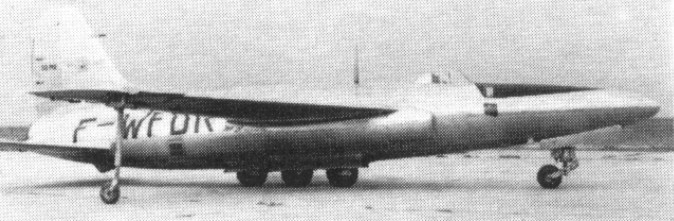
The half-scale model predecessors of the SO 4000 were the SO M.1 glider (F-WFDJ) and the powered SO M.2 (F-WFDK), these featuring a laminar flow wing swept 31 deg at the mainspar, mounted in the high-mid position and combining small ailerons interconnected with spoilers and leading-edge slats. The undercarriage consisted of a retractable central skid with wingtip stabilising skids in the case of the M.1, while that of the M.2 comprised a nosewheel, three main-wheels in train and wingtip outrigger wheels.
The powered M.2 had entered flight test five months earlier than the M.1, on 13 April 1949, when it was flown for the first time at Orléans-Bricy with Jacques Guignard at the controls. The M.2 was powered but was in most other respects, similar to the M. 1.
During its seventh flight in May 1950, with Daniel Rastel at the controls, the M.2 exceeded 621 mph (1 000 km/h) in a shallow dive. For the second phase of its flight test programme, commencing in October 1951, the M.2 was fitted with a modified control system, a revised undercarriage retraction system, provision for the installation of powder rockets to augment thrust at high altitude and wingtip fuel tanks. Empty and loaded weights being raised to 9,369 lb (4 250 kg) and 11,905 lb (5400kg).
Engine: Rolls-Royce Derwent V turbojet, 3,000 lb st (1360 kgp) Span: 3l ft 2 in (9,50m) Length of 32 ft 5.75 in (9,90 m) Wing area: 193.76 sq ft (18,00 sq.m) Empty wt: 8,466 lb (3 840 kg) Loaded wt: 10,362 lb (4 700 kg)
The Alouette II is a turbine development of the earlier SE-3120 Alouette with 200 h.p. Salmson 9 NH piston engine. A small pre-production batch was under construction, with the first five due for delivery late 1955.
Engine: Turbomeca Artouste II turbine, 360 hp Rotors: 3-blade main; 2-blade tail Rotor diameter: 38 ft Loaded weight: 2,980 lb Ceiling: 14,764 ft Typical range: 323 miles at 106 mph Seats: 5