The 1931 Sullivan Goblin N10694 c/n SC-1 was a two-place open cockpit monoplane powered by a 38hp Continental.
Sold and resold many times around the Bay Area and Santa Rosa. Officers in the Sullivan company were J W Robb and J J Schmidt, who also show up later as principals in the Ful-Vue Fixtures Co Ltd, one of the plane’s buyers (24 June 1932).
Universal Engine & Propeller Co, Berkeley (SF Bay Airdrome, Alameda 1937), acquired it on 29 January 1934 and installed their 50hp Universal Indian with variable-pitch prop.
After several more changes of owners, and a 60hp LeBlond in 1937, the reg was cancelled on 15 April 1940 Its registration expired in 1940 and was cancelled.
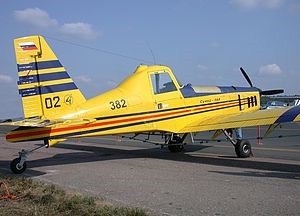
The Su-38L is a Russian agricultural aircraft, the first aircraft of this type to be designed and built by the Sukhoi Design Bureau civil aircraft section (Sukhoi Civil Aircraft (CJSC)). Design originally began in 1993 as a development of the Sukhoi Su-29 aerobatic aircraft. Development was suspended due to economic problems, and when restarted in 1998, the aircraft was redesigned, reducing the aircraft’s size and replacing the originally planned M-14 radial engine with a LOM Praha 337S inline engine. The first prototype made its maiden flight on 27 July 2001, with a second flying by June 2002. As no users had yet expressed interest in the aircraft, the project was proceeding at a low pace.
Su-38L
Engine: 1 × LOM Praha 337S, 184 kW (247 hp)
Max takeoff weight: 1,200 kg (2,646 lb)
Capacity: 500L (132 US Gallon) chemical hopper
Maximum speed: 150–180km/h (81–97 knots, 93–112 mph)
A further development of the Su-29, it has an even more impressive performance, and has sales success in the UK, Australia, the USA and elsewhere. The new wing is 70 per cent by weight composite materials. The pilot’s seat is inclined at 35 degrees, allowing an expert flyer to fully exploit the Su-31’s g tolerance of +12/-10. The first prototype flew in June 1992. In production since 1994.
Su-31 Engine: 1 x M-14PF, 300kW Max take-off weight: 968 kg / 2134 lb Empty weight: 670 kg / 1477 lb Wingspan: 7.80 m / 26 ft 7 in Length: 6.90 m / 23 ft 8 in Height: 2.76 m / 9 ft 1 in Wing area: 11.80 sq.m / 127.01 sq ft Max. speed: 330 km/h / 205 mph Ceiling: 4000 m / 13100 ft Range: 290 km / 180 miles Range w/max.fuel: 740-1200 km / 460 – 746 miles Roll rate: 400 deg/sec Max ROC: 4725 fpm
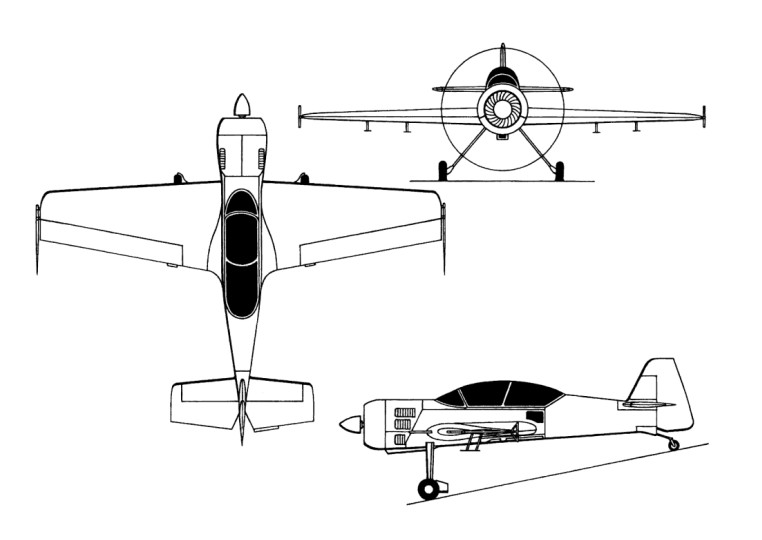
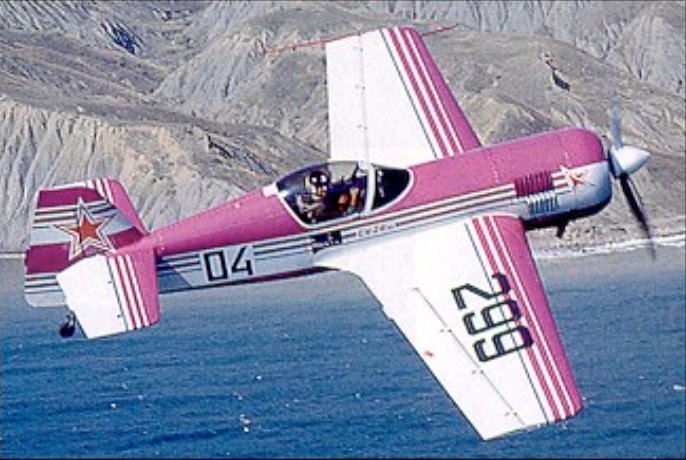
With the political changes that have occurred, the former Soviets have found an increasing desire to attract, sales abroad. The former Soviet pilots soon came to the conclusion that there was a requirement for a two seat aircraft with the same performance as the single seat Su-26, principally for training purposes, and Sukhoi developed the SU29.
The two-seat Su-29 is just 50 kg heavier than the single seat Su-26/31 models. It features a high proportion of composites in the structure including the wings and parts of the fuselage.
The two-seater is flown from the rear seat.
The Su-29 is placarded to +12/-10g but factory test demonstrated a minimum fail load at no less than 23.5g. It is impossible to achieve more than 18g in flight but the +12g limit allows a 50% safety margin.
The cockpit includes an anthropometric seat reclined at 35 degrees to increase pilot ‘g’ tolerance.
Fuel endurance is limited to about 30 minutes of aerobatic flying with a reserve, but filling up the wing tanks will give you four hours in the air at 157 knots ( 65 per cent ) plus reserve. It is stressed to plus and minus 23 g at the factory although the brochure states plus 9 and minus 7 with two persons on board and plus 11 and minus 9 solo. The engine life is 2250 hours at normal operation but restricted to 500 hours of “UNLIMITED” aerobatics. The propeller is a three bladed MT composite prop from Germany.
Su-29M is equipped with ejection seats, the lightest aircraft in the world with such a facility.
Su-29 Engine: 1 x M-14PT, 270kW Max take-off weight: 860-1204 kg / 1896 – 2654 lb Empty weight: 735 kg / 1620 lb Wingspan: 8.20 m / 27 ft 11 in Length: 7.29 m / 24 ft 11 in Height: 2.89 m / 10 ft 6 in Wing area: 12.20 sq.m / 131.32 sq ft Max. speed: 325 km/h / 202 mph Ceiling: 4000 m / 13100 ft Range w/max.fuel: 1200 km / 746 miles Crew: 1-2
SU-29 Engine: Vedeneyev M14P radial 9-cylinder, 360 hp Empty Weight: 1738 lb Gross Weight: 2684 lb Max Load: 946 lb Fuel Capacity: 71.6 Usgal / 451 lb Wing Area: 131.95 sq. ft Wingspan: 27 ft Length: 24 ft Height: 9.5 ft Vne: 273 mph Vs: 71 mph Rate of Climb: 3150 fpm Max Range: 890 sm High Speed Cruise: 183 mph Roll Rate: 360 deg/sec Takeoff Distance: 495 ft Landing Distance: 1247 ft
Su-29KS Engine: M-14P, 360 hp Max speed: 325 kph ROC: 16m/sec Range: 1200 km Loading: +10/-9 Height: 2.49 m Length: 7.22 m Wing span: 8.20 m
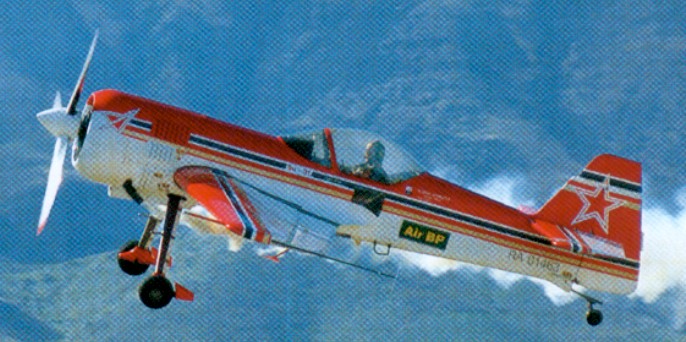
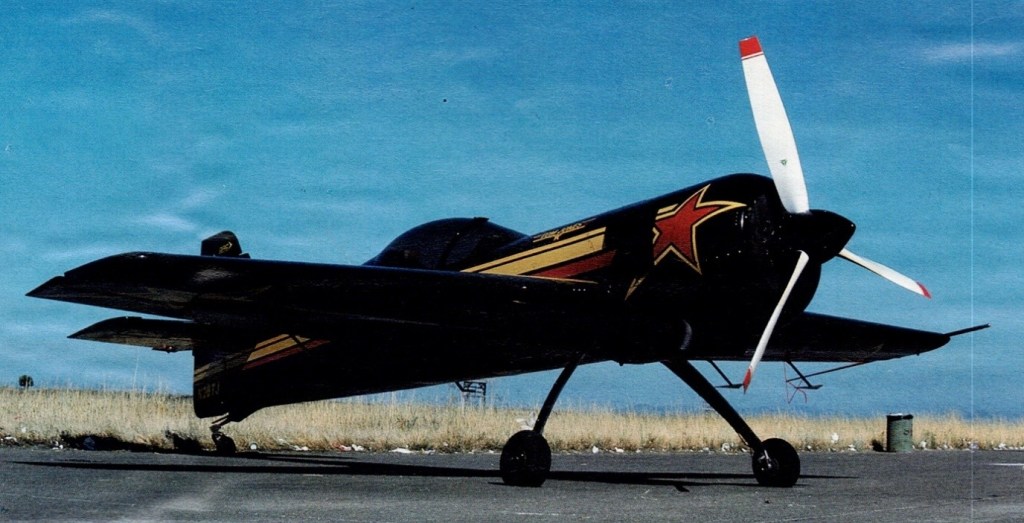
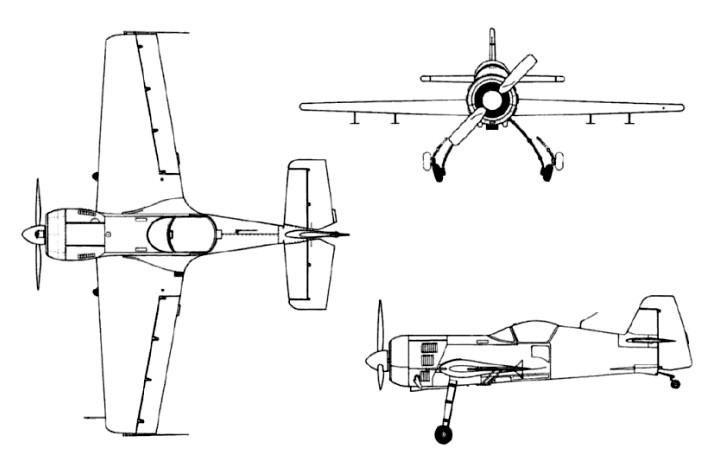
The first prototype flew on June 30, 1984, and at the World Aerobatic Competitions in Hungary 1984 western pilots saw, for the first time, the replacement for the very competitive Yak 50 and Yak 55; the standard competition aircraft of the Soviet pilots. This was the Sukhoi Su26 (originally called the Su42). The two new aircraft were prototypes with wings and tail made of foam covered plywood and apparently not well finished. They weren’t highly placed and did little to impress. It wasn’t until 1986 at the world championships in England that the western world saw for the first time the redeveloped Su26M when three aircraft arrived in tight formation. The Su26M had carbon fibre and keviar technology with extensive use of titanium in the spar and landing gear, as well as a longer wing. It was to become the standard aircraft for the Soviet team and very quickly impressed all who saw it in action. The engine never changed and is the same nine cylinder Vedenyev M 14P 360HP engine as in the Yak 55.
Su-26 N26TJ
A mid-wing, aerobatic taildragger, the fuselage is made of stainless steel tube and kevlar, the wings are composite and the landing gear is titanium. The main spars are a combination of carbon fibre covered with kevlar (ultimate strength +- 28g).
With the political changes that have occurred, the former Soviets have found an increasing desire to attract, sales abroad. The former Soviet pilots soon came to the conclusion that there was a requirement for a two seat aircraft with the same performance as the single seat, principally for training purposes; a point not lost on the Sukhoi design team. Hence the development of the two seat Su29.
Su-26 Engine: 1 x M-14P piston engine, 270kW Max take-off weight: 835 kg / 1841 lb Wingspan: 7.80 m / 26 ft 7 in Length: 6.83 m / 22 ft 5 in Wing area: 11.83 sq.m / 127.34 sq ft Max. speed: 450 km/h / 280 mph Range w/max.fuel: 800 km / 497 miles Seats: 1
Su-26MX Engine: Ivchenko, 360 hp Cruise: 190 mph Stall: 60 mph Roll rate: 400 deg/sec
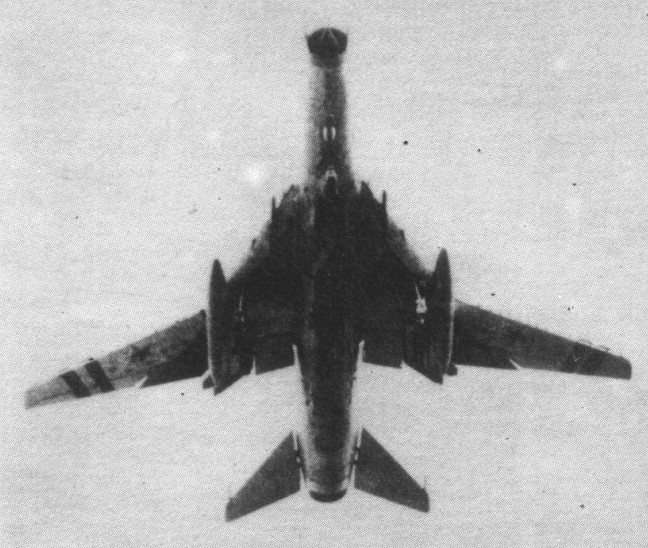
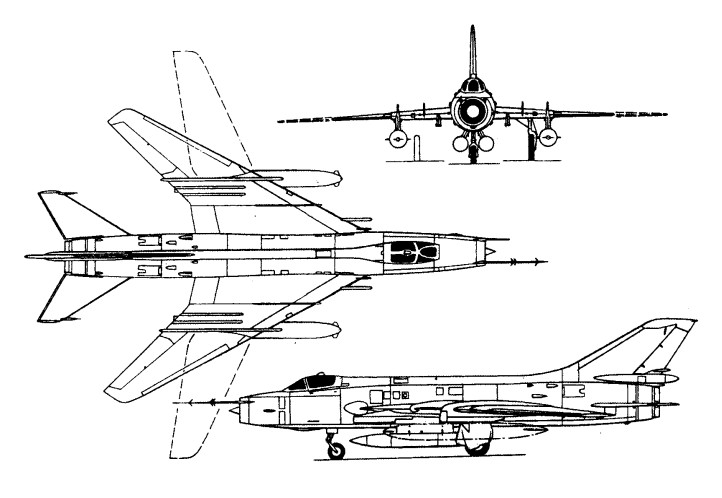
Derived from the swept-wing Su-7 Fitter A (NATO code name), essentially by fitting variable-sweep outboard wing panels, the Su-17 was first revealed in 1967, and labelled ‘Fitter-B’ by NATO but dismissed as a research version.
Under the leadership of Nikolai Zyrin, the Sukhoi OKB adapted an Su-7BMK as a low risk, low cost variable wing geometry demonstrator. Mid-span pivot points were introduced so that the outer wing panels could be sweptback from 28 degrees to 45 degrees and 62 degrees positions. As the Su-7IG (Izmenyaemaya Geometriya, or variable geometry), or S-22I, the demonstrator flew on 8 August 1966, proving the efficacy of the variable-geometry arrangement and providing the basis for a production aircraft, the Su-17. This entered the VVS-FA inventory in 1970.
The Su-17 was powered by the Lyulka AL-21F-3 turbojet with a military power of 7800kg and 11200kg with afterburning. Maximum external stores load was 4000kg distributed between nine external stations, and built-in armament comprised two 30mm cannon.
Not until the mid-1970s did it dawn on the West that the modification, together with a more powerful but fuel efficient engine and new avionics, had resulted in a vastly improved aircraft with doubled weapon load, 30 per cent greater range and substantially better short-held take-off characteristics. So successful has been the aircraft that numerous versions are in service with Frontal Aviation, the Soviet naval air arm, Warsaw Pact and left-leaning countries abroad.
An upgraded version, the Su-17M (S-32M), entered production in 1974, this having a drooped and lengthened – by 38cm –fuselage nose with ventral Doppler navaid pod. This, like the preceding Su-17, was exported as the Su-20 (S-32MK), recipients including Algeria, Egypt, Iraq, North Korea, Vietnam and Poland.
By 1972 the initial Fitter B version was in limited service. Sukhoi Su-17 variants based in eastern Europe and the USSR have been progressively improved from the basic Fitter-C.
Whereas the Fitter B had been a straightforward adaptation of the Fitter A airframe, the Fitter C took the process of incremental design development a stage further. The wing remained basically similar to that of the v g prototype but was now mated with a derivative engine of the original AL 7F series turbojets. This, the similarly dimensioned AL 21F, offered a respectable increase in power and a modest improvement in SFC. A nominal increase in internal fuel capacity was acquired by adopting the deeper fuel housing dorsal spine that had been introduced by the two seat Su 7U as a means of compensating for some of the ill afforded loss in tankage that had inevitably accompanied the introduction of a second seat in a dimensionally barely lengthened (by 12 in/30cm) fuselage.
Su-17
The result was a tactical fighter capable of lifting from much shorter airstrips almost double the ordnance load and carrying it some 25 30 per cent further. A multi role warplane toting respectable payloads over reasonable radii. This was more than could be claimed for the preceding fixed geometry Fitter¬ A, the good low level gust resistance and manoeuvrability, and highly regarded handling qualities of which the Fitter C reputedly retained. Within little more than two years of its FA debut, Fitter C was being exported to WarPac countries and Middle Eastern recipients of Soviet military aid.
The export version of Fitter C was referred to by its recipients as the Su 20, and there is some evidence to suggest that this designation is also used by the V VS. Su 20s were in service with the air forces of Algeria, Czechoslovakia, Egypt, Iraq, Libya, Syria and Poland.
Su-20
Fitter C was the first series production model, with the Lyulka AJ-21F engine. The Fitter C was supplied to Warsaw Pact and other allies as the Su-20. Replacing the Fitter C was the ‘Fitter D’, appearing in 1976, with its undernose terrain avoidance radar and a marked-target seeker in the inlet centre-body. The laser ranger was accommo¬dated within the lower half of the intake centrebody and the fuselage nose was lengthened 1.25 ft (38 cm) to permit a flat, elongated lozenge shaped avionics housing to be mounted beneath the nose, ahead of the nosewheel bay, the aft end of this housing apparently accommodating doppler. No attempt would seem to have been made on Fitter D to compensate for the inevitable destabilising effect resulting from this longer and deeper forebody.
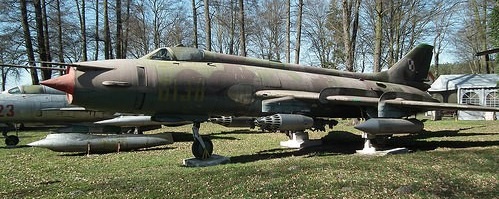
6138 Sukhoi Su-20 R 74828
A design change introduced with Fitter F and to be retained by succeeding variants of the Sukhoi ground attack fighter was an increase in the diameter of the rear fuselage, this increase being vertically asymmetric. A conversion trainer, the ‘Fitter-E’, parallels the Fitter-G except for a slightly drooped forward fuselage and lack of a port wing root gun, whilst the ‘FitterG’ operational trainer has a taller, straight-topped fin and a marked-target seeker. Newest of the single-seat variants is the ‘Fitter-H’ which has the revised fin and a deep dorsal fairing behind the canopy, presumably for extra fuel tanks.
A further export derivative using the basic Su-17M airframe, but re-engined with a Tumansky R-29BS-300 augmented turbojet with a max thrust of 11500kg, received the designation Su-22 and was supplied to Angola, Libya and Peru. Featuring a deeper forward fuselage and enlarged spine, and a redesigned tail to restore yawing stability, yet a further single-seat version, the Su-17M-1, appeared in mid-1979. The Su-17M-2, which appeared almost simultaneously, differed in equipment fit, with the export version, the Su-22M-2, supplied to both Libya and Peru, having the Tumansky engine. The definitive single-seat production versions were the Su-17M-3 and M-4, the former supplied to Hungary as the Su-22M-3 and the latter to Afghanistan, Czechoslovakia, East Germany and Poland as the Su-22M-4. These AL-21F-powered models embodied much improved avionics and introduced extra stations for R-60 or R-73 close range AAMs.
Su-22M-4
Export versions of the Su-17 ‘Fitter-C have a reduced avionics fit and are designated Su-20, but when the Su-22 ‘Fitter-F’ appeared as a ‘Fitter-D’ counterpart, its bulged rear fuselage revealed a change of engine to the 11500-kg (25,353-lb) thrust Turnansky R-29B afterburning turbojet for even better performance. A ‘Fitter H’ counterpart, the Su-22 ‘Fitter-J’, is similarly powered and identified by a more angular dorsal fin. Su-22s are also employed as interceptors with AA-2 ‘Atoll’ AAMs. A Tumansky-powered two-seater has been noted in Soviet service, the Fitter E is a two-seat Su-17 with a drooped nose, a feature retained by the Fitter G trainer, which also introduced a deeper fuselage spine. Fitter H, a single-seater distinguished by its dorsal fairing and drooped nose, can carry two AS-7 Kerry radio-command air-to-surface missiles. The twin wing root mounted 30 mm NR 30 cannon are retained by Fitter H, which, like preceding variable geometry Fitters, has four fuselage and four wing stores stations. Two of the fuselage stations – at least, on export examples (eg, Libya) – are “wired” for Atoll IR homing AAMs, providing some defence capability. The inboard wing and the fuselage stores stations can each lift “iron” bombs of up to 1,102 lb (500 kg), and the former and two of the latter may be fitted with adaptor shoes for radio command guidance AS 7 Kerry ASMs, or the various anti radiation missiles, such as AS 9.
Peru purchased its first Su-22s in 1976, comprising 32 single seat Su-22s and 4 two seat Su-22Us.
The latest version of the Su-17 ground-attack aircraft appeared in 1984. The Fitter K is distinguished by an intake extending forward of the fin root.
With more than 3,000 built, including two-seat training variants, production of the Su-17 terminated in 1984.
Poland received a total of 90 single-seat Su-22M4s and 20 two-seat Su-22UM3Ks, which were deployed within four tactical bomber regiments based at Piła, Powidz, Mirosławiec, and Swidwin. The first example arrived in Poland in August 1984.
Su-22
After Poland joined NATO in 1999, its Su-22s underwent limited upgrades, the air force deciding to continue flying the Soviet-type, as well as the MiG-29 Fulcrum fighter. Among others, the Fitters received NATO-standard avionics and more modern VHF/UHF communication systems. Also, service life was extended by 10 years on 18 of the aircraft, with work performed in-country, at Bydgoszcz, from 2014. In the process of modernization, the jets traded their former green and brown camouflage for a low-visibility two-tone gray scheme.
While the Su-22’s original role was as a low-level strike specialist, with a secondary reconnaissance mission, toward the end of its Polish service, it was also used for adversary work.
The retirement of the last Polish Su-22s was finally enabled by the arrival of the Korea Aerospace Industries FA-50 light combat aircraft, acquired as part of a multi-million-dollar South Korean arms package. The initial 12 FA-50GFs (representing the initial Block 10 configuration) were delivered to Poland between July and December 2023. Another 36 of the more advanced FA-50PL (Block 20) aircraft were also on order.
In terms of crewed combat aircraft, the Polish Air Force donated 14 of its MiG-29s to Ukraine, leaving 14 more based at Malbork, where they are expected to serve until 2027.
Su-17 Fitter C Engine: 1 x Lyuika AL-21F-3, 11,200 kg / 24,691 lb thrust Installed thrust (dry / reheat): 76.5 / 110 kN Span: 14.0 m / 45 ft 11.25 in spread Span: 10.60 m / 34 ft 9.5 in swept Length: 19.2 m / 63 ft 0 in Height: 5.35 m / 12 ft 6.5 in Wing area: 40.10 sq.m / 431.65 sq.ft spread Wing area: 37.20 sq.m / 400.4 sq.ft swept Empty wt: 10,900 kg / 24,030 lb MTOW: 17,700 kg / 39,020 lb Max speed: 2305 kph / 1432 mph Initial ROC: 13,800 m / min Ceiling: 18,000 m / 59,055 ft T/O run: 1000 m Ldg run: 600 m Range: 1255 km / 780 mi Combat radius: 700 km Fuel internal: 4000 lt Air refuel: no Armament: 2 x 30 mm NR-30 cannon Hard points: 8 Bombload: 4000 kg / 8818 lb Seats: 1
Su 17M Fitter D
Su-17M-4 Fitter K Max take-off weight: 19500 kg / 42990 lb Wingspan: 10.04-13.66 m / 33 ft 11 in-45 ft 10 in Length: 19.10 m / 63 ft 8 in Height: 4.86 m / 16 ft 11 in Max. speed: 2220 km/h / 1379 mph Range: 2300 km / 1429 miles Crew: 1
Su-17 ‘Fitter-G’ Type: single-seat variable-geometry ground-attack fighter Armament: two 30-mm NR-30 cannon (with 70 rpg) in wing roots Hardpoints: four underwing and four underfuselage weapon pylons for up to 4000 kg (8,818 lb) Powerplant: one 11200-kg (24,691-lb) thrust Lyulka AL-21F-3 afterburning turbojet Maximum speed 2300 km/h (1,429 mph) or Mach 2.17 at altitude Maximum speed 1285 km/h (798 mph) or Mach 1.05 at sea level Initial climb rate 13,800 m (45,275 ft per minute) Service ceiling 18000 m (59,055 ft) Combat radius with 2000 kg (4,409 lb) of stores 630 km (391 miles) on a hi-lo-hi mission Combat radius with 2000 kg (4,409 lb) of stores 360 km (224 miles) on a lo-lo-lo mission Wingspan, extended (28 deg sweep) 14. 00 m (45 ft 11 in), fullyswept (62 deg) 10. 60 m (34 ft 9.5 in) Length 18.75 m (61 ft 6.25 in) Height 4.75 m (15 ft 7 in) Wing area, extended 40.1sq.m (432 sq ft)
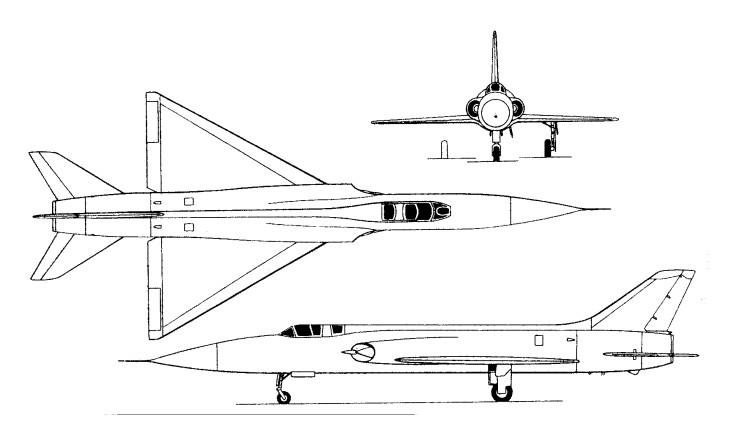
During 1957, the Sukhoi OKB began construction of the prototype of a new tailed-delta interceptor, the two-seat P-1 (the prefix letter indicating Perekhvatchik, or interceptor) intended to meet a requirement for a fighter equipped with collision-course radar and carrying a mixed armament of guided and unguided missiles plus cannon. Flown on 12 July 1957 by Nikolay Korovushkin, the P-1 had a 57 degree delta wing with dog-tooth leading edges and lateral air intakes with translating centrebodies. Power was provided by an unspecified turbojet with a maximum afterburning thrust of 10600kg and armament included a battery of 50 unguided spin-stabilised 57mm rocket missiles, provision being made for a single 37mm cannon and guided missiles on underwing pylons. Poor engine reliability and serious delay in development of the intended X-band radar led to discontinuation of development of the P-1 on 22 September 1958.
P-1 (estimated) Max take-off weight: 17010 kg / 37501 lb Wingspan: 9.50 m / 31 ft 2 in Length: 21.30 m / 70 ft 11 in Max. speed: 2050 km/h / 1274 mph Ceiling: 19500 m / 64000 ft Range: 2000 km / 1243 miles
The limited range of the TsD-30T radar and K-5MS led Sukhoi to develop the Su-11 with new Oryol radar and K-8M missile.
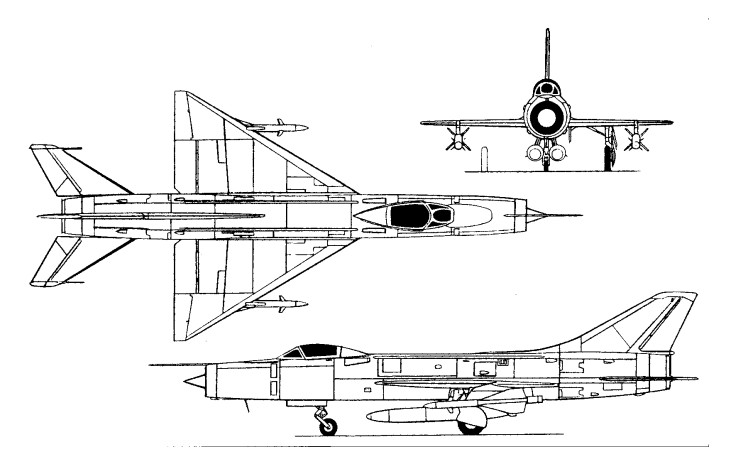
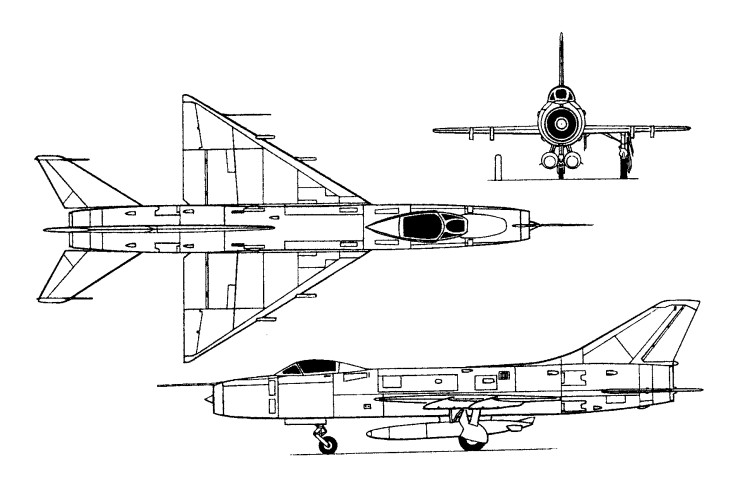
The availability of a more powerful radar, the Uragan (Hurricane) 5B, matched with new medium-range AAMs available in alternative semi-active radar guidance and infra-red homing versions in the mid ‘sixties, led to upgrading of the basic T-43 (Su-9). The larger-diameter dish of the Uragan I-band radar necessitated an intake centrebody of almost twice the cross-section area of that of the series Su-9. This, in turn, required increasing the intake lip diameter to allow for the same airflow, which, the AL-7F engine being retained, remained essentially unchanged. External piping ducts along the upper rear fuselage, similar to those of the Su-7BM, signified a revised fuel system, and armament comprised two medium-range missiles (one radar-guided and the other IR-homing). With the AL-7F-1 turbojet providing an afterburning thrust of 10,110kg, the revised T-43 series limited all-weather interceptor was adopted by the IA-PVO Strany under the (re-used) designation Su-11 as interim equipment pending introduction of the more advanced Su-15 that was being developed in parallel. The Su-9 fighter was used in large numbers as a standard Soviet (P-VO Strany) defensive fighter, replaced from 1968 by the Su-11 with long nose, large radar and inlet and new missiles. The Su-11 supplemented and partly replaced the Su-9 until similarly withdrawn in the early ‘eighties.
The Su-11 ‘Fishpot-C’ first flew on 25 Dec 1958 as the T-47 prototype, and entered series production in 1962 at Novosibirsk. After the series production of 112 aircraft, the Su-11 production was ceased because of its poor performance and flight handling, caused by its heavy nose shifting the centre point of gravity forward disrupting the design’s balance.
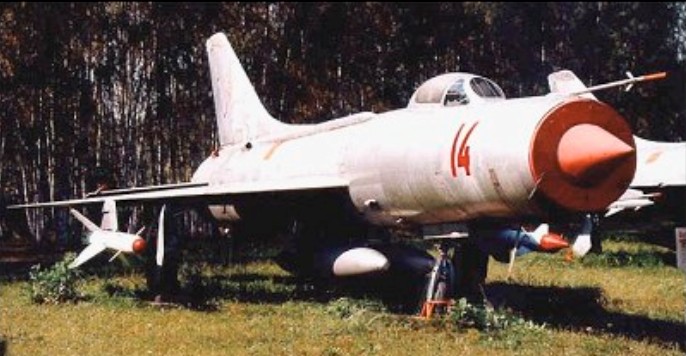
An all weather fighter and trainer aircraft. NATO code name ‘Fishpot-C’ and ‘Maiden’’. The Su-11 ‘Fishpot-C’ is an improved version of the Su-9 with a more powerful engine, the Lyulk4 AL-7F turbo¬jet of 22,000 lbs thrust with afterburner. It has a maximum speed of Mach. 1.8 at 36,000 feet and carries two ‘Anab’ air-to-air missiles, one radar-homing and one infra¬red.
Su-11 Type: single seat all weather interceptor Engine: 1 x Lyulka AL-7F single-shaft afterburning turbojet 22,046 lb (10.000 kg) thrust Wingspan: 8.43 m / 28 ft 8 in Wing area: 26.2 sq.m / 282.01 sq ft Length: 17.4 m / 57 ft 1 in Height: 16 ft (4.88 m) Max take-off weight: 14000 kg / 30865 lb Empty weight: 9100 kg / 20062 lb Initial climb 27.000 ft (8230 m)/min Max. speed: 1915 km/h / 1190 mph Ceiling: 17000 m / 55750 ft Range with twin drop tanks: 900 miles (1450 km) Armament: two Anab air-to-air missiles, one radar-homing and one infra-red on wing pylons, no guns.
The Su-9 ‘Fishpot-B’ developed in the late 1950s was a successful fighter with just over 1,000 aircraft produced between 1957 and 1962. The limited range of the TsD-30T radar and K-5MS led Sukhoi to develop the Su-11 with new Oryol radar and K-8M missile.
Within a short timescale, the Pavel Sukhoi OKB succeeded in developing a successful limited all-weather single-seat interceptor fighter from the T-3 and its immediate derivatives. Assigned the designation Su-9, this interceptor was available to enter IA-PVO Strany service from 1961. The Su-9 was directly evolved from the T-4 series of prototypes, which, sharing the 57 degree delta wing and Lyulka AL-7F turbojet with the preceding prototypes, differed from one another in detail design, systems and equipment. With a single exception, the T-4 prototypes featured a circular nose intake with a translating centrebody to accommodate the S-band R1L search-and-track radar. The exception, the T-49, had a unique arrangement of box-type intakes flanking a slim, ogival nose radome.
The first T-4 series prototype, apparently designated T-401, entered flight test during 1957, and, in May 1960, an essentially similar aircraft, the T-405, established a new 100km closed-circuit record of 2092km/h. The definitive fighter development, the T-43, was first flown on 10 Sept 1957 as the T-431, and established a zoom climb altitude record of 28,850m on 14 July 1959. Three years later, the T-431 set both a sustained altitude record of 21,170m and a 500km closed-circuit record of 2337km/h.
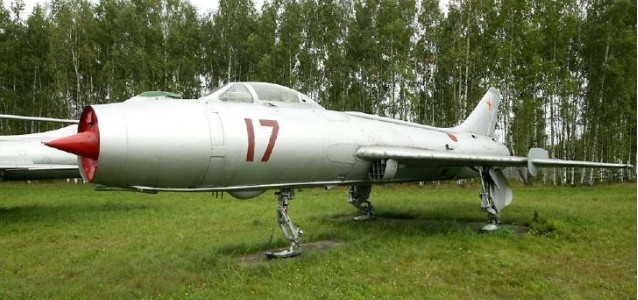
Revealed at the 1956 Aviation Day at Tushino were large Sukhoi fighters; one with a swept wing (called Fitter by NATO) and the other a tailed delta (called Fishpot). Both were refined into operational types, losing some of their commonality in the process. The delta Su-9 fighter was used in large numbers as a standard Soviet (P-VO Strany) defensive fighter, replaced from 1968 by the Su-11 with long nose, large radar and inlet and new missiles. Code names of tandem trainers are Su-7U Moujik and Su-9U Maiden.
An all weather fighter aircraft. NATO code name ‘Fishpot-B’.
Series production of the T-43 as the Su-9 was launched in 1959, standard armament comprising four beam-riding K-5 AAMs on underwing pylons. Production of the Su-9 is believed to have exceeded 1,000 aircraft, and this type remained in Soviet service until the beginning of the ‘eighties.
Su-9 Type: single seat all weather interceptor Engine: 1 x Lyulka AL-7F single-shaft afterburning turbojet, 22,046 lb (10.000 kg) thrust Wingspan: 8.43 m / 28 ft 8 in Length: 16.70 m / 55 ft 9 in Wing area: 26.25 sq.m / 282.55 sq ft Height: 16 ft (4.88 m) Max take-off weight: 12000 kg / 26456 lb Empty weight: 8750 kg / 19291 lb Max. speed: 1915 km/h / 1190 mph Range with twin drop tanks: 900 miles (1450 km) Armament: four Alkali-air-to-air missiles on wing pylons: no guns
Su-9U Type: dual control trainer Engine: 1 x Lyulka AL-7F single-shaft afterburning turbojet, 22,046 lb (10.000 kg) thrust Range with twin drop tanks: 900 miles (1450 km)