Hanriot HD.1

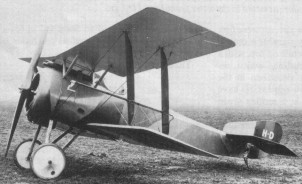
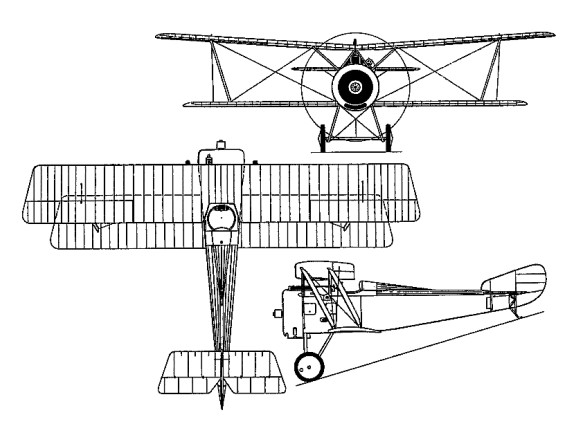
French single seat fighter biplane, prototype first flown 1916. It was designed by Pierre Dupont for the Sociote Anonyme des Appareils d’Aviation Hanriot and built by Hanriot at Billancourt, and was of sesquiplane configuration. The powerplant was a 110 hp Le Rhone 9 J rotary engine (120 hp Le Rhone 9 Jb on production aircraft) and carrying an armament of one synchronised 7,7 mm Vickers machine gun (although a few aircraft were later to be fitted with two Vickers guns). Tests proved it to be compact, manoeuvrable and with a good field of view. Although the HD.1 was accepted by the French government in early 1917, the huge contemporary production of the Spad 7 C1 precluded any production order for the French Aviation Militaire. Neither was the HD.1 considered to be a suitable replacement for the ageing Nieuport single seaters.

Hanriot HD.1 Article

However, the HD.1 did impress the Italian and Belgian authorities. It was adopted by Italy as the main Nieuport replacement, and went into licence production by the Societa Nieuport Macchi at Varese. It seems that reports of 1700 being ordered from Nieuport-Macchi may have been exaggerated. Societa Nieuport Macchi delivered 125 to the Aeronautica del Regio Esercito in 1917, 706 in 1918, and a further 70 after the Armistice. 831 were received by the war’s end, the balance coming from French production.

The HD.1 entered Italian service in mid 1917, serving in the Austrian, Macedonian and Albanian theatres. During the latter stages of the war they equipped 16 of the Italian air arm’s 18 fighter squadrons, and some continued in service until 1925. Over nine-hundred were produced for the Italians and they used the type in greater numbers than any other fighter during the First World War.
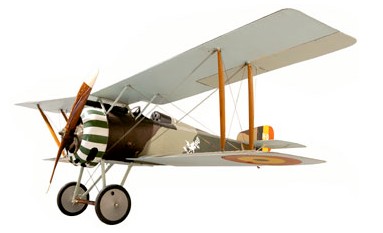
The HD.1 was also adopted by Belgium to which country Hanriot supplied 79 fighters of this type from August 1917. The HD.1 continued in service in both Italy and Belgium into the mid ‘twenties, and in 1921, Switzerland purchased 16 from Italian war surplus stocks and retained these in service until 1930.

Standard armament was a single 0.303 in (7.7 mm) Vickers gun, initially offset but later moved to a central position where the firepower was more effective, although the pilot’s view was slightly impaired. Belgian orders, for French built HD.1s, totalled 125, the first being delivered in August 1917. They were not instantly successful, but later gained popularity. One Belgian HD.1 was fitted with a single 11 mm (0.433 in) gun, which proved highly successful. Belgian HD.1s also served long after the war, some until 1926.

Small numbers were used by the French Aviation Maritime (naval air arm), with 130 hp Clerget 9 B engines and, on some, fin and rudder modifications similar to those of the HD.2. Switzerland purchased 16 HD.1s in 1921, and these remained in service until 1928.
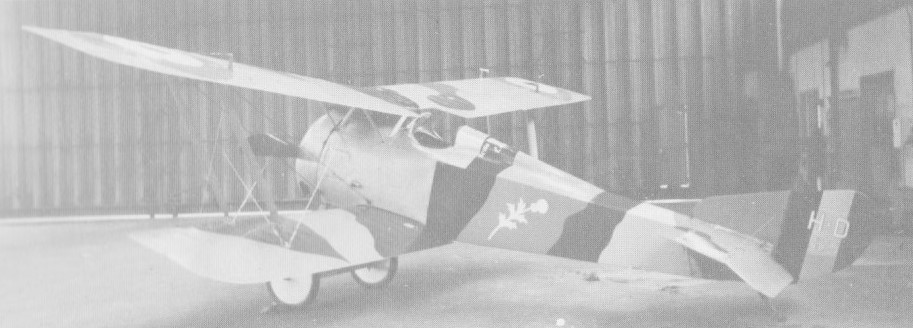
No.75 Hanriot HD 1 at RAF Cardington Museum

Gallery

HD 1
Engine: 120 hp Le Rhone 9Jb.
Max speed, 115 mph (184 km/h) at sea level, 111 mph (178 km/h) at 6,560 ft (2 000 m).
Time to 3,280 ft (1000 m), 2.97 min.
Ceiling, 20,670 ft (6 000 m).
Range, 224 mls (360 km).
Empty weight, 983 lb (446 kg).
Loaded weight, 1,437 lb (652kg).
ROC: 894 fpm / 272 m/min
Span: 8.70 m, (28 ft 6.5 in) upper
Span: 7.40 m (24 ft 3.25 in) lower
Length, 19 ft 2.25 in (5,85 m)
Height, 9 ft 7.5 in (2,94 m)
Wing area, 195.9 sq ft (18,20 sq.m)
Seats: 1
Hanriot X

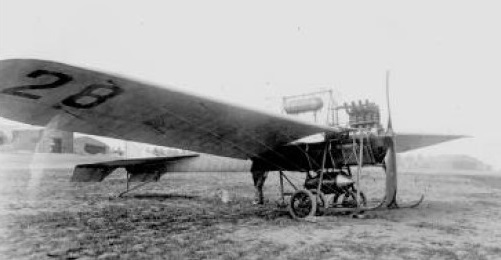
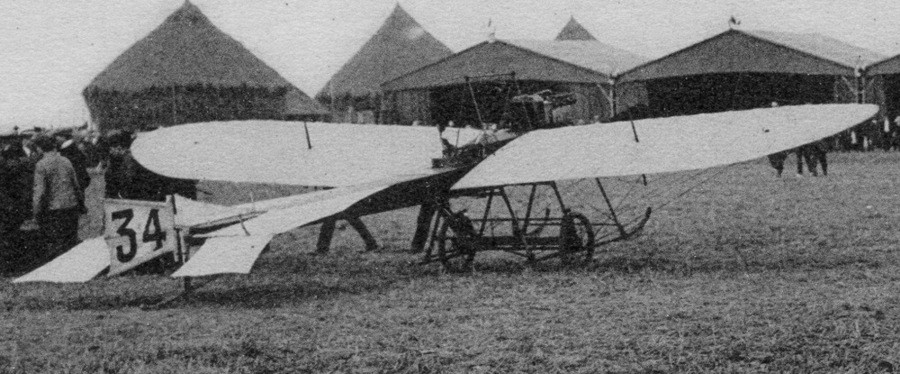
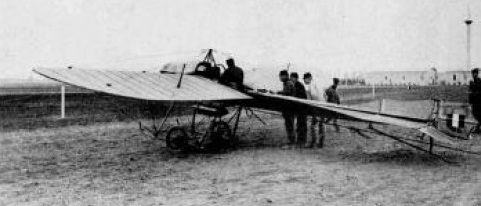
The third Hanriot entered in the 1911 Concours military trials had a 200hp Clement-Bayard. Photos show a machine similar to the IX but with an extended wingspan, single, larger tank hanging form the pylon and triangular, non-arched pylon uprights front and back. It looks to have a 100hp Clement-Bayard. This is the machine featured in the Automobiline ad.

The longer-winged 100hp machine at the 1911 Concours Militaire has a “28” on the underside of the starboard wing.

Hanriot IX

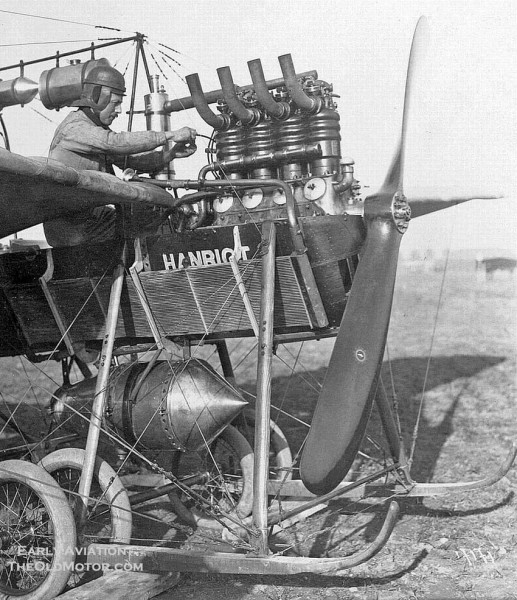
Hanriot entered three machines into the 1911 Concours military trials. A larger machine than the VIII, the 100hp Clement-Bayard powered IX had two pair of wheels, a fuel tank carried below the fuselage in the middle of the undercarriage birdcage, and two smaller tanks on the pylon. The rear pylon uprights were curved, coming to a point at the top rather like a gothic arch. Radiators are mounted on each side of the forward fuse Antoinette-style. The rear fuse is fabric-covered and the rudder is completely above the stabilizer/elevators (whereas earlier types had a “fishtail” rudder centered on the back end with small fins above and below the fuse). Curiously, there is one photo of what appears to be this machine with an early-style rudder. There is a large steering wheel in place of the trademark Hanriot dual levers.
A photo of Dubreuil in the cockpit of the shorter-winged one (IX) shows a small “23” on the fusealge side, near the seat.

Hanriot VIII

Marcel Hanriot in a 1911 Hanriot Militaire Triplace Type VIII

Built in cooperation with Henri-Hubert Pagny, who had previously worked with Nieuport. This 100 hp Clement Bayard powered machine, the first of the Antoinette-developments by Hanriot, was designed for the Concours Militaire de Reims in October 1911, where it was flown by Gaston Dubreuil.

Hanriot entered three machines into the 1911 Concours military trials. The VIII looks very similar to but perhaps a little larger than the VII, except there is no tank on the pylon. Since one of the requirements of the Concours was that the aeroplane carry three people, possibly the tank was moved in the interest of headroom.

Hanriot’s craft was passed over at the trials because the fuselage was very slender and open which left the crew unprotected.

The VIII should be powered by a 40hp Clement-Bayard.

Hanriot VI 40 hp Clerget, Reims 1911
Hanriot VIII Clément-Bayard 100hp 1911
Hanriot VIII Clément-Bayard 100hp at concours militaire de Reims 1911

Hanriot VII

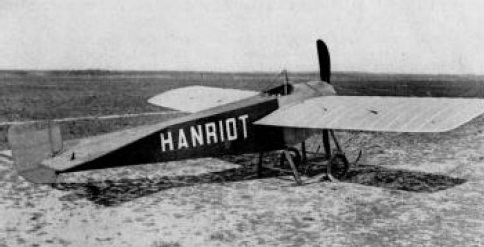
The Type VII appeared in 1911, after Clément-Bayard had built a 100 hp engine for. I always thought that had three sets of wires for the wings. Only I can’t prove this with photographs and I might be mistaken.

A single-seater similar to the VI, but without the extra inverted-V brace in the undercarriage or tailwheel. There’s a small fuel or oil tank suspended from the wing warping/bracing pylon. Possibly this is the machine shown at the 2nd Exposition de Locomotion Aerienne in Paris, Oct – Nov 1910, and also pictured on at least two postcards with Henri Lefargue.

Hanriot VI

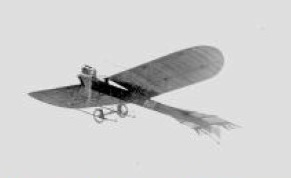
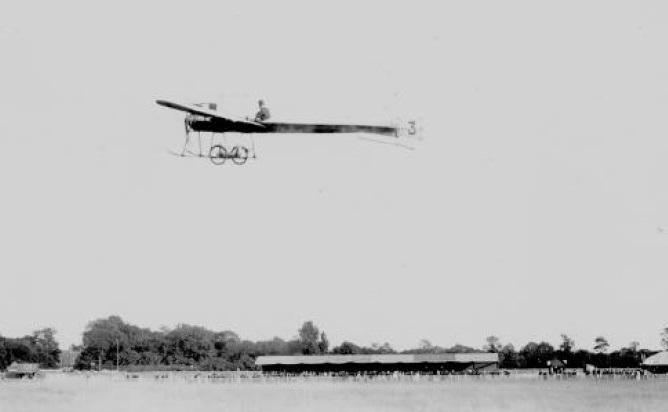
This single-seat machine was introduced by Louis Wagner at the Budapest meet (No.3) in June 1910. Later that month Marcel Hanriot piloted such a type at the meeting of Rouen (No.20).

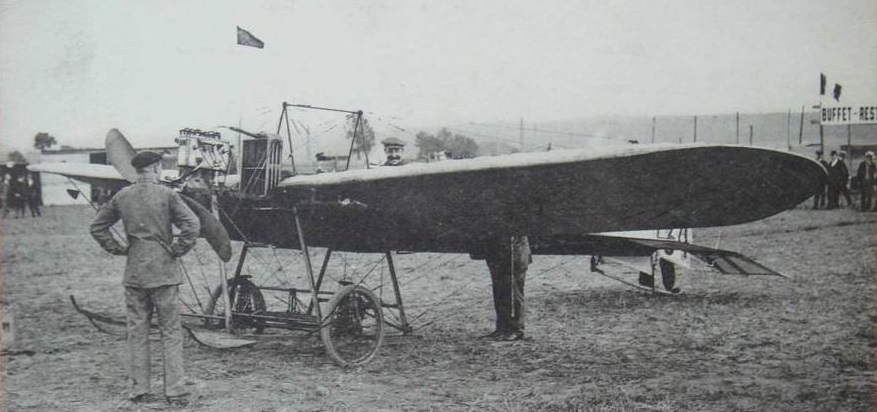
The VI seems to be the most successful and popular of all the Hanriots. A triangular-section fuse that is wood planked in front and fabric-covered in rear, six-legged undercarriage with an auxiliary diagonal inverted-V brace in the forward bay, no tank suspended from the pylon and what appears to be a small wheel at the end of the tailskid.

But the Type VI was then the high praised machine and entered to most of the important and less important meetings. The type V and type VI were used in 1910 by Marcel Hanriot in air meets.

The 1910-type Hanriot was flown by Georges Bathiat at the September 1910 Maubeuge meeting.

By the end of 1910 the Type VI had lost its tiny tailwheel and was eventually fitted with an 8-cylinder ENV (60 hp).

Engine: Grégoire-Gyp / 8-cylinder ENV, 60 hp
Wingspan: 43 feet
Wing area: 300 square feet
Total weight: 1,120 pounds

Hanriot V

The type V and type VI were used in 1910 by Marcel Hanriot in air meets.
There is a postcard titled “Marcel HANRIOT – Monoplan № 5.” Unfortunately, it’s a closeup of Marcel in the cockpit and doesn’t show any identifiable features of the aeroplane. There are also a few photos of a machine with an all-wood fuselage and six-legged undercarriage (matching the Old Rhinebeck repro in most respects) marked with a large “5” on the fuse.

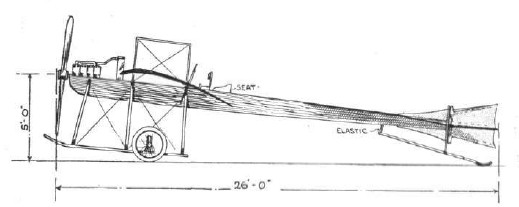
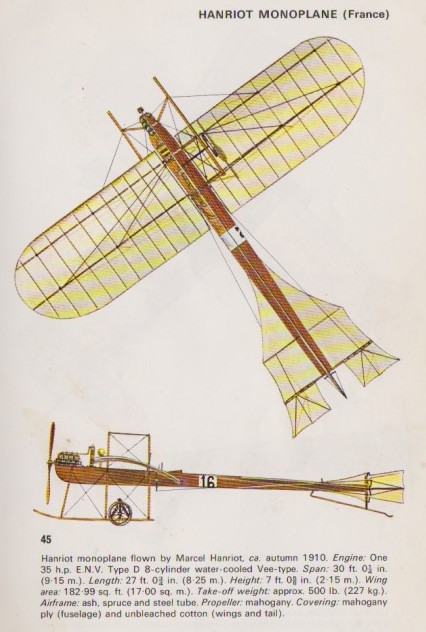
Although Hanriots first airframe had sustained damage during landing, it had nevertheless provided the foundation for a smaller, but similar monoplane which had sported a simple, elegant, aerodynamically-clean configuration when it had appeared in July of 1910. Constructed of ash, spruce, and steel tubes, the aircraft had a mahogany ply-covered, inverted, A-frame, and racing skiff-like fuselage.
On June 4, 1910, a sixteen year boy, Marcel Hanriot, takes off in a graceful aeroplane designed by his father, Rene Hanriot.
The light, but strong structure eliminated the need for the number and complexity of bracing wires traditionally required by box frame or girder build-up assembly. The main spars for the planes are made of wood in three layers and are 3 inches deep. The skids are fixed at the bottom of an A-type frame, the upper part of the A forming a triangular frame above the planes, to which the latter are fastened by stout wires.

The landing gear is mainly on two strong skids at the front supported by three uprights of the A-type frame work; the axles of the two wheels are carried on vertical guides, and are suspended by rubber springs anchored to the skids. There is a small skid at the rear.

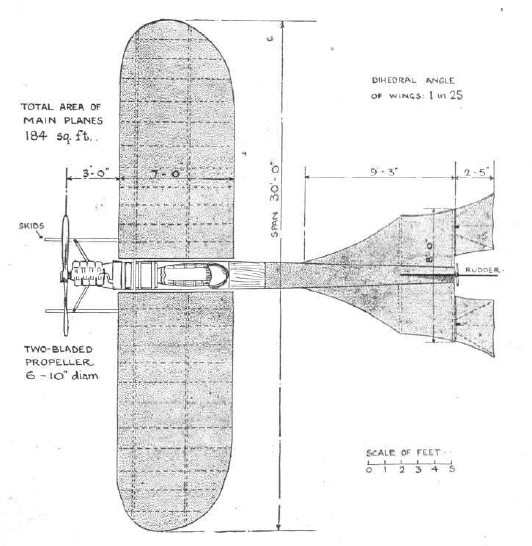
Cambered, rounded-tip wings, formed by two laminated spars and multiple ribs and covered with unbleached cotton fabric, were steel tape lashed to the fuselage and hinged, like those of the Wright Flyer and the Bleriot XI, to induce in-flight banking by means of wing-warping. The 30.5-foot span and seven-foot chord resulted in a 183 square foot area.

The large, triangular-shaped, fixed horizontal tail, measuring 9.3 feet long by eight feet wide and was also covered with unbleached cotton, extended to two separate, longitudinal-controlling elevators, while the fixed surface had been tightly stretched with the aid of two transverse spars and sported both unmoveable, dorsal and ventral, triangular-shaped fins to increase stability.

The laced fabric, scalloped, vertical tail was hinged to provide control about the yaw axis.

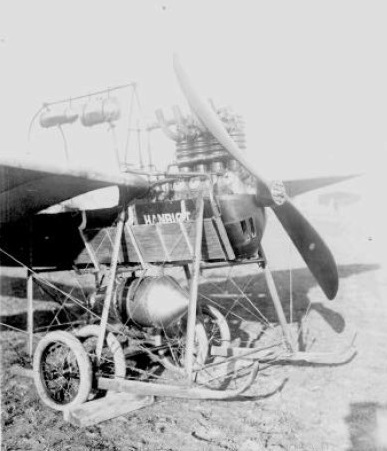
Power was provided by a 35-hp, eight-cylinder, water-cooled, V-type, E.N.V. engine, mounted on, and partially supported by, the A-frame struts, its two rows of cylinders set at 45-degree angles to the vertical and sharing a common crankshaft. It drove a single-bladed, mahogany propeller. The type also flew with a Clerget engine.
A four-cylinder 50 horse-power Clerget at 1.203 r.p.m with a Chauviere propeller, 7.2 feet in diameter and 3.8 feet pitch.

With a 27-foot, 3/4-inch airframe and a seven-foot, 5/8-inch height, the pioneer aircraft had a 500-pound gross weight.

The shallow cockpit featured little more than engine and axis-control levers. The right side stick moved forward and aft to actuate the hinged, fabric-covered elevators for pitch control, while the left side stick, moveable in a sideways direction, activated the wing-warping mechanism for in-flight banking, or lateral axis control. The rear spars are hinged, to permit of this. The elevators are 2 feet deep. The coupe atop it, informally known as a “blip switch” provided engine control, usually replacing the left-located throttle, since a hand was seldom free to operate it.

Fuel, stored in the cylindrical, metal tank, directly behind, and on the same level as, the engine, often required pressure to ensure continued flow, initiated by the squeezable rubber ball mounted on top of the right, pitch-control stick.

The scalloped single surface rudder, ensuring yaw-axis stability, was moved by means of a foot-depressed bar.
Initial taxi and direction were usually aided by the ground crew, who lifted the tail from the grass, but a significant power application made the vertical and horizontal tail surfaces effective.

Although there were no incremental throttle settings and the aircraft therefore flew at full, continuous power, its original, 35-hp engine had been inadequate to exert other than a sluggish, wing-warping created banking response.

Descent, induced by a combination of blip switch power interruptions and backward-stick, downward pitch, enabled the Hanriot to return to the ground.

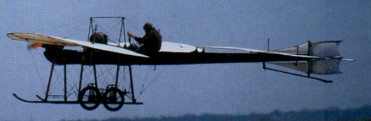
The Old Rhinebeck Aerodrome has a reproduction constructed by Cole Palen, Mike Lockhart, and Andy Keefe with the aid of drawings published in Flight during the winter of 1974 in Florida, had originally been powered by a 1910, two-cycle, water-cooled Elbridge Featherweight engine, but it had later been retrofitted with a more capable, water-cooled, 50-hp Franklin after it had sustained connecting rod damage.

Reproduction:
Old Rhinebeck Aerodrome Hanriot V

Wingspan: 30.5-foot
Length: 27-foot, 3/4-in
Height: 7-foot, 5/8-inch
Wing chord: 7-foot
Wing area: 183 square foot
Tailplane span: 8 ft
Tailplane length: 9.3 feet
Gross weight: 500-pound
Speed: 51 mph approx
Total weight: 760 pounds
Aspect ratio: 4.2 to 1.