In a few months, Hanriot and Ruchonnet designed a new lighter monoplane, the type II. Baptized “Dragonfly” it flew at Bétheny in April, equipped with a 40hp Clément-Bayard. Exhibited at the January 1910 Brussels show, the II has an all-wood fuselage and upright Gregoire engine.
Aircraft
Hanriot I / 1907 Monoplane
In 1908, while the automobile races are in full swing, René Hanriot wins the World Championship (unofficial) in a Benz of 150 hp. In May he bought one of Léon Levasseur’s Antoinette monoplanes with a 25 hp motor. But by the end of 1908, the monoplane was not yet delivered and René Hanriot lost patience. This was when he decided to make his own machine. In February 1909 he creates the Hanriot Monoplane Corporation with 500,000 Francs capital. A shed was used as a hangar, workshop and office. His son assisted with the building of the aeroplane. In the summer of 1909, the first Hanriot I proudly left the workshop for its first flight. The motor seemed questionable as early as the departure. Hanriot bought a 6-cyl Buchet, that develops 45 hp and weighs 155 kg.
The machine was subsequently displayed at the Salon de la Aeronautique in 1909.
The aircraft, powered by a single, 50-hp Buchet engine, featured an open framework fuselage mated to two rectangular wings of 31.2 feet span.
Its slender lines and good looks instill confidence and Hanriot receives orders for about twenty of his machines, although it did not again fly. In October, the flights to Bétheny and those carried out at Reims by René and Marcel show that the motor is too heavy! The machine is unable to do more than short hops. He looks for another motor. A virtually unknown engineer by the name of Pierre Clerget, from la Maison Clément-Bayard, that he knows from his auto racing days designs a four cylinder in-line engine of 40 hp.
Although Hanriots first airframe had sustained damage during landing, it had nevertheless provided the foundation for a smaller, but similar monoplane which had sported a simple, elegant, aerodynamically-clean configuration when it had appeared in July of 1910.
Hanriot
In 1908, while the automobile races are in full swing, René Hanriot wins the World Championship (unofficial) in a Benz of 150 hp. But he already had another sport in mind. In May he bought one of Léon Levasseur’s Antoinette monoplanes with a 25 hp motor. But by the end of 1908, the monoplane was not yet delivered and René Hanriot lost patience. This was when he decided to make his own machine. In February 1909 he creates the Hanriot Monoplane Corporation with 500,000 Francs capital. A shed was used as a hangar, workshop and office. His son assisted with the building of the aeroplane. In the summer of 1909, the first Hanriot I proudly left the workshop for its first flight. The motor seemed questionable as early as the departure. Hanriot bought a 6-cyl
Buchet, that develops 45 hp and weighs 155 kg.
The machine was subsequently displayed at the Salon de la Aeronautique in 1909.
By this time, devoting himself to his aviation business, René Hanriot abandons autoracing permanently for the flying. In the winter 1909- 1910, he buys several motors that he installs in his monoplanes. By now several copies and versions of the engine are available:
the V8 E. N. V., 50hp, 105kg, designed in 1908 by the British engineer Paul Rath
the four cylinder Vivinus, 70hp, 159kg
the Grégoire GYP by Pierre Joseph Grégoire, weighing 115kg,
the two cylinder Darracq , 30hp, 55 kg,
and a four cylinder of the Même Marque, 60hp, 130 kg.
But it is with the 4-cylinder Clément-Bayard of 40hp that the best results are obtained. The motor, cooled by water, weighs in at just 78kg, in working condition, and it develops not 40hp, as its competitors, but close to 50 true hp. With this motor the flights during the winter 1909-1910 are successful. The monoplane sometimes being piloted by the father, sometimes by the son.
With money earned racing automobiles, René Hanriot continues to develop his aviation business. Committed to flying, he opens a piloting school in Bétheny in December 1909, then in London in January 1910 where he opens a commercial affiliate The Hanriot Monoplane Company Ltd, with 600,000 Francs capital. The first year, 1910, he gains notoriety in Paris, at the 14, place du Havre, and creates at vast workshop in Paris at 34, rue du Moulin. Prudent, he recruits an experienced airman, Emile Ruchonnet, to develop his flying machines, and serve as engineer and chief pilot in his flight school. Former carpenter and former foreman with Levavasseur, Ruchonnet, who was registered in Reims, August 1909, in an Antoinette monoplane, has had his pilot’s license in France’s flying club since June 21, 1910. In April René Hanriot hires autoracer Louis Wagner as test pilot. He is in charge of representing the company at international meetings. His first competition is in Budapest June 5.
Eugene Ruchonnet, Leon Levasasseurs engineer, subsequent designs, developments of the first constructed at his Rheims workshop, had included the 20-hp, Darracq-engined Libellule and a larger derivative powered by a 40-hp Gype, both of which had enabled him to establish a flying school in Betheney in 1910. Instrumental in these aircraft had been Louis Wagner who, like Hanriot himself, had risen from the ground up as a racing car driver, and Marcel Hanriot, Hanriots son, who, at the age of 15, had become the world’s youngest pilot.
In a few months, Hanriot and Ruchonnet designed a new lighter monoplane, the type II. Baptized “Dragonfly” it flew at Bétheny in April, equipped with a 40hp Clément-Bayard. Then, they create a third type of monoplane, more powerful, intended for the competitions. The type IV, a two place, interested the army.
The type V and type VI were used in 1910 by Marcel Hanriot in air meets. Finishing his school year, Marcel Hanriot spends his Sundays on the grass in Bétheny. His father asks him to try all monoplanes produced by their firm. May 17 in Bétheny, Marcel Hanriot takes engineer Etienne Grandjean, a professor at à l’Ecole supérieure de l’aéronautique, for a flight over Champangne in the two place.
June 9, Marcel Hanriot flies from Bétheny to Mourmelon in their model VI. It gets ahead of Marthe Niel, a woman, flying a slower Voisin biplane. The following day Marcel Hanriot obtains his pilot’s license, with the n° 95. He is the youngest licensed pilot in France and most likely in all of Europe. During the 1910 season, the Hanriot monoplanes, piloted by Wagner (Budapest), Marcel Hanriot (Rouen, Caen, Dijon, Reims, Bournemouth), René Vidart (Lanark) and several foreign pilots, achieve glory in the aerial meetings. They win a number of honors and have several victories, showing off the French brand to the entire world, and reaping great financial rewards for the firm.
Aerial demonstrations are organized throughout the year from April to October, in the field at Budapest, but the summit of the 1910 season was the Grand Prix, from 5 May to 15 May1910 in Vienna, then the big week of aviation, June 5 to June 12, with prizes for flight time, distance traversed, altitude, and best take-off, plus a special prize for the trip (230 km traversed in six hours), with 200,000 Francs payoff.
Beginning 1910, thirty competitors were registered in Hungary. France engaged its habitual stables: with Voisin Rougier, Croquet, the Italian Baron of Caters, the Viscount Montigny and John Adorjan, with H. Farman Paulhan, Nicolas Kinet, Chavez, Efimoff and Jullerot, with Sommer André Frey, Hélène Dutrieu and Amerigo, Latham with Antoinette, Alfred of Pischoff (pardon, von Pischoff it was born Vienna Austria!). Orville Wright registered and entrusted a biplane to Engelhardt. Several pilots of the Austro-Hongrois Empire appear in local machines: Agoston Kutany, Erno of Horvath, Aladan of Zsekely. The day of the competition half of the registered competitors were missing. Dutrieu s’est abattue sur son Sommer to Odessa, and this is the Baroness of La Roche that defends the colors Voisin; she had access to a big ENV engine, as did Frey (Sommer) and Pischoff. The Austrian Illner (Etrich) and the French Wagner (Hanriot) had access to a 40hp Clément-Bayard (Clerget) engine. Kinet, Efimoff and Paulhan had access to Gnome engine with a remarkably effective propeller. The wind was blowing strong during the ten days of the competition and caused several spectacular accidents.
On June 7, Efimoff lost some pieces and crashed. Injured to the forehead and to the leg the French pilot was taken to hospital. On June 9, Latham breaks a wing strap (flying wire?) and crashed. His machine was pulverized but the Frenchman was miraculously unharmed.
The pilot is but one of six injured. Later in the evening, Bielovucic crashed but he was fortunately unhurt. The next day Illner’s airplane returned to service. Louis Wagner succeeded taking off in the evening but is forced to the ground by the wind. His machine is irreparable. Thus begins for Hanriot the 1910 season, and Marcel will outshine his father.
Aeroplanes Hanriot et Cie was founded during the First World War. Its first design was the Le Rhone-engined HD.1 sesquiplane fighter, rejected by the French services but subsequently used very successfully by Italian and Belgian pilots. An HD.2 floatplane version and more-powerful HD.3 two-seat reconnaissance/escort fighter were also built. After the war Hanriot license-manufactured British Sopwith aircraft and produced the H.43 advanced biplane trainer, H.46 Styx liaison and ambulance monoplane, and the H.131 low-wing racing monoplane, which won the 1931 Coupe Michelin. In 1930 the company became a division of Societe General Aeronautique (SNCAC), manufacturing aircraft under the Lorraine-Hanriot name.
In France, the Socialist Government of the so called Popular Front brought all the companies building military aircraft, aero engines and ar¬mament under its control in 1936. The im¬mediate result was the socialized oblivion of such established companies as Marcel Bloch, Bleriot, Nieuport, Potez, Dewoitine, Hanriot and Farman within half a dozen nationalized groups or Societies Nationales, named ac¬cording to their geographical location (Nord, Ouest, Centre, Midi and so on).
Akaflieg Hannover AFH-24
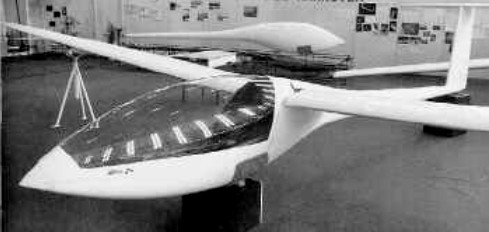
Wing span: 15m
Wing area: 10.27sq.m
Empty Weight: 245kg
Gross Weight: 500kg
Wing Load: 46.7kg/sq.m
Aspect ratio: 21.91
Airfoil: HQ
No. of Seats: 1
No. Built: 1
Structure: GFRP
Akaflieg Hannover AFH-22
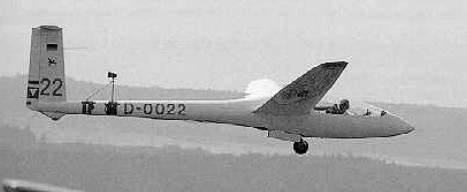
Wing span: 17.5m
Wing area: 17.8sq.m
Empty Weight: 376kg
L/DMax: 37 @ 95 kph
MinSink: 0.65 m/s @ 95 kph
Aspect ratio: 17.21
Airfoil: Eppler 603
No. of Seats: 2
No. Built: 1
Structure: GFRP
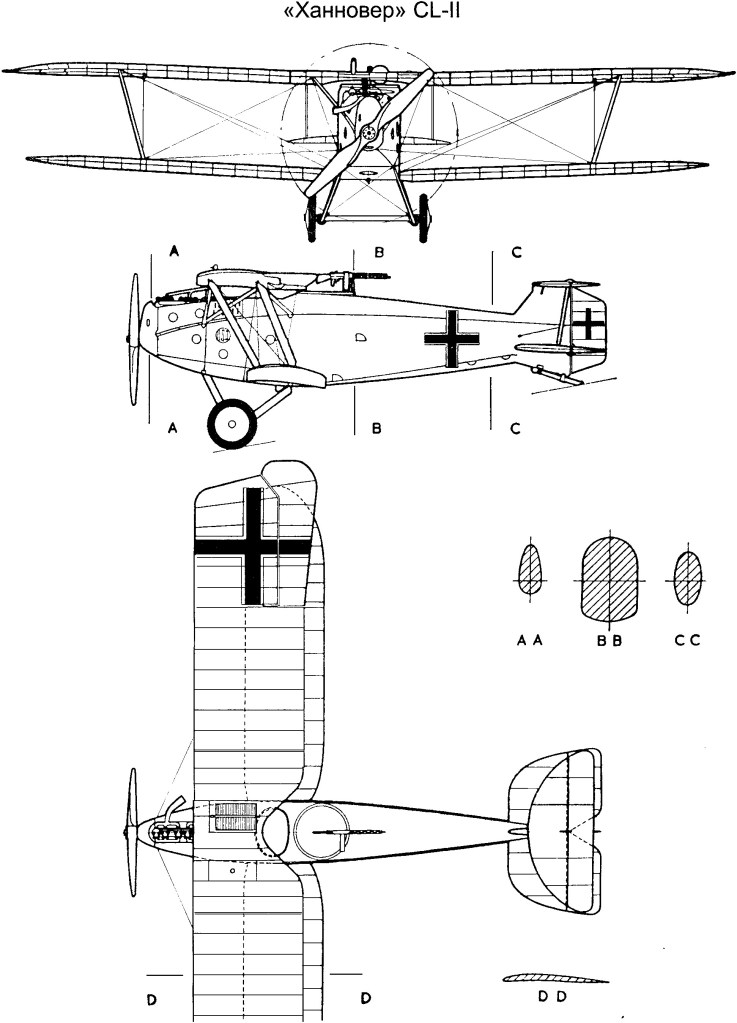
Hannover CL.I / CL.II / CL.III / CL.IV / CL.V / Kjeller Flyvernaskinsfabrik F.F.7 Hauk (Hawk)
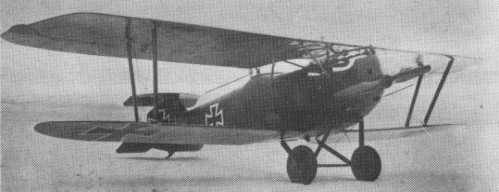
Designed by the Hannoversche Wag¬gonfabrik AG, the Hannover CL.II was produced in mid 1917 in response to an official requirement for a high performance two seat fighter for mainly low level tactical support of ground troops. The CL.II, which first went into operational service in late 1917, was unique for a single engined design in having a biplane tail assembly for greater field of fire by the observer/gunner and for a two seater was relatively small in overall dimensions. Its deep, ply covered fuselage gave the machine great strength, while the close set upper wing and narrow lower wings offered its crew an excellent field of vision both above and below.
A single-bay biplane, the two spar wooden wings were fabric covered. Both elevators, ailerons (on top wings only) and rudder were fabric covered steel tube structures.
In combat the Hannover proved itself as a formidable opponent to the Allied figh¬ters, able to manoeuvre with reasonable agil¬ity at most combat altitudes, and able to absorb battle damage to a high degree with¬out serious results.
A total of 439 Cl.II were built before production switched to an improved version, the CL.III, with a 160 hp Mercedes D.III engine, and incorpo¬rated modifications to the wingtips and ailerons, but only 80 machines were built due to the outstanding demands for Mercedes engines for single seat fighters.
Returning to the original 180 hp Argus engine, the next variant was designated CL.IIIa and saw large quantity production.
First production CL.IIs arrived on the Western Front in October 1917 and, along with the Halberstadt CL.II, became the backbone of the German Schutz¬staffeln (protection flights), escorting, the slower two seat reconnaissance machines. As such Hannovers were initially employed in a variety of roles, including artillery spot¬ting, reconnaissance, and photo sorties, apart from their nominal role of providing fighter cover for the older machines of the patrol flights.
Though extremely well constructed, the CL.II was temporarily grounded in May June 1918 due to a rash of wing failures, but after the safety factors of the wing fitting had been improved to double their former figure.
A progressive development of the Cl II designed by Hermann Dorner, the Cl III was intended to offer improved altitude capability with the 160 hp Mercedes D III water cooled engine. Despite some airframe strengthening, the Cl III possessed a slightly reduced structural weight and marginally smaller overall dimensions. The Typenprufung was success¬fully passed on 23 February 1918, and an order placed for 200 aircraft with deliveries to commence in the following month. In the event, as a result of shortages of the Mercedes engine, only 80 Cl IIIs were delivered, the remainder of the order being completed with 180 hp Argus As III(O) licence built by Opel as the Cl IIIa. A total of 537 Argus-powered Cl.IIIa were built, with the biplane tailplane span reduced to give the rear gunner a better field of fire. This version was to remain in production until the end of hostilities, 573 being delivered.

The designation Cl IIIb was allocated to the version that was to have been powered by the 185 hp NAG C III engine, and the Cl IIIc was a twin bay version built specifically as a test bed for the NAG engine. The Cl III and IIIa entered service in April 1918, serving primarily with the Schlachtstaffeln operating in the ground attack fighter role. Oddly, the Hannoversche Waggonfabrik completed a further 100 Cl IIIs and 38 Cl IIIa’s after the Armistice.
Hannovers continued to equip first line units throughout late 1918. A total of 293 CL.IIs and CL.IIIs were in service on September 1 of that year.
The C.IV, the next development, did not go into production, but from it was evolved the CL.V. In mid 1918, the Idflieg prepared a specification calling for a Jagdzweisitzer a two seat fighter intended to engage the newer Allied single seaters on even terms, emphasising high speed, diving capability and manoeuvrability, and carrying a fixed forward firing armament of twin synchronised machine guns plus a third gun in the rear cockpit. To meet this requirement, which called for the aircraft to be tested to single¬ seat fighter load requirements, Hermann Dorner produced an extremely rugged and compact airframe. Designated Cl V, the prototype was powered by a 185 hp BMW IIIa engine and, tested against a similarly powered Fokker D VII, demonstrated comparable speed and climb. Twenty examples were ordered for operational evalu¬ation, but instead of being ordered into large production, Hannover’s chief designer, Her¬mann Dorner, was requested to develop the CL.V for a new category of two seat fighter (Jagdzweisitzer) specification. With the original biplane tail replaced by one of monoplane configuration, the Cl V was ordered into production, a contract for 100 aircraft being placed in September 1918, over 80 CL.Vs were thus built and tested to the new specification each armed with two forward and one rear firing machine guns although it is doubtful if any of the 46 completed before the end of hostilities reached the Front, a further 62 being completed after the Armistice. A stripped down example of the Cl V was to establish a world altitude record of 27,355 ft (8 340 m) on 22 November 1919. During 1923 24, the Kjeller Flyvernaskinsfabrik at Halden, Norway, built 14 Cl Vs under licence for the Norwegian Army as the F.F.7 Hauk (Hawk), these remaining in service until 1929.

After the war Hannovers continued to be built, mainly as civil passenger machines or for export to other countries.
CL.II
Engine: 180 hp Argus As III
Seats: 2
Span: 11.70 m (38 ft 4.75 in)
Length: 7.58 m (24 ft 10.5 in)
Maximum speed: 166 km/h (103 mph) at 5000 m (16400 ft)
Service ceiling: 7500 m (24 600 ft)
CL.III
Engine: 160 hp Mercedes D.III
Cl. IIIa
Engine: 180 hp Argus As III(O)
Max speed, 103 mph (165 km/h) at 16,405 ft (5 000 m).
Time to 3,280 ft (1000 m), 5.3 min.
Endurance, 3 hrs.
Empty weight, 1,653 lb (750 kg).
Loaded weight, 2,447 lb (1110 kg).
Span, 38 ft 4.5 in (11,70 m).
Length, 24 ft 10.25 in (7,58 m).
Height, 9 ft 2.25in (2,80 m).
Wing area, 351.97 sq ft (32,70 sq.m).
CL IIIb
Engine: 185 hp NAG C III
Cl. V
Engine: 185 hp BMW IIIa
Max speed, 109 mph (175 km/h) at 6,560 ft (2 000 m).
Time to 9,840 ft (3 000 m). 12 min.
Range, 211 mls (340 km).
Empty weight. 1588 lb (720 kg).
Loaded weight, 2,381 lb (1080 kg).
Span, 34 ft 5 in (10,49 m).
Length, 22 ft 11.5 in (7,00 m).
Height, 9 ft 3.25 in (2,84 m).
Wing area, 306.76 sq ft (28,50 sq.m).
Seats: 2
Armament: 3 mg
Hannoversche Waggonfabrik AG / Hannover
Hannover, a manufacturer of railway rolling stock, began license production of Aviatik C.1, Rumpler C.1 A, and Halberstadt scouts in 1915 before proposing a compact two-seat escort fighter to German High Command. The biplane-tailed CL.II entered service in late 1917, and was succeeded by the CL.III and CL.IIIa, also built under license by Luftfahrzeug Gesellschaft as CL.IIa. Small numbers of the enlarged CIV and CL.V were constructed, plus experimental CL.IIIs with various engine and airframe changes. The company’s fighters were known popularly as “Hannoveraners”.
Hannaford Aircraft Co
USA
After acquiring in 1948 the manufacturing and marketing rights to the prewar Rose Parakeet single-seat sports biplane from Rose Aeroplane & Motor Company, Hannaford Aircraft Co offered production versions of the airplane with 40- 85hp engines.
Handley Page (Reading) HPR-3 Herald / HPR-7 Herald

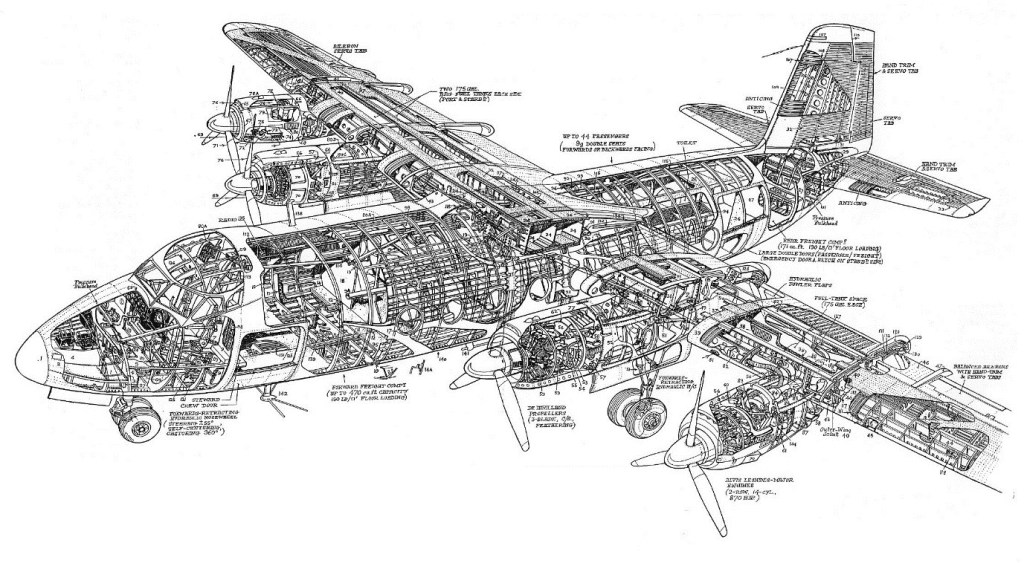
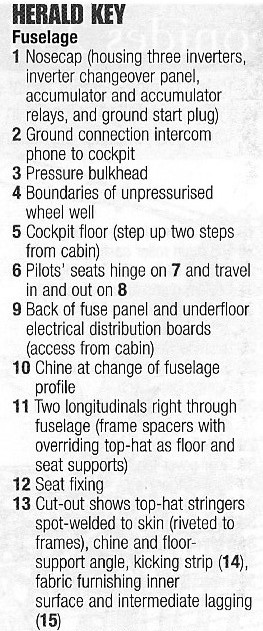
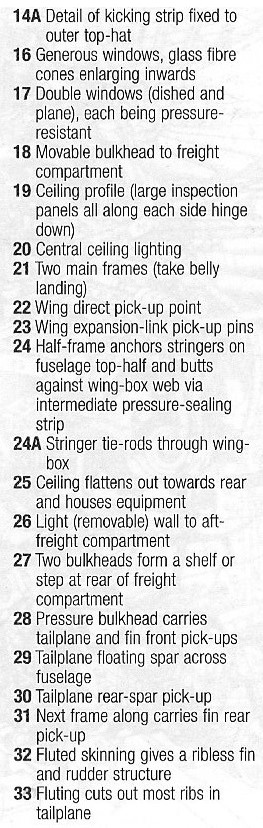
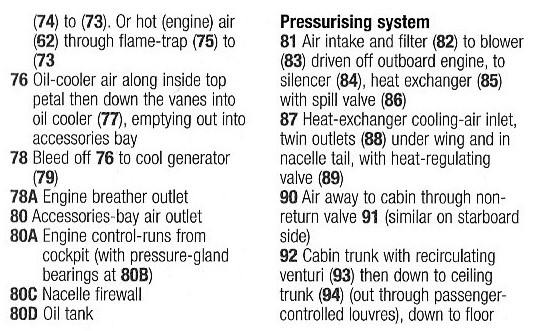
A medium sized transport designed to take the place of the DC 3, the Handley Page HPR 3 Herald design shows an essentially straight forward approach ¬with four piston engines, a high wing layout and a fuselage designed to carry 44 passengers, freight, or mixed loads. It is to be pressurized to a relatively low differential, and will carry a full payload of 10,705 lb. for a no reserve range of 350 st. miles, or 4,650 lb. for a full tank range of 2,050 miles.
Two prototypes were being built in 1954.
Handley Page (Reading) HPR-3 Herald / HPR-7 Herald Article
The first Herald, G-AODE, flew on 25 August 1955 from Radlett, powered by four Alvis Leonides piston engines. Airborne for 30 minutes, the pilot was H.G.Hazelden. It appeared at that years SBAC Display.

The first Handley Page Herald completed 125 hours flying in a year and received a Special Category of C of A in 1956.
By 1956 the Herald had been ordered by Queensland Airlines, Australian National Airways, Lloyd Aereo Colombiano and Air Kruise.
The prototype Dart-engined Herald made its first flight on 11 March 1958 and the first production Herald Series 100 flew on 30 October 1959. The Series 100 accommodated between 38 and 47 passengers. The Series 200 was the main production version with a forward fuselage 1.07m longer than that of the Series 100. Accommodation was provided for 50-56 passengers. Powered by two Rolls-Royce Dart 527 turboprops of 2,150 shaft hp, its maximum cruise speed is 274 mph.
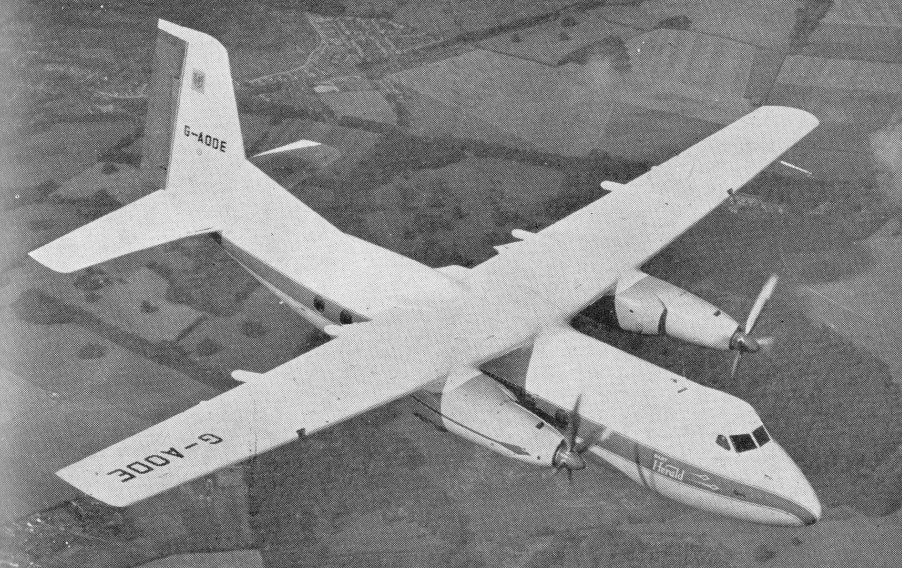
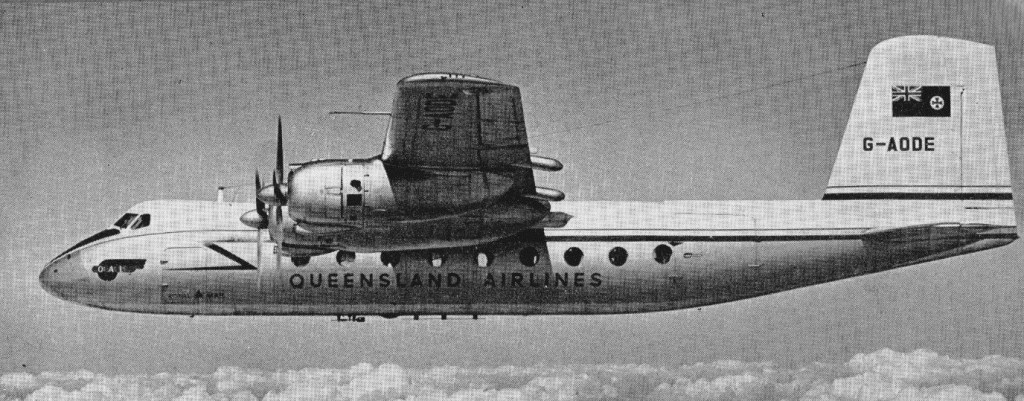
In 1960 Handley Page were offering both the Leonides Major and Dart powered versions.
The Series 300 (a modified Series 200 developed to meet US airworthiness requirements) was followed by the Series 400 military transport with a side loading door and accommodation for 50 troops, paratroops, 24 stretchers or freight, eight of which went to the Royal Malaysian Air Force. The projected Series 500 was followed by the Dart 532/9 turboprop-engined Series 600.
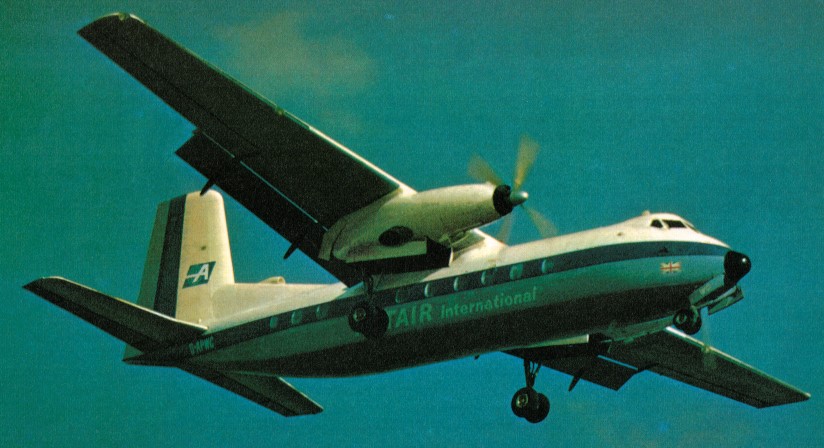
The final two versions were the Series 700 long-range version of the Series 600, accommodating up to 60 passengers or 52 passengers and baggage over 1,980km stages, and the Series 800 military version of the 700.
By 1958, when they offered an alternative version powered by Rolls-Royce Dart turboprops, the Fokker F 27 had cornered the market. Only 48 aircraft were produced.
HP(R) HP.3 Herald
Engines: 4 x Alvis Leonides Major, 850 bhp
Wingspan: 95 ft
Length: 70 ft 3 in
Mauw: 34,000 lb
Max speed: 263 mph
HP Herald Srs 200
Powerplant: two Rolls-Royce Dart RDa.7 M1k. 527 turboprops, 1570kW / 2105 ehp
Propellers: Rotol four-blade, fully feathering 12 ft 6 in diameter
Wingspan, 94 ft 9 in / 28.88 m
Length, 75 ft 6 in / 23.01 m
Height, 24 ft 1 in / 7.34 m
Gross wing area, 82.31 sq.m / 886 sq.ft
Max. usable floor area, 283 sq.ft
Max. usable volume, 1802 cu.ft
Max. cabin length, 54 ft 0 in
Max. width, 8 ft 8.25 in
Max. height, 6 ft 3.75 in
Accommodation: 50 passengers at 30.5 in pitch; 56 at 30 in pitch.
Basic operational 25,758 lb
Total fuel, 8640 1b
Max. take-off with 5 deg flap, 41000 lb
Max. landing, 39,500 lb
Max. payload, 11,242 lb
Max. zero fuel, 37,500 lb
Power loading (max. take-off weight), 10.2 lb/ehp
Wing loading (max. take-off weight), 48.5 lb/sq.ft
Wing loading (max. landing weight), 44.5 lb/sq.ft
Max level speed: 275 mph / 443 kph
High-speed cruise, 237 kt. at 15,000 ft
Long-range cruise, 230 kt. at 23,000 ft
Approach speed, 89 kt
Ceiling: 8500 m / 27900 ft
Take-off field length, ISA at sea level, 5000 ft
Landing field length, ISA at sea level, 3575 ft
Range, no reserves, ISA with max fuel, 8602 lb payload, 1 500 nm
Range w/max.payload: 1786 km / 1110 miles
Crew: 2
Passengers: 50-56




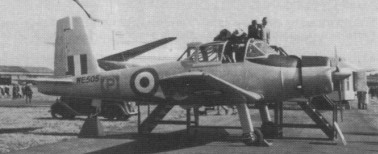
Handley Page (Reading) HPR-2
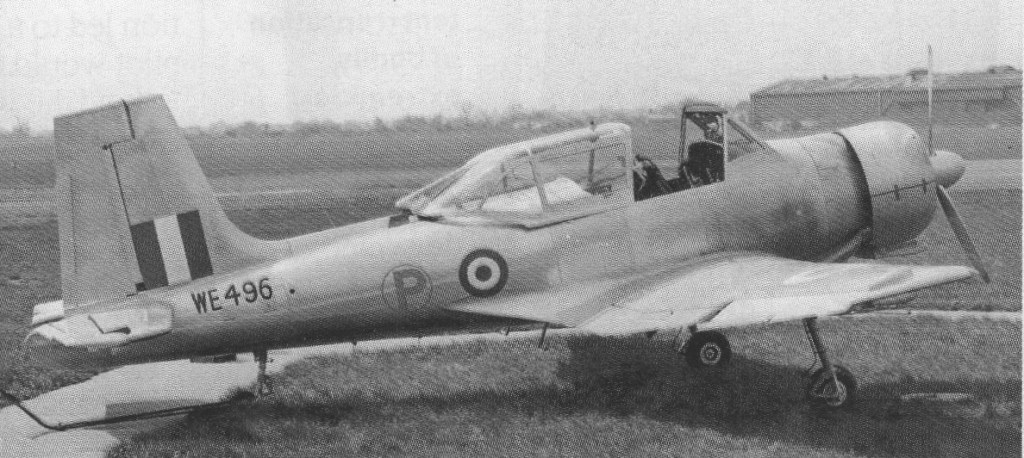
Competing with the Percival Provost for an RAF order circa 1950, two HPR-2 basic trainers were built. Seating two side by sice and powered by an Armstrong Siddeley Cheetah 17 radial, the original canopy generated too much turbulence and had to be replaced.