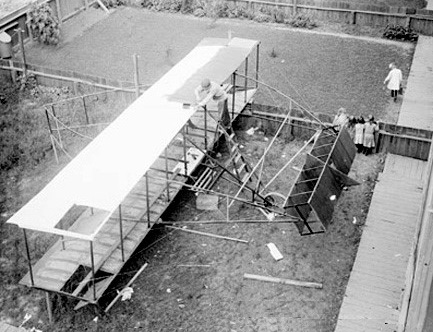
In 1910 J E Mair built a single seat copy of a Wright Flier in his back yard, but there is no record of it flying or if it even left the back yard.
In 1910 J E Mair built a single seat copy of a Wright Flier in his back yard, but there is no record of it flying or if it even left the back yard.
J E Mair
3106 W Fullerton Ave
Chicago IL.
USA
Circa 1910 built a Wright Flyer copy.
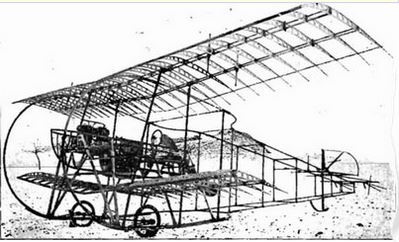
The Mainz Motor School airplane, known as the “One and a Half Decker” was built at the German Motor School at Mainz, Germany. The upper wing of this two-decker had 10 m span, the lower deck 7 m. The 50 hp Argus engine was placed in the front of the fuselage and drove the pusher propeller by means of a transmission. In the gondola-like cockpit there was space for the pilot and two passengers. Radiators were fixed on both sides of the fuselage.
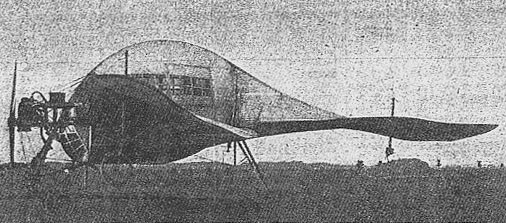
The Henri Mainguet La Dorade / Sea-bream of 1910 was intended to hold ten passengers in an enclosed cabin. Distinctive for its bulbous fuselage and lack of a stabilizing vertical tail fin, the pilot was seated outside, at the nose of the all-covered fuselage, the engine set out above him.
The passengers sat in the enclosed cabin with mica windows which made up the bulk of the streamlined guppy fuselage; aft, it tapered down to a long sweeping horizontal tail. No vertical surface appears to have been fitted. The oval somewhat drooping wings were mounted at a very high angle of attack, and had wheels set below the tips; the whole machine was resting on a long skid with two trailing wheels forward and one under the rear of the cabin. The engine seems to have been a 40 hp 3-cylinder Anzani. With a higher-powered engine, Mainguet at first succeeded at first only in running into the trees, and later in some prolonged hops.
Henri Mainguet built this tractor monoplane, in 1910 at Chartres: it appeared for the first time on 21 May.
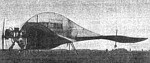
It flew but without passengers.
This single-seater sailplane is an experimental variable-geometry version of the Swiss Neukom S-4A Elfe 15, and was first flown by Herr Fritz Mahrer on 6 May 1977.
It is basically a modified Neukom S-4A with new 15m span wings; these have Eppler wing sections similar to those on the Neukom AN-66C Super-EIfe, and are fitted with area-increasing Fowler-type flaps actuated electrically. When extended these flaps increase the wing area from 107.6sq ft to 121.6sq ft, and the aspect ratio of 22.5 with flaps in becomes 19.9 when they are extended.
The Delphin also has a T-tail unit similar to that of the Schempp-Hirth Cirrus replacing the Neukom S-4A’s low-set tailplane, thus avoiding tailplane buffeting when the flaps are extended. Construction of the Delphin is mainly of plastics materials.
Span: 49 ft 2.5 in
Wing area: 107.6 sq.ft (flaps in) / 121.6sq ft (flaps out)
Aspect ratio: 22.5 (flaps in) / 19.9 (flaps out)
Empty weight: 617 lb
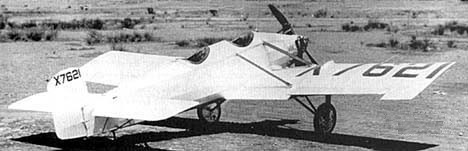
The 1928 X-1 Special aka Sportster experimental lightplane was designed by Don Hall and first flown in September 1928 (piloted by Red Harrigan, registered NX7621). Power was an 80hp Siemens-Halske.
Repowered with 90hp Warner Scarab as a 1929 Safety Plane entry with a variable-airfoil wing (“no two ribs are alike”) controlled by a lever in the cockpit. No fin or stabilizer, which were replaced by a large, moveable “stabilator” and a longitudinally adjustable 50 lb weight on a track to shift the c/g. All that resulted in enough stability problems to cancel the project.
Only the one was built, reportedly flown several times by Charles Lindbergh.
Wing span: 27’0″
Length: 22’0″
Max speed: 135 mph
Seats: 2
USA
Incorporated 1922 at St Louis, Missouri, known originally as Ryan Airlines. Developed Ryan M-1 mailplane from which, in 1927, was derived Spirit of St Louis, built for Charles Lindbergh’s New York-Paris flight; commercial development produced as Ryan Brougham.
Purchased Ryan Aircraft Co as B F (Ben Franklin) Mahoney Aircraft Co, later B F Mahoney-Ryan Aircraft Co, San Diego, in 1927.
1929: Ryan Aircraft Corp.
Company merged with Detroit Aircraft Corporation May 24, 1929.
The 1970 Sorceress racing biplane built by Lee Mahoney first flew on 1 August 1970, registered N89TT.
Engine: Lycoming O-290-3, 125hp
Wingspan: 16’0″
Length: 17’0″
Useload: 400 lb
Speed: 202 mph
Empty wt: 700 lb
Seats: 1
Mr Mahindra and his uncle Keshub Mahindra, who joined the group in 1947 and has been its chairman since 1963. Keshub Mahindra sits on the Prime Minister’s Council on Trade & Industry, while last month, Anand Mahindra was named Ernst & Young’s entrepreneur of the year and business channel NDTV’s business leader of the year.
The Mahindra group’s businesses include financial services, automotive products, trade, retail and logistics, information technology and infrastructure development. It is one of the world’s biggest tractor makers, with plants in India, China and the United States, and an assembly site in Brisbane, Australia. In Australia, it also sells the Mahindra Pik-Up, a light utility.
The Mahindra family and associates hold a stake of about 13 per cent in the main group company, Mahindra & Mahindra, which has a market capitalisation of $7bn.
Mr Mahindra, vice-chairman and managing director of the $7 billion conglomerate that bears his family’s name, aspired to turn the group’s aerospace arm into an Indian version of the Brazilian Embraer. The Mahindra brand is better known for its tractors and utility vehicles, and building a regional jet is a complex and time consuming business that usually starts with the production of much smaller turbo prop aircraft. To speed up the process Mahindra agreed to pay about $40 million for a controlling stake in two small Australian aviation companies, Gippsland Aeronautics and Melbourne-based component maker Aerostaff Australia.
Gippsland Aeronautics, based in Victoria’s Latrobe Valley and maker of the popular 8-seat GA8 Skyvan utility plane, planned to beef up its range with an updated 18-seat version of the controversial Australian-made Nomad twin turbo-prop. It bought the rights to the Nomad’s type certification in 2008.
Aerostaff Australia makes high precision aircraft components and assemblies for makers such as Boeing and Lockheed Martin.
Mahindra group’s experience in aviation extends to the co-design of a five-seater plane with the National Aeronautics Laboratory (NAL) of India – designated the NM5 – and the production under licence of a light Australian plane, the Seabird Seeker, for the Middle East.
“The driving force behind our Australian acquisitions is to be the Embraer of India,” Mr Mahindra said. “We are not gunning for Embraer. It’s more a case that we see it as a role model.”
The NM5 programme is unique in the sense that NAL / National Aerospace Laboratories has started work for creation of an airplane, in equal partnership with a private production agency cum development partner, M/s Mahindra Plexion Technologies Private Ltd., a unit of the Mahindra & Mahindra industrial house. NAL signed an MoU with M/s Mahindra Plexion Pvt Ltd (MP) to jointly develop the 5 seater general aviation aircraft, NM5 and to undertake its production and marketing.
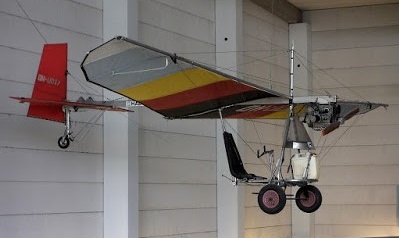
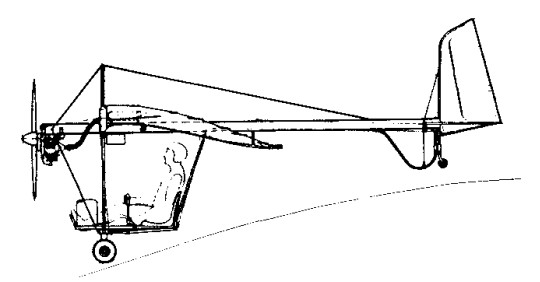
Single seat single engined high wing monoplane with two axis control. Wing has unswept leading edge, swept forward trailing edge, and tapering chord; conventional tail. Pitch control by fully flying tail; yaw control by fully flying rudder; no separate roll control; control inputs through stick for pitch/yaw. Wing braced from above by kingpost and cables, from below by cables; wing profile single surface. Undercarriage has three wheels in tail dragger formation, with suspension on tailwheel and steel spring suspension on main wheels. No ground steering. An aluminium tube framework, without pod. Engine mounted below wing driving tractor propeller.
The Pfadfinder is in fact a version of the Australian Scout built under licence in West Germany by Mahe.
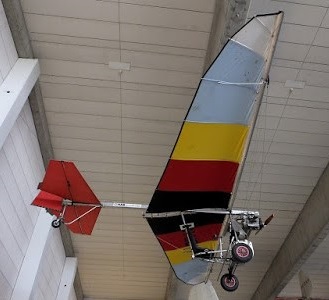
The Pfadfinder uses a noticeably different wing from the original Scout and is fitted with the Konig SC430 engine. Used at 4400 rpm, this gives 27 hp with a three blade ground adjustable propeller. Options include floats, instruments, and a document and map case.
Length overall 17.1 ft, 5.22 m.
Height overall 6.9 ft, 2.09 m.
Wing span 28.4 ft, 8.67 m.
Chord at root 5.7ft, 1.75m.
Chord at tip 1.3 ft, 0.41 m.
Sweepback: 0 degs.
Tailplane span 10.7ft, 3.25m.
Fin height 4.9 ft, 1.50m.
Total wing area 125 sq.ft, 11.6 sq.m.
Rudder area 8.3 sq.ft, 0.77 sq.m.
Total elevator area 17.0 sq.ft, 1.58 sq.m.
Wing aspect ratio 6.5/1.
Wheel track 4.8 ft, 1.47 m.
Wheelbase 12.5 ft, 3.78 m.
Tailwheel diameter overall 11 inch, 27 cm.
Main wheels diameter overall 11 inch, 27 cm.
Engine: Konig SC430, 27 hp at 4400 rpm.
Propeller diameter 51 inch, 1.30 m.
Belt reduction, ratio 1.511.
Max static thrust 155 lb, 70 kg.
Power per unit area 0.22 hp/sq.ft, 2.3 hp/sq.m.
Fuel capacity 2.6 US gal, 2.2 Imp gal, 10.0 litre.
Empty weight 132 lb, 60 kg.
Max take off weight 375 lb, 170kg.
Payload 243 lb, 110kg.
Max wing loading 3.00 lb/sq.ft, 14.7 kg/sq.m.
Max power loading 13.9 lb/hp, 6.3kg/hp.
Load factors; +6.0, NC ultimate.
Max level speed 56 mph, 90 kph.
Never exceed speed 65 mph, 105 kph.
Max cruising speed 56 mph, 90 kph.
Economic cruising speed 47mph, 75kph.
Stalling speed 28 mph, 45 kph.
Max climb rate at sea level 500 ft/min, 2.5 m/s.
Best glide ratio with power off 7/1.
Take off distance 130 ft, 40 m.
Landing distance 82 ft, 25 m.
Range at average cruising speed 112 mile, 180 km.