North Dakota
USA
Emil Magnuson was an early constructor of propellers for aircraft and farm wind machines, reported to have built an airplane of some sort, as well.
North Dakota
USA
Emil Magnuson was an early constructor of propellers for aircraft and farm wind machines, reported to have built an airplane of some sort, as well.
Piero Magni’s own aircraft included PM-3-4 Vale 1937 single-seat aerobatic aircraft and the derived PM-4-1 Supervale.
Piero Magni’s own aircraft included PM-3-4 Vale 1937 single-seat aerobatic aircraft and the derived PM-4-1 Supervale.
A conventional winged military trainer
A tilting-wing sesquiplane
Italy
Founded by Piero Magni in 1919, primarily research and development organization but manufactured aircraft for other designers, including Jona J-6 tilting-wing sesquiplane and the conventional-winged J-6S military trainer. Magni’s own aircraft included PM-3-4 Vale 1937 single-seat aerobatic aircraft and the derived PM-4-1 Supervale.
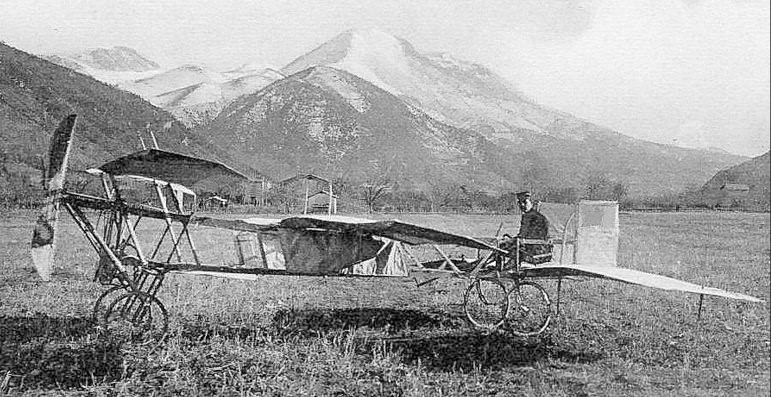
Little is known about the “Zézé 1” tandem wing monoplane, which was tested at Pont des Arches, near Dignes, Haute Provence, France, probably in 1910.

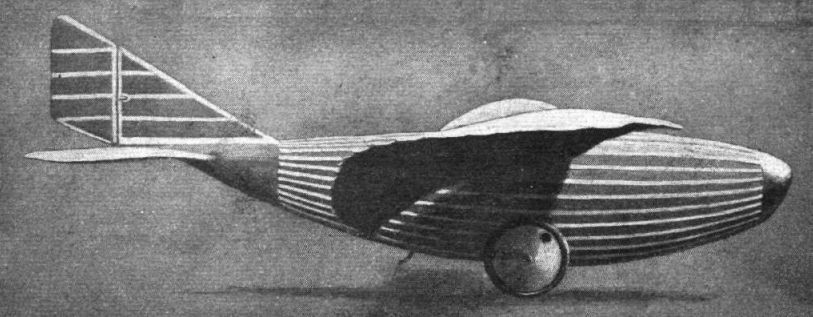
Apart from the studies made in Germany, several French experimenters have attacked the problem of “gust-soaring,” among them being Dr. Magnan, who has made a close study of bird flight, and who reached a stage when he could justify the building of a machine for the purpose of carrying out actual flying experiments. This machine is of unorthodox design, both aerodynamically and structurally.
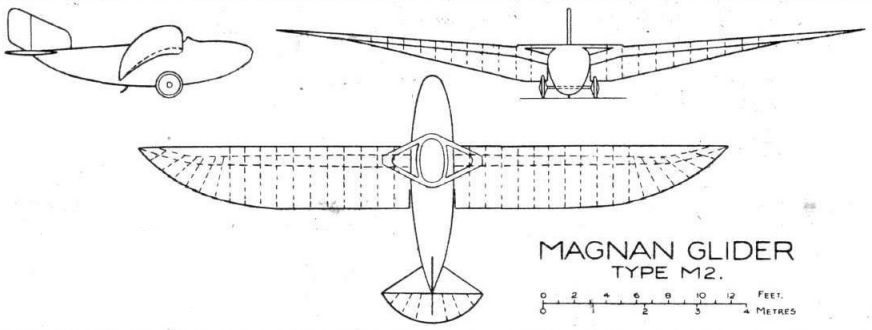
Basing his design to some extent upon birds, in 1921 Dr. Magnan produced a cantilever monoplane, the wing of which is of uniform chord over approximately one-half of its span, but tapering to a point at the tips. The leading edge is straight and the taper is provided solely by the trailing edge. Near the root the wing is swept down suddenly and sharply to form a pronounced dihedral angle. This angle extends over but a few feet of the span, and the rest of the wing is at a smaller dihedral. The wing tapers in thickness as well as in chord, and the angle of incidence is progressively altered, being around 20 degrees at the root. In addition to the change in section and angle, the wing ribs are so constructed that they are capable of being flexed to an extent under varying loads. No ailerons are fitted. Lateral control is by wing warping.
The fuselage is short in proportion to the span, and a large portion of it projects ahead of the wing. This results in the tail being very close to the wing, only about one chord-length separating the trailing edge from the forward end of the fixed tail plane. A large rudder is fitted. The “fin area” of the forward portion of the fuselage is very considerable, of rounded section.
The monoplane wing has but a single spar, of box section and built of wood. There are two fairly sharp bends in each spar, one a few feet out from the body, where the horizontal cabane meets the spar, and another a few feet from the tip, where the spar tip is swept forward to meet the straight leading edge. The ribs have top and bottom flanges of ash, the lower flange, which runs from leading to trailing edge, being screwed and glued to the lower face of the spar. The top flange stops short of the trailing edge, about one-third of the chord from it, and is so attached to the lower flange and to the spar that it can slide a short distance in a fore-and-aft direction, thus allowing the trailing edge to flex.
Near the wing tips the ribs slope outwards, and also they are so mounted on the spar as to give a pronounced “wash-out” to the wing. Lateral control is by warping, but instead of the warp causing a change of angle without sensible change in camber, in the Magnan monoplane both angle of incidence and camber are altered. The fabric covering is applied in a way which was claimed to prevent wrinkling when the wing is being warped.
The fuselage is of egg-shape section, and is built up of formers alternating sloping back and forward, thus forming a series of Vees as seen in side view. To these formers are attached four main longerons and a great number of stringers, and wire bracing is employed for stiffening the structure against torsion. The fuselage is fabric covered except at the extreme nose and stern. The tail is of more or less orthodox design, but is supported on a duralumin cone bolted to the rear bulkhead of the fuselage proper.
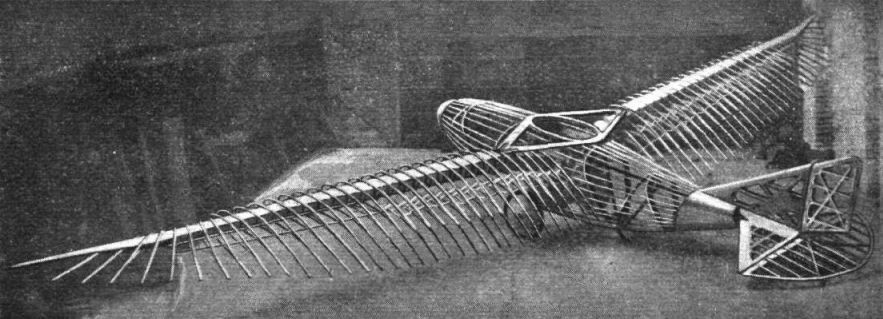
A simple undercarriage consisting of two wheels carried on a duralumin axle is fitted, the axle being sprung by rubber cords anchored inside the lower portion of the fuselage.
The pilot’s seat is mounted on longitudinal rails, somewhat like the sliding seat in a boat, and for fore-and-aft control he can alter the position of the centre of gravity by sliding the seat along. The ordinary controls are of the usual type.
The machine was to be launched from a cliff on the coast, and glide into the wind until fairly low over the sea. During a gust the pilot would pull back the stick, and if necessary shift his seat back so as to bring the tail down quickly. As a gust dies down he would push the stick forward and slide his seat forward at the same time so as to avoid stalling the machine. During a lull it was to be the pilot’s endeavor to glide forward with the minimum loss of height, i.e., at the best gliding angle for the particular conditions. Dr. Magnan considered that another method would be to glide down-wind during the lulls and up-wind during the gusts, but that it was doubtful if the machine could be manoeuvred quickly enough to make this form of gust-soaring feasible.
Some preliminary tests over land were made with the machine, piloted by Canivet, and these were stated to have indicated that the machine should, under suitable conditions, be capable of taking advantage of a gusty wind.
As alighting on the sea was to be one of the normal functions of the machine, the fuselage and wings have been made watertight, the opening for the wheel axle being bulkheaded off from the rest of the fuselage.
Type Marin M.2
Length o.a., 4-95 m. (16 ft. 3 ins.)
Wingspan, 11-5 m. (37 ft. 9 ins.)
Chord (root), 1-3 m. (4 ft. 3 ins.)
Wing area, 10 -25 sq. m. (110 sq. ft.)
Weight of wing, 60 kgs. (132 lbs.)
Weight of machine (empty) 130 kgs. (286 lbs.)
Weight in flying trim, 200 kgs. (440 lbs.)
Wing loading, 19 kgs./sq. m. (4 lb./sq. ft.).
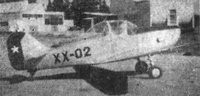
Designed by Hugo Fuentes (hence the HF in the designation), the HF XX-02 trainer was a conventional, low-wing cantilever monoplane of mixed construction with fixed tailwheel undercarriage. The pilot and instructor sat side by side.
Two prototypes were constructed at El Bosque Air Base, designated XX-02 and XX-02B, and the first flew in 1954. Development was abandoned due to difficulties maneuvering at lower altitudes, which in one case, led to a crash in which the instructor was killed while attempting to land after a tight turn at low altitude.
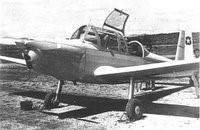
The design was subsequently refined by Francisco Bravo and an improved version, the HFB XX-02 flew in 1958 powered by a Continental O-470 engine in place of the Ranger L-440 that powered the original. Only the two were ever built.
HFB XX-02
Engine: 1 × Continental O-470-B, 168 kW (225 hp)
Wingspan: 10.10 m (33 ft 2 in)
Length: 6.60 m (21 ft 8 in)
Height: 2.15 m (7 ft 1 in)
Wing area: 16.0 m2 (172 ft2)
Empty weight: 760 kg (1,675 lb)
Gross weight: 1,060 kg (2,337 lb)
Maximum speed: 195 km/h (121 mph)
Range: 800 km (500 miles)
Service ceiling: 4,570 m (15,000 ft)
Crew: Two, pilot and instructor
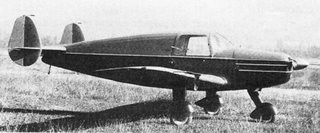
In 1947, the Maestranza Central de Aviación, the Central Workshops of the Chilean Air Force designed and built the first Chilean-designed aircraft, the Triciclo-Experimental (also designated XX-01), unveiled in May 1947. The Triciclo, designed by Alfredo D. Ferrer, was a low-winged monoplane of wooden construction with a fixed tricycle landing gear and a twin tail. The crew of two sat side-by-side in an enclosed cockpit, and were provided with dual flight controls.
Built with indigenous materials, Ferrer received tuition in the XX-01.
Only one was built.
Engine: 1 × Franklin, 75 kW (100 hp)
Propeller: two-blade
Length: 6.50 m (21 ft 4 in)
Wingspan: 11.0 m (36 ft 1 in)
Height: 1.80 m (5 ft 11 in)
Wing area: 13 m2 (140 sq ft)
Empty weight: 355 kg (783 lb)
Gross weight: 600 kg (1,323 lb)
Maximum speed: 180 km/h (112 mph; 97 kn)
Cruising speed: 160 km/h (99 mph; 86 kn)
Range: 1,000 km (621 mi; 540 nmi)
Service ceiling: 5,500 m (18,045 ft)
Crew: 2

