A two-seat trainer biplane suitable for engines of 95-150 hp.
Aircraft
Mercury B-100
A four seat cabin monoplane with Allied Monsoon (license-built Regnier) engine
Mercury Aircraft Inc
USA
Formed at Menominee, Michigan, developed B-100 four seat cabin monoplane with Allied Monsoon (license-built Regnier) engine, and BT-120 two-seat trainer biplane suitable for engines of 95-150 hp.
Merckle Kiebitz
Merckle acquired from Dr. Winter of Brunswick Technical College a license to build the Kiebitz two-seat STOL monoplane.
Merckle Flugzeugwerke GmbH
Established at Oedheim in 1960, and acquired from Dr. Winter of Brunswick Technical College license to build Kiebitz two-seat STOL monoplane. In 1956 began development of SM-67 Turbomeca Artouste-powered five-seat helicopter, initially as private venture and later to government contract.
Merckle joined Dornier in 1969.
Merćep 1912 / Merćep-Rusjan Military-Monoplane / Rusjan-Novak No.2
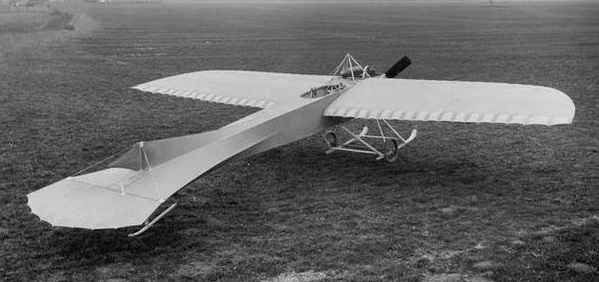
The Merćep 1912 aka Merćep-Rusjan Military-Monoplane of 1912 or Rusjan-Novak No.2, was the second design after the crash of the Slovenian aviation pioneer Eduardo Rusjan. Earlier, Eduardo Rusjan had moved with his brother to Zagreb, Croatia, where Guiseppe Rusjan and Dragutin Karlo Novak then continued to build aircraft for the “Agramer Aëroplanfabrik M. Merćep”, set up by the businessman Mihajlo Merćep in Zagreb.
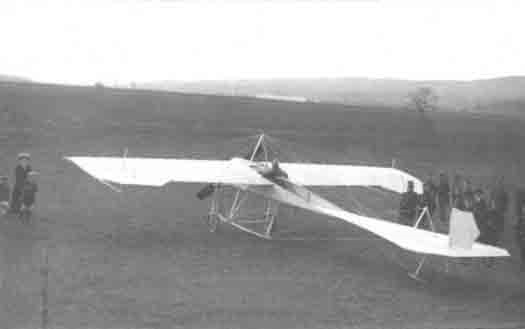
Engine: Gnome, 50 h.p.
Span: 32½ ft / 10 m
Wing area: 204 sq. ft / 19 m²
Length: 23 ft / 7 m
Weight: 617 lb / 280 kg
Useful load: 661 lb / 300 kg
Number built: 1
Merćep, Mihalis
Mihalis Mercep
Aeroplanwerkstatte,
Agram,
Hungary.
Russjan was connected with this firm, which built 2 biplanes to his designs in 1909. Russjan was killed in the second of these.
Melsheimer FM-1
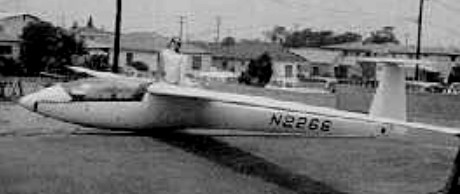
First flown in 1968, the FM-1 featured seating and a steel tube and fiberglass front fuselage with steel tubing, plywood aft fuselage and wings. Designed by Frank Melsheimer.
Wing span: 15.54 m / 51 ft
Wing area: 11.61 sq.m / 125 sq.ft
Aspect ratio: 21
Empty Weight: 227 kg / 500 lb
Payload: 103 kg / 250 lb
Gross Weight: 340 kg / 750 lb
Wing Load: 29.28 kg/sq.m / 6 lb/sq.ft
L/DMax: 35 97 kph / 52 kt / 60 mph
MinSink: 0.55 m/s / 1.8 fps / 1.07 kt
Airfoil: NACA 4400R
Seats: 1
Mellander Monoplane 1911
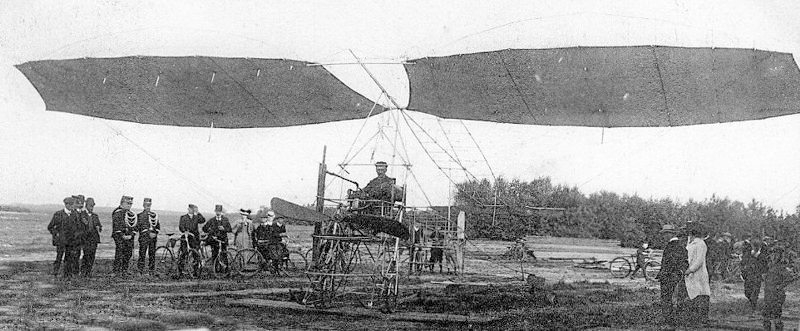
This machine was built at the Sint-Job-in-‘t-Goor airfield, Belgium, in the hangars of baron Pierre de Caters, by the Swedish inventor Janne Mellander, who lived in Antwerp at the time. In 1911 he was granted French patent No. 422954, which disclosed some details of his rather fragile-looking machine, which was equipped with an automatic stabilization device and had the wings mounted very high on a secondary fuselage.
Melfa VCA-1
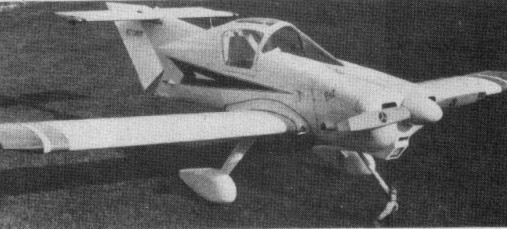
The VCA-1 is a tiny single-seat, low-wing monoplane of all-metal construction. The wing section is NASA GA(W)-1 with no sweepback. It has a constant chord with plain ailerons and electrically operated flaps. The fuselage uses 2024-T3 aluminum alloy. Landing gear are nonretractable tricycle type, and the Continental 0-200 fiat-four engine drives a two-blade Sensenich fixed-pitch propeller. The cockpit is enclosed and sweeps back to a combination fuselage/T-tail empennage.
Gross Wt. 1100 lb
Empty Wt. 710 lb
Fuel capacity 24.5 USG
Wingspan 20’
Length 18’
Engine 100-hp Continental
Top speed 150 mph
Cruise 130 mph
Stall 57 mph
Climb rate 1100 fpm
Range 200 miles

