Nord N.1402 Gerfaut / 1405 Gerfaut II

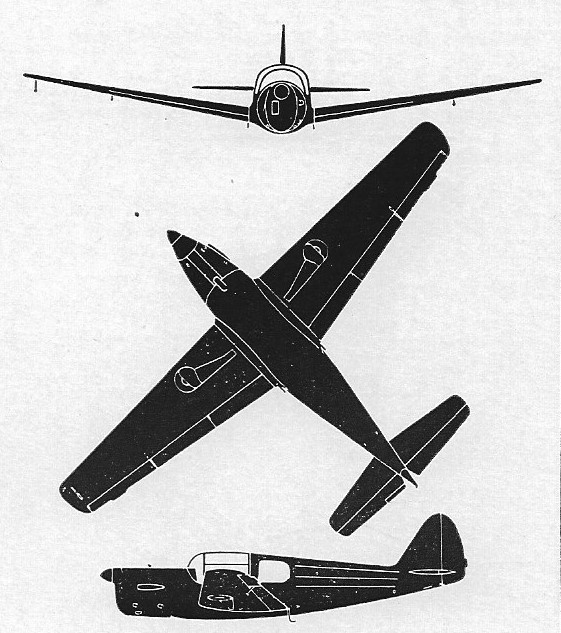
N.1402 Gerfaut I

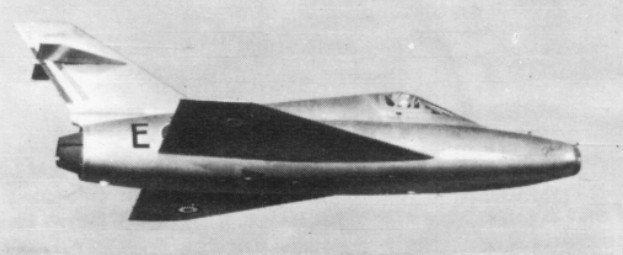
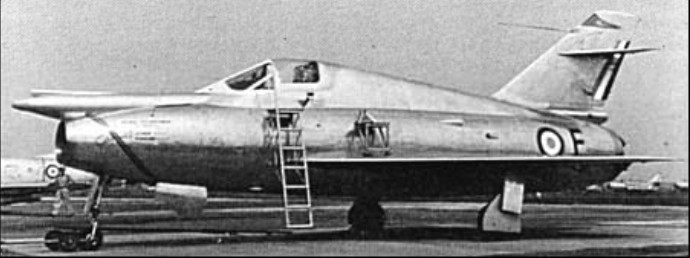
Nord was another protagonist of the tailless delta configuration, and on 3 August 1954 is N.1402 Gerfaut I prototype with the Atar 101D3 turbojet became the first aeroplane to exceed Mach 1 in level flight without an afterburner or a supplementary rocket motor. Gerfaut IB and Gerfaut II prototypes were also produced, and these paved the way for the N.1500 Griffon prototype of interceptor potential.

Nord N.1402 Gerfaut / 1405 Gerfaut II Article

The Gerfaut II was a development of the Gerfaut 1A, which was the first high-powered jet delta-wing aircraft to fly in France (15 January 1954), powered by a 43.15kN SNECMA Atar 101G turbojet with afterburner. The Gerfaut II first flew on 17 April 1956 and on 16 February 1957 established a number of time-to-height records from a standing start, including a climb to a height of 6,000m in 1 minute 17 seconds and to 9,000m in 1 minute 34 seconds. The Gerfauts were used to collect data for a high-speed fighter design.

Nord 1400 Noroit

Nord 1402

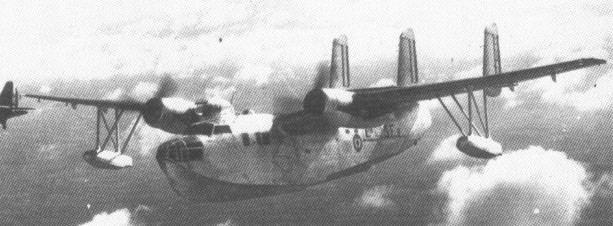
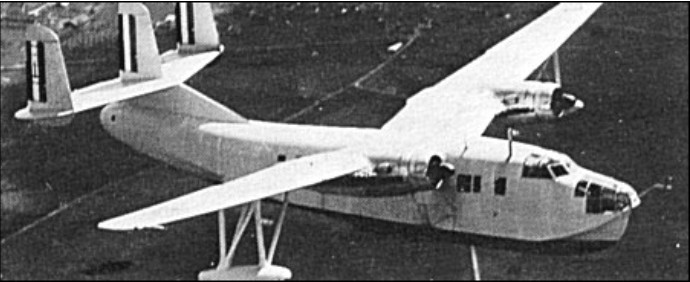
Despite the decline of the seaplane’s importance after the Second World War, France still saw a limited future for the type and commissioned from the Societe Nationale de Constructions Aéronautiques du Nord (generally known as SNCAN or Nord) a flying boat for the reconnais¬sance and air/sea rescue roles.

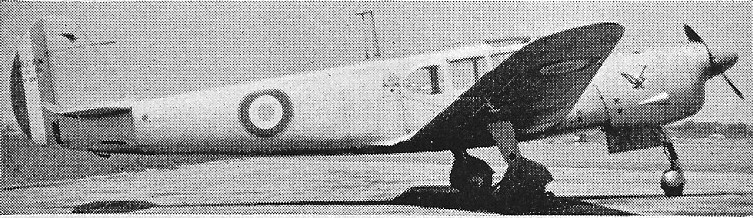
This was an all-metal monoplane with a gulled wing and a two ¬step hull, and had accommodation for a crew of seven, plus a roomy rear cabin with a large sliding door on the port side for rescue operations. It first flew on 6 January 1949 as the N.1400.01 Noroit prototype (F-WFDL) with 1,600-hp (1,193-kW) Gnome-Rhone 14R radials. The N.1400.02 second prototype introduced retractable tailwheel landing gear to provide an amphibious capability. Retractable tailwheel landing gear was installed on the N 1400-01 at a later date. There followed a pair of N.1401 pre-production machines with two 1,800-hp (1,342-kW) SNECMA-built Junkers Jumo inlines and annular radiators. The N 1401 Noroit (F-WFKU) was flown on 6 August 1949, the second example (F-SFKN) being flown later, and both were tested in 1950 with two Bristol Hercules radial engines. Finally there came 21 N.1402 Noroit (North-West Wind) production aircraft, the last of them delivered in 1956. Together with the two N.1401s modified to the same standard, these served with Flottille 5F.

Nord N. 1402 Noroit
Engines: two 2,100-hp (1,566-kW) SNECMA 12H.00 (Junkers Jumo 213A) inline piston
Maximum speed 230 mph (370 km/h) at 8,695 ft (2,650 m)
Initial climb rate 984 ft (300 m) per minute
Range 2,610 miles (4,200 km)
Empty weight 28,660 lb (13,000 kg)
Maximum take-off weight 45,040 lb (20,430 kg)
Wingspan 103 ft 8 in (31.60 m)
Length 72 ft 4 in (22.05 m)
Height 22 ft 5.5 in (6.85 m)
Wing area 1,076.43 sq ft (100.00 sq.m)
Armament: six 20-mm cannon in two-gun nose, dorsal, and tail positions, and bombs carried in nacelle bays plus provision for eight rockets on the hull sides.
Crew: 7

Nord 1200 / 1201 / 1203 / 1204 Norecrin

1203/II Norécrin II

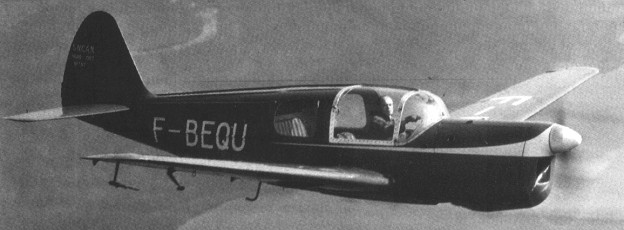
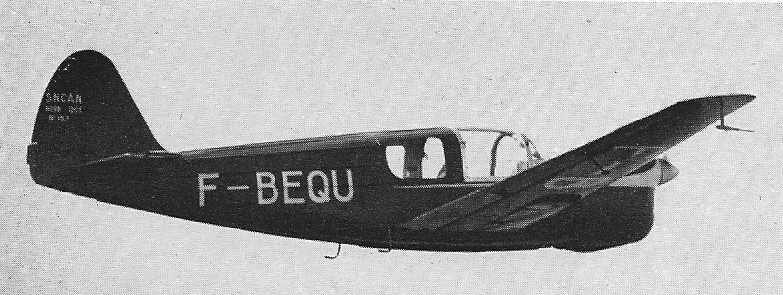
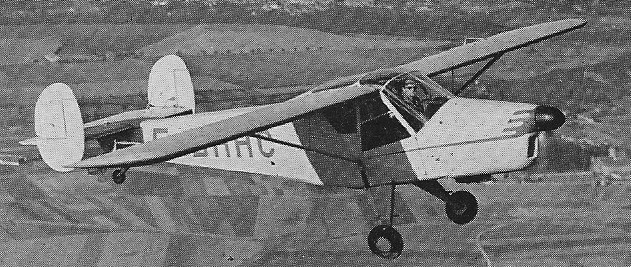
Using the same basic configuration as the Messerschmitt Bf 108, Nord developed the three-seat Nord 1200 with fixed tricycle landing gear, whose prototype flew on 15 December 1945 with a 75-kW (100-hp) Mathis G4R engine.

There were several military and civil variants, the main versions to enter civil service being the three-seat Nord 1201 Norécrin I with the 104-kW (140-hp) Renault 4Pei engine.

The four-seat Nord 1203/II Norécrin II was powered with the 101-kW (135-hp) Regnier 4L00 engine. In 1948 the Nord 1203/II was placed in production.

Nord 1203/II Norécrin II

The Nord 1203/III Norecrin III had a modified landing gear.

The Nord 1203/lV Norecrin IV had the 127-kW (170-hp) Regnier 4L02 engine.

The Nord 1203/Vl Norécrin VI had the 108-kW (145-hp) Regnier 4L14 engine, and the final Nord 1204 and the experimental Nord 1204/II models of 1959 with the 93- and 108-kW (125- and 145-hp) Continental C125 and C145 engines respectively.

A total of 380 had been built when production was suspended, being resumed in 1955 with an order for another 90.

Nord 1200
Engine: Mathis G4R, 75-kW (100-hp)
U/C: fixed

Nord 1201 Norécrin I
Engine: Renault 4Pei, 104-kW (140-hp)
Seats: 3

Nord 1203/II Norécrin II
Powerplant: l x Regnier 4L00, 101 kW (135hp)
Span: 10.22m (33ft 6.25 in)
Wing area: 410 sq.ft
Length: 7.21 m (23ft 8in)
Empty weight: 1437 lb
Max T/O weight: 1050kg (2,315Ib)
Max speed: 174 mph
Cruise speed: 137 mph at sea level
Operational range: 559 miles
ROC: 985 fpm
Seats: 4

Nord 1203/III Norecrin III

Nord 1203/lV Norecrin IV
Engine: Regnier 4L02, 127-kW (170-hp)

Nord 1203/Vl Norécrin VI
Engine: Regnier 4L14, 108-kW (145-hp)
Length: 23.163 ft / 7.06 m
Height: 9.088 ft / 2.77 m
Wingspan: 33.465 ft / 10.2 m
Wing area: 140.685 sqft / 13.07 sq.m
Max take off weight: 1730.9 lb / 785.0 kg
Weight empty: 1080.5 lb / 490.0 kg
Max. weight carried: 650.5 lb / 295.0 kg
Max. speed: 133 kts / 246 km/h
Initial climb rate: 708.66 ft/min / 3.60 m/s
Service ceiling: 16404 ft / 5000 m
Wing load: 12.3 lb/sq.ft / 60.0 kg/sq.m
Range: 486 nm / 900 km
Endurance: 5 h
Crew: 2

Nord 1203/II Norécrin II

Nord 1100 Srs / Messerschmitt 208

1101 Noralpha

The four seat Nord 1101 Noralpha was developed by the French company SNCAN post war from the Messerschmitt 208.

Nord 1101 Ramier

Two prototype Me 208s, powered by Argus 10c engines, were built at Les Mureaux in occupied France during 1943 44, one being destroyed in an Allied bombing raid. The surviving aircraft was redesignated Nord 1100 after the Liberation, and production versions were fitted with the Renault 6Q engine as Nord 1101s.

Two hundred were built, many serving with French forces on communications, training and liaison duties.

Nord NC.856 Norvigie / SNCA du Centre NC.856

NC.856N

The SNCA du Centre NC.856 tourer first flew on 12 March 1949, powered by a 105 hp Walter Minor 4-III, but development ceased with the liquidation of SNCA du Centre.

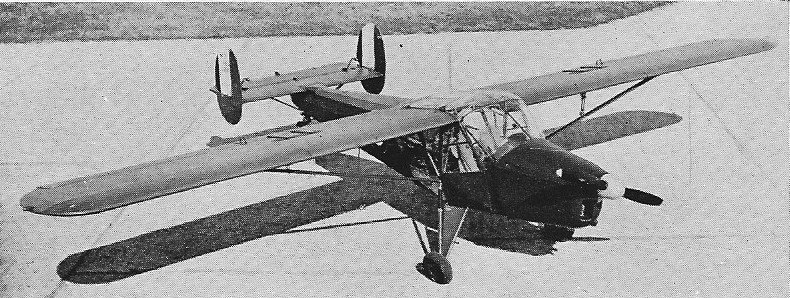
A second prototype, modified for use as an air observation post, was built by SNCA du Nord, and first flown on 15 March 1951.

An order for 112, designated NC.856A Norvigie, was placed for the French Army, the first production Norvigie flying on 12 March 1953.

NC.856A Norvigie

Derived from the NC.856A Norvigie, the NC.856N is a four-seat cabin monoplane. Powered by a 160 hp SNECMA-Regnier 4LO-8 engine, the NC.856N is generally similar to the three-seat NC.856H twin-float seaplane variant.

The wing is a single spar metal structure with fabric covering, and the fuselage is welded steel tube with fabric covering over light wooden formers.

Gallery

NC.856 Tourer
Engine: 105 hp Walter Minor 4-III

NC.856A Norvigie
Engine: 140 hp Regnier 4 LO.4
Wingspan: 41 ft
Wing area: 183 sq.ft
Length: 25 ft 3 in
Height: 7 ft 4.5 in
Empty weight: 1432 lb
Loaded weight: 1984 lb
Max speed: 118 mph
Cruise: 105 mph
Endurance – AOP: 1 hr
Endurance – Liaison: 3 hr
ROC: 984 fpm
Seats: 2

NC.856H
Twin floats
Seats: 3

NC.856N
Engine: 160 hp SNECMA-Regnier 4LO-8
Wing span: 41 ft
Wing area: 183 sq.ft
Length: 25 ft 3.25 in
Height: 7 ft 6 in
Empty weight: 1389 lb
Loaded weight: 2447 lb
Max speed: 127 mph
Cruise: 112 mph
ROC: 689 fpm
Ceiling: 18,040 ft
Range: 360 mi
Seats: 4

Nord / SNCAN

Societe Nationale De Constructions Aeronautiques Du Nord
Nord-Aviation

In France, the Socialist Government of the so called Popular Front brought all the companies building military aircraft, aero engines and ar¬mament under its control in 1936. The im¬mediate result was the socialized oblivion of such established companies as Marcel Bloch, Bleriot, Nieuport, Potez, Dewoitine, Hanriot and Farman within half a dozen nationalized groups or Societies Nationales, named ac¬cording to their geographical location (Nord, Ouest, Centre, Midi and so on). Les Mureaux, CAMS, and part of Breguet, Amoit and Potez formed SNCAN in 1938.

Dominant concern was production of Potez 630 series of twin-engined multipurpose aircraft. Peak output reached in May 1940. Development of basic type (e.g. Potez 671 specialized fighter with elliptical wing) was also SNCAN concern.

After World War II, although four of the nationalized groups continued operating un¬der state control, private companies were al¬lowed to resume the design and manufacture of both civil and military aircraft. Some of the pioneering names of French aviation, such as Breguet and Morane Saulnier, returned to prominence, and by 1950 a new one had been added Avions Marcel Dassault.

Caudron joined SNCAN in 1947.

Aerocentre / SNCAC went into liquidation during 1949, its plants and work being shared by SNCAN (Nord), SNCASO (Sud-Ouest) and engine form SNECMA.

In 1954, when company flew prototypes of trainers later built in quantity, amalgamated with Societe Frangaise d’Etudes et de Constructions de Materiels Aeronautiques Speciaux (SFECMAS, formerly Arsenal de I’Aeronautique).

From January 1958 called Nord-Aviation. Under new name continued development of Nord/SFECMAS Gerfaut delta-wing fighter; also Griffon, with fuselage forming outer casing of very large ramjet with turbojet in center for take-off and to ignite ramjet. Noratlas twin-boom transport, though first flown September 1949, continued in production and development under new name, achieving wide success. Nord name was emphasized in Noroit flying-boat and Noreclair shipboard aircraft.

Max Holste joined Nord in 1961.

On January 1st, 1970 three French nationalised aircraft companies – Sud-Aviation, Nord Aviation and the missile manufacturing company, SEREB – were merged into Aérospatiale.

Nord-Aviation produced a version of the Messerschmitt Bf 108 Taifun, known as the Nord 1002 Pingouin, for the French military service immediately after the Second World War. A tricycle landing gear variant, the Nord 1101 Noralpha, and a redesigned civilian four-seat derivative, the Nord 1203 Norecrin, were also produced in quantity, together with Nord NC-853/856 Norvigie liaison/trainer aircraft delivered to the French army and to aero clubs in the mid-1950s. A batch of N.1402 Noroit twin-engined amphibians were built for the French navy; and the N.2501 Noratlas twin-boom, twin-engined transport, first flown 1952, was subsequently produced in France and Germany. Nord took over the Max Holste Super Broussard twin-engined transport design and developed it as the Nord 262 airliner, delivered to European and U.S. airlines and to the French navy by Aerospatiale.

Noonan-Wiseman Petaluma / Wiseman-Cooke Petaluma

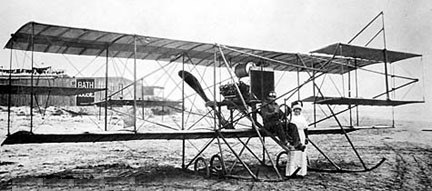
1911 (Petaluma) = A second Hall-Scott-powered aircraft was built in 1911, practically a duplicate of the first, for use by “Wiseman the Fearless” in exhibition flights throughout the West, as well as for the first Post Office-sanctioned air mail flight, on 17 February 1911, from Petaluma to Santa Rosa.

The names Wiseman-Cooke and Noonan-Wiseman often appear in conjunctive reports—Ben Noonan, a Santa Rosa butcher, supplied finances for Wiseman’s projects; Weldon B Cooke (an aircraft builder in his own right) purchased Wiseman’s 1911 machine, thought to have been repowered with 75hp Roberts, to fly in exhibitions after his Black Diamond was retired.

Restored in 1985 for the Smithsonian’s Postal Museum.

Nogrady Avionette AN2

Designer Bela Nogrady started prototype 01 of the AN 2 in 1982 and it made its first flights in July 1982. The Avionnette had a conventional empennage at first, with quar¬ter span spoilers, after which a V tail was tried with fully flying elevons. This butterfly ¬tail configuration with 110 degrees between the two surfaces was adopted for prototype 02, which made its first flights at the end of April 1983, but the elevons are no longer fully flying, hingeing instead from inclined fixed surfaces, this tail being a NACA 0015 profile.

Production Avionnettes retain the constant ¬chord wing without leading edge sweepback, as used on the first prototype, but will be fitted with ailerons and flaps as tried on 02. With a total surface area of 15.1 sq.ft (1.40sq.m), these flaps have three positions: 15, 30 and 55 degrees. The wing tips now have semi elliptic end plates and the profile used on 01, the Worthmann FX S02 184, set at 6 degrees without washout and with 3 degrees of dihedral, has been replaced by an FX 66S-171, set at 6 degrees incidence with the same dihedral and still without washout.

Production was programmed to get up to six machines a month before the end of 1983. The AN 2 comes as standard with dual controls and a retractable main wheel with wheel well door and drum brake; under development is a tail dragger version with laminated carbon ¬fibre main gear. The wings and tail surfaces are easily de mountable and the AN 2 is trailer transportable.

The standard model comes with a three blade propeller, ground adjustable for pitch.

Side by side two seat single engined mid wing monoplane with conventional three axis con¬trol. Wing has unswept leading and trailing edges, and constant chord; V tail. Pitch/yaw control by elevon; roll control by one third ¬span ailerons; control inputs through stick for pitch/roll and pedals for yaw. Cantilever wing of Worthmann FX66 S 171 profile; double surface. Undercarriage has two wheels in tandem with skid under each wing; rubber suspension on main wheel. Push right go right tailwheel steering connected to yaw control. Brake on main wheel. Glass fibre fuselage totally enclosed. Engine mounted at wing height driving tractor propeller. Carbon fibre wing spar with Kevlar, aluminium ribs, Dacron covering and plastic leading edge.

This microlight offers a maximum level speed of 106 mph (170 kph) take off at 23mph (38kph) and cruise be¬tween 56 and 93 mph (90 150 kph) with 43 hp thrust and a gross weight of 662 lb (300 kg). The AN 2 could be mistaken for a modern motor glider, with its composite construction, glide ratio of 26.4/1 and aspect ratio of almost 12/1.

Engine: Hirth 2701R 53, 43 hp at 6750 rpm
Propeller diameter and pitch: 51 x 45 inch, 1.30 x 1.15 m
V belt reduction ratio: 2.21
Power per unit area 0.28 hp/sq.ft, 3.0hp/sq.m
Fuel capacity 10.6 US gal, 8.8 Imp gal, 40.0 litre
Length overall 21.1 ft, 6.38 m
Height overall 5.1ft, 1.80m
Wing span 42.8ft, 13.00m
Constant chord 3.7 ft, 1.10m
Dihedral 3 degrees
Sweepback 0 degrees
Tailplane span 12.2 ft, 3.70 m
Total wing area 152 sq.ft, 14.1 sq.m
Total aileron area 8.6 sq.ft, 0.80sq.m
Tailplane area 22.8 sq.ft, 2.12 sq.m
Total elevon area 11.6 sq.ft, 1.08 sq.m
Wing aspect ratio 2.1/1
Wheelbase 16.1ft, 4.90m
Tailwheel diameter overall: 6 inch, 16 cm
Main wheels diameter overall 19 inch, 48 cm
Empty weight 2651b, 120kg
Max take off weight 6621b, 300kg
Payload 397 lb, 180 kg
Max wing loading 4.351b/sq.ft, 21.3 kg/sq.m
Max power loading 15.41b/hp, 7.0kg/hp
Load factors; +8.0, 4.0 ultimate
Max level speed 106mph, 170kph
Never exceed speed 117mph, 189kph
Max cruising speed 93mph, 150kph
Economic cruising speed 56mph, 90kph
Stalling speed 23mph, 38 kph
Max climb rate at sea level: 600 ft/min, 3.1 m/s
Min sink rate 138ft/min at 30mph, 0.7 m/s at 48 kph
Best glide ratio with power off: 26.4/1 at 45 mph, 72 kph
Take off distance 193 ft, 59m
Landing distance 213 ft, 65 m
Service ceiling 23,000ft, 7000m
Range at average cruising speed: 497 mile, 800km
Noel 1911 “Le Moineau” (Sparrow)

The first aeroplane designed by Louis Noel (sometimes mistakenly called Paul Noel) appeared in 1911. It was completed in April in France and flew in June. It was an unequal-span biplane with an all-tubing airframe for disassembly. The box fuselage was uncovered with a rudder hinged at the tail and a huge tail plane set ahead of it. After brief testing at the end of June, the Anzani was replaced with a Viale, itself an Anzani copy, and the balance was changed. Later a Gnome was installed.

Span: upper 39’4″ lower 26’3″
Length: 31’2″

Noël J. N. Type 3

J. N. Type 3

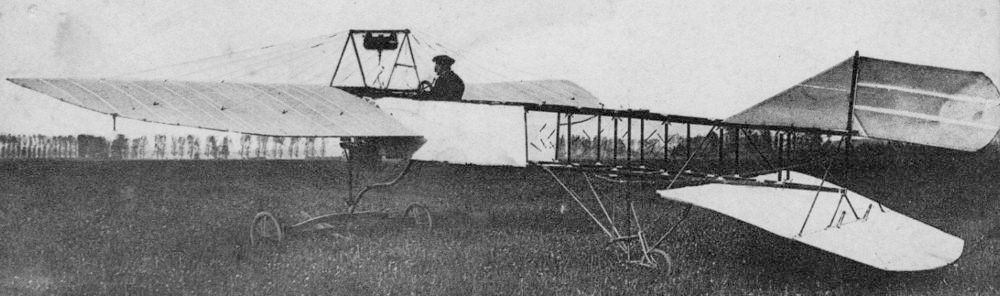
Jules Noël qualified for French license No. 322 on a Sommer and was then employed by Sommer. Before, he had built at least three aeroplanes of his home town Carignan, in the northeast of France. The third was a monoplane with an uncovered rear fuselage and Bleriot-style kingposts. Its empty weight was 210 kg and the machine was powered by a 25 hp Anzani. Noël and an Italian passenger were killed in a testing accident at the Sommer airfield in Douzy on 9 February 1911.